Creation of HARP Mortgage Loans
Bankruptcy and foreclosure rates have skyrocketed and set historical highs. For homeowners who had mortgage loan balances higher than the value of their homes and who wanted to stick the real estate collapse out, the government created the Home Affordable Refinance Program.
If your conventional conforming mortgage loan is underwater, the balance is higher than the value of your home, you may qualify to do a refinance mortgage loan without having any equity and/or having your mortgage loan balance higher than the market value of your home and without having to pay private mortgage insurance through the Home Affordable Refinance Mortgage loan program.
Basics of HARP Refinance
The Home Affordable Refinance Program was launched in April 2009. The loan program was created and launched to assist reward homeowners whose mortgage balance was higher than the market value of their homes. The goal of the loan programs was to prevent the foreclosure crisis from further escalating. In order to be eligible for a HARP loan, the homeowner needs to have a mortgage owned and backed by either Fannie Mae and/or Freddie Mac. The current loan needs to be backed by Fannie/Freddie no later than May 31, 2009.
Why HARP Helped Homeowners With Little Or No Equity
The Home Affordable Refinance Program (HARP) was created to help homeowners whose mortgage balances exceed their property values, a situation known as being “underwater.” The program became prominent after the housing market crash.
Many homeowners, despite making timely payments, could not refinance through traditional programs because of falling property values and high loan-to-value ratios.
HARP allowed eligible homeowners to refinance into more affordable or stable mortgages, even without home equity, if their loans were owned by Fannie Mae or Freddie Mac. HARP stopped accepting new applications after December 31, 2018, and is now officially closed.
More on HARP Mortgage Loans
The Home Affordable Refinance Program did not require appraisals. This was because the home mortgage loan balance is higher than the actual value of your home. HARP finally expired on December 31, 2015. The real estate market has been booming for the past several years where most homeowners have substantial equity in their homes.
Qualification Requirements For HARP For Underwater Mortgages
Many homeowners who went through the real estate market crash of 2008 got so discouraged about having underwater mortgages. The shock of losing most or all of the equity in their homes devasted countless homeowners who had not participated in the Home Affordable Refinance Program. The Home Affordable Refinance Program is for conventional loans only. Does not apply to FHA loans. To participate in HARP for underwater mortgages, a home does not have to be an owner-occupant home. Home can be the following:
- second home
- investment home
- multi-unit 2 to 4 unit primary
- investment home
- Condominium
- PUDS ( Which are Planned Unit Development )
- manufactured homes
Refinancing with HARP with Second Mortgage
Many homeowners assume that having a second mortgage means they can’t refinance using HARP or any government-backed refinance programs. Fortunately, this is not the case. While there are specific rules to follow, refinancing with a second mortgage is possible.
Subordination of Your Second Mortgage
If you have a second mortgage, the key is something called subordination. When you refinance your first mortgage under a HARP-like program, the second mortgage lender must agree to keep their loan in a “subordinate” position. This indicates that your second mortgage will stay intact while your primary mortgage is refinanced, enabling you to benefit from reduced rates.
In 2024, most lenders are still willing to subordinate second mortgages under these conditions, meaning your second loan stays put while your new, lower-rate mortgage takes over as the primary loan.
Benefits of Refinancing with HARP and a Second Mortgage
Why should you even consider refinancing when you have a second mortgage? Let’s explore some of the key benefits:
- Lower Interest Rates: If your existing mortgage rates are significantly higher than those offered in 2024, refinancing could save you thousands throughout your loan.
- Lower Monthly Payments: Refinancing to a lower rate will likely result in reduced monthly mortgage payments, giving you extra room in your budget.
- Build Equity Faster: You can accelerate the process of building equity in your home by obtaining a refinance at a reduced interest rate, even if you currently owe more than it’s worth.
- Avoid Foreclosure: Refinancing with a second mortgage might provide the breathing room you need to avoid foreclosure or other financial difficulties. If you’re feeling the pressure, this could be the solution you’ve been waiting for.
Can I Combine My First and Second Mortgages Under HARP?
One common question is whether you can combine your first and second mortgages when refinancing under HARP. Unfortunately, the answer is no. Under HARP 2.0, you can only refinance the first mortgage. As discussed earlier, the second mortgage must remain in place and be subordinated.
If you hope to consolidate both loans, you must explore other refinancing options beyond HARP.
HARP for Underwater Mortgages Eligibility Requirements
Millions of homeowners turned in their keys to their homes to their lenders and walked due to being upside down on their mortgages. This was because their loan balance was substantially higher than the value of their homes.
I’m combining and bolding headings that make sense to keep this post to the point and concise. Here’s how I would format this new combination. I’m sure you understand that the HARP (Home Affordable Refinance Program) ended in 2018, so right after this section, I’ll dive into the options available post-HARP.
What was HARP for Underwater Mortgages?
If a homeowner made all the payments, HARP was available to homeowners who made timely payments but could not refinance due to a drop in home value, provided their mortgage was held or securitized by Fannie Mae or Freddie Mac. It was designed to help borrowers improve their mortgage terms when a standard refinance was not possible due to a high loan-to-value ratio.
What HARP Did for Underwater Homeowners
HARP assisted homeowners whose properties lost value and became “underwater,” meaning their mortgage balance equaled or exceeded their home’s value. These borrowers made timely payments and did not require a loan modification.
Briefly, HARP Was Available To:
- Borrowers with little or no equity in their home
- Borrowers whose mortgage balance was equal to or greater than the value of the home
- Borrowers who had loans that were secured or held by Fannie Mae or Freddie Mac, and who had a good payment history on the loan.
- Borrowers seeking a more affordable mortgage, a lower interest rate, a shorter loan term, or a more secure mortgage.
- The FHFA says more than 3.4 million homeowners refinanced under HARP before its discontinuation.
Who is Eligible for the Home Affordable Refinance Program HARP?
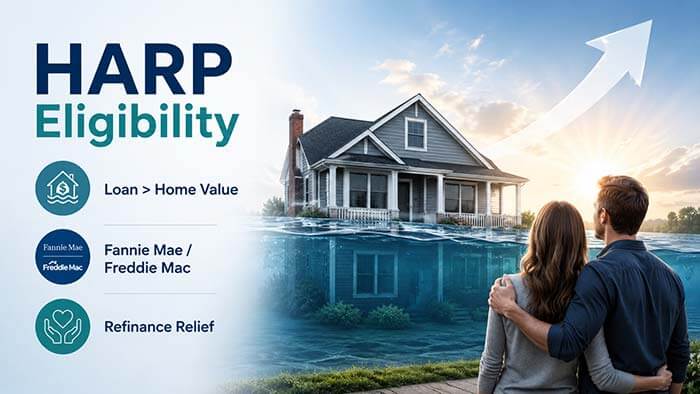
As mentioned above, The Home Affordable Refinance Program was introduced by the US government face in 2009 as part of the initiatives to aid parents in recovering from the collapsed US housing bubble policy aimed quickly and specifically to meet the needs of the homeowners with:
- Mortgages are greater than the value of a house that a person owns.
- Roll the loans through FNMA and FHLMC with guarantee us or owned.
- Domicile owners who lost hope of refinancing due to decreased values of their houses.
What Are The Benefits of The HARP Program?
HARP was intended to achieve the following goals:
- Introduce a Low Refinancing Ceiling through which they would reduce the interest rate.
- Directly translating to a cut in the monthly mortgage repayment.
- Restructuring the mortgage would enhance the chances of retaining home equity while paving the way for shorter loan periods.
- Minimize any associated chances of defaulting or being foreclosed on any loans.
- Enhance the housing market by avoiding a situation where homes are abandoned.
Contact With Our Loan Officer For Qualify For HARP
Apply Online And Get recommendations From Loan Experts
Can You Outline the Eligibility Criteria You Must Meet to Qualify For HARP?
For HARP, People Needed to Fulfill the Following Requirements:
- FHA, VA, or USDA Loans Not Accepted:
- Only First Fannie Mae or Freddie Mac Backed HARP Loans:
Ownership by Freddie Mac and Fannie Mae:
- The Borrower had to have either a loan owned or guaranteed by them.
Current on Payments:
- There should not have been more than 1 late payment in the last 12 months.
- Ideally, there should be no late payments within 6 months of the current month.
Loan-to-Value Ratio:
- Previously, harm was created only for loans with an LTV of 80 percent.
- However, changes were made to remove the 80 % limit for clients with negative equity.
Principal Elements of HARP
No Appraisal Requirement:
- HARP frequently permitted borrowers to refinance without requiring an appraisal of the home.
Sufficient Underwriting:
- Because of the lack of income or bad credit, borrowers did not have to follow normal underwriting criteria.
- Therefore, they were furloughed.
Lower Costs:
- The closing and other fees were reduced relative to what is usually noticed in refinancing procurement.
Simple Procedures:
- The program enabled eligible borrowers to do refinancing faster and more effectively than before.
Development of HARP
HARP underwent more than one update to increase coverage and expand accessibility:
HARP 2 0:
- This includes the removal of the one hundred twenty-five percent LTV limit so deeply underwater borrowers can qualify.
HARP 3.0 (Proposed but Not Implemented):
- It attempted to broaden coverage to include loans not owned by Fannie Mae and Freddie Mac.
- However, it was not implemented.
Program Extensions
- The HARP program was meant to run until 2013. However, certain events prolonged it several times until it ended on December 31, 2018.
HARP’s Effects
Homeowners Helped In:
- Over 3.4 million homeowners were guided through the process of lowering the interest payments on their mortgages through HARP.
Economic Recovery:
- HARP enhanced consumer confidence by lowering monthly payments and stabilizing homeowners.
Defaulted Inside Mis edging:
- HARP increased chances for borrowers to benefit by lowering default rates on homes they owed up to.
- Increased Housing Prices played a key role in the mental experiment of the home price crisis.
- They set the center of the new economy.
Criticisms of HARP
- Despite its effectiveness, the HARP encountered certain challenges as follows:
Limited Scope:
- If a person had securities that were not part of the options, Fannie Mae and Freddie Mac loans on their loans.
- Then, there was no relief available aside from them.
Information Awareness Gaps:
- This program should have greatly aided many people.
- However, the issue arose due to government programs.
- Many inducing paranoia and mistrust were potentially eligible but never enrolled in these programs.
Lesser Payment Impact:
- The main goal of HARP was to pay less.
- But rather reduce payments altogether instead of concluding.
- In some cases, the borrowers still owe a fortune.
HARP Alternative Programs
In 2017, three specialized refinancing’s had been developed to assist homeowners after the expiration of HARP:
Fannie Mae High LTV Refinance Option:
- This program was offered to potential borrowers with a loan-to-value ( LTV ) ratio of more than 97.
- The borrowers are allowed to refinance loans granted after October 1, 2017.
Freddie Mac Enhanced Relief Refinance:
- This program was offered to a different set of borrowers.
- This program targeted borrowers with high LTV ratios who would have benefited from loans with lower interest rates.
Features that Are Important to Note from HARP
Acting Fast:
- HARP and similar programs reiterate the need for quick intervention in housing crises.
Understanding the Limits:
- One important aspect is ensuring entitled borrowers know what is available.
Willingness to Write:
- To reach out to more needy borrowers, tactics included giving borrowers the option of a high LTV ratio.
- Making the underwriting criteria more flexible.
Why Wasn’t the Home Affordable Refinance Program Extended?
As successful as HARP was, it wasn’t extended beyond its final deadline of December 31, 2018. By then, the housing market had recovered significantly, and fewer homeowners found themselves underwater. The need for HARP diminished with home values rising and more refinancing options available through traditional loans.
The government and lenders also introduced alternative refinancing options. As a result, there was less demand for a specific program like HARP. Simply put, HARP wasn’t extended because the situation that created the need for it—widespread negative equity—had improved for most homeowners. However, that doesn’t mean there aren’t options for those in a similar financial situation today.
Why HARP Is No Longer Available
HARP was introduced after the housing crisis to help homeowners refinance. Although renewed several times, it was phased out.
The FHFA announced HARP would be extended until December 31, 2018, giving eligible high-LTV borrowers more time to refinance. Fannie Mae will also phase out DU Refi Plus and Refi Plus, which allow manual underwriting, along with HARP.
Why You Should Avoid “New HARP Loans”
HARP is no longer available to lenders. Any current promotions advertising HARP loans are invalid and should be disregarded.
Are there options available today for borrowers with little equity, high loan-to-value ratios, or underwater mortgages?
How HARP Was Replaced
After HARP ended, Fannie Mae and Freddie Mac introduced high-LTV refinance options for borrowers who could not use standard limited-cash-out refinancing due to high loan-to-value ratios.
Fannie Mae High LTV Refinance Option
Fannie Mae developed the High LTV Refinance Option for borrowers with existing Fannie Mae loans who maintained current payments but had an LTV ratio above the standard cash-out refinance limit. (Fannie Mae)
Fannie Mae states that the High LTV Refinance Option is currently paused due to low demand and the Revised QM Rule. Additionally, Fannie Mae notes that High LTV refinance requests had to be submitted on or before June 30, 2021, and purchased or securitized on or before August 31, 2021.
Freddie Mac Enhanced Relief Refinance
Freddie Mac’s Enhanced Relief Refinance program succeeded HARP and aimed to assist eligible Freddie Mac borrowers with high loan-to-value ratios who were current on their mortgages.
Because the Enhanced Relief Refinance program is subject to availability, borrowers seeking a Freddie Mac high-LTV refinance should have a lender verify current Freddie Mac eligibility and investor access.
HARP Frequently Asked Questions
I Thought HARP Was No Longer Available. Why Am I Still Able To Refinance Using HARP?
- As some newer programs have come into play, eligible borrowers may still have options; however, HARP stopped after 12/31/2018.
Is HARP Still Available For Underwater Mortgages?
- No, HARP is no longer offered for additional mortgage applications.
- While FHFA extended HARP through December 31, 2018, the program was completely terminated afterward.
Could You Get Cash Out With HARP?
- No. HARP did not. HARP did not permit cash-out refinancing.
Is HARP A Loan Modification?
- HARP is not a loan modification. HARP was a refinance program, not for borrowers who were behind on payments or facing financial hardship. A loan modification changes the terms of your current mortgage.
As I Understand, HARP Is A Handout That Forgives Loan Balances To People Who Might Have Lost Their Jobs. Is That Correct?
- That is not true. In fact, HARP loans do not ordinarily include a loan reserve or any principal forgiveness; they are about making funding easier by refinancing and reducing interest charges and monthly payments.
Is There A New Program Similar To HARP?
- Some options for high-LTV borrowers include the Fannie Mae High LTV Refinance Option and the Freddie Mac Enhanced Relief Refinance programs.
HARP enabled millions of homeowners to save their homes after the 2008 housing crisis and helped prevent foreclosures. While the program no longer exists, many follow-up programs seek to keep aiding needy borrowers. Suppose you are thinking about refinancing your mortgage. In that case, speaking with a mortgage specialist about the options available is highly advised, as there are plenty.
Why A New HARP Program Is Not Guaranteed
The government typically creates refinance rescue programs only after a crisis has caused significant financial problems.
So, homebuyers shouldn’t assume:
- “I can overpay today because the government will save me later.”
- A more prudent approach is to consider:
- “If prices drop 10% to 20%, can I still afford this home, keep making payments, and stay long enough to recover equity?”
Final Thoughts On A Second Wave Of Upside-Down Mortgages In 2026
Another wave of upside-down mortgages may occur in certain markets, especially where home prices rose quickly, and recent buyers made minimal down payments. However, not every housing correction should be compared to 2008.
The main risk in 2026 may not be immediate foreclosure. Instead, homeowners could become unable to refinance or sell due to insufficient equity.
Relying on a future HARP program is not recommended, as government intervention through a new refinance initiative is uncertain. The best protection is to buy a home with an affordable payment, maintain emergency savings, understand available refinance options, and work with a lender experienced in FHA, VA, USDA, conventional, manual underwriting, and non-QM loans.oans.
This article was updated on March 10th, 2026.