Government Shutdown And Effects To Mortgage Programs: FHA, VA, USDA, Conventional Loans, Closings, And Borrower Delays
Have you ever wondered what a government shutdown is and what its effects are on mortgage programs? A government shutdown occurs when non-essential federal government offices close because of a lack of approval on the federal budget for the upcoming fiscal year. This event can significantly impact various sectors of the economy.
Government shutdown and effects on mortgage programs explained. Learn how FHA, VA, USDA, conventional loans, appraisals, IRS transcripts, and closings may be affected.
These include the housing market and mortgage programs. This article explores how government shutdowns affect mortgage programs, the broader housing market, and individuals and families seeking to buy or refinance homes. In the following paragraphs, we will cover the government shutdown and its effects on mortgage programs.
What Happens To Mortgage Programs During A Government Shutdown?
A federal government shutdown often leaves homebuyers, homeowners, real estate agents, and mortgage professionals feeling uncertain. Many people worry that all mortgage lending stops during a shutdown, but that is rarely the case. Most lending continues, though you may see delays, documentation problems, appraisal slowdowns, income verification issues, or interruptions in closing, depending on your loan type.
The effects of a government shutdown on mortgage programs depend on the agency, lender, loan type, and the length of the shutdown. FHA, VA, USDA, conventional, jumbo, non-QM loans, and refinances can all be affected in different ways.
At Gustan Cho Associates, we help borrowers understand how government shutdowns impact mortgage approvals, underwriting, appraisals, verifications, and closings. It is important to know which mortgage programs are moving forward, which may slow down, and what steps you can take to protect your purchase or refinance timeline.
What is a Government Shutdown?
A government shutdown happens when Congress fails to pass sufficient funding for government operations and agencies or when the President refuses to sign the appropriations bills. When this occurs, all non-essential federal government services are halted until new funding legislation is passed. Essential services, like national security and public safety, continue to operate. Still, many federal employees are furloughed, and various services are delayed or suspended.
Government Shutdown And Effects To Mortgage Programs & How It Will Affect Consumers

- FHA: Has indicated they will continue to endorse loans, and TOTAL and the FHA Connection will be fully functional.
- VA: Will continue business as usual.
- USDA: Will not issue new commitments or guarantees during a shutdown period.
- CAIVRS: Will be available to determine if a borrower has a delinquent federal debt
- IRS Validations (4506T) The Internal Revenue Service (IRS) has indicated that they will not process any forms, including issuing tax return transcripts
- Social Security Administration (SSA) Social Security validations will not be able to be processed
The Role of the Federal Government in Mortgage Programs
The federal government plays a crucial role in the housing market through various mortgage programs and regulatory bodies. Key agencies and programs involved include:
- Federal Housing Administration (FHA): Provides mortgage insurance on loans made by FHA-approved lenders.
- Department of Veterans Affairs (VA): Propose mortgage loans with favorable terms to veterans and active-duty military personnel.
- United States Department of Agriculture (USDA): Give out loans for rural property buyers.
- Federal Housing Finance Agency (FHFA): Oversees Fannie Mae and Freddie Mac, which supply liquidity to the mortgage market.
- Internal Revenue Service (IRS): Verifies income for mortgage applications.
- Social Security Administration (SSA): Provides income verification for certain borrowers.
Government Shutdown and Effects To Mortgage Programs and Mortgage Processing
When a government shutdown occurs, the immediate effects on mortgage processing can be significant. Here’s how each major agency and program can be affected:
Federal Housing Administration (FHA)
- Delayed Processing: FHA loan approvals and processing can be delayed as many employees may be furloughed.
- This delay can affect homebuyers relying on FHA loans, potentially causing them to miss out on home purchases or face extended closing times.
- Reduction in Availability: Some lenders might temporarily stop offering FHA loans due to uncertainties and delays associated with the shutdown.
Department of Veterans Affairs (VA)
- Loan Processing Continuation: VA loan processing typically continues during a shutdown because the VA considers these services essential.
- However, there could be delays if there is a significant backlog.
- Appraisal Delays: Appraisals, a critical part of the loan process, can face delays if contractors are not available or there is a slowdown in processing these appraisals.
United States Department of Agriculture (USDA)
- Suspended Loan Programs: USDA loan programs often halt during a shutdown.
- This suspension can severely impact rural homebuyers who depend on USDA loans for financing.
- Delayed Approvals: Even if some parts of the USDA loan programs remain operational, significant delays in approval and processing are common.
Federal Housing Finance Agency (FHFA)
- Limited Impact: Fannie Mae and Freddie Mac, regulated by the FHFA, are government-sponsored enterprises (GSEs) that typically continue to operate during a shutdown.
- However, there could be indirect impacts due to delays in other parts of the mortgage process.
Internal Revenue Service (IRS)
- Income Verification Delays: The IRS’s closure or reduced capacity can delay income verification, which is crucial for mortgage approvals.
- This delay can affect all types of mortgage loans, including conventional loans.
- Transcript Processing: Lenders often require tax transcripts from the IRS for income verification, which can be delayed during a shutdown.
Social Security Administration (SSA)
- Income Verification: Similar to the IRS, the SSA’s reduced capacity can delay the verification of Social Security income, impacting mortgage approvals for those who rely on this income.
Know what still moves during a shutdown
See which steps (appraisal, title, lock) continue and which may pause
Broader Impacts on the Housing Market
Beyond the immediate delays in mortgage processing, a government shutdown can have broader effects on the housing market:
Decreased Buyer Confidence:
- Uncertainty surrounding a government shutdown can lead to decreased consumer confidence.
- Potential homebuyers may delay purchasing decisions due to concerns about job security or economic stability.
- This hesitation can lead to a slowdown in the housing market.
Economic Slowdown:
- A prolonged government shutdown can contribute to a broader economic slowdown.
- Federal employees and contractor who are working without pay may cut back on spending, affecting local economies.
- Reduced economic activity can lead to lower housing demand and home prices.
Impact on Interest Rates:
- The uncertainty and economic impact of a government shutdown can influence interest rates.
- Suppose investors view the shutdown as a sign of broader economic instability.
- In that case, they may seek safer investments, leading to lower mortgage interest rates.
- Conversely, prolonged uncertainty could lead to higher rates if there is a perceived risk of default on government obligations.
Impact on Housing Supply:
- Homebuilders and developers may delay projects due to economic uncertainty and potential disruptions in financing.
- This delay can exacerbate housing supply shortages, particularly in markets struggling with inventory issues.
Case Studies of Past Government Shutdowns
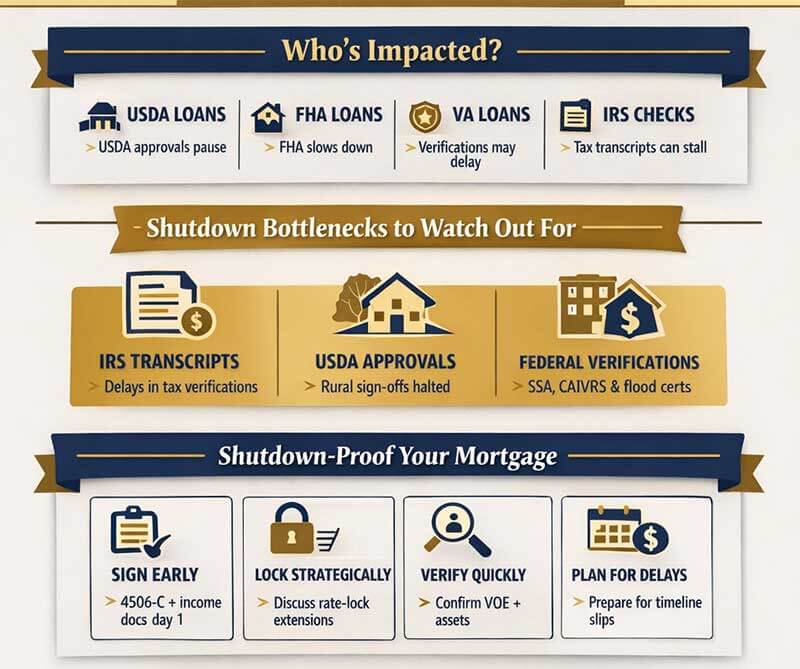
Examining past government shutdowns can provide insight into the potential impacts on mortgage programs and the housing market:
The 2013 Shutdown
- The 2013 government shutdown lasted 16 days and had notable impacts on the housing market:
FHA Loan Delays:
- FHA loans experienced significant processing delays, causing frustration for homebuyers and sellers.
IRS Income Verification:
- Delays in IRS income verification affected all types of mortgage loans, leading to slower approval processes.
Economic Confidence:
- Consumer confidence dipped during the shutdown, contributing to a temporary slowdown in home-buying activity.
The 2018-2019 Shutdown
- The longest shutdown in U.S. history, lasting 35 days, occurred from December 2018 to January 2019:
Severe FHA and USDA Delays:
- Both FHA and USDA loan programs were significantly affected, with many transactions delayed or put on hold.
VA Loans:
- While VA loan processing continued, there were delays in appraisals and other necessary steps.
IRS and SSA Delays:
- Income verification from the IRS and SSA was delayed, affecting many mortgage applications.
- Market Uncertainty: The prolonged uncertainty led to decreased buyer confidence and a temporary slowdown in the housing market.
Mortgage Programs During A Government Shutdown?
A government shutdown occurs when Congress fails to pass the funding needed to keep some federal agencies running. Some government workers are sent home without pay, while others keep working in essential jobs.
For most borrowers, the main issue is not that lending stops, but that some government services may slow down or be unavailable for a time.
This can affect mortgage approvals if your loan depends on things like federal agency systems, government insurance, tax transcripts, employment checks, flood insurance, or rural housing approvals. Mortgage lenders can usually keep applications moving, issue preapprovals, review files, order appraisals, and close many loans. However, if your loan needs direct help from a government agency, there may be delays. Short shutdowns may cause only minor problems, but longer ones can lead to significant delays in processing and closing loans.
Government Shutdown And Effects To Mortgage Programs By Loan Type
Not all mortgage programs are affected the same way. Some experience only minor delays, while others may face significant slowdowns. My conventional loans that need federal verifications are usually the most affected. Non-QM and bank statement loans are less connected to federal agencies, but they can still be delayed by market changes, job disruptions, or third-party verification issues.
The Biggest Mortgage Problems During A Government Shutdown
During a government shutdown, common mortgage problems include slow responses from agencies, delays in government-backed loan approvals, tax transcript hold-ups, trouble verifying employment for federal workers, appraisal backlogs, USDA approval delays, and uncertainty about when you can close.
If you already have a contract, don’t worry. A shutdown does not mean your mortgage approval is canceled. It’s best to talk early with your loan officer, real estate agent, seller, title company, and underwriter.
How A Government Shutdown Affects FHA Loans
FHA loans are government-insured mortgages backed by the Federal Housing Administration, which is part of HUD. FHA loans are popular with first-time homebuyers, borrowers with lower credit scores, higher debt-to-income ratios, limited savings, or past credit challenges.
During a government shutdown, FHA lending may continue, but certain services may slow. HUD’s lapse plan has indicated that lenders can still obtain FHA case numbers through FHA Connection during a shutdown.
The Mortgage Bankers Association reported that the FHA Single Family Housing may continue endorsing new loans during a shutdown, with exceptions for certain products, such as HECM reverse mortgages, Title I loans, and endorsements that require an FHA underwriter assessment.
Can FHA Loans Close During A Government Shutdown?
Yes, many FHA loans can still close during a government shutdown. However, closing delays may happen if the loan requires additional HUD review, manual intervention, special documentation, or agency support that is not fully staffed.
Most standard FHA purchase and refinance loans can continue through the mortgage process if the lender, underwriter, appraiser, and closing team have what they need.
FHA Case Numbers During A Shutdown
An FHA case number is required for an FHA loan. Without an FHA case number, the lender cannot proceed with the FHA mortgage file. HUD’s shutdown guidance has indicated that FHA case numbers may still be available through FHA Connection during a lapse in appropriations.
This is important because many borrowers assume that the FHA shuts down completely. This matters because many people think the FHA shuts down completely.
In reality, the main problems are slower processing, fewer staff, and less support from the agency. A shutdown, but delays can occur depending on appraiser availability, property condition issues, FHA repair requirements, or additional agency involvement.
If an FHA appraiser finds problems with health, safety, structure, or if the home is not livable or easy to sell, the lender may ask for repairs or more paperwork before closing. During a shutdown, fixing these issues can take longer if government support is reduced.
How A Government Shutdown Affects VA Loans
VA loans are mortgages guaranteed by the U.S. Department of Veterans Affairs. VA loans are available to eligible veterans, active-duty service members, surviving spouses, and qualifying military borrowers.
VA loans are made by private lenders, not directly by the VA. The VA guarantees a portion of the loan, which allows approved lenders to offer favorable mortgage terms to eligible borrowers.
Can VA Loans Close During A Government Shutdown?
Yes, VA loans often continue during a government shutdown. A shutdown does not automatically stop veterans from using their VA home loan benefit.
The VA has issued guidance in past shutdown periods to clarify the impact of a federal government shutdown on new and existing VA-guaranteed home loans.
VA Certificate Of Eligibility Delays
One possible issue during a shutdown is a delay in obtaining the VA Certificate of Eligibility (COE). The COE confirms whether the borrower is eligible for a VA home loan.
Many lenders can get the COE online. But if your file needs a manual VA review, a shutdown can delay things. Veterans should provide their DD-214, statement of service, or other proof of eligibility as soon as possible.
VA Appraisals During A Government Shutdown
SVA appraisals can still happen during a shutdown, but there may be delays if there are not enough staff, problems assigning appraisers, questions about the property, or slow VA systems.m If you are using a VA loan, try to allow extra time, especially if your contract has a tight closing date. ing date.
How A Government Shutdown Affects USDA Loans
USDA loans are often more vulnerable to shutdown delays than FHA and VA loans. USDA Rural Development loans are government-backed mortgages for eligible properties in approved rural and suburban areas.
The main problem with USDA loans during a government shutdown is that final loan approvals, guarantees, and agency sign-offs may slow down or stop, depending on USDA staff and system availability.
Can USDA Loans Close During A Government Shutdown?
Some USDA loans may be delayed during a government shutdown, especially if the lender still needs a final USDA commitment or guarantee. Unlike many FHA and VA loans, USDA loans can require more direct agency involvement before closing.
That’s why people using USDA loans should be extra careful with contract dates, rate lock deadlines, what sellers expect, and their moving plans during a shutdown.
USDA Guaranteed Loans Versus USDA Direct Loans
USDA guaranteed loans are originated by approved lenders and backed by USDA. USDA direct loans are made by the government to qualifying low-income borrowers.
During a shutdown, both types of USDA loans can be delayed, but direct loans may have more problems because they depend more on government staff and direct agency work.
What USDA Borrowers Should Do During A Shutdown
USDA borrowers should keep in close touch with their loan officer and ask if their file already has USDA approval. If not, they should be ready for possible delays.
Borrowers should also ask about extending their rate lock, changing contract dates, speaking with the seller, and backup loan options if the shutdown lasts longer than expected.
How A Government Shutdown Affects Conventional Loans
Conventional loans are not insured or guaranteed by FHA, VA, or USDA. Most conventional loans are backed by Fannie Mae or Freddie Mac guidelines. Because Fannie Mae and Freddie Mac are not regular federal agencies funded through the annual appropriations process, conventional loans usually continue during a government shutdown.
Still, people with conventional mortgages can be affected in other ways.
Conventional Loans May Still Need Federal Verifications
A conventional loan can be delayed if the lender needs IRS tax transcripts, Social Security number checks, federal job verification, flood insurance, or other government paperwork.
Self-employed people, those earning commissions or overtime, and anyone who needs to show tax returns may face more delays if the lender needs IRS transcripts.
Fannie Mae And Freddie Mac Loans During A Shutdown
Fannie Mae and Freddie Mac loans usually continue to move during a shutdown. The bigger issue is whether the lender can complete all required verifications and satisfy underwriting conditions.
Borrowers should not assume a conventional loan can’t be delayed by a shutdown. If your file needs government paperwork that isn’t available, you could still run into problems.
Delayed During A Government Shutdown
Mortgage closings can be delayed during a government shutdown because the process has many steps. Approval is not just about your income, credit, and savings. Lenders also need appraisals, title work, fraud checks, verifications, insurance, and sometimes responses from government agencies.
Common Reasons Mortgage Closings Get Delayed
Closings can be delayed if you are waiting for FHA, VA, or USDA paperwork, missing tax transcripts, slow job verification, not enough federal staff, property problems, appraisal fixes, flood certification issues, or questions about yourA shutdown can also affect federal employees, government contractors, military families, and anyone whose income is put on hold. terrupted.
Rate Lock Problems During A Shutdown
A mortgage rate lock keeps your interest rate the same for a set time. If a shutdown delays your closing past that date, you may need to extend the lock.
Rate lock extensions. Extending a rate lock can cost money. Sometimes the lender pays for it, but other times you might have to. It depends on your lender, the reason for the delay, and your loan details.
Delays With IRS Tax Transcripts And Verifications.
IRS tax transcripts can be a major issue during a government shutdown. Many mortgage lenders use tax transcripts to verify income, especially for self-employed borrowers, business owners, 1099 workers, commission borrowers, and borrowers using rental income.
If the IRS transcript system is slow or unavailable, some lenders may not be able to complete the final steps to approve your loan.
Self-Employed Borrowers May Face More Delays
Self-employed borrowers often need to show tax returns, business returns, profit-and-loss statements, K-1s, 1099s, and IRS transcripts. If the lender can’t get these transcripts quickly, your loan could be delayed.
Give your loan officer all your tax documents early and ask if transcripts are needed before closing.
Borrowers May Have Fewer Transcript Issues
If you get a W-2, you may have fewer delays if your lender can check your income with pay stubs, W-2s, or job verification. But federal employees and contractors may still have problems if their income is stopped or their job can’t be verified.
How Federal Employee Borrowers Are Affected By A Shutdown
Federal employees can be directly affected by a shutdown if they are furloughed, working without pay, or can’t show proof of current income. A shutdown does not automatically make you ineligible for a mortgage. But lenders still have to check that your income is steady and likely to continue.
Furloughed Federal Workers And Mortgage Approval
If you are furloughed, the underwriter will decide if your income can still count for the loan. This depends on the loan type, lender rules, your paperwork, when you expect to return to work, and if you will get back pay.
Some lenders may ask for more paperwork from your employer or agency. Others may put your loan on hold until you return to work or your income can be checked.
Government Contractors And Shutdown Risk
Government contractors may have different problems than federal employees. If your income stops because a federal contract is paused, the lender will look at whether your income is steady and likely to continue.
Contract workers, temps, and people with variable income may need to show more paperwork to get loan approval.
Can You Still Close On A Mortgage During A Government Shutdown?
Yes, many people can still close on a mortgage during a government shutdown. It depends on your loan type, lender, paperwork, the property, and if you still need something from a government agency.
FHA and VA loans often keep moving, but there can be delays. USDA loans may have bigger delays if you still need final USDA approval. Conventional loans usually continue, but tax transcripts and verification problems can still happen.
The Loan Program Matters
The type of loan matters because FHA, VA, USDA, conventional, jumbo, and non-QM loans all rely on different agencies, systems, and rules. A borrower with a conventional loan and simple W-2 income may face fewer shutdown-related issues than a borrower with a USDA loan that still requires final agency approval. A VA borrower with a COE already issued may face fewer delays than one who needs a manual eligibility review.
The Stage Of The Mortgage File Matters
Timing matters too. If you are already clear to close, you may have fewer problems than someone just starting the loan process. If your file already has the appraisal, title work, underwriting approval, agency case number, tax transcript, and all final conditions done, you are usually in a better spot.
What Borrowers Should Do Before And During A Government Shutdown
Be proactive during a government shutdown. Waiting until the last minute can cause extra stress, especially with contract dates, inspection deadlines, financing rules, and rate locks.
Get Fully Documented Early
Give your lender pay stubs, W-2s, tax returns, bank statements, ID, gift letters, explanations, student loan info, bankruptcy papers, divorce papers, and any other needed documents as soon as you can.
Having a complete file gives your lender more time to handle any delays caused by the shutdown.
Ask Your Loan Officer About Agency-Specific Risk
Ask your loan officer if your file depends on FHA, VA, USDA, IRS, Social Security, FEMA flood insurance, or other federal paperwork. This helps you spot possible closing delays before they become urgent problems.
Build Extra Time Into The Purchase Contract
Buyers should consider adding extra time to the contract if a shutdown is underway or likely. This is especially important for USDA loans, manual underwriting, federal employees, and self-employed borrowers.
Real estate agents should talk with sellers early so everyone understands the delay is due to federal agency issues, not the buyer’s fault.
Watch The Rate Lock Expiration Date
Ask when your rate lock ends and what happens if the shutdown delays your closing. Find out if you can extend the lock, how much it costs, and who pays for it.
Keep Cash Reserves Available
Avoid big purchases, new debt, overdrafts, unexplained deposits, job changes, or moving money around during the mortgage process. A shutdown can already cause delays, so don’t add to the underwriter’s problems.
Government Shutdown And Mortgage Forbearance Concerns
A government shutdown can cause financial problems for people who are not getting paid. Federal employees, military families, government contractors, and others may worry about making their mortgage payments.
If you can’t make your mortgage payment, call your mortgage servicer right away. Don’t ignore the problem.
Existing Homeowners Should Call Their Servicer Early
Your mortgage servicer may offer help depending on your loan and situation. Options can include repayment plans, forbearance, loan changes, partial claims, or other ways to avoid losing your home.
The help you can get depends on your loan program, servicer rules, investor guidelines, and if you qualify.
Do Not Skip Payments Without Talking To The Servicer
Don’t assume missed payments will be forgiven just because of a shutdown. Missing a mortgage payment can hurt your credit and make it harder to get a loan in the future.
The safest thing to do is call your mortgage servicer before your payment is late.
Government Shutdown And Effects To Mortgage Programs For Homebuyers
If you are a homebuyer under contract, focus on staying in touch, keeping your paperwork ready, and protecting your contract. It can affect the mortgage timeline, but it does not mean the borrower is automatically denied. The borrower needs a mortgage team that understands FHA, VA, USDA, conventional, manual underwriting, AUS findings, and lender overlays.
Homebuyers Should Stay In Contact With All Parties
Stay in close contact with your loan officer, processor, real estate agent, title company, attorney, insurance agent, and seller.
If a delay is possible, everyone should know early. If a delay might happen, let everyone know as soon as possible. Last-minute surprises cause more stress and can put your deal at risk. Come frustrated if a closing is delayed. A well-documented explanation from the lender can help the seller understand that the delay is related to federal agency processing rather than buyer weakness.
This is especially important for USDA loans or files that require government documentation.
Government Shutdown And Effects To Mortgage Programs For Refinances
People refinancing can also be affected by a shutdown. FHA streamline, VA IRRRL, conventional, cash-out, and USDA refinances may all be impacted in different ways.
Refinance Delays May Affect Rate Locks
Refinance borrowers should pay close attention to the expiration dates of their rate locks. If the shutdown delays income verification, tax transcripts, appraisal review, or agency requirements, the borrower may need a rate lock extension.
Cash-Out Refinances May Face More Conditions
Cash-out refinances often require more detailed underwriting than streamline refinances. Borrowers may need stronger income documentation, appraisal review, title review, and reserve documentation.
Shutdown-related delays can be more frustrating when the borrower needs cash-out funds for debt consolidation, repairs, business expenses, or emergency needs.
Lender Overlays Can Make Shutdown Problems Worse
One of the biggest issues during a government shutdown is lender overlays. Agency guidelines may allow a loan to proceed, but an individual lender may add extra rules.
For example, FHA, VA, USDA, Fannie Mae, or Freddie Mac may have baseline guidelines. Still, the lender may require additional documentation, additional verification, lower debt-to-income ratios, higher credit scores, more reserves, or stricter income rules.
Why Gustan Cho Associates Focuses On Agency Guidelines
Gustan Cho Associates is known for helping borrowers who may not fit inside traditional lender overlays. During a government shutdown, this can matter even more because some lenders may become more conservative.
Borrowers should work with a mortgage lender that understands agency guidelines, automated underwriting systems, manual underwriting, and alternative mortgage options.
Strategies for Homebuyers and Homeowners During a Shutdown
During a government shutdown, homebuyers and homeowners seeking to refinance should consider several strategies to mitigate potential delays and challenges:
Prepare for Delays
- Start Early: To account for potential delays, begin the mortgage application process as early as possible.
Maintain Communication: Stay in close contact with your lender to understand any impacts on your loan process and to provide any additional documentation promptly.
Explore Alternative Loan Options
- Conventional Loans: If you are eligible for conventional loans, consider them as they may be less affected by a shutdown than FHA, VA, or USDA loans.
- Private Lenders: Explore options with private lenders who may be less directly impacted by federal agency delays.
Maintain Financial Stability
- Avoid Major Financial Changes: Do not make significant financial changes during the mortgage application process, such as changing jobs or making large purchases.
- Keep Savings Accessible: Ensure you have accessible savings to cover potential delays in closing and other unexpected expenses.
Monitor the Market
- Interest Rate Trends: Keep an eye on interest rate trends, as they may fluctuate due to the economic uncertainty caused by a shutdown.
- Local Market Conditions: Stay informed about local housing market conditions, as they can be influenced by broader economic factors.
Long-Term Considerations for Policymakers
To minimize the impact of future government shutdowns on mortgage programs and the housing market, policymakers could consider several long-term strategies:
Protecting Essential Services
-
- Define Essential Services Broadly: Ensure that critical services related to mortgage processing, such as FHA and USDA loan approvals, IRS income verification, and SSA income verification, are deemed essential and continue to operate during a shutdown.
Funding Mechanisms: Establish automatic funding mechanisms for essential services to prevent disruptions during a shutdown.
- Define Essential Services Broadly: Ensure that critical services related to mortgage processing, such as FHA and USDA loan approvals, IRS income verification, and SSA income verification, are deemed essential and continue to operate during a shutdown.
Improving Communication
- Transparent Communication: Federal agencies should provide clear and transparent communication to lenders and the public about the status of services during a shutdown.
- Contingency Plans: Develop and publicize contingency plans to minimize disruptions in mortgage processing during a shutdown.
Strengthening Economic Resilience
- Economic Policies: Implement economic policies that enhance the resilience of the housing market and the broader economy to withstand the government shutdown’s impacts.
- Consumer Protection: Strengthen consumer protection measures to support homebuyers and homeowners during economic uncertainties.
Verify employment the resilient way
VOE strategies for furloughed/contracted or federal employees
How Long Will The Government Shutdown Be?
Nobody has a crystal ball but many experts and analysts are only expecting a short term government shutdown. It can be as few as one or two days or can get prolonged to several weeks. Lets hope our politicians get their act together and come to terms and swallow their pride and do what is the best for the people of the United States of America. We will keep you posted as we get some more information on the effects this government shutdown has on mortgage loan programs.
Final Thoughts On Government Shutdown And Effects To Mortgage Programs
The government shutdown and its effects on mortgage programs can create delays, but it does not mean that mortgage lending stops. FHA, VA, USDA, conventional loans, refinances, and purchase transactions may continue depending on the file.
The biggest risks are usually delays with agency approvals, USDA commitments, IRS tax transcripts, employment verification, appraisals, rate locks, and federal employee income documentation.
Borrowers should not panic. They should get fully documented, communicate early, monitor rate lock deadlines, and work with a mortgage team that understands FHA, VA, USDA, conventional, non-QM, manual underwriting, AUS findings, and lender overlays.
Gustan Cho Associates helps borrowers navigate complicated mortgage situations, including government shutdown delays, lender overlays, agency guideline issues, and unique borrower scenarios.
FAQs About Government Shutdown And Effects To Mortgage Programs
Can I Get A Mortgage During A Government Shutdown?
- Yes, many borrowers can still get a mortgage during a government shutdown.
- Mortgage lenders may continue taking applications, issuing pre-approvals, underwriting loans, ordering appraisals, and closing loans.
- However, delays can happen if the file requires government agency involvement, IRS transcripts, USDA approval, FHA support, VA documentation, or federal employment verification.
Do FHA Loans Stop During A Government Shutdown?
- FHA loans usually do not stop completely during a government shutdown.
- Many FHA loans can continue, but some FHA services may slow down due to reduced staffing.
- FHA case numbers may still be available through FHA Connection, but loans requiring special HUD review may take longer.
Can VA Loans Close During A Government Shutdown?
- Yes, VA loans can often close during a government shutdown.
- VA loans are made by private lenders and guaranteed by the VA.
- Delays may occur if the borrower needs a manually reviewed Certificate of Eligibility, VA appraisal support, or additional assistance from the VA agency.
Are USDA Loans Delayed During A Government Shutdown?
- USDA loans are often delayed during a government shutdown.
- If the file needs a final USDA commitment or guarantee, closing may be postponed until USDA processing is available.
- USDA borrowers should ask their loan officer whether final agency approval has already been issued.
Do Conventional Loans Get Affected By A Government Shutdown?
- Conventional loans are usually less directly affected than FHA, VA, or USDA loans.
- However, conventional loans can still be delayed if the lender needs IRS tax transcripts, federal employment verification, Social Security verification, flood insurance documentation, or other government-related information.
Can A Government Shutdown Delay My Mortgage Closing?
- Yes, a government shutdown can delay a mortgage closing.
- Delays may occur due to agency staffing shortages, tax transcript issues, appraisal problems, USDA approval delays, FHA or VA documentation issues, or federal employment verification issues.
What Should I Do If My Closing Is Delayed By A Shutdown?
- Contact your loan officer immediately.
- Ask what condition is causing the delay, whether the issue is agency-related, when your rate lock expires, and whether the purchase contract needs an extension.
- Your real estate agent should also communicate with the seller as early as possible.
Can Federal Employees Qualify For A Mortgage During A Shutdown?
- Federal employees may still qualify for a mortgage during a shutdown, but the lender must verify stable income and employment.
- If the borrower is furloughed or working without pay, the underwriter may require additional documentation or wait until income can be verified.
Can A Shutdown Affect My Mortgage Rate Lock?
- Yes, a shutdown can affect your mortgage rate lock if the closing is delayed beyond the lock expiration date.
- Borrowers should ask whether a lock extension is available, how much it costs, and who is responsible for the fee.
Is A Government Shutdown A Good Reason To Delay Buying A Home?
- Not always.
- A government shutdown may create delays, but it does not automatically mean buyers should stop shopping for homes.
- The best decision depends on the loan program, the closing timeline, the borrower’s documentation, the property type, and whether the lender expects agency-related delays.
What Is A Government Shutdown?
- A government shutdown occurs when non-essential federal government offices close due to the lack of approved funding.
- This happens when Congress fails to pass sufficient budget legislation or the President needs to sign appropriations bills.
How Does A Government Shutdown Affect Mortgage Programs?
- A government shutdown can delay processing various mortgage programs, particularly those involving federal agencies like the FHA, VA, and USDA.
- It can also impact income verification processes handled by the IRS and SSA.
Are FHA Loans Affected During A Government Shutdown?
- Yes, FHA loans can be significantly affected.
- Processing delays are common due to furloughed employees and limited operations, which can slow down approvals and disbursements.
Do VA Loans Continue To Be Processed During A Shutdown?
- VA loan processing typically continues because these services are considered essential.
- However, delays can still occur, especially with appraisals and other ancillary services.
What Happens To USDA Loans During A Government Shutdown?
- USDA loan programs often halt during a shutdown, which can significantly delay rural homebuyers who rely on these loans.
Can I Get My Income Verified By The IRS During A Shutdown?
- Income verification by the IRS can be delayed or unavailable during a shutdown, impacting the approval process for many types of mortgage loans.
Can I Still Get A Mortgage If There’s A Government Shutdown?
- You can still get a mortgage, but you should be prepared for potential delays.
- Conventional loans may be less affected than government-backed loans.
How Can I Prepare For A Potential Government Shutdown If I’m Planning To Buy A Home?
- Start your mortgage application process early, maintain close communication with your lender, explore conventional loan options, and ensure you have accessible savings to cover unexpected delays.
Will Interest Rates Be Affected By A Government Shutdown?
- Interest rates can be influenced by the economic uncertainty caused by a shutdown.
- Rates may fluctuate depending on investor reactions and broader economic conditions.
What Impact Does A Government Shutdown Have On The Overall Housing Market?
- A government shutdown can lead to decreased buyer confidence, economic slowdown, delayed housing projects, and fluctuating interest rates, all of which can affect the housing market.
Can Homebuyers And Homeowners Do Anything To Mitigate The Effects Of A Government Shutdown?
- Homebuyers and homeowners can mitigate the effects by starting their mortgage process early, keeping close contact with their lenders, exploring alternative loan options, and maintaining financial stability.
What Measures Can Policymakers Take To Minimize The Impact Of Future Government Shutdowns On Mortgage Programs?
- Through supportive policies and consumer protection measures, policymakers can protect essential services related to mortgage processing, improve communication from federal agencies during shutdowns, and strengthen economic resilience.
Are There Any Historical Examples Of How Past Government Shutdowns Have Impacted Mortgage Programs?
- Yes, past shutdowns, such as those in 2013 and 2018-2019, caused significant delays in FHA and USDA loan processing, issues with IRS income verification, and temporary slowdowns in the housing market due to decreased consumer confidence.
How Gustan Cho Associates Helps You Navigate a Shutdown
At GCA, we specialize in complex, time-sensitive scenarios, including manual underwriting, borrowers with recent credit events, and multi-layered documentation. In a government shutdown mortgage environment, we:
- Front-load verifications (IRS/SSA/VOE) at application.
- Engineer alternatives when transcripts stall, where investor rules allow.
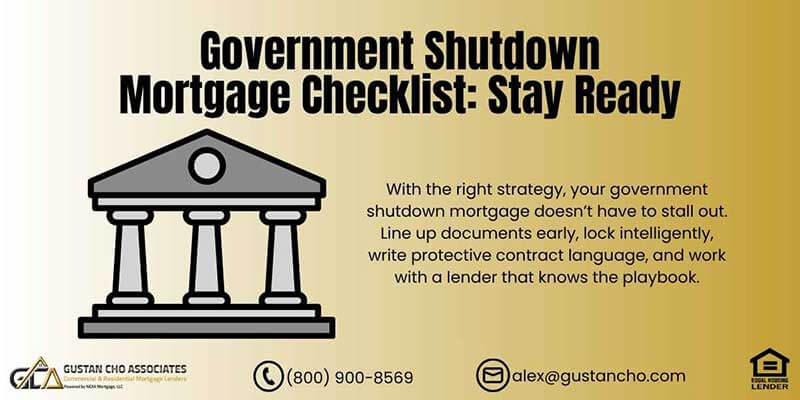
- Coordinate your contract strategy with your agent to ensure your government shutdown mortgage remains protected.
- Communicate daily so you never guess what happens next.
Call Gustan Cho Associates at 800-900-8569 or start your application to build a shutdown-ready plan for your government shutdown mortgage today.
Plan for income interruptions
Pay histories, reserves, and letters of explanation to maintain eligibility