FHA Back to Work Versus Non-QM Mortgages: Pros, Cons, and Current Options After Bankruptcy, Foreclosure, or Short Sale
The Federal Housing Administration Back to Work program is a mortgage loan program that helps people who have had problems. This program started on August 15 2013. Many people who have had a bankruptcy, foreclosure, or short sale have used the Federal Housing Administration Back to Work program to buy a home. The FHA Back to Work loan program turned out to be a total flop and a losing proposition, as it stressed out millions of borrowers who applied.
Meta Description: FHA Back to Work ended in 2016. What are the FHA and Non-QM mortgage options today after bankruptcy, foreclosure, short sale, and credit hardship?
As time went on, mortgage loan officers and lenders fully understood the criteria they needed to meet before approving a mortgage loan application. Most lenders eliminated the FHA back-to-work mortgage program. Those who got turned down for this new FHA Program turned to NON-QM Loans and closed on their home loans. In the following paragraphs, we will compare FHA back-to-work mortgages with non-QM mortgages.
Pros and Cons of FHA Back to Work versus Non-QM Mortgages
The FHA Back to Work loan program was supposed to shorten the waiting period to 1 year after a bankruptcy, foreclosure, deed-in-lieu of foreclosure, or short sale. When this FHA Loan Program was first launched, there was massive confusion, not just among mortgage loan applicants but also among mortgage loan underwriters. Countless borrowers were told they qualified and were issued pre-approval letters to go and get purchase contracts.
Many borrowers were then told they were denied for the FHA Loan under this HUD program, which shortened the waiting period due to an economic event.
Borrowers who were told they qualified and given the lender’s blessing to proceed with the home-buying process ended up not qualifying after they had a signed real estate purchase contract. Most FHA mortgage applications went into processing, and underwriting came back as a mortgage denial. Some borrowers received conditional approvals and, after loan approval, were denied because underwriters did not know what they were doing.
What Was the FHA Back to Work Mortgage Program
Buying a home after bankruptcy, foreclosure, deed-in-lieu, or short sale can be tough. Many people still ask about the FHA Back to Work program, hoping it will help them buy a home after major credit issues. However, this program is no longer available. When you are trying to decide if the Federal Housing Administration Back to Work program is right for you, you need to think about when your credit problems happened. You also need to consider your credit history, how much money you make, how much money you have for a down payment, how much you have in savings, and how much debt you have compared to your income. It is also important to be able to explain what happened with your credit.
The Federal Housing Administration Back to Work program was created by the United States Department of Housing and Urban Development. This program was announced in a letter to people who give out mortgages. The program was available for people who applied for a mortgage between August 15, 2013, and September 30, 2016.
The Federal Housing Administration Back to Work program ended on September 30, 2016, according to the HUD Exchange website. The Back to Work Extenuating Circumstances Initiative is no longer available to help people who have had problems as the Federal Housing Administration Back to Work program did. Today, borrowers with major financial problems often look at standard FHA rules, special exceptions, or non-QM loans. The Back to Work program was a short-term FHA rule for people with significant financial problems resulting from economic downturns. It allowed borrowers to get a mortgage sooner after bankruptcy, foreclosure, a deed-in-lieu, or a short sale if they could demonstrate the cause and prove they were getting back on track financially.
Why Borrowers Still Search for FHA Back to Work?
People still mention the FHA Back to Work program because old articles, videos, and mortgage websites are still online. This can make it seem like the program is still available, leading many to think there is an FHA shortcut to shorten waiting times. The truth is, the FHA Back to Work program is gone for good. Borrowers should plan with this in mind to avoid disappointment. For example, someone might expect to get FHA financing just one year after a major credit issue, but they may still need to wait the usual time, provide a valid special reason, or consider other mortgage options.
Letter of Explanation
There are strict FHA guidelines regarding qualification requirements. Besides qualifying for credit, lenders required a detailed letter explaining the circumstances that led to bankruptcy, foreclosure, a deed-in-lieu of foreclosure, or a short sale. The only extenuating circumstance permitted to qualify for this program was the applicant’s involuntary unemployment.
Need to be Involuntarily Out of Work Through the Following:
- Layoff
- Company downsizing
- Or the company is going out of business.
If the Applicant Did Not Get Terminated Involuntarily and Quit Their Jobs Due to Rumors That the Company Was Going to Lay Employees Off or That the Company Was Going to Shut Their Doors, They Would Not Qualify.
- A detailed letter of explanation, along with supporting documents, was required to determine whether the borrower qualified.
The Letter of Explanation Should Detail the Applicant’s Following:
- Work and credit history
- What triggered the involuntary termination
- What the mortgage applicant did during the layoff period
- How they went about working for work
- How they found their work
- What they have done to re-establish their credit after obtaining new full-time employment
Extenuating Circumstances That Do Not Apply
To qualify for this FHA Loan Program, which has shortened the waiting period after a bankruptcy and foreclosure, borrowers needed to have been voluntarily terminated from employment. Or the company they worked for had been shut down or closed its branch operations. A termination letter is required, or proof that the company shut its operations or went out of business.
The Effect of the 2008 Financial Crisis
The Great Recession of 2008 impacted thousands of businesses nationwide.
- Many hard-working business owners had to mortgage their homes to the max to keep their businesses afloat.
- Ended up closing their doors, and a large percentage of those business owners ended up closing their doors and had their homes foreclosed on
- Unfortunately, under HUD’s rules and guidelines, a loss of business does not constitute being out of work, and business owners who lost their business due to the economic collapse do not qualify.
- HUD, the United States Department of Housing and Urban Development, considers self-employed folks and business owners as sophisticated investors
- Losing their business due to the economic collapse is considered a calculated risk for the business owner.
- Business owners who lost their businesses and were out of work due to business failures did not qualify.
Unfortunately, those folks with other extenuating circumstances, such as divorce or medical issues, did not qualify.
20% Household Income Reduction
To qualify for HUD’s new program, the mortgage applicant must have been out of work for at least 6 months and experienced a 20% or more reduction in household income.
Mortgage lenders are extremely strict with the 20% household income reduction rule. FHA loans are backed by the government and must follow rules set by the U.S. Department of Housing and Urban Development (HUD).
Non-QM loans, on the other hand, are mostly offered by private investors. This means lenders can set their own rules for credit, down payments, waiting periods, pricing, savings, and property standards.
Is Unemployment Income Counted In 20% Household Reduction in Household Income Rule?
Borrowers with unemployment income after being out of work, that unemployment income will not count to calculate 20% reduction in household income qualification purposes. Unemployment income will not count toward household income under HUD’s Guidelines for this program.
Credit Factors
There are Strict Credit Criteria for This Loan Program and Mortgage Guidelines:
- The mortgage applicant needs to have had good credit and no late payments until the day they lost their jobs.
- Late payments and derogatory credit after losing a job were fine.
- However, after the mortgage applicant got a new full-time job
- Need to go back to work.
- The perfect timely payment was expected.
- Lenders expected re-established credit.
- One late payment after the mortgage applicant returns to work will disqualify them from this loan program.
HUD Approved Counseling Certificate
A HUD-Approved Home Counseling Course is Required.
- A certificate of completion of the HUD-approved housing course was required.
- Needed to be signed and dated by the HUD-approved housing counselor
- Borrowers could apply for FHA Loans up to 30 days after the date of the housing certificate.
FHA Back to Work vs Non-QM Mortgages—Which Option Fits You Now?
If you’ve had a bankruptcy, foreclosure, or short sale, the right loan depends on your timeline, credit, and income documentation. Get a quick review to see your best path to approval.
What Are Non-QM Mortgages?
Non-QM mortgages are a type of loan that does not follow the rules of a Qualified Mortgage. This does not mean that Non-QM mortgages are always a good idea. They are for people who cannot get a loan from the Federal Housing Administration, the Department of Veterans Affairs, the United States Department of Agriculture, or Fannie Mae or Freddie Mac.
The government wants to make sure that people can pay back their loans. So the Consumer Financial Protection Bureau has a rule that lenders must follow. This rule is called the ability-to-repay rule. Both Qualified Mortgage and Non-QM mortgages have to follow this rule.
Non-QM mortgages are often used by people who work for themselves. They are also used by people who buy and sell estates. People who have had money problems in the past, like bankruptcy or foreclosure, might use Non-QM mortgages. Some people have a lot of debt compared to their income, so they might use Non-QM mortgages. People who cannot show their income in the way might use Non-QM mortgages, too. People who have been turned down by other mortgage programs might use Non-QM mortgages. These loans can use ways to verify income, like tax forms, lists of assets, or debt service coverage ratio, or profit and loss statements. Non-QM mortgages can be an option for people who do not fit the usual mold. Non-QM mortgages are a type of loan that can help people who cannot get a Qualified Mortgage.
What is the Main Difference Between FHA Back to Work and Non-QM Mortgages?
The main difference is that the FHA Back to Work program is no longer available, while non-QM mortgages remain an option for people who do not meet traditional loan guidelines.
FHA Back to Work Was a Temporary Measure
Back to Work was a temporary HUD policy that was never meant to be permanent. Since it ended in 2016, it cannot be used for loan approval now.
While the FHA Back to Work program is no longer available, non-QM mortgages are still popular and offer flexible approval processes. These loans can help people with poor credit, recent credit problems, unusual income, or special situations that do not meet standard rules.
Many applicants may still qualify for an FHA loan after bankruptcy, foreclosure, deed-in-lieu, or short sale. Approval depends on the type of credit event, time since the event, credit rebuilding efforts, payment history, income, debt-to-income ratio, and loan review results.
FHA After Chapter 7 Bankruptcy
FHA borrowers may qualify again after a Chapter 7 bankruptcy if they wait the required time and show responsible credit use. After bankruptcy, it is important to avoid new late payments, overdrafts, and extra debt, and to keep steady employment.
FHA loans may be available during Chapter 13 bankruptcy if the borrower has made the required payments to the trustee and obtained court or trustee approval.
After the bankruptcy ends, an FHA qualification may happen sooner than with some conventional loans, depending on the person’s situation and lender rules. policies.
FHA After Foreclosure, Short Sale, or Deed-in-Lieu
FHA waiting times after bankruptcy or foreclosure are often longer than people expect. Even if you have recovered financially, you usually have to wait unless you can prove a special reason. Divorce, job changes, or moving out are usually not considered special reasons. FHA loans can be a good option for qualified applicants. They are often more flexible than conventional loans when it comes to credit score requirements, debt-to-income ratios, accepting gift funds, and handling past credit problems.
FHA May Allow a Lower Down Payment
FHA loans usually require a smaller down payment than many Non-QM loans. This helps people who are ready to buy a home but do not have much savings for a large down payment.
FHA vs Non-QM Pricing
Non-QM loans are not backed by the government, but FHA loans are. Because of this, FHA loans usually have lower interest rates than Non-QM loans. For borrowers with credit problems who meet the waiting periods and eligibility rules, FHA loans may be a more affordable option.
FHA is an Option for Borrowers With Bad Credit
FHA rules are usually less strict than those for conventional loans. For people with lower credit scores, FHA may be a better choice. However, you still need to show that your financial problems are resolved and that you can manage a mortgage. Getting an FHA loan after bankruptcy or foreclosure is not always the quickest option. Waiting times, additional lender rules, mortgage insurance, and manual checks can make the process more difficult.
FHA Back to Work Program Is Not an Option
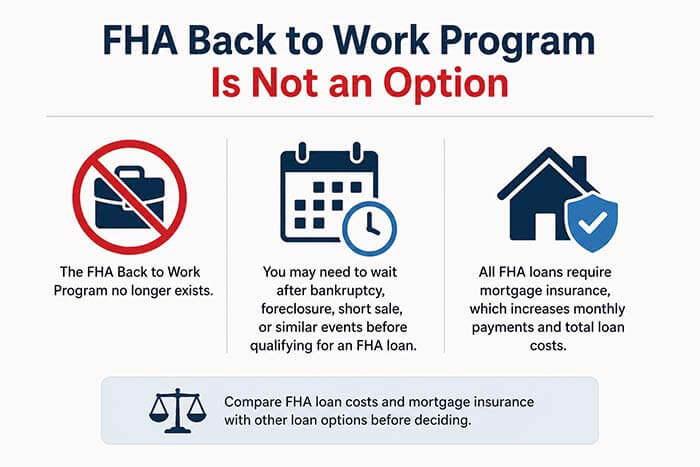
The main issue for people looking for this option is that the program no longer exists. The FHA Back to Work Program cannot be used to get around current FHA rules.
FHA: If you have had a bankruptcy, foreclosure, deed-in-lieu, short sale, or similar event, you may need to wait a certain amount of time before you can get an FHA loan.
All FHA loans require mortgage insurance, which increases both the monthly payment and the total cost of the loan. It’s important to compare the mortgage insurance and other costs of FHA loans with those of other loan options before deciding.
Non-QM Mortgages After Bankruptcy, Foreclosure, or Short Sale
Non-QM mortgages can be a lifeline for people who want to buy a home but cannot qualify for FHA, VA, USDA, conventional, or jumbo loans. They are especially helpful for applicants with strong positive factors. Mortgages. Some non-QM loans may let you qualify after bankruptcy, foreclosure, short sale, or deed-in-lieu with a shorter waiting time than other loan types. However, approval is not guaranteed. Applicants still need to meet credit, income, down payment, and savings requirements.
Help Self-Employed Borrowers
Many self-employed people find it hard to show enough taxable income on their tax returns, even if their business is doing well. In these cases, bank statement loans or Non-QM programs that use profit-and-loss statements can work better than traditional income checks.
Non-QM May Create More Income Opportunities
Non-QM loans give self-employed borrowers more flexibility by accepting different types of income proof, such as business or personal bank statements, 1099s, assets, or rental income. This flexibility is very helpful for people with unusual earnings. of Non-QM Mortgages
Non-QM mortgages can help with special challenges, but they often cost more. They usually have higher fees, bigger down payments, and stricter savings requirements than other loans.
Interest rates for Non-QM loans are usually higher than for FHA loans. The exact rate depends on your credit score, down payment, loan amount, property type, how your income is verified, and how recent your credit problem is. Borrowers with recent bankruptcy or foreclosure may need to put down more money up front or keep more cash saved. Non-QM programs depend on investors, so one lender might say no while another says yes. Your outcome can change depending on the lender, the program, and the documents you provide.
FHA Versus Non-QM After a Major Credit Event
The best loan option depends on whether you qualify for FHA financing or need to look at other mortgage products.
When FHA May Be the Better Option
FHA may be the best option for people who have finished the required waiting period, have a steady income, have improved their credit, and qualify for a smaller down payment. It is also good for those who plan to live in the home and want affordable long-term financing. Non-QM loans may be better for people who have not finished the FHA waiting period, have recent credit events, are self-employed, have large bank deposits but low reported income, own investment properties, or need more flexible loan options.
When Waiting May Be the Better Strategy
Sometimes, waiting a few months to improve your credit score, save more money, or get a better interest rate is the best plan. Waiting to apply may help you qualify for an FHA loan instead of a Non-QM loan, which could save you money. How Lenders Review Borrowers Who Have Experienced Financial Hardship Lenders look beyond just bankruptcy, foreclosure, or short sale. They also consider your overall financial recovery.
How Credit Re-establishment is Important After Financial Distress
Keeping a clean payment history after financial problems is very important. New late payments after bankruptcy, foreclosure, or a short sale are a big concern because they show ongoing financial trouble.
Housing Payment History
Your housing payment history matters a lot. Lenders look more favorably on applicants with 12 months of on-time payments than on those with late, missed, or no payment records.
The Impact of Down Payment Size
A larger down payment can strengthen your mortgage application.
- Extra savings show you are financially stable after closing and ready for unexpected costs.
- What not to do to avoid losing buying power
- Many applicants make it harder to get approved without realizing it.
- The best approach is to keep your application simple and provide clear documentation.
- Do not rely on old FHA Back to Work information.
- This program ended on September 30, 2016. Use current FHA or Non-QM rules for your application.
- Opening new credit accounts can increase your debt-to-income ratio and lower your chances of approval.
- Talk to your loan officer before taking on new debt.
Presuming All Lenders Operate the Same
Some lenders follow agency rules strictly, while others add extra requirements called overlays. If one lender denies your application, try other lenders, including those that offer FHA manual reviews or Non-QM loans.
Comparing The FHA Back to Work versus NON-QM Mortgages
Many borrowers asked about FHA Back to Work versus NON-QM Mortgages. This program turned out to be a total disaster, with many home buyers living a nightmare as they dealt with lenders, only to be told they were denied.
Many turned to NON-QM Loans, where NON-QM Mortgage Lenders honored FHA appraisals and closed the home loan in a couple of weeks.
There is no comparison between FHA back-to-work and NON-QM mortgages. NON-QM mortgages are portfolio loans where the lender holds the mortgage in-house. Gustan Cho Associates Mortgage Group offers NON-QM loans, with no waiting period after bankruptcy and/or foreclosure.
FAQs Regarding FHA Back to Work and Non-QM Mortgages
Is the FHA Back to Work Program Offered Anymore?
No. The FHA Back to Work program is no longer offered. The program was created via HUD Mortgagee Letter 2013-26 for FHA case numbers with an assignment date between August 15, 2013, and September 30, 2016. Per the HUD Exchange, this program ended on September 30, 2016.
Is it Possible to get a Mortgage After Declaring Bankruptcy and Not Using the FHA Back to Work Program?
It is possible, yes. A number of programs besides the FHA Back to Work program may be viable options. It will depend on the specific bankruptcy type, the discharge date, the bankruptcy payment history, the post-bankruptcy score, income, the debt-to-income ratio, and the mortgage program. All of these factors will affect eligibility for the FHA, VA, conventional, and non-QM loans.
Do Non-QM Mortgages Serve Only Those with Bad Credit?
No. Non-QM loans serve a much broader clientele, including the self-employed, active real estate investors, those with substantial assets and alternative income, and those who do not meet agency guidelines. It is important to understand that credit does matter with non-QM loans, but the file will be viewed through a more flexible lens than with FHA or conventional loans.
Is There a Safety Concern with Non-QM Products?
Non-QM products can be safe and beneficial if they are used to construct a legitimate loan and are afforded to the borrower. The CFPB’s ability-to-repay rule requires lenders to assess and ensure that borrowers can afford non-QM mortgage loans. It is essential for borrowers to analyze all variables, including the rate, fees associated with the product, payments, and prepayments, and assess these products in the context of a long-term plan.
Is an FHA or a Non-QM Loan Cheaper?
If the borrower meets qualifications, then FHA is cheaper than non-QM. FHA has cheaper rates and down payments, while non-QM loans are more costly because they are for borrowers who do not meet certain guidelines for standard mortgages and loans that require little documentation.
Can I Refinance Non-QM Loans for FHA Later?
It is possible to refinance from non-QM loans to FHA later if the borrower meets FHA requirements. This is dependent on the borrower’s credit score and history, income, and debt-to-income ratio, property equity, and whether bankruptcies, foreclosures, short sales, and deeds-in-lieu are older than 7 years.
Should I Wait and Get an FHA or Use a Non-QM Loan Now?
This depends on your specific situation. If you are close to the FHA waiting period or if you can improve your credit score in the short term, then FHA is a better option. If you do not meet either of these conditions, then the non-QM loan is a better option, especially if you have the down payment, understand the risks and costs, and have a long-term plan to refinance.
This Guide on FHA Back to Work versus non-QM Mortgages Was Updated on June 7, 2026
Ready to Move Forward? Start Your Pre-Approval
Complete a quick application or send your scenario. We’ll recommend FHA vs Non-QM and guide you step-by-step to closing.