
Can You Get a Conventional Loan with Bad Credit in 2026?
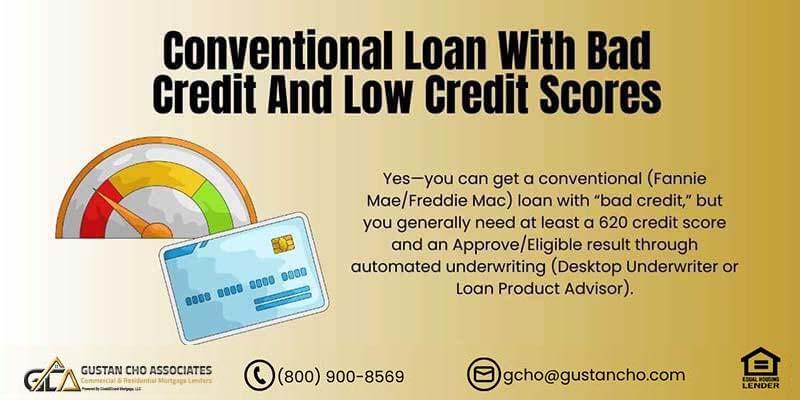
Yes—you can get a conventional (Fannie Mae/Freddie Mac) loan with “bad credit,” but you generally need at least a 620 credit score and an Approve/Eligible result through automated underwriting (Desktop Underwriter or Loan Product Advisor). The closer your score is to 740, the better your rate and mortgage insurance pricing usually get. If you’re below 620, a conventional loan is typically not an option—FHA or other programs may be a better fit.
What You’ll Learn in This Guide
In this updated guide, you’ll learn:
- The real minimum requirements for conventional loans (credit score, down payment, income, and DTI)
- What changes when your score is 620–639 vs. 640–679 vs. 680+
- How private mortgage insurance (PMI) works on conventional loans—and how to remove it
- Waiting periods after bankruptcy, foreclosure, short sale, or deed-in-lieu (and what exceptions may exist)
- What lenders look for beyond the score: payment history, reserves, job stability, and DTI
- Step-by-step ways to improve approval odds in the next 30–90 days
- A clear, borrower-friendly FAQ section with straight answers (no fluff)
What Are Conventional Loans?

A conventional loan is basically a home mortgage that isn’t backed by the government, unlike FHA, VA, or USDA loans. Most of these loans follow the guidelines set by Fannie Mae or Freddie Mac, which is why they’re often referred to as conforming loans.
Who Conventional Loans Are Best For
Conventional loans are often a great fit if you:
- Have a credit score of 620+ (higher scores usually get better pricing)
- Want lower mortgage insurance costs compared to FHA (in many cases)
- Plan to remove PMI once you reach enough equity
- Looking to buy your main home, a vacation spot, or an investment property? The options change based on what you’re going for
Minimum Requirements (Quick Snapshot)
While exact approval depends on your full profile and automated underwriting results, these are common baselines:
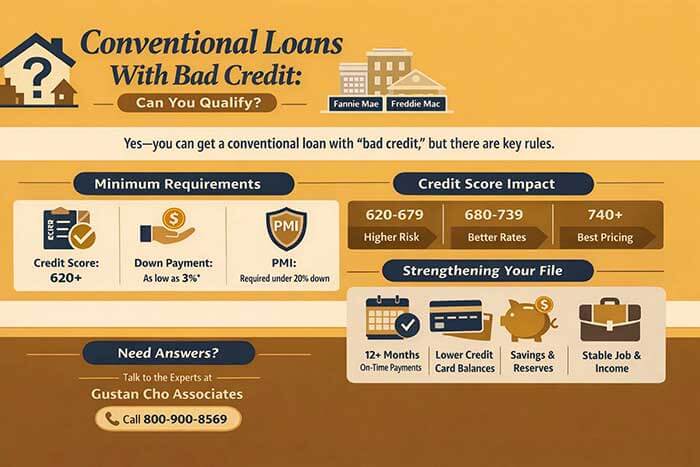
- Minimum credit score: typically 620
- Down payment: as low as 3% for many first-time homebuyers (other scenarios may require more)
- PMI: required when putting less than 20% down
- The good news: PMI can usually be removed later once you reach the required equity.
Why Borrowers Choose Conventional
Conventional loan with bad credit can be a smart move especially if you want:
- Flexibility (especially if you’re buying a second home or investment property)
- PMI cancellation once you build equity
- You might end up paying less for mortgage insurance over your lifetime than you would with FHA, depending on how much you put down and your credit score.
Conventional Loan With Bad Credit And Low Credit Scores
Learn how to qualify for a Conventional Loan with bad credit and low credit scores in 2026. Discover Fannie Mae and Freddie Mac guidelines, compensating factors, and tips to boost your approval chances with Gustan Cho Associates.
Can You Get a Conventional Loan With Bad Credit?
Many Americans think a conventional loan is only within reach for those with perfect credit, but this isn’t always true. While a higher score smooths the path, qualifying for a Conventional Loan with Bad Credit is still possible.
Fannie Mae and Freddie Mac’s honor guidelines include credit scores below the average line. The trick is to match these scores with solid factors, like a stable job, decent reserve funds, and a reasonable debt-to-income ratio.
Here at Gustan Cho Associates, we’ve built a solid track record of turning “no” into “yes” for clients whose credit stories may not be polished.
Understanding Conventional Loan Basics
Before we dive into the credit side, a quick refresher on conventional loans is useful. Conventional loans are not insured or guaranteed by the federal government—insurance programs like those for FHA and VA aren’t in play.
Because of this, the lender briefly assumes more risk, meaning credit score, debt-equity ratio, and income stability carry extra weight.
Conventional loans can be less expensive in mortgage insurance terms when compared to government loans, especially for homebuyers with the right financial profile. They can also be quicker to process, because less paperwork is often needed. Understanding this foundation helps the next pieces come into sharper focus.
Fannie Mae and Freddie Mac: Bad Credit Tolerance
Fannie Mae and Freddie Mac have adapted to changing housing markets by accepting blemished credit scores. Fannie Mae, for instance, may consider a borrower whose score dips as low as 620.
Freddie Mac’s threshold is similar, often accepting starts in the low 620s when other signs of credit strength are in evidence.
The key is providing extra proof that the borrower is on solid financial ground—pay stubs showing at least two years of steady income, bank statements documenting cash reserves, and a debt-to-income ratio smooth enough not to budget.
What Strengthens a Conventional File (When Your Credit Isn’t Perfect)?
With conventional loan with bad credit, approval is usually driven by automated underwriting (Fannie Mae DU or Freddie Mac LPA). That means the goal isn’t “manual underwriting compensating factors”—it’s showing the system (and the underwriter) that you’re a lower risk today than your score alone suggests.
Here are the biggest factors that can strengthen a conventional loan file:
1) Clean 12-Month Payment History
Even if you had older credit issues, lenders and AUS focus heavily on recent behavior. A strong pattern of on-time payments over the last 12 months can make a big difference.
2) Lower Credit Card Utilization
Your score can jump quickly when you reduce how much of your available revolving credit you’re using. In simple terms:
Lower credit card balances = a stronger approval profile (and often better pricing).
3) Stable Income and Job History
A steady job and consistent income help show you can maintain payments long-term. In many cases, lenders look for a stable 2-year work history (with reasonable explanations for any gaps).
4) Cash Reserves After Closing
Reserves are the money you still have after your down payment and closing costs. Having extra funds set aside can strengthen your file—especially for borrowers with scores in the 620–660 range.
5) Lower Debt-to-Income Ratio (DTI)
DTI measures how much of your monthly income goes to debt payments. In general, the lower your DTI, the easier it is to get approved—particularly when your credit score is on the lower side.
6) Higher Down Payment
Putting more down reduces the lender’s risk and can improve the overall loan profile. While some programs allow low down payments, a larger down payment can help offset weaker credit and may reduce PMI costs.
Bottom line: If your score is near the minimum, the fastest way to improve your conventional approval odds is to focus on recent payment history, card balances, reserves, and DTI—the areas that most often move the AUS decision in your favor.
Strategies to Improve Approval Odds (30–90 Day Checklist)
If your credit score is near the minimum for a conventional loan, small moves can make a big difference—especially before your lender runs automated underwriting. Use this checklist to strengthen your file without guesswork.
✅ Correct Errors on Your Credit Report
Pull your credit reports and look for:
- wrong balances or late payments
- accounts that aren’t yours
- duplicate collections
Disputing legitimate errors can improve your score and reduce underwriting questions.
✅ Reduce Revolving Balances (Lower Utilization)
One of the fastest ways to improve a conventional approval profile is to lower credit card utilization.
- Focus on paying cards down (not closing them)
- Keep balances as low as possible compared to the limits
Even without paying off anything in full, lowering utilization can improve your score.
✅ Avoid New Credit Before You Apply
New accounts and inquiries can drop scores and raise risk flags.
- Avoid financing furniture, cars, or opening new cards
- Don’t co-sign for anyone
- Keep your credit activity quiet until you close
✅ Document Rent (If It Helps Your File)
If you’ve been paying rent on time, that history can strengthen the overall story—especially for borrowers with limited credit depth.
- Save proof of rent payments (bank statements, canceled checks, or a verified rent history if available)
Not every file needs this, but when it applies, it can help.
✅ Build Cash Reserves
Reserves are what you have left after the down payment and closing costs.
- Aim for at least 1–2 months of total housing payment (or more, if possible)
- Keep funds in verifiable accounts and avoid large unexplained cash deposits
Reserves can be a strong positive factor when your score is in the 620–660 range.
✅ Ask for an AUS Run Early (Before You Commit)
A lender can run your file through automated underwriting early to see:
- whether you’re getting an Approve/Eligible
- what conditions you’ll likely need to meet
- whether a small credit/DTI adjustment could flip the result
This prevents surprises and helps you focus on the changes that actually matter.
Bottom line: Most conventional approvals improve fastest by fixing report errors, lowering utilization, avoiding new credit, documenting rent when helpful, building reserves, and getting an AUS read early so you’re not guessing.
Gustan Cho Associates Can Help
At Gustan Cho Associates, we like to say the journey to homeownership is still open, even if the credit path is marked with obstacles. Our team of in-house underwriting experts can craft a game plan that accents strengths, addresses weaknesses, and gets to closing quickly on a conventional loan with credit in the hot 620s. With strategic preparation, a reasonable action plan can allow borrowers to enter their new home, even with an imperfect credit record.
Conventional Loan Requirements for Low Credit Scores
Minimum Credit Score for Conventional Loans
620 is the cutoff that most lenders work with. However, anything higher tends to get you a better interest rate and lower monthly payments. If you are still under 640, be ready for a more careful review of your application.
Debt-to-Income Ratio Guidelines
- Standard Maximum DTI: 45%
- With Strong Credit: Lenders may go to 50%.
- With Bad Credit: Expect DTI caps of 36% to 43%
Conventional Loan vs. FHA Loan for Bad Credit Borrowers
Choose FHA for Simplicity
FHA loans accept scores of 500 if you put 10% down. Conventional loans usually require better credit scores.
When to Choose Conventional
- To skip FHA MIP: Conventional loans often lack the upfront and monthly lender insurance that FHA loans do.
- High Loan Limits Help: If the home is in a county above the FHA ceiling, a Conventional loan may go higher without the stricter FHA process.
- PMI Cancellation Strategy: If you plan to build equity quickly and drop PMI at 20%, a Conventional loan can keep monthly payments lower, sometimes sooner than FHA.
Steps to Improve Approval Chances with Bad Credit
Even a few months can make a difference in a low score.
- Pay Down Cards: Lower the balance on revolving accounts to boost scoring models.
- Freeze New Credit Pulls: Each new application can ding your score; wait a year to build without hits.
- Set a 12-Month Calendar: Pay every account on time and see your history start to pull the score up.
- Grow Savings: Adding reserves in checking and savings proves you can cover issues later.
- Look for a co-borrower: If a friend or family member has a stronger score, see if they can get on the application to stabilize the risk.
Looking for a Low-Rate Mortgage?
Apply Online And Get Pre-Approved for a Conventional Loan Today
How Gustan Cho Associates Helps Borrowers with Bad Credit
Some borrowers are denied because lenders apply stricter requirements than the agencies require. Our process is built around agency guidelines, and we work to avoid additional overlays when possible—while keeping your file fully documented and AUS-supported. Final approval depends on your automated underwriting results and standard underwriting conditions.
Can I Qualify For A Conventional Loan With Bad Credit
Student Loans + IBR
Agency Baseline (what the rules allow)
FHA (HUD): Student loans generally must be counted in DTI. If the credit report shows $0 or no payment, FHA typically uses a payment calculation based on the balance (commonly 0.5% of the outstanding balance) unless documented terms allow a different fully amortizing payment.
Conventional (Fannie Mae): If a borrower is on an income-driven repayment plan, lenders may document the plan and can use an actual payment, even $0 in some instances.
VA: If the payment shown is too low, VA uses a 5% of balance ÷ 12 method as a threshold for DTI in many cases.
Common Lender Practice (what many lenders require)
- FHA lenders often default to the 0.5% calculation when payments show $0 or are missing, because it’s straightforward and avoids post-close issues.
- Conventional lenders often accept the documented IDR payment, but may still ask for servicer documentation (not just a credit report line).
- VA lenders commonly apply the 5%-12% threshold when required, in accordance with VA guidance.
No-Overlay Note (how we handle it)
We don’t blanket-deny borrowers just because their student loan payment is $0 or unclear. We’ll:
- review how your loan type treats student loans,
- collect the right documentation (servicer letter/statement when needed), and
- run AUS early to confirm the best path before you waste time or money.
“Government Loans are Owner-Occupant only” Nuance
Agency Baseline (what the rules allow)
- FHA / VA / USDA are primarily designed for primary residences (owner-occupied homes).
- Conventional can be used for primary homes, second homes, and investment properties (with different down payment and pricing requirements). (General program structure; no citation needed here.)
Common Lender Practice (what many lenders require)
- Lenders typically expect you to move in and occupy the home within a set period (often around 60 days) for owner-occupied loans, and they verify your intent to occupy.
- Second-home and investment guidelines are usually tighter: higher down payments, higher reserves, stricter DTI/credit requirements.
No-Overlay Note (how we handle it)
We’ll help you choose the cleanest lane based on your goal:
- Primary residence with lower scores: FHA is often easier.
- Second home/investment: conventional is often the correct fit.
- And we’ll clearly label what’s an agency rule vs. a lender overlay so you’re not guessing.
Conventional Loan With Bad Credit Mortgage Guidelines: Minimum Agency Guidelines
Two different types of loan guidelines conform. The first is the minimum agency guidelines of Fannie Mae or Freddie Mac. The second is lender overlays set by each lender. Lenders require all borrowers to meet the minimum agency guidelines of Fannie Mae or Freddie Mac. Mike Gracz, a senior mortgage loan originator at Gustan Cho Associates says the following about lender overlays imposed by individual lenders on government and conventional loans:
Each lender can have higher lending requirements above and beyond the minimum agency guidelines of Fannie or Freddie. Lenders can have lender overlays on just about anything.
For example, lenders can require higher credit score requirements for second home financing or investment home mortgages. A lender can require a 660 to 680 credit score for second home and investment home financing when the minimum conventional loan guidelines are set at a 620 FICO. A lender can set a lender overlay on debt-to-income ratios at 45% DTI when Fannie and Freddie allow a maximum DTI cap at 50%. The good news is that lenders like Gustan Cho Associates have no lender overlays on government and conventional loans.
Minimum Conforming Mortgage Guidelines on Conventional Loans
Below are the minimum conforming mortgage guidelines on conventional loan with bad credit:
- You must be a US citizen and/or legal resident
- The minimum credit score of 620 is required on all conventional loans
- Minimum down payment of 3% for first-time homebuyers
- Seasoned home buyers require a 5% down payment
- First-time homebuyers are defined as homebuyers who have had no ownership in a home in the past three years
- Private mortgage insurance (PMI) is required for home buyers with down payments less than 20%
- 2-year work history is required
- Fully documented income
- Debt-to-income ratio of 50% or less
- There is a four-year waiting period after the Chapter 7 Bankruptcy discharge date
- There is a four-year waiting period after a deed instead of foreclosure and/or as a short-sale
- There is a seven-year waiting period after a regular foreclosure
- There is a two-year waiting period after the Chapter 13 Bankruptcy discharge date
- There is a four-year waiting period after a Chapter 13 Bankruptcy dismissal date
Self-employed borrowers can qualify for conventional loans with two years of experience as self-employed workers and two years of income tax returns.
Credit Scores Versus Conventional Mortgages
Conventional loans are extremely credit score-sensitive. The lower the borrower’s credit scores, the higher the mortgage rates. Lower credit scores are viewed as riskier borrowers. So, for borrowers to get the best rates, they need higher credit scores and lower loan-to-values. Dale Elenteny, a senior mortgage loan originator at Gustan Cho Associates says the following about qualifying for a conventional loan with bad credit and low credit scores:
Borrowers can qualify for a conventional loan with bad credit. Homebuyers seeking the best conventional mortgage rates will need credit scores of at least 740.
Debt-to-income ratio is also a factor in conforming mortgage rates. Borrowers need at least 20% equity in the home to get the par rates on conventional loans. Any credit scores lower than 740 will get pricing adjustments, known as LLPA (LOAN LEVEL PRICING ADJUSTMENTS). The minimum credit score to qualify for conventional loans is 620. A 620 credit score is considered a very low credit score for conventional loans.
Cases Where Conventional Loans Are The Only Option
As mentioned earlier, homebuyers can qualify for a conventional loan with bad credit. However, the chances are that you will be paying a very high interest rate. Here is a hypothetical case scenario:
- Prime borrower
- Prime borrowers are borrowers with at least a 740 credit score and a 20% down payment
- Get quoted a conventional mortgage rate of 4.0%
- A borrower seeking a conventional loan with bad credit, for example, a 620 credit score, may be quoted a rate of 5.0%
- These conventional mortgage rates are not real quotes and are just for illustration purposes
How Credit Scores Impact Conventional Loans With Bad Credit vs FHA Loans
FHA loans are not credit-sensitive like conventional loans. This is because the government insures government loans against borrowers’ default. Conventional loans are not. Cases where borrowers need to go with conventional loans instead of other types of loans, such as FHA, VA, and USDA loans, are homebuyers purchasing second homes, vacation homes, or investment homes. FHA, VA, and USDA loans are only for primary residences. Homebuyers need to purchase only owner-occupied homes.
Other cases where home buyers need to go with conventional loans instead of FHA loans are when they want to purchase a condominium and the condominium complex is not FHA condo-approved.
In general, conventional loans are for people with good credit. Since no government agencies guarantee conventional loans, lenders have stricter mortgage underwriting guidelines. They need to go with conventional loans. Conventional loans have higher loan limits than FHA loans. If a homebuyer with bad credit and low credit scores is trying to get a house that exceeds the FHA loan limit, they need to get approved for a conventional loan with bad credit.
Conventional Loan With Bad Credit Low Credit Scores Guidelines
No government entity can guarantee conventional loans. Conventional lenders normally want borrowers to put a 20% down payment on a home purchase. Borrowers can put as little as 3% or 5% down payment on a home purchase. John Strange, a senior mortgage loan originator at Gustan Cho Associates, says the following about private mortgage insurance on conventional loans:
Private mortgage insurance is required for borrowers with less than a 20% down payment. Borrowers pay for private mortgage insurance to benefit lenders if the borrower defaults on their loan.
Homebuyers can qualify for a conventional loan with bad credit. The minimum credit score required on conventional loans is 620.
Bad Credit? You May Still Qualify for a Conventional Loan
Apply Online And Explore Your Loan Options Today
Conventional Loan With Bad Credit and Low Credit Scores Lending Requirements
Borrowers can qualify for a conventional loan with bad credit. The minimum credit score required for conventional loans is 620 for low credit scores. Borrowers with credit scores under 620 will not qualify for conventional loans. Alex Carlucci says the following about qualifying for a conventional loan with low credit scores:
Borrowers must try to boost their credit scores to above 620 to qualify for a conventional loan. In addition to meeting the minimum 620 credit score, the maximum debt-to-income ratio allowed on conventional loans is 50%.
For borrowers with a prior bankruptcy, there is a four-year mandatory waiting period after the discharge date of Chapter 7 Bankruptcy. There is a two-year waiting period after the discharge date of Chapter 13 Bankruptcy. There is a four-year waiting period after the dismissal date to qualify for a conventional loan after Chapter 13 dismissal. There is a four-year waiting period after a deed-in-lieu of foreclosure or short sale. The waiting period is seven years to qualify after a standard foreclosure.
Benefits of Conventional Loans
There are instances where borrowers need to go with conventional versus FHA loans. Fannie Mae and Freddie Mac allow income-based repayment on deferred student loans. This holds even if the IBR payment on student loans is zero monthly. Under updated HUD and USDA Agency Mortgage Guidelines, income-based repayment is now allowed as long as the IBR payment reports to the credit bureaus. Dale Elenteny explains the following about qualifying for a conventional loan with low credit scores:
HUD and USDA require mortgage underwriters to take 0.50% of the outstanding student loan balance as a monthly hypothetical debt when calculating the borrower’s debt-to-income ratio.
VA loans allow deferred student loans that have been deferred longer than 12 months to be exempt from DTI calculations. On deferred student loans for less than 12 months, the VA requires underwriters to multiply the student loan’s balance by 5%. Could you take the resulting figure and divide it by 12? The resulting number is the amount mortgage underwriters must take and use as a monthly hypothetical debt on student loans.
Down Payment Requirements on Conventional Loans
Fannie Mae and Freddie Mac now allow a 3% down payment on conventional loans for first-time homebuyers. Fannie Mae and Freddie Mac define first-time homebuyers as those who have not owned a home for at least three years. Normally, the minimum down payment requirement for conventional loans is a 5% down payment. To get the best mortgage rates on conventional loans, borrowers need a 740 credit score and a 20% down payment. Mortgage rates on conventional loans increase as borrowers’ credit scores get lower. Prior bankruptcies, foreclosures, deed-in-lieu of foreclosures, or short sales have no impact on mortgage rates with conventional loans.
How Lower Credit Scores Hurt Borrowers With Higher DTI
Most conforming borrowers will have difficulty qualifying with 50% debt-to-income ratios. Fannie Mae and Freddie Mac now allow up to 50% debt-to-income ratios.
Most private mortgage insurance companies will not insure borrowers with over 45% debt-to-income ratios unless their credit scores exceed 700.
This puts a drain on many borrowers with higher debt-to-income ratios and under 700 credit scores. The great news is that Gustan Cho Associates has investors who will allow conventional borrowers up to 50% debt-to-income ratios with under 700 credit scores.
Requirements For a Conventional Loan With Bad Credit
To qualify for a conventional loan with bad credit, borrowers must meet conforming mortgage guidelines. Here are the basics in qualifying for conventional loans:
- Have at least a 620 credit score
- Been timely on their monthly credit obligations for the past 12 months
- 3% down payment for first-time home buyers and 5% down payment for seasoned home buyers
- The maximum debt-to-income ratios required are no greater than 50%
- The minimum waiting period after Chapter 7 Bankruptcy is 4 years after the discharge date
- At least 4 years out of deed instead of foreclosure
- At least 4 years out of the short sale
- At least 7 years out of foreclosure
- Borrowers with outstanding judgments and/or tax liens can qualify with a written payment agreement with the judgment creditor and/or Internal Revenue Service and have at least three months of payment history
Frequently Asked Questions on Conventional Loans With Bad Credit and Low Credit Scores
What Credit Score do I Need for a Conventional Loan if My Credit is “Bad”?
Most lenders look for a minimum 620 score for conforming conventional loans, but the best pricing usually starts much higher (often 740+). If you’re near 620, your DTI, reserves, and recent payment history matter more than ever.
Can I Get a Conventional Loan with Collections or Charge-Offs?
Often, yes—depending on AUS findings and how recent the issues are. Many conventional approvals focus on your current payment pattern and overall risk profile, rather than just whether each collection is paid. Some lenders still require payoff as an overlay, so it’s important to run AUS early with a lender that follows agency guidelines without unnecessary overlays.
How Much Down Payment do I Need for a Conventional Loan with Low Credit?
Some standard programs let you put down as little as 3% if you qualify. But if your credit score isn’t great, putting more money down might help you get approved more easily and score better rates on private mortgage insurance (PMI). Your down payment, credit score, and the type of loan you choose all affect how much you’ll pay for PMI.
What DTI is Allowed on a Conventional Loan with Bad Credit?
Conventional loans can allow higher DTIs in some instances, but real-world approvals are often easier when DTI is lower—especially for borrowers with lower scores. If your credit is “borderline,” aiming closer to the low-40s (or below) can improve your AUS results.
Is PMI Higher with a 620–660 Credit Score, and When Can I Remove it?
Yes—PMI is usually more expensive when credit scores are lower. The upside is that PMI on conventional loans doesn’t have to last forever: you can typically request cancellation around 80% loan-to-value, and it must automatically terminate around 78% (if you’re current), under federal rules.
How Long After Bankruptcy Can I Qualify for a Conventional Loan?
A common baseline is 4 years after a Chapter 7 discharge, and 2 years after a Chapter 13 discharge (or longer after dismissal in many cases). Exact timing can vary based on details and AUS findings, so it’s smart to get your dates reviewed early.
Pro Tip:
- Shop with various lenders and banks to gauge their rates and criteria before applying.
Final Takeaways
Obtaining a conventional loan with bad credit is difficult but not impossible. If you:
- Have a credit score that is above 620,
- Can make a bigger down payment,
- And possess strong compensating factors,
You could still qualify for a conventional loan mortgage. However, your credit score is below 620. In that case, consider FHA loans or, better yet, improve them before applying.
Questions more geared toward comments? Don’t be shy! Could you share with us below?
Homebuyers who need to qualify for conforming or government loans with a direct lender with no overlays should contact Gustan Cho Associates at 800-900-8569 or text us for a faster response. They can also email us at gcho@gustancho.com. We are a five-star national mortgage company with no lender overlays on government and conventional loans.
This article about “Conventional Loan With Bad Credit And Low Credit Scores” was updated on February 17th, 2026.
Your Credit Score Shouldn’t Stop You
Apply Online And Find Out If You Qualify for a Conventional Loan
