Home loans are still available to borrowers with collections, charged-off accounts, or late payments. Lenders are generally willing to approve applicants with a history of bad credit, bankruptcy, foreclosure, a deed instead of foreclosure, a short sale, or a period of financial hardship. However, lenders expect borrowers to have rebuilt their credit following any previous issues.
You can still qualify for a mortgage with late payments after bankruptcy or other housing events. Despite this, minimum waiting periods to qualify for a mortgage after bankruptcy or a housing event vary by loan program.
It’s important to understand that simply passing the mandatory waiting period after bankruptcy, foreclosure, deed instead of foreclosure, or short sale does not guarantee mortgage approval. Lenders will want evidence that borrowers have worked to reestablish their credit responsibly. While no late payments are ideal after bankruptcy and foreclosure, one or two late payments may not necessarily be a dealbreaker.
Mortgage with Late Payments After Bankruptcy and Foreclosure Guidelines
Late payments after bankruptcy or foreclosure can complicate mortgage approval, but they do not necessarily result in disqualification. Many borrowers mistakenly believe that a single late payment after bankruptcy, foreclosure, a deed-in-lieu, or a short sale eliminates the possibility of homeownership. This is not always the case.
Eligibility depends on several factors, including the type and recency of late payments, the loan program, credit scores, debt-to-income ratio, down payment, reserves, and the presence of lender overlays.
FHA, VA, USDA, Fannie Mae, and Freddie Mac each assess credit risk differently. Additionally, lenders may impose stricter requirements beyond agency guidelines, referred to as lender overlays. Gustan Cho Associates is recognized nationally for assisting borrowers who have been declined by other lenders. Frequently, mortgage denials occur not due to violations of agency guidelines, but because of additional lender overlays.
Can You Get a Mortgage with Late Payments After Bankruptcy and Foreclosure?
Obtaining a mortgage after bankruptcy and foreclosure is possible, even with late payments. However, the timing and severity of these late payments are critical considerations.
A borrower with a single, isolated 30-day late payment from several months prior is typically evaluated differently than one with multiple recent 60-day or 90-day late payments.
Recent late payments are generally more concerning, as they may indicate incomplete financial recovery. Fannie Mae states that recent late payments pose a higher credit risk than older ones, and lenders must determine whether late payments are isolated or frequent.
Why Late Payments After Bankruptcy Are Treated More Seriously
Bankruptcy is supposed to give borrowers a fresh financial start. When late payments happen after bankruptcy, underwriters may question whether the borrower has recovered financially.
The Underwriter May Ask:
- Did the borrower rebuild credit after bankruptcy?
- Were the late payments isolated or part of a pattern?
- Was there a valid hardship?
- Has the borrower made timely payments since?
- Does the borrower have a stable income?
- Does the borrower have enough reserves?
- Is the loan receiving automated approval?
- Late payments following bankruptcy do not automatically preclude mortgage approval.
- However, they must be thoroughly and clearly explained.
Mortgage with Late Payments After Chapter 7 Bankruptcy
- A Chapter 7 bankruptcy usually requires a waiting period before a borrower can qualify for a new mortgage.
- The waiting period depends on the loan program.
- FHA and VA loans are often more flexible than conventional loans after Chapter 7 bankruptcy.
- Conventional loans follow Fannie Mae and Freddie Mac rules, and Fannie Mae lists waiting periods for significant derogatory credit events such as bankruptcy and foreclosure.
FHA Loans After Chapter 7 Bankruptcy
FHA loans can be a strong option for borrowers with prior bankruptcy and credit issues. HUD Handbook 4000.1 is the main source for FHA single-family mortgage policy.
Just because borrowers have good credit scores after bankruptcy and foreclosure does not meet the credit criteria. Credit history and payment history after bankruptcy and foreclosure will carefully be analyzed and reviewed as well.
Late payments after Chapter 7 bankruptcy may require a stronger explanation, especially if the loan is manually underwritten. Borrowers should be prepared to document what happened, why it happened, and why it is unlikely to happen again.
Conventional Mortgage After Chapter 7 Bankruptcy with Late Payments
Conventional loans are usually stricter when there are recent late payments after bankruptcy. Fannie Mae’s Desktop Underwriter and Freddie Mac’s Loan Product Advisor evaluate the overall credit profile, but lender overlays can make approval harder.
A Borrower May Need:
- Stronger credit scores
- Lower debt-to-income ratio
- More reserves
- Longer time since late payments
- Clean housing payment history
- A strong letter of explanation
Mortgage with Late Payments After Chapter 13 Bankruptcy
Chapter 13 bankruptcy differs from Chapter 7 because the borrower enters into a repayment plan. FHA and VA loans may allow borrowers to qualify for a loan during or after a Chapter 13 bankruptcy if the guidelines are met.
Late Payments During Chapter 13 Bankruptcy
Late payments during Chapter 13 can be a serious issue, especially if the borrower misses trustee payments, housing payments, or other required debts. Many lenders want to see a clean payment history during the repayment plan.
Borrowers may still have options if the late payment was isolated and well-documented. The key is whether the borrower can show recovery and stability.
Late Payments After Chapter 13 Discharge
Late payments after a Chapter 13 discharge may raise red flags, as the borrower has recently completed a court-supervised repayment plan. Underwriters want to see that the borrower can manage debt after bankruptcy.
A Strong File Should Show:
- Stable employment
- On-time rent or mortgage payments
- No recent major derogatory credit
- Low revolving credit balances
- Documented savings or reserves
- Clear explanation for any late payments
Mortgage with Late Payments After Foreclosure
Foreclosure is one of the most serious credit events in mortgage underwriting. Waiting periods vary by loan program. Fannie Mae generally requires a seven-year waiting period after foreclosure, with possible exceptions for documented extenuating circumstances.
Why Foreclosure Plus Late Payments Can Be Difficult
A foreclosure already shows a serious housing payment default. If the borrower also has late payments after the foreclosure, the lender may view the borrower as a higher risk.
This does not always mean denial. It means the borrower needs a stronger file and the right loan program.
FHA and VA Options After Foreclosure
FHA and VA loans may offer more flexible paths to borrowers after foreclosure than conventional loans. VA loans are especially powerful for eligible veterans, active-duty service members, and surviving spouses because they can offer no down payment and flexible credit requirements. The VA home loan guaranty helps protect lenders against loss, allowing them to offer more favorable terms to eligible borrowers.
Mortgage with Late Payments After Short Sale or Deed-in-Lieu
A short sale or deed-in-lieu can also create mortgage waiting periods. The rules depend on whether the borrower had late mortgage payments before the event, the loan program used, and whether extenuating circumstances apply.
Why Payment History Before and After the Event Matters
Underwriters Look at the Full Timeline. They Want to Know:
- Were mortgage payments late before the short sale?
- Were consumer debts late after the short sale?
- Was the borrower a borrower who maintains clean credit following a short sale typically has more mortgage options than one with repeated late payments after the event.
Can I Qualify for a Mortgage with Late Payments After Bankruptcy and Foreclosure with An AUS Approval
Lenders generally frown upon late payments after bankruptcy and foreclosure, often viewing borrowers with such a history as “second offenders.” This term suggests that these applicants are seen as financially irresponsible, prone to habitually missing payments, and therefore considered a high credit risk.
It is possible to achieve an “approve/eligible” status through the automated underwriting system (AUS), even if you have had one or two late payments after a bankruptcy or foreclosure. Despite common belief, this is achievable. However, many lenders will not accept these applicants even with AUS approval due to their lender overlays.
Gustan Cho Associates stands apart from most lenders by not imposing overlays on late payments after bankruptcy or housing events. You can secure an approve/eligible rating through the automated underwriting system. Gustan Cho Associates will approve and close your home mortgage in that case, as they have no lender overlays. This option is viable for those seeking a mortgage with late payments after bankruptcy.
Late Payments, Bankruptcy, and Foreclosure Don’t Have to Stand in the Way of Your Home!
Reach out now to find out how we can help you get the home loan you need.
Importance Of Timely Payments And Payment History After Period Of Bad Credit
Borrowers are not required to pay off outstanding collections and charged-off accounts to be eligible for home loans. Lenders will typically require a consistent record of 12 months of on-time payments. The Automated Underwriting System (AUS) only approves borrowers demonstrating this recent, reliable payment history.
While securing an AUS approval with one or two late payments in the past year is possible, qualifying for a mortgage with late payments after bankruptcy and/or a housing event is more challenging.
Though it’s not impossible to obtain an AUS approval for a mortgage with late payments after bankruptcy and/or foreclosure, most lenders remain hesitant to approve these borrowers due to their internal overlays. However, Gustan Cho Associates, a nationwide mortgage company licensed in multiple states, overlooks government and conventional loans. With AUS approval, they can fund loans even if you have late payments after bankruptcy and/or foreclosure.
Qualifying For Mortgage After Bankruptcy And Foreclosure
A Chapter 7 Bankruptcy is a federal law designed to help individuals eliminate most of their debts and reset their financial lives. This type of bankruptcy allows consumers to discharge obligations like credit card debt, judgments, installment loans, personal loans, and other non-government liabilities.
Debts like federal student loans, cannot be discharged through Chapter 7. This form of debt relief is particularly beneficial for consumers overwhelmed by financial burdens due to unemployment, business failure, divorce, medical issues, or other circumstances.
After completing the Chapter 7 process, all eligible debts are wiped out, giving the debtor a fresh start without outstanding financial obligations. It’s an effective option for people seeking a mortgage with late payments after bankruptcy to rebuild their finances and credit history.
Debts That Cannot Be Discharged In Bankruptcy
There are certain debts that cannot be discharged through a Chapter 7 Bankruptcy such as the following:
- student loans
- government loans
- child support payments
- tax debts
- tax liens
- Once a debt from a creditor is discharged through bankruptcy, the consumer no longer owes the debt
- They are no longer responsible to pay that debt
- All unsatisfied judgments also get discharged
- Consumers do not have to worry about getting any future collection activities from the judgment creditor such as wage garnishments, bank levy, or have liens placed on their assets
- Homebuyers can qualify for Mortgage With Late Payments After Bankruptcy and foreclosure after meeting the waiting period requirements
- However, late payments after bankruptcy and foreclosure are often frowned upon by all lenders
Late payments after bankruptcy can be deal killers in getting qualified for home loans after bankruptcy.
Qualifying For Home Loan After Bankruptcy
People can definitely get a home loan after bankruptcy and the majority of folks who filed bankruptcy eventually have become homeowners in as little as two years from their bankruptcy discharged date with FHA and VA Home Loans:
- One of the major issues where getting a home loan after bankruptcy becomes a major issue is if borrowers had late payments after bankruptcy
- It is possible to qualify for Mortgage With Late Payments After Bankruptcy and Foreclosure
Most mortgage companies will disqualify applicants who had late payments after bankruptcy and foreclosure as well as those with late payments after a short sale.
What Happens if You Make a Late Payment on a Mortgage?
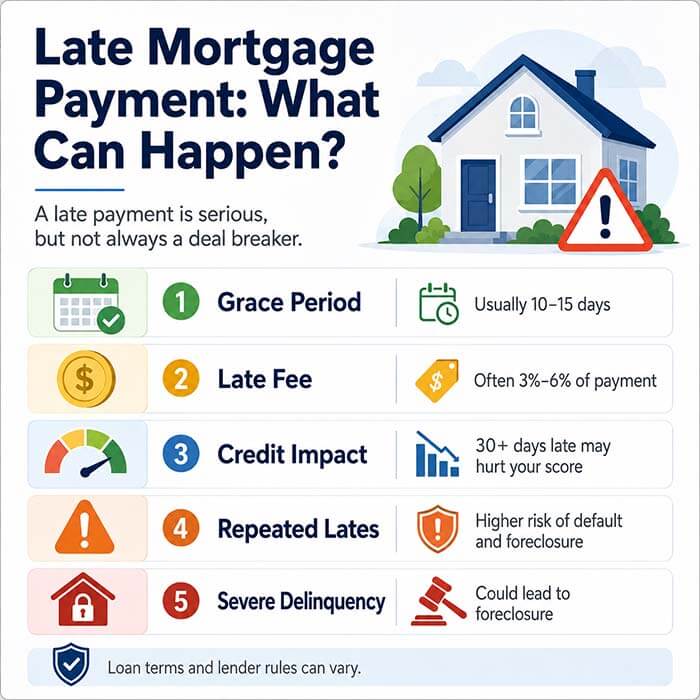
Late payments after bankruptcy and housing events are not deal killers. However, making a late payment on a mortgage can have several consequences, depending on the timing and frequency of the lateness:
- Grace Period: Many mortgage contracts have a grace period, usually around 10 to 15 days after the due date. If you pay within this period, it usually won’t be considered late, and you won’t incur late fees.
- Late Fees: After the grace period has elapsed, lenders typically impose a late fee of 3% to 6% of the overdue payment. It’s important to note that these fees may differ based on the terms of your loan.
- Credit Impact: If your payment is more than 30 days late, the lender may report it to the credit bureaus. Your credit score will likely be negatively affected by this, which will continue to be reflected in your credit report for 7 years.
- Repeated Late Payments: Missing payments or paying late on multiple occasions can escalate the chances of foreclosure. Paying your bills past their due date can increase interest rates and fees if you apply for additional credit.
- Foreclosure: If payments remain unpaid and the delinquency becomes severe, the lender might start foreclosure, which can result in you losing your home.
Lenders are more than happy to lend on borrowers with prior bankruptcies but not late payments after bankruptcy and/or housing events. Lenders do expect that they do not have any late payments after bankruptcy. Lenders want to see re-established credit after bankruptcy and foreclosure and steady employment.
Will Late Payments be Removed After Bankruptcy?
In the United States, filing for bankruptcy can provide financial relief. Still, it does not automatically remove late payments from your credit report. Here’s what typically happens:
- Chapter 7 Bankruptcy: If your debt is discharged under Chapter 7, the late payments will not be removed from your credit report. However, those accounts will be marked as “discharged in bankruptcy.” This notation indicates that the debt was included in your bankruptcy and will remain on your report for up to 10 years from the bankruptcy filing date.
- Chapter 13 Bankruptcy: Under Chapter 13, you work out a 3- to 5-year repayment plan. Late payments before the bankruptcy filing will remain, but accounts will be marked to show they are part of a repayment plan. This bankruptcy remains on your credit report for up to 7 years after filing.
Late payments are part of your credit history. Past-due accounts can appear on your credit report for seven years, starting from the initial delinquency date. Consider checking with your bankruptcy attorney or credit reporting agency for more specific guidance based on your circumstances.
Can You Still Get a Mortgage with Missed Payments?
Yes, getting a mortgage is possible despite having missed payments in the past, but securing approval can be more challenging, and the terms may need to be more favorable. Missed payments often hurt your credit score, making lenders view you as a higher-risk borrower.
Lenders may demand a larger down payment or higher interest rates to offset risk. Recent missed payments have more impact than older ones. Explaining a medical emergency or job loss could help your application.
Some mortgage types, like FHA loans, are designed for individuals with less-than-perfect credit. Still, their qualification requirements tend to be more stringent. Every lender has different criteria, so shopping around or working with a mortgage broker could lead you to one willing to approve your application.
How Underwriters Review Late Payments After Bankruptcy and Foreclosure
Mortgage underwriters do not only look at credit scores. They review the full credit pattern. In the meantime, improving your credit score by paying off outstanding debts and consistently making on-time payments can help increase your chances of approval. If you’re concerned about your financial situation, consulting a financial advisor or mortgage specialist could provide useful strategies for repairing your credit and finding the right lender.
One Late Payment Versus Multiple Late Payments
A single, isolated 30-day late payment may be adequately explained. In contrast, multiple late payments across several accounts may indicate ongoing financial instability.
Recent Late Payments Are More Serious
A late payment from two years ago is usually less damaging than one from two months ago. Fannie Mae specifically notes that recent late payments pose a higher credit risk than older ones.
Housing Late Payments Matter the Most
Late mortgage or rent payments are usually more serious than late payments on small installment accounts. Lenders want confidence that the borrower will make the new housing payment on time.
Automated Underwriting System Approval After Late Payments
Most mortgage approvals start with an automated underwriting system. FHA loans often use the TOTAL Mortgage Scorecard. Conventional loans use Desktop Underwriter or Loan Product Advisor. USDA loans use GUS. VA loans may also receive automated findings, but the underwriter still evaluates VA-specific credit and residual income rules.
AUS Approval Can Help a Borrower with Late Payments
If the borrower receives an approve/eligible or accepted finding, the file may be easier to approve. However, the lender still must verify the information and follow the findings.
AUS Approval Does Not Remove Lender Overlays
Many borrowers are denied at this stage. Even if FHA, VA, USDA, Fannie Mae, or Freddie Mac guidelines are met, a lender may still deny the application due to overlays.
Examples of Overlays Include:
- No late payments after bankruptcy
- Higher minimum credit scores
- Lower debt-to-income caps
- Extra reserve requirements
- Longer waiting periods
- No manual underwriting allowed.
- Gustan Cho Associates assists borrowers who meet agency guidelines but have been denied due to lender overlays.
Manual Underwriting with Late Payments After Bankruptcy
Manual underwriting may be available on FHA and VA loans in certain cases. Manual underwriting means the file is reviewed in greater depth by a human underwriter rather than relying solely on automated approval.
What Manual Underwriting Looks For
Manual Underwriting Focuses Heavily on Compensating Factors. These May Include:
- Low debt-to-income ratio
- Verified rent history
- Cash reserves
- Stable employment
- Low payment shock
- No recent overdrafts
- Limited new debt
- High residual income on VA loans
Why Clean Payment History Is Important on Manual Underwriting
Manual underwriting typically requires a robust recent payment history. Late payments within the past 12 months can significantly hinder manual underwriting approval. Therefore, borrowers with late payments after bankruptcy should prioritize establishing a clean 12-month payment record.
How To Explain Late Payments After Bankruptcy or Foreclosure
A letter of explanation is often essential. Its purpose is to provide the underwriter with a clear, honest, and well-documented timeline, rather than to offer excuses.
What To Include in a Letter of Explanation
The Letter Should Explain:
- What caused the late payment
- When the issue happened
- Whether it was isolated or recurring
- How the issue was resolved
- Why is it unlikely to happen again
- What has changed financially since then
Good Examples of Explaining Late Payments
Strong explanations may include temporary job loss, medical hardship, divorce, death in the family, payroll delay, employer shutdown, or documented income interruption.
Weak explanations usually include vague statements such as “I forgot,” “I was busy,” or “I did not know the bill was due.”
Best Loan Programs for Borrowers with Late Payments After Bankruptcy
There is no one-size-fits-all loan program. The best option depends on the borrower’s full profile.
FHA Loans After Bankruptcy and Late Payments
FHA loans are often one of the best options for borrowers with lower credit scores, prior bankruptcy, foreclosure, and late payments. FHA allows more credit flexibility than many conventional loan programs, but recent late payments still matter.
VA Loans After Bankruptcy and Late Payments
VA loans can be one of the most flexible mortgage options for eligible veterans and active-duty service members. VA underwriting looks at the full borrower profile, including residual income, housing history, and credit patterns.
USDA Loans After Bankruptcy and Late Payments
USDA loans may be an option for eligible rural and suburban properties. However, USDA underwriting can be sensitive to recent credit issues. Borrowers usually need to show that late payments were isolated and that credit has been re-established.
Conventional Loans After Bankruptcy and Late Payments
Conventional loans may work if the borrower meets waiting periods, has strong credit scores, receives automated approval, and has no serious recent derogatory credit. Fannie Mae and Freddie Mac guidelines are usually less forgiving than those of the FHA or VA for borrowers with recent late payments after major credit events.
Non-QM Loans After Bankruptcy and Late Payments
Non-QM loans may be an option when agency loans do not work. These programs may allow recent bankruptcy, foreclosure, or credit events, but they usually require larger down payments, higher rates, and more reserves.
Ready for a Mortgage After Late Payments, Bankruptcy, and Foreclosure? We’ll Help You Get Approved!
Reach out today to discuss your options and see how we can help you get a mortgage after late payments, bankruptcy, or foreclosure.
How To Improve Mortgage Approval Chances After Late Payments
Applicants should avoid submitting mortgage applications without adequate preparation following bankruptcy or foreclosure. Thorough preparation is essential.
Rebuild 12 Months of Clean Payment History
The most critical step is to eliminate any new late payments. Maintaining a clean recent payment history can help mitigate the impact of previous credit issues.
Keep Credit Card Balances Low
High credit card balances can hurt credit scores and increase the risk of default. Paying down revolving debt can improve the borrower’s credit profile.
Avoid New Debt Before Applying
New auto loans, personal loans, and credit cards can hurt debt-to-income ratios and lower credit scores.
Save Money for Reserves
Financial reserves can strengthen a mortgage application. Even when not required, retaining funds after closing serves as a significant compensating factor.
Work with a Lender That Has No Overlays
This consideration is crucial. Many borrowers face denial due to lender-specific rules that are more stringent than those of FHA, VA, USDA, Fannie Mae, or Freddie Mac.
Common Reasons Borrowers Get Denied After Bankruptcy and Foreclosure
Borrowers with late payments after bankruptcy or foreclosure are often denied for reasons that could have been avoided.
Applying Too Soon
Some borrowers apply before they meet waiting periods or before their credit has recovered enough.
Not Explaining the Late Payments
Unexplained late payments create uncertainty for the underwriter. Providing a clear explanation can significantly influence the approval decision.
Using the Wrong Loan Program
A borrower may not qualify for conventional financing but may qualify for FHA, VA, USDA, or non-QM.
Working with a Lender with Overlays
This is one of the biggest reasons borrowers get denied. The borrower may meet agency guidelines, but the lender’s overlays result in the denial.
Mortgage with Late Payments After Bankruptcy: Example Scenario
A borrower filed Chapter 7 bankruptcy after a job loss and medical bills. The bankruptcy was discharged more than two years ago. The borrower rebuilt credit with two secured credit cards and an auto loan. However, one credit card had a 30-day late payment 9 months ago due to a payroll issue.
Gustan Cho Associates’ zero-overlays policy on government and conventional loans makes them a potential solution for borrowers seeking a mortgage with late payments after bankruptcy.
This borrower may still qualify for mortgage options. The application would be strengthened by consistent on-time payments since the late payment, stable employment, low credit card balances, and sufficient reserves. FHA or VA loans may be preferable to conventional financing, depending on the overall profile.
Denied for Mortgage with Late Payments After Bankruptcy and Foreclosure
I have many calls from borrowers who are told by lenders that they do not qualify for a home loan and will never qualify for a home loan because they had late payments after bankruptcy and foreclosure. Many lenders will not budge on this rule. They will automatically disqualify borrowers who had late payments after bankruptcy and foreclosure.
However, there are solutions to overcome this major issue. I have helped countless borrowers with late payments after bankruptcy and foreclosure.
If told that you do not qualify for a mortgage due to late payments after Bankruptcy and Foreclosure, please contact us at Gustan Cho Associates at 800-900-8569 or text us for a faster response. Or email us at gcho@gustancho.com so I review the overall credit profile and see if we can come up with a solution that will fit and suit the credit profile and implement them so we can qualify for a home loan.
Final Thoughts on Getting a Mortgage with Late Payments After Bankruptcy and Foreclosure
Securing a mortgage after bankruptcy and late payments on foreclosed property presents challenges, but approval remains possible. Understanding the distinction between agency guidelines and lender overlays is essential.
Late payments after bankruptcy or foreclosure must be reviewed carefully. The underwriter will look at how recent the late payments are, how many there were, whether they involved housing payments, and whether the borrower has recovered financially.
Gustan Cho Associates assists borrowers who have been declined by other lenders due to lender overlays. For individuals with bankruptcy, foreclosure, short sale, deed-in-lieu, or late payments after a significant credit event, selecting the appropriate lender is critical.
Frequently Asked Questions: Mortgage With Late Payments After Bankruptcy and Foreclosure
Can I Qualify for a Mortgage if I Have Past Collections, Charge-Offs, or Late Payments?
- You can still qualify for a mortgage even with past credit issues like collections, charge-offs, or late payments.
- Borrowers who have faced credit issues such as bankruptcy, foreclosure, or short sale can still get approval from lenders, given that they have taken steps to rebuild their credit.
Are There Waiting Periods for Mortgages After Bankruptcy or Foreclosure?
- Yes, waiting periods vary by loan program.
- The required period begins after the bankruptcy, or housing event is finalized.
- However, passing the waiting period does not automatically mean qualification.
- Lenders will review your credit history to see if you’ve re-established credit responsibly.
Will Late Payments Be Removed from My Credit Report After Bankruptcy?
- No, late payments are not automatically removed.
- In Chapter 7 bankruptcy, late payments will be marked as “discharged in bankruptcy” but remain on your report for up to 10 years.
- For Chapter 13, late payments before filing remain on your report but are marked as part of a repayment plan and stay for up to 7 years.
What Happens if I Have Late Payments on a Mortgage After Bankruptcy or Foreclosure?
- Lenders generally frown upon late payments after bankruptcy or foreclosure.
- They may consider applicants with such a history to be at higher risk and might reject their application.
- However, some lenders, like Gustan Cho Associates, have no overlays and may approve borrowers who receive Automated Underwriting System (AUS) approval, even if they have one or two late payments.
How Can I Improve My Chances of Qualifying for a Mortgage?
- Rebuilding your credit is crucial.
- Ensure a consistent 12-month history of on-time payments.
- Although some late payments might still qualify for an AUS approval, working to pay off outstanding debts and maintaining a steady employment record will enhance your credibility.
Do I Need to Pay Off All Collections and Charge-Offs to Qualify for a Mortgage?
- Not necessarily. Lenders often do not require the settlement of old collections and charge-offs to approve a loan. However, they will expect you to have a recent, timely payment history.
What Should I Do if Denied a Mortgage Due to Late Payments After Bankruptcy or Foreclosure?
-
- If denied, consider contacting mortgage specialists like Gustan Cho Associates, who work with borrowers facing these challenges.
- They can provide solutions tailored to your situation and guide you in improving your credit profile to qualify for a mortgage.
This Guide About Mortgage with Late Payments After Bankruptcy and Foreclosure Was Updated on May 26, 2026.
Had Late Payments After Bankruptcy and Foreclosure? We Can Help You Qualify for a Mortgage!
Contact us today to explore your mortgage options and get pre-approved.