Understanding the VA funding fee is one of the first things veterans, active-duty service members, and eligible surviving spouses should know before using a VA loan. The VA funding fee is a charged on most VA loans. The VA loan program helps qualified buyers purchase a home with no down payment and no monthly mortgage insurance.
The amount of the VA funding fee depends on the type of VA loan, your down payment, whether you have used your VA loan benefit before, and whether you qualify for an exemption. Some borrowers do not have to pay the fee at all, including certain veterans with a service-connected disability and eligible surviving spouses.
Most borrowers do not have to pay the VA funding fee in cash during closing. This is good news. In many cases, the fee can be rolled into the loan amount, helping reduce the upfront cash needed to buy or refinance a home. In this guide, we will explain how the VA funding fee works, how much it may cost, who may be exempt, and how it affects your total VA loan amount.
What’s The Deal With The VA Funding Fee On A VA Loan?

Who Has To Pay The VA Funding Fee?
Most VA borrowers have to pay the VA funding fee unless they qualify for an exemption. The fee applies to many VA purchase loans, VA cash-out refinance loans, and VA streamline refinance loans. The exact amount depends on the loan type, down payment, and whether the borrower has used a VA loan before. Some borrowers might not have to pay the VA funding fee. You may be eligible for an exemption if you receive VA disability compensation for a service-related disability. Plus, if you’re eligible for VA disability compensation but are currently getting retirement pay or active-duty pay instead, you might be off the hook, too.
Eligible surviving spouses may also be exempt if the veteran died in service or passed away from a service-connected disability. In some cases, active-duty service members who have received a Purple Heart may also qualify for a VA funding fee exemption.
The best way to confirm whether you have to pay the VA funding fee is to review your Certificate of Eligibility, also called the COE. Your COE should show whether you are exempt. If your exemption status is missing, incorrect, or still pending, your lender may need updated VA documentation before closing. If your VA disability claim is approved after closing, you may be able to request a refund of the VA funding fee. This usually depends on whether the disability effective date is before the loan closing date. Because this can affect your final costs, borrowers should discuss exemption status with their lender as early as possible in the VA loan process.
How Much Is The VA Funding Fee In 2026?
The VA funding fee in 2026 depends on the type of VA loan, your down payment, and whether this is your first time using your VA loan benefit. The funding fee is determined as a percentage of the VA loan sum instead of the sale price. The current VA funding fee schedule has been in effect since April 7, 2023. For most VA purchase and construction loans, the funding fee is lower when the borrower makes a down payment of at least 5%. Veterans, active-duty service members, National Guard members, and Reserve members use the same VA funding fee chart for purchase and construction loans.
VA Funding Fee Chart For Purchase Loans In 2026
For a VA purchase loan or VA construction loan, the 2026 VA funding fee is:
- First-time use with less than 5% down: 2.15% of the loan amount.
- First-time use with 5% to 9.99% down: 1.50% of the loan amount.
- First-time use with 10% or more down: 1.25% of the loan amount.
- Subsequent use with less than 5% down: 3.30% of the loan amount.
- Subsequent use with 5% to 9.99% down: 1.50% of the loan amount.
- Subsequent use with 10% or more down: 1.25% of the loan amount.
This means a first-time VA loan borrower with zero down will usually pay a 2.15% funding fee, unless they qualify for an exemption. A repeat VA borrower with zero down will usually pay a higher 3.30% funding fee. However, both first-time and repeat-use borrowers can reduce the funding fee by putting down at least 5%.
Example Of A 2026 VA Funding Fee On A Purchase Loan
If a first-time VA borrower buys a home with a $300,000 VA loan and no down payment, the VA funding fee would be 2.15% of the loan amount. That equals $6,450. If the borrower rolls the fee into the loan, the new total loan amount would be $306,450. The borrower doesn’t need to pay the funding fee at closing, but their monthly payments might be higher because the fee is rolled into the loan. If the same borrower puts down at least 5%, the funding fee drops to 1.50%. If the borrower makes a down payment of 10% or higher, the funding fee decreases to 1.25%.
VA Funding Fee For IRRRL And Cash-Out Refinance Loans In 2026
VA refinance loans have different funding fee rules than VA purchase loans.
- For a VA Interest Rate Reduction Refinance Loan, also called a VA IRRRL or VA Streamline Refinance, the funding fee is 0.50%. This fee does not change based on whether the borrower has used a VA loan before.
- For a VA cash-out refinance, the funding fee is 2.15% for first-time use and 3.30% for subsequent use. Unlike a VA purchase loan, the VA cash-out refinance funding fee does not decrease based on the down payment or equity amount.
VA Funding Fee For Manufactured Homes, Loan Assumptions, And Other VA Loans
Some VA loan types have separate funding fee rules. A manufactured home loan that is not permanently affixed has a 1.00% funding fee. A VA loan assumption has a 0.50% funding fee. A Native American Direct Loan has a 1.25% funding fee for purchases and a 0.50% funding fee for refinances.
If your only prior use of a VA-backed or VA direct loan was for a manufactured home purchase, the VA says you may still pay the first-time funding fee on a later VA purchase or refinance loan.
The most important point is that not every VA borrower pays the same funding fee. Before closing, your lender should verify your Certificate of Eligibility, confirm whether you are exempt, determine whether this is a first-time or subsequent use, and calculate the correct fee based on the loan type and loan amount.
Rolling The VA Funding Fee Into Your Loan: Pros And Cons
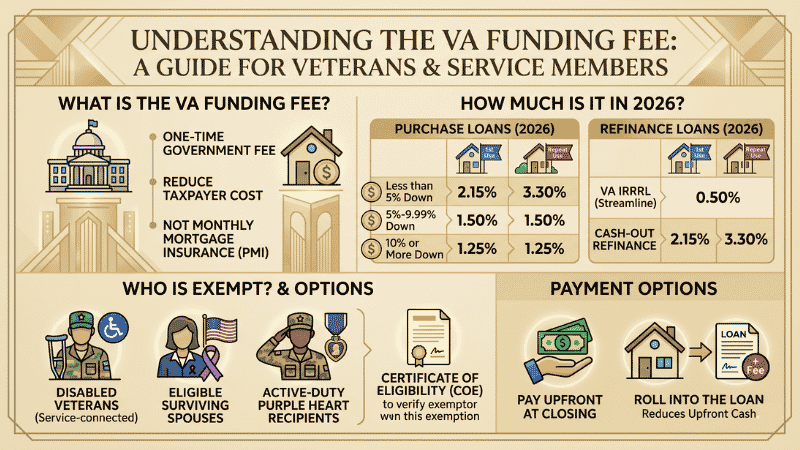 One cool thing about a VA loan is that you can add the VA funding fee to the loan amount instead of having to pay it upfront when closing. This can help veterans, active-duty service members, and eligible surviving spouses buy a home with less upfront cash. Rolling the VA funding fee into the loan can be helpful if you want to preserve money for moving expenses, emergency reserves, furniture, home repairs, or other costs after closing. Many VA borrowers choose this option because VA loans are designed to reduce the cash required to buy a home.
The tradeoff is that financing the VA funding fee increases your total loan balance. Because the loan amount is higher, your monthly mortgage payment may also be slightly higher. You are also paying interest on the funding fee over the life of the loan.
Paying the VA funding fee upfront can lower your total loan amount and slightly reduce your monthly payment. However, this requires more cash at closing. For many borrowers, keeping cash in the bank is more important than lowering the loan amount by a small amount. In most cases, rolling the VA funding fee into the loan does not prevent approval as long as the borrower still meets VA and lender guidelines. The VA funding fee can be financed above the base loan amount, even when the veteran is using a zero-down VA loan. Your lender will calculate the final loan amount and explain how the fee affects your payment before closing. The best choice depends on your cash reserves, monthly budget, and long-term plans. If paying the fee upfront leaves you short on savings, rolling it into the loan may be the better option. If you have strong reserves and want to keep the loan balance lower, paying it upfront may make sense.
Example: How The VA Funding Fee Affects Your Loan Amount
Here is a simple example of how the VA funding fee can affect your total loan amount. If a first-time VA borrower buys a home with a $250,000 VA loan and puts no money down, the VA funding fee would be 2.15% of the loan amount. That means the funding fee would be: $250,000 x 2.15% = $5,375 If the borrower pays the VA funding fee upfront, the base loan amount stays at $250,000. However, many VA borrowers choose to finance the funding fee into the loan instead of paying it out of pocket at closing. If the $5,375 funding fee is rolled into the loan, the new total loan amount becomes: $250,000 + $5,375 = $255,375 This can help reduce the cash needed at closing, but it also means the borrower is financing the fee over the life of the loan. As a result, the monthly mortgage payment may be slightly higher than it would be if the fee were paid up front. For many VA borrowers, rolling the funding fee into the loan helps them preserve cash for moving expenses, emergency savings, furniture, repairs, or other costs after buying the home.
Can The VA Funding Fee Be Waived?
Yes. The VA funding fee can be skipped for borrowers who meet the requirements for a VA-approved exemption. This can save borrowers thousands of dollars on a VA purchase loan, VA cash-out refinance, or VA streamline refinance. If you get VA disability compensation for a service-related issue, you might not have to pay the VA funding fee. You may also qualify if you are eligible to receive VA disability compensation but receive retirement pay or active-duty pay instead. Eligible surviving spouses may also be exempt if the veteran died in service or passed away from a service-connected disability.
Your Certificate of Eligibility, also called the COE, usually shows whether you are exempt from the VA funding fee. Your lender should review your COE early in the loan process to confirm whether the fee applies.
If your exemption status is missing, incorrect, or still pending, your lender may need updated documentation from the Department of Veterans Affairs before closing. If your VA disability claim is approved after closing, you may be able to request a refund of the funding fee if the disability’s effective date was before the loan closing date. The best step is to confirm your exemption status before closing, so the correct VA funding fee is calculated from the start.
Who Qualifies for a VA Loan?
Apply Now And Get recommendations From Loan ExpertsCan The Seller Pay VA Closing Costs?
Yes. Sellers can often pay all or some of the allowable VA closing costs for the buyer. This can help reduce the amount of cash a veteran, active-duty service member, or eligible surviving spouse needs at closing. However, VA seller-paid costs and VA seller concessions are not always the same thing. This is where many borrowers get confused.
A seller might cover typical closing costs, such as title fees, recording fees, credit report fees, discount points, and other loan-related expenses. These are generally treated as seller-paid closing costs.
VA seller concessions are different. VA rules limit certain seller concessions to 4% of the purchase price. Seller concessions may include items such as prepaid property taxes, homeowners’ insurance, temporary buydowns, payment of certain borrower debts, or other costs that go beyond normal closing costs. For example, if the purchase price is $300,000, the 4% seller concession limit would be $12,000. That does not automatically mean every seller-paid cost is limited to $12,000. Normal closing costs and seller concessions are treated differently under VA guidelines. Borrowers should review the loan estimate, purchase contract, and closing disclosure with their lender before closing. This helps confirm which costs the seller is paying, which costs count toward the 4% concession limit, and whether the buyer still needs any money at closing. The key point is this: sellers can help VA buyers reduce out-of-pocket costs, but the structure must follow VA guidelines. A knowledgeable VA lender can help make sure the seller credit is applied correctly.
Real-Life Example: How Seller Concessions Can Reduce VA Closing Costs
Here is a simple example of how seller concessions can help reduce the cash needed at closing for a VA buyer. Let’s say a veteran is buying a home for $300,000. Under VA guidelines, certain seller concessions are limited to 4% of the purchase price. In this example, 4% of $300,000 equals $12,000. Now, let’s say the buyer has $8,500 in allowable closing costs and prepaid expenses. If the seller agrees to contribute enough toward those costs, the buyer may be able to reduce, or even eliminate, the cash needed for those items at closing. However, the VA funding fee is separate from normal closing costs and seller concessions. In most cases, the VA funding fee is either financed into the loan or paid by the borrower unless the borrower qualifies for an exemption. For example, if the buyer is using a VA loan for the first time with no down payment, the VA funding fee may be 2.15% of the base loan amount. If the borrower is not exempt, the fee can usually be rolled into the VA loan rather than paid up front. The key point is that seller concessions can help with many VA closing costs, but borrowers should not assume the seller credit automatically covers everything. Your lender should review the purchase contract, loan estimate, and VA funding fee calculation before closing so you know exactly what is covered and what, if anything, you still need to bring to closing.
VA Funding Fee Versus FHA Mortgage Insurance And Conventional PMI
The VA funding fee is different from mortgage insurance on FHA and conventional loans. VA loans do not require monthly mortgage insurance, even when the borrower buys a home with no down payment. Most VA borrowers only have to pay a one-time VA funding fee unless they qualify for a waiver. FHA loans work differently. FHA loans usually require both an upfront mortgage insurance premium and monthly mortgage insurance. The upfront FHA mortgage insurance premium can often be rolled into the loan. However, the borrower still typically pays monthly FHA mortgage insurance as part of the mortgage payment. Conventional loans may require private mortgage insurance (PMI) when the borrower puts down less than 20%. PMI can bump up your monthly payment, especially if you have a lower credit score or didn’t put much down. The good news is that conventional PMI can be dropped later on once you’ve built up enough equity, depending on your loan and payment history.
For many eligible veterans, active-duty service members, and qualifying surviving spouses, a VA loan can be more affordable than FHA or conventional financing because it does not require monthly mortgage insurance. This can lower the monthly payment and improve buying power.
VA loans can be a big deal for borrowers who don’t have to pay the VA funding fee. If a borrower qualifies for a funding fee exemption, they may be able to buy a home with zero down payment, no monthly mortgage insurance, and no VA funding fee. That combination can make the VA loan one of the strongest mortgage options available. However, VA is not always automatically the best choice in every situation. A conventional loan may make sense for borrowers with strong credit and a large down payment of at least 20%. FHA may be an option for borrowers who do not qualify for VA benefits or need more flexible credit guidelines. The best loan depends on the borrower’s eligibility, credit profile, down payment, monthly budget, and long-term plans. Veterans and service members should compare the full payment, total loan costs, mortgage insurance, and funding fee before choosing between VA, FHA, and conventional financing.
Step-By-Step Guide To Getting A VA Loan
Getting a VA loan is easier when you understand the steps before you apply. The VA loan process is similar to other mortgage programs, but there are a few VA-specific requirements, including the Certificate of Eligibility, VA appraisal, and VA funding fee.
- The first step is to confirm your VA loan eligibility. You’ll need to get your Certificate of Eligibility, or COE, for your lender. This document proves that you’re eligible for a VA loan and may also indicate whether you don’t have to pay the VA funding fee.
- Next, you should get pre-approved with a mortgage lender experienced in VA loans. When you get pre-approved, the lender takes a look at your income, credit score, debts, and assets to see if you can handle paying back the loan. This is also when the lender can estimate your VA funding fee, monthly payment, and closing costs.
- After pre-approval, you can begin shopping for a home with a stronger understanding of your price range. Once your offer is accepted, the lender will order the VA appraisal to confirm the property meets VA minimum property requirements and supports the purchase price.
- Before closing, your lender will review your final loan terms, closing costs, seller credits, and VA funding fee. If you are not exempt from the funding fee, you can likely finance it into the loan instead of paying it upfront.
Gustan Cho Associates helps eligible veterans, active-duty service members, and surviving spouses understand the VA loan process from pre-approval through closing. A knowledgeable VA lender can help confirm your eligibility, review your COE, explain the VA funding fee, and make sure your loan follows VA guidelines.
How A VA Mortgage Lender Reviews The Funding Fee
A VA mortgage lender should review the VA funding fee early in the loan process so the borrower knows what to expect before closing. The funding fee can affect the total loan amount, monthly payment, and cash needed at closing. The first step is verifying VA loan eligibility. The lender will request the borrower’s Certificate of Eligibility (COE). The COE checks if the borrower has access to their VA loan benefits and can also let you know if they’re exempt from paying the VA funding fee. Next, the lender reviews the type of VA loan being used. The funding fee may be different for a VA purchase loan, VA cash-out refinance, VA IRRRL streamline refinance, manufactured home loan, or VA loan assumption. The lender also checks whether the borrower is using the VA loan benefit for the first time or has used it before.
The lender then confirms whether the borrower qualifies for a VA funding fee exemption.
Some borrowers may be exempt because of a service-connected disability, eligible surviving spouse status, active-duty Purple Heart status, or another VA-approved exemption. If the exemption is not listed correctly on the COE, the lender may need updated documentation from the Department of Veterans Affairs. After eligibility and exemption status are reviewed, the lender calculates the correct VA funding fee based on the loan type, loan amount, down payment, and prior VA loan use. This calculation should be explained clearly before closing, so the borrower understands the full cost. Finally, the lender explains whether the VA funding fee will be paid up front or rolled into the loan. Many VA borrowers choose to finance the fee because it reduces out-of-pocket cash needed at closing. However, financing the fee increases the total loan amount and may slightly increase the monthly mortgage payment. A knowledgeable VA lender can help borrowers avoid surprises by confirming the correct VA funding fee, reviewing exemption status, and explaining how the fee affects the final loan terms.
Final Thoughts On Understanding The VA Funding Fee
The VA funding fee is one of the most important costs to understand before using a VA loan. It is a one-time fee charged on most VA purchase loans, VA cash-out refinances, and VA streamline refinances unless the borrower qualifies for an exemption.
The amount of the VA funding fee depends on the type of loan, the down payment, whether the borrower has used a VA loan before, and whether the borrower is exempt from the fee. Many VA borrowers choose to roll the funding fee into the loan rather than pay it upfront, which can help reduce the cash needed at closing.
Veterans, active-duty military members, and surviving spouses may be eligible for a full exemption from the VA funding fee. The best way to confirm this is to review your Certificate of Eligibility and ensure your exemption status is correct before closing. Before applying for a VA loan, review your VA eligibility, ask your lender to calculate the correct funding fee, and compare the impact of paying the fee upfront versus financing it into the loan. A knowledgeable VA lender can help you understand your options and avoid surprises before closing. At Gustan Cho Associates, we help veterans, active-duty service members, and eligible surviving spouses understand VA loan guidelines, funding fee exemptions, seller concessions, and closing costs so they can make confident mortgage decisions.
FAQs About The VA Funding Fee
What Is The VA Funding Fee On A VA Loan?
The VA funding fee is a one-time government fee charged on most VA-backed and VA direct home loans. It reduces the amount taxpayers need to spend on VA loans because those loans don’t require a down payment or monthly mortgage insurance. You can pay the fee when you close or roll it into the loan amount.
How Much Is The VA Funding Fee In 2026?
The VA funding fee in 2026 depends on the loan type, loan amount, down payment, and whether the borrower has used a VA loan before. For VA purchase loans, the fee is 2.15% for first-time use with less than 5% down payment and 3.30% for subsequent use with less than 5% down payment. The fee can be lower if the borrower puts down at least 5%.
Who Is Exempt From The VA Funding Fee?
Some borrowers do not have to pay the VA funding fee. Exempt borrowers may include veterans receiving VA disability compensation, veterans eligible for disability compensation but receiving retirement or active-duty pay instead, certain surviving spouses, and some active-duty Purple Heart recipients. Borrowers should review their Certificate of Eligibility to confirm exemption status.
Can The VA Funding Fee Be Rolled Into The Loan?
Yes. Most borrowers can finance the VA funding fee into the loan instead of paying it upfront at closing. This can reduce cash needed at closing, but it also increases the total loan amount and may slightly increase the monthly payment.
Can The Seller Pay The VA Funding Fee?
A seller may be able to help pay certain VA closing costs and seller concessions, but VA rules limit the amount of seller concessions. Borrowers should not assume the seller credit automatically covers the VA funding fee. The lender should review the purchase contract, seller credit, and VA funding fee calculation before closing.
Is The VA Funding Fee The Same As Mortgage Insurance?
No. The VA funding fee is not monthly mortgage insurance. VA loans do not require monthly mortgage insurance or PMI. Instead, most non-exempt borrowers pay a one-time funding fee, which can often be financed into the loan.
This article about “Understanding The VA Funding Fee on VA Loans” was updated on May 7th, 2026.