This guide covers FHA versus conventional mortgage rates on purchase and refinance transactions. One of the most common questions the team at Gustan Cho Associates gets is: How do FHA versus Conventional mortgage rates? Not all borrowers get the same mortgage rates. Prime borrowers will get the best mortgage rates and terms.
Prime borrowers have at least a 740 credit score and a 20% down payment. However, all lenders have pricing hits, which are called loan-level pricing adjustments, commonly referred to as LLPAs or pricing adjustments.
Lenders will charge pricing hits on riskier borrowers. One of the major factors that determine risk by lenders is the borrower’s credit score. The lower the borrower’s credit score, the higher the risk. Borrowers with lower credit scores will get higher mortgage rates and possibly be charged discount points. In the following paragraphs, we will discuss FHA versus conventional mortgage rates.
Better Rates: FHA versus Conventional Mortgage Rates Due to Government Guarantee

FHA mortgage rates are often lower than conventional rates, making FHA loans appear more attractive. However, a lower interest rate does not always result in a lower total cost. FHA loans include both upfront and ongoing mortgage insurance, while conventional loans may require insurance only if the down payment is below 20%.
To compare loan costs accurately, review the interest rate, APR, mortgage insurance, discount points, closing costs, cash to close, and total monthly payments. Compare these factors on the same day for consistency.
Mortgage rates change daily. Your rate depends on factors such as credit score, down payment, property, loan amount, occupancy, points, lender pricing, and market conditions. The Consumer Financial Protection Bureau recommends reviewing multiple Loan Estimates instead of choosing a mortgage based solely on an advertised rate.
Why FHA Loans May Incur Different Rates from Conventional Loans
FHA and conventional loans both help finance homes, but they are structured differently. FHA loans are insured by the Federal Housing Administration, which protects lenders if a borrower defaults.
Conventional loans are not backed by the FHA. Loans sold to Fannie Mae or Freddie Mac must meet their specific guidelines and rules. As a result, borrowers with average credit may get competitive rates from the FHA.
Conventional loan pricing is typically based on the borrower’s credit and loan characteristics. Fannie Mae pricing also considers credit score and other loan features.
FHA Loans Do Not Use Fannie Mae LLPAs
This distinction is important when evaluating loan options. Fannie Mae LLPAs are for conventional loans delivered to Fannie Mae. FHA loans do not use Fannie Mae’s LLPA matrix. Not all FHA borrowers receive the same rate. FHA loans have pricing adjustments based on market conditions, risk factors, credit details, lock periods, loan size, property type, loan purpose, and other variables. Therefore, rates can vary between FHA lenders for the same borrower.
FHA Interest Rate vs. Conventional Interest Rate
The interest rate shows what the lender charges to lend you money, but it does not reflect the full cost of the loan. For example, a borrower may secure a lower FHA interest rate, but higher FHA mortgage insurance could lead to greater total housing costs than a slightly higher conventional rate, especially if the conventional loan has lower PMI or allows PMI removal. Choosing a loan based only on interest rates can be misleading.
Interest Rate, APR, and Total Mortgage Payment
When comparing FHA and conventional rates, focus on three main factors instead of just the rate. The second is the annual percentage rate (APR). Tanhia Romero, NMLS 489760, a senior loan officer at Gustan Cho Associates says the following:
According to the Consumer Financial Protection Bureau (CFPB), APR includes the interest rate, as well as the associated points, fees, other broker costs, and other finance charges.
The third is the total housing cost. Your total housing cost should include, at a minimum, principal, interest, mortgage insurance, real estate taxes, homeowners’ insurance, and normal HOA costs. While lower rates are helpful, payment amounts and closing costs have a greater impact on a borrower’s budget.dget.
Compare Loans with the Same Amount of Points
A 6.25% mortgage with two discount points is different from a 6.50% mortgage with no points. Each discount point equals one percent of the total loan amount. Paying points to lower the interest rate increases closing costs. The CFPB advises comparing offers with the same number of points when possible.
How Credit Scores Impact FHA Versus Conventional Mortgage Rates
Credit scores influence loan pricing, and FHA and conventional loans assess credit risk differently. Borrowers with good credit often choose conventional loans because these are typically more competitive for them. Borrowers with poor or rebuilt credit may find that FHA loans offer better pricing and higher approval chances. Comparing FHA and conventional loans is essential, as neither option is universally less expensive.
FHA Credit Score Guidelines
FHA financing is allowed for credit scores of 580 or higher by HUD and has a 96.5% loan-to-value ratio, which equates to a 3.5% minimum equity contribution on most purchases.
Borrowers with an FHA minimum decision credit score of 500 to 579 have a maximum LTV of 90%, requiring a minimum 10% down payment on a purchase.
These guidelines are for FHA programs. Each FHA lender will establish their own requirements, which may be more stringent. Conventional Loans No Longer Have a Universal 620 Minimum for Automated Underwriting. This is a significant update for 2026. Previously, many mortgage sites said all conventional borrowers needed at least a 620 credit score. That is no longer always true.
Fannie Mae Update on Credit Scores on Conventional Loans
According to the April 2026 Fannie Mae Selling Guide, there is no minimum credit score required by DU. The Desktop Underwriter evaluates risk based on the credit report and other loan-related factors.
Fannie Mae still imposes minimum credit scores for certain types of manual underwriting. Currently, the minimum score is 620 for fixed-rate loans, with an exception for ARMs, where the minimum credit score is 640.
Freddie Mac has the same policy in their latest changes. For a Loan Product Advisor classification of Accept, no minimum score is required. Not all lenders will approve conventional loans for borrowers with low scores, as they set their own requirements. Automated underwriting will still assess overall risk.
Why Conventional Mortgage Pricing is More Credit-Sensitive
Conventional loan eligibility and conventional loan pricing are two different things. Even if a borrower qualifies for a conventional mortgage, risk factors may result in less favorable terms. Fannie Mae states that LLPAs may be charged based on the representative credit score, along with other qualification criteria and loan characteristics.
Borrowers Should Avoid Asking Only This Question:
- “Can I qualify for conventional financing?”
The Proper Question Should Be:
- “What does conventional financing cost compared to FHA financing for my specific credit profile?”
- These two options can differ significantly.
FHA Mortgage Insurance
FHA and conventional financing have major distinctions, most notably FHA mortgage insurance. Standard FHA loans have two mortgage insurance components.
FHA Upfront Mortgage Insurance
The FHA upfront mortgage insurance premium (UFMIP) is 1.75% of the base FHA loan. Most borrowers opt to include the UFMIP in the mortgage rather than pay the full premium at closing. This premium increases the loan amount and should be considered when comparing FHA and conventional loans.
FHA loans include an annual mortgage insurance premium collected monthly for the life of the 30-year fixed rate loan. There is a one-time upfront FHA MIP of 1.75% and a 0.55% annual FHA MIP during the term of the loan.
For a prototypical 30-year FHA purchase loan with a loan amount and an LTV that place the loan in the standard MIP tier and an LTV greater than 95%, a borrower can expect to pay an annual MIP of 0.55% of the loan amount, per HUD’s current mortgage insurance premium policy. Other factors can also affect the annual MIP.
Does FHA Mortgage Insurance Last for the Life of the Loan?
No, not always. This FHA rule is often misunderstood. For FHA mortgages longer than 15 years, HUD’s current schedule states that MIP will be charged annually for 11 years and, for LTVs of 90% or less, will be charged for the life of the mortgage.
For LTVs above 90%, FHA MIP will be charged for the life of the mortgage. It is inaccurate to state that all 30-year FHA borrowers pay mortgage insurance premiums for the entire loan term.
A borrower who makes a 10% down payment may experience a different FHA mortgage insurance outcome than a borrower who makes a 3.5% down payment.
Conventional PMI versus FHA Mortgage Insurance
When comparing FHA to Conventional mortgage insurance, the term PMI (private mortgage insurance) is used to describe insurance for conventional mortgages.
PMI is priced based on several factors, including a borrower’s credit score, loan structure, type of insurance, and LTV ratio. A key difference is that conventional mortgage insurance can be removed without refinancing.
For qualifying conventional mortgages on primary residences, a borrower can request that PMI be removed if the outstanding balance reaches 80% of the home’s original value, provided the borrower has a good payment history and is current. Generally, PMI is automatically removed when the outstanding balance reaches 78% of the home’s original value, and the borrower is current. As a result, many borrowers choose conventional loans.
FHA versus Conventional Down Payments
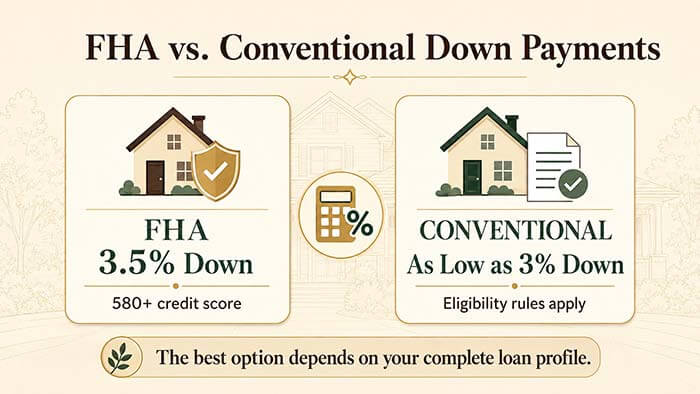 FHA loans have a maximum loan-to-value ratio of 96.5 percent for qualified borrowers with a minimum credit score of 580. They require a 3.5 percent down payment. Conventional loans also offer low-down-payment options.
Fannie Mae supports a loan-to-value ratio of 97 percent, which equates to a 3 percent down payment. Most standard 97 percent Fannie Mae purchase-money loans require at least one borrower to be a first-time buyer.
However, the HomeReady program has different criteria and does not require the buyer to be a first-time homebuyer. Consequently, FHA does not always offer the lowest down payment option. The right program depends on the borrower, property, income, credit profile, and automated underwriting results.
2026 FHA and Conventional Loan Limits
Loan limits are another major distinction between FHA and conventional loans.
- In 2026, the single-family, conventional, conforming loan limit in most of the country is $832,750.
- The single-family, conforming, ceiling loan limit in higher-priced markets is $1,249,125.
- The FHA loan limits are county-specific.
- In 2026, the FHA single-family loan limit floor for lower-priced markets is $541,287, and the standard high-cost ceiling is $1,249,125.
- There may be special exception areas with different limits.
These figures apply to 2026. Verify updates annually, as loan limits may change.
When FHA Mortgage Rates May Make More Sense
FHA loans can help borrowers with bad credit, poor down payment savings, and a history of credit issues. Automated underwriting plays a key role in credit evaluation. It is essential to consider your overall financial situation and compare the total cost of the loan. MIP, or mortgage insurance premiums, are often higher than PMI for conventional loans, which can make FHA loans attractive in some cases. Sometimes, FHA loans allow for more concessions.
When Conventional Mortgage Rates May Make More Sense
Conventional loans can be more favorable as the borrower’s credit improves. A down payment of over 20% eliminates PMI. Even with less than 20% down, PMI is likely to be low with good credit and can be removed after a certain period. Conventional loans offer more options, while FHA and similar products are primarily for first-time homebuyers.
Using Conventional and FHA Loan Programs with a 620 to 680 Credit Score
This is the credit score range for a borrower for whom the two programs would be approximately the same. Borrowers in this range may receive conventional automated underwriting approval, but the conventional rate could be higher, resulting in a less competitive payment. In that situation, FHA pricing could be lower, making FHA the better loan option. Other factors to consider include down payment, DTI, property type, reserves, mortgage insurance, occupancy, and lender pricing.
Using Conventional Loans with Good Credit
For borrowers with good credit and a strong down payment or equity, conventional loan pricing can be better than FHA pricing. However, a good credit score does not always guarantee that a conventional loan will be less expensive.
FHA versus Conventional Loans
The same FHA versus conventional mortgage loan decision applies when refinancing. If the FHA mortgage insurance is removed in favor of conventional financing, refinancing is not always better. Homeowners should review the new interest rate, closing costs, remaining loan term, new payment, equity, and expected length of homeownership.
FHA Streamline Refinance
FHA Streamline Refinancing is available for current FHA borrowers. Each program has its own characteristics, and the best refinance is determined by the borrower’s current mortgage and the proposed loan.
Example of FHA versus Conventional Mortgage Rates
Consider a Borrower Who Qualifies for Both Programs:
- Let’s assume the FHA quote has a lower interest rate than the conventional quote.
- If you focus only on the interest rate, the FHA loan may appear better.
- However, FHA mortgage insurance is financed with the loan amount.
- Conventional loans may have a higher interest rate but lower PMI, and cash required at closing; the conventional loan would result in a lower monthly payment.
- Now, assume the credit profile has been impacted.
- If the impact on conventional loan pricing is significant, the conventional loan could have a higher payment than the FHA loan, even with FHA mortgage insurance.
- No single loan option is universally optimal.
This example is for illustration only. Actual mortgage pricing and credit eligibility depend on borrower, lender, property, and market factors.
Correct Way to Compare FHA and Conventional Mortgage Pricing
Ask your loan officer to give you quotes for both FHA and conventional loans using the same details. Ensure the same purchase price, closing date, occupancy, and down payment are used. Finally, see if the quotes include the same credits. Confirm that the quotes include the same credits and points. rest payment, mortgage insurance payment, total estimated payment, loan costs, lender credits, and cash to close.
The CFPB strongly advises borrowers not to focus solely on the interest rate. Instead, they recommend comparing at least some of these elements listed across multiple Loan Estimates.
Also consider how long you plan to own the home when evaluating mortgage options. A mortgage that appears less expensive in the first two years could cost more over seven or ten years. No single mortgage program is best for all borrowers. FHA can be especially beneficial when credit, down payment, or underwriting issues make conventional financing more costly or unavailable.
Mortgage Rates on Conventional Loans
Conventional financing is often attractive to borrowers with good credit and significant equity who can avoid or secure low-cost private mortgage insurance.
All of the Following Factors Should Be Compared:
- rate + points + mortgage insurance + closing costs + monthly payment + long-term cost
- This comprehensive approach is more effective than comparing only posted mortgage rates.
- When choosing between FHA and conventional mortgages, a lower advertised interest rate does not always indicate the best option.
- FHA may offer a lower interest rate, but it often includes higher upfront and monthly mortgage insurance premiums.
- Conventional loans may have higher rates, but their mortgage insurance can decrease over time.
Credit scores were assessed differently, but starting in 2026, scores of 620 or higher will no longer qualify as the universal minimum for all conventional loans processed through automated underwriting. Fannie Mae’s DU and Freddie Mac’s Loan Product Advisor assess qualifying automated underwriting files without a universal minimum score. However, lender criteria and other program requirements will still be in effect.
Comparing FHA versus Conventional Mortgage Rates
The best approach is to compare both programs using the same financing details. Borrowers can contact Gustan Cho Associates to review both options and determine which aligns best with their financial goals. While conventional mortgage rates are often higher than FHA rates, FHA loans may be more competitive for borrowers with adverse credit. However, FHA mortgage insurance can offset the benefit of lower FHA rates. Always compare total closing and financing costs, not just the interest rate.
Why are FHA Rates Lower Than Conventional Rates?
FHA loans are government-backed, so lenders assume less risk. Conventional loans have varying risk layers and pricing adjustments, such as Fannie Mae LLPAs, so the actual rate depends on the borrower, property, lender, and market.
Mortgage Loans for Borrowers with Bad Credit?
Generally, FHA pricing is more favorable for borrowers with lower credit scores. However, comparisons must include FHA Mortgage Insurance Premium (MIP) fees. All costs should be evaluated to determine the best option.
Will I Qualify for a Mortgage in 2026 with a Credit Score of 620 or Lower?
Maybe. Fannie Mae has said that its DU case files no longer require a minimum credit score, and Freddie Mac has also issued a directive stating that no minimum Indicator Score is required for relevant mortgage loans that receive an Accept recommendation through the Loan Product Advisor. That said, approval is in no way guaranteed. Individual lenders set minimum credit score requirements and other requirements.
FHA or Conventional Mortgage? Let’s Help You Choose the Right Loan for Your Home Purchase!
Contact us today to discuss your options and find the best loan for your needs and financial situation.Which Loan Program Has Lower Rates: FHA or Conventional Loans
When comparing FHA versus conventional mortgage rates, it’s essential to note that FHA loans often have slightly lower interest rates, making them an attractive option for eligible borrowers. FHA loans include extra expenses such as an initial mortgage insurance premium (UFMIP) and a yearly mortgage insurance premium (MIP) paid monthly.
Compare FHA versus conventional mortgage rates in 2026, including credit pricing, MIP, PMI, down payments, loan limits, and total costs.
Despite these additional costs, the overall rate for home loan can still be favorable, especially for those who might not qualify for competitive rates on conventional loans. FHA loans also allow higher debt-to-income ratios and are available for primary residences only, making them a flexible and accessible choice for many homebuyers.
Comparison of FHA versus Conventional Mortgage Rates
Borrowers under 700 credit scores will benefit from FHA versus conventional mortgage rates. As mentioned earlier, Conventional mortgage rates are more sensitive to credit scores. In general, FHA mortgage rates are about 0.25% to 0.50% lower than conventional rates due to the government guarantee by HUD.
One of the disadvantages of FHA loans is FHA mortgage insurance premium is mandatory on all 30-year fixed-rate FHA loans. This holds true no matter how much the loan to value is. You cannot opt out of the annual FHA MIP on FHA loans. No matter how low the loan to value, FHA MIP is required for the term of the 30-year fixed-rate mortgage.
You cannot cancel the FHA MIP. Conventional Loans require no private mortgage insurance if the borrower has 20% equity. Borrowers who do not have a 20% down payment when purchasing a home with a conventional loan can cancel the private mortgage insurance once they have an 80% LTV. This can be done sooner than later in an appreciating housing market.
Which is Better for You?
Decide between FHA and conventional loans based on your numbers. If your credit is below 620, your down payment is stuck at 3.5%, or your DTI is over 45%, FHA often works best to let you buy or refinance easily. If your credit is 740 or higher, you have 20% equity, and your goal is the long haul, conventional loans cut costs by avoiding high, never-ending insurance. FHA also requires a 0.55% annual mortgage insurance premium for the life of a 30 year fixed-rate FHA loan. John Strange, a senior mortgage loan originator at Gustan Cho Associates says the following about FHA versus conventional loans.
Conventional loans require private mortgage insurance (PMI) for the loan-to-value higher than 80%. The higher the loan to value, the higher the pricing adjustments which means higher mortgage rates.
Run the full cost: FHA can be cheaper up front, but MIP adds up over time; conventional loans have steady, lower ongoing fees. Talk to lenders for price quotes made for you, taking 2025 rates and limits into account, so you can align the right plan for your next buy or refinance move.
FHA versus Conforming Mortgage Rates and Pricing Adjustments
There are pricing adjustments on all loan programs. Every loan program has its own pricing adjustments. Prior bankruptcies and/or housing events do not have an effect on mortgage rates. Credit scores and the type of properties do. Lower credit scores mean higher mortgage rates. Loan-Level Price Adjustments are different for the various loan programs. It is up to the lender to create its pricing adjustment matrix.
FHA versus Conventional Loans on LLPA
Loan-level pricing adjustment is different on FHA versus conventional loans. There are no pricing adjustments on FHA loans since they are guaranteed by the government. There are LLPAs on conventional loans since conforming loans are not insured and/or partially guaranteed by the government. FHA loans require a one time upfront 1.75% FHA mortgage insurance premium. Private mortgage insurance on conventional loans can be canceled if the homeowner has at least an 80% loan to value. If the loan to value falls down to 78% LTV, the lender needs to automatically cancel the private mortgage insurance. Homeowners with at least an 80% LTV can request the lender to cancel their private mortgage insurance.
FAQs: FHA versus Conventional Mortgage Rates
Can FHA Mortgage Insurance Be Removed Without Refinancing?
Generally, for FHA loans with terms longer than 15 years and an original loan-to-value (LTV) ratio of 90 percent or lower, annual mortgage insurance premiums (MIP) will be removed after 11 years. For FHA loans with an original LTV ratio greater than 90 percent, annual MIP will remain in place for the duration of the loan.
Can Conventional PMI Be Removed?
Conventional mortgages with qualifying terms allow PMI to be removed when the loan balance is reduced to 80 percent of the original home value. At that point, automatic PMI termination usually occurs, provided the mortgage is current.
Is a Conventional Loan Better Than an FHA Loan with a 20 Percent Down Payment?
With a 20 percent down payment, conventional financing is likely more economical. However, borrowers should compare loan rates, closing costs, and fees for both loan types to determine the best option.
When Choosing Between FHA and Conventional Loans, Should I Consider APR or the Interest Rate?
Consider both. The interest rate is what a lender charges for the use of borrowed principal, while pricing reflects the total cost of the loan. Evaluate mortgage insurance, closing costs, cash to close, and the estimated total monthly payment on the Loan Estimate version. It should perform better
What are FHA versus Conventional Mortgage Rates?
When you compare FHA and conventional mortgage rates, it’s important to consider the interest rates for FHA loans, which receive support from the Federal Housing Administration, and conventional loans, which lack government backing. Typically, FHA loans have slightly decreased interest rates because of the government’s assurance, which makes them an appealing choice for borrowers with lower credit scores.
Why Do FHA Loans Typically Have Lower Interest Rates?
FHA loans usually have lower interest rates because they are insured by the Federal Housing Administration, which reduces the risk for lenders. This government guarantee allows lenders to offer more favorable rates for home loans to eligible borrowers, even those with less-than-perfect credit scores.
How Does a Borrower’s Credit Score Affect FHA versus Conventional Mortgage Rates?
Credit scores play a significant role in determining mortgage rates. Conventional loans are more sensitive to credit scores, meaning that borrowers with lower scores will see higher interest rates and possibly additional costs such as discount points. Conversely, FHA loans have more lenient credit score requirements and tend to offer lower rates for home loans to borrowers with scores as low as 580 for a 3.5% down payment, or even 500 with a 10% down payment.
What Are the Key Differences Between FHA and Conventional Loans in Mortgage Insurance?
FHA loans need both an initial mortgage insurance premium (UFMIP) and a yearly mortgage insurance premium (MIP) that is paid every month throughout the loan period, regardless of the loan-to-value (LTV) ratio. Conventional loans, however, demand private mortgage insurance (PMI) from borrowers with less than 20% equity. Nevertheless, they permit the cancellation of PMI once the borrower achieves 20% equity in their home.
Can You Cancel Mortgage Insurance on FHA Loans?
You cannot cancel the mortgage insurance premium (MIP) on FHA loans with a 30-year term, regardless of the loan-to-value (LTV) ratio. On conventional loans, you can cancel the private mortgage insurance (PMI) once you reach an 80% LTV, which can save money over time.
How Do Debt-to-Income Ratio Requirements Compare Between FHA and Conventional Loans?
FHA loans generally have higher debt-to-income ratio limits compared to conventional loans. Borrowers can have a back-end debt-to-income ratio of up to 56.9% for FHA loans. Conventional loans typically cap the ratio at 50% to receive an approved/eligible recommendation from the automated underwriting system (AUS).
Why Are FHA Loans Popular Among Homebuyers?
FHA loans are well-liked as they provide more relaxed qualification criteria than conventional loans, including reduced credit score prerequisites and greater debt-to-income ratio thresholds. Moreover, the government guarantee, which leads to lower interest rates, makes FHA loans appealing for numerous borrowers. More than 40% of homebuyers in the United States utilize FHA loans to fund their homes.
If you have any questions about FHA Versus Conventional Mortgage Rates or borrowers who need to qualify for FHA loans with a lender with no overlays on government or conforming loans, please contact us at 800-900-8569. Text us for a faster response. Or email us at gcho@gustancho.com. The team at Gustan Cho Associates is available 7 days a week, on evenings, weekends, and holidays. This Guide About FHA versus Conventional Mortgage Rates Was Updated on August 12, 2026.