Can you get a VA loan pre-approval before finding a home if your file needs manual underwriting? Yes, in some cases, eligible veterans, active-duty service members, and surviving spouses can get a VA TBD manual underwriting pre-approval before they have a property address.
A VA TBD manual underwriting pre-approval allows the lender and underwriter to review the borrower’s credit, income, assets, debt-to-income ratio, residual income, and overall mortgage file before the borrower goes under contract on a home. “TBD” means the property address is to be determined. This can help borrowers find out whether they may qualify before spending time shopping for homes.
This process can be especially helpful for VA borrowers with lower credit scores, recent late payments, prior bankruptcy, Chapter 13 bankruptcy, foreclosure, short sale, higher debt-to-income ratios, or other credit issues that may require a manual underwriting review.
The goal of VA TBD manual underwriting is simple: give the borrower a stronger, more reliable pre-approval before they make an offer on a home. Instead of guessing whether the loan can be approved, the file is reviewed by an underwriter upfront.
For veterans who were denied by another lender or told they do not qualify because of a credit score overlay, a VA TBD manual underwriting pre-approval may provide another path forward. VA loans do not have a VA-required minimum credit score, but lenders may still have their own credit score requirements. That is why working with a lender experienced in VA manual underwriting can make a major difference.
Who May Need VA TBD Manual Underwriting?

Some VA borrowers need manual underwriting when their loan file cannot get a clean automated approval. This often happens when the borrower has credit, income, debt, or bankruptcy issues that need a human underwriter to review the full file.
VA TBD manual underwriting may help borrowers who:
- Have had recent late payments
- Had a bankruptcy, foreclosure, short sale, or deed-in-lieu
- Are currently in Chapter 13 bankruptcy or recently discharged
- Have a limited credit history or nontraditional credit
- Have a higher debt-to-income ratio but strong residual income
- Were denied by another lender because of overlays
- Need an underwriter to review the file before finding a home
“TBD” means the property address is still to be determined. The borrower’s credit, income, assets, residual income, and overall qualifications can be reviewed before they go under contract.
The main benefit is simple: borrowers can get a stronger pre-approval before house shopping instead of guessing whether the loan will work.
What Is Required For VA Manual Underwriting?
VA manual underwriting reviews the borrower’s full mortgage file rather than relying solely on an automated approval. The underwriter reviews credit history, income, assets, debt-to-income ratio, residual income, and the reason the file needs manual review.
VA Manual Underwriting Credit Guidelines
The VA does not set a minimum credit score for VA loans. But keep in mind that lenders might set their own minimum credit score requirements. Some lenders allow VA manual underwriting with lower credit scores, while others require higher scores due to lender overlays.
The underwriter will focus heavily on the borrower’s recent payment history. Late payments, recent collections, bankruptcy, foreclosure, or other credit issues may need a written explanation and supporting documents.
VA Manual Underwriting Debt-To-Income Ratio Guidelines
The debt-to-income ratio, also called DTI, is important in VA manual underwriting, but VA loans are not approved based on DTI alone. VA loans also look closely at residual income, credit history, employment stability, assets, and the borrower’s overall ability to repay.
A 41% DTI is an important VA benchmark. However, it is not always a hard maximum. Borrowers with a DTI above 41% may still be considered if the file has strong residual income and acceptable compensating factors.
If the borrower’s DTI is over 41%, the underwriter will review the file more carefully. The borrower may need strong residual income, clean recent payment history, stable income, cash reserves, or other strengths that support approval.
In many cases, borrowers with DTI above 41% need residual income that exceeds VA’s minimum residual income requirement by at least 20%. This helps show the borrower has enough money left over after paying the mortgage and other monthly obligations.
Higher DTI does not guarantee approval. The full file must still make sense. The underwriter must determine that the borrower is a satisfactory credit risk and can afford the new VA mortgage payment.
VA Residual Income Requirements
Residual income is one of the most important parts of the VA manual underwriting. It measures how much money the borrower has left each month after paying major monthly debts, including the new mortgage payment.
VA residual income requirements depend on family size, loan amount, and location. A borrower with strong residual income may have a better chance of approval, even with a higher debt-to-income ratio.
Compensating Factors For VA Manual Underwriting
Compensating factors are strengths that can help offset risk in the file. Common compensating factors include:
- Strong residual income
- Clean recent payment history
- Stable long-term employment
- Cash reserves after closing
- Low increase in housing payment
- Additional income not used to qualify
- A larger down payment, if the borrower chooses to make one
Compensating factors do not guarantee approval, but they can help the underwriter feel more confident about the borrower’s ability to repay the loan.
Documents Needed For VA TBD Manual Underwriting Pre-Approval
A VA TBD manual underwriting pre-approval is stronger when the borrower submits a complete file upfront. The underwriter needs enough documentation to review credit, income, assets, VA eligibility, residual income, and overall ability to repay.
Borrowers are usually asked to provide the following documents:
Recent Pay Stubs
Pay stubs help verify current income, year-to-date earnings, deductions, and employment status. Most lenders ask for the most recent 30 days of pay stubs.
Last Two Years Of W-2s
W-2s help confirm employment history and income stability. They are especially important when the borrower has overtime, bonus, or commission income, or has job changes.
Bank Statements
Bank statements are used to verify available funds for closing costs, prepaid items, escrow setup, and reserves. Most lenders ask for the most recent 60 days of bank statements.
Certificate Of Eligibility
The Certificate of Eligibility, also called the COE, confirms that the borrower meets VA service eligibility requirements. Some lenders may be able to help retrieve the COE if the borrower has the required military service information.
Driver’s License Or Government ID
A government-issued ID is required to verify the borrower’s identity and complete the mortgage application.
Tax Returns, If Required
Tax returns are not always required for every W-2 borrower. They may be needed if the borrower is self-employed, owns rental property, receives business income, or has income that requires a deeper review.
Explanation Letters
Explanation letters may be needed for late payments, collections, bankruptcy, foreclosure, employment gaps, large deposits, or other issues in the file. The letter should clearly explain what happened, why it happened, and why the issue is unlikely to happen again.
Submitting complete documents upfront can help avoid delays and give the underwriter a clearer picture of the borrower’s ability to qualify for a VA TBD manual underwriting pre-approval.
How The VA TBD Manual Underwriting Process Works
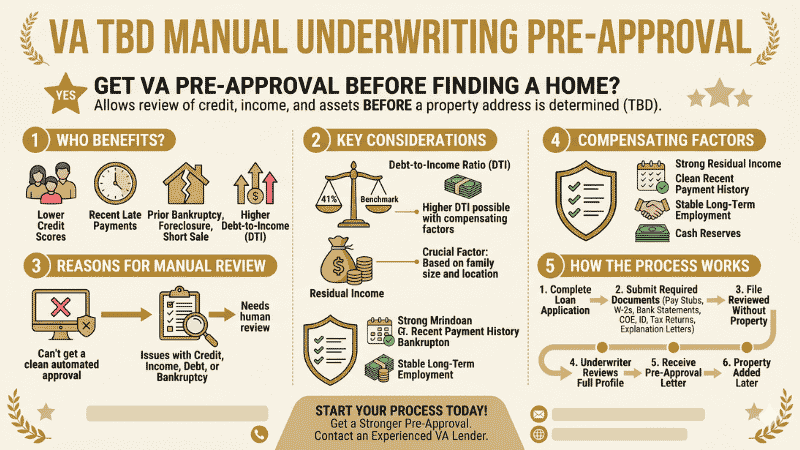
The VA TBD manual underwriting process allows a borrower to be reviewed before choosing a property. “TBD” means the property address is to be determined.
Here is how the process usually works:
Step 1: Complete The Loan Application
The borrower completes a VA loan application so the lender can review income, credit, debts, assets, and VA eligibility.
Step 2: Submit The Required Documents
The lender collects the borrower’s pay stubs, W-2s, bank statements, Certificate of Eligibility, identification, and any required explanation letters.
Step 3: The File Is Reviewed Without A Property Address
The file is sent to underwriting before the borrower has a signed purchase contract. The underwriter reviews the borrower’s qualifications without a property address.
Step 4: The Underwriter Reviews The Full Borrower Profile
The underwriter looks at credit history, payment history, income stability, employment, assets, debt-to-income ratio, residual income, and any past credit issues.
Step 5: The Borrower Receives A Credit And Income Pre-Approval
If the file is acceptable, the borrower may receive a VA TBD manual underwriting pre-approval. This approval is still subject to finding an eligible property, a VA appraisal, a title review, final conditions, and full VA loan guidelines.
Step 6: The Property Is Added Later
Once the borrower finds a home, the lender completes the property side of the loan. This includes the purchase contract, VA appraisal, title work, homeowners’ insurance, and any final underwriting conditions.
The biggest benefit is confidence. Instead of house shopping with a weak pre-qualification, the borrower has a stronger pre-approval based on an upfront underwriting review.
VA Manual Underwriting Payment History Requirements
Payment history is one of the most important parts of VA manual underwriting. The underwriter wants to see that the borrower has the ability and willingness to make the new mortgage payment on time.
Recent late payments, recent non-medical collections, or a pattern of missed payments can make VA manual underwriting more difficult. These issues do not always mean the borrower will be denied, but they usually require a stronger explanation and more documentation.
The underwriter may request a written explanation if the borrower has had late payments, collections, bankruptcy, foreclosure, or other major credit issues. The explanation should be clear, honest, and, when possible, supported by documents.
For example, a late payment caused by a temporary medical issue, job interruption, divorce, or another documented hardship may be viewed differently from repeated missed payments with no clear reason.
A strong recent payment history can help the file. Borrowers who have paid rent, mortgage payments, car loans, credit cards, and other debts on time for the most recent 12 months may have a stronger chance of VA manual underwriting approval.
The goal is to show the underwriter that any past credit problems were temporary and that the borrower is now financially stable enough to handle the new VA mortgage payment.
VA TBD Manual Underwriting: A Flexible Option for Pre-Approvals!
Reach out now to learn more about VA TBD manual underwriting and get started on your pre-approval.
How Long Does VA TBD Manual Underwriting Take?
VA TBD manual underwriting often takes one to three weeks, depending on how complex the file is and how quickly the borrower provides documents.
Files with recent late payments, Chapter 13 bankruptcy, prior foreclosure, variable income, higher debt-to-income ratios, or missing paperwork may take longer because the underwriter may request additional conditions.
The fastest way to avoid delays is to submit a complete file upfront. This usually includes pay stubs, W-2s, bank statements, a Certificate of Eligibility, identification, and explanation letters for any credit issues, late payments, bankruptcy, or employment gaps.
A clean, complete file is easier for the underwriter to review. It can help the borrower secure a stronger VA TBD manual underwriting pre-approval before shopping for a home.
Assets And Reserves For VA Manual Underwriting
VA loans do not require a down payment for eligible borrowers. However, that does not always mean the borrower needs no money at closing.
Borrowers may still need funds for closing costs, prepaid taxes, homeowners’ insurance, escrow setup, inspections, and other settlement costs. In some cases, the seller can help pay part of the borrower’s closing costs. However, the borrower should still be prepared to show available funds.
Reserves can also help strengthen a VA manual underwriting file. Reserves are the funds left over after closing. In many VA manual underwriting cases, having at least one month of the proposed mortgage payment left in the bank after closing can strengthen the file.
More reserves may improve the overall risk profile, especially if the borrower has a higher debt-to-income ratio, recent credit issues, variable income, or other risk factors.
The underwriter wants to see that the borrower is not using every dollar just to close. Having money left over after closing can help show the borrower is better prepared for the new VA mortgage payment.
What is the Maximum DTI for VA Manual Underwriting?
The maximum Debt-to-Income (DTI) ratio for VA manual underwriting in 2024 is generally capped at 41%. However, exceptions can be made if the borrower has strong compensating factors that mitigate the risk associated with a higher DTI. These compensating factors include significant cash reserves, a large down payment, a long, stable employment history, or additional income not used to qualify for the loan. Meeting the residual income requirements, which ensure that the borrower has enough income left over after paying all monthly obligations, is also crucial in the manual underwriting process.
VA Manual Underwriting With Chapter 13 Bankruptcy
Veterans and eligible VA borrowers may qualify for a VA loan while they are still in Chapter 13 bankruptcy. They may also qualify after a Chapter 13 bankruptcy is discharged.
This is one reason VA TBD manual underwriting can be helpful. The borrower can have the file reviewed by an underwriter before finding a home and before making an offer.
Can I Get A VA Loan While In Chapter 13 Bankruptcy?
Yes, it may be possible to get a VA loan while still in an active Chapter 13 bankruptcy repayment plan. The borrower usually needs at least 12 months of on-time Chapter 13 trustee payments and written approval from the bankruptcy trustee or court to take on a new mortgage payment.
The file will usually need to be manually underwritten. The underwriter will review the borrower’s Chapter 13 payment history, credit after filing bankruptcy, income stability, debt-to-income ratio, residual income, and ability to afford the new VA mortgage payment.
Do I Need Trustee Approval For A VA Loan During Chapter 13?
Yes. If the borrower is still in an active Chapter 13 bankruptcy, trustee or court approval is usually required before the borrower can close on a new VA mortgage. The trustee needs to confirm that the new mortgage payment fits within the borrower’s repayment plan and budget.
A VA TBD manual underwriting pre-approval may help, as the borrower can show the trustee that an underwriter has already reviewed the credit and income portions of the file.
What If My Chapter 13 Bankruptcy Was Recently Discharged?
A recently discharged Chapter 13 bankruptcy does not always require a long waiting period for a VA loan. Some VA borrowers may be eligible after a Chapter 13 discharge. However, the file may still need manual underwriting depending on the lender, credit history, and automated underwriting findings.
The underwriter will look closely at the borrower’s payment history during the Chapter 13 plan and after discharge. Clean payments, stable income, acceptable residual income, and documented recovery after bankruptcy can strengthen the file.
Does VA Require A Two-Year Waiting Period After Chapter 13 Discharge?
VA guidelines are generally more flexible with Chapter 13 bankruptcy than many borrowers realize. A two-year waiting period after getting your Chapter 13 discharge is usually more of a lender’s rule than something that’s strictly required by the VA.
Some lenders may still require additional seasoning after a Chapter 13 discharge due to their internal rules. That is why one lender may deny the file. At the same time, another may be able to review it under VA manual underwriting.
The key is not just the discharge date. The underwriter will review the full file, including payment history, trustee payment record, income, residual income, assets, and whether the borrower can afford the new VA loan. Current VA- and lender-related guidance commonly require 12 months of satisfactory Chapter 13 plan payments and trustee/court approval for active Chapter 13 cases.
Why VA TBD Manual Underwriting Helps Chapter 13, Borrowers
VA TBD manual underwriting can give Chapter 13 borrowers a clearer answer before they shop for a home. Instead of waiting until after a purchase contract is signed, the borrower’s credit, income, assets, debt-to-income ratio, residual income, bankruptcy history, and explanation letters can be reviewed upfront.
This can help avoid surprises later in the mortgage process and give the borrower a better idea of what needs to be documented before moving forward.
Need a VA Pre-Approval with Manual Underwriting? We Can Help You Qualify!
Reach out today to find out if manual underwriting is the right solution for your VA loan.
How To Start The VA TBD Manual Underwriting Mortgage Process
This process is designed to be as easy on you as possible. You will simply gather some basic documentation and complete an online application. From there we will submit all documentation to our underwriting department for credit in asset pre-approval. Below are the documents you will need:
- Last 60 Days Bank Statements – to source money for escrows/ reserves.
- Last 30 Days Pay Stubs.
- Last Two Years W2’S.
- Last Two Years Tax Returns – not always needed.
- Driver’s License.
- Certificate of Eligibility.
If you need help obtaining your Certificate of Eligibility (COE), please give us a call today. We may be able to access it for you if you have your DD-214. During the underwriting process, you may need to provide additional documentation. Once you have provided the required information, you will receive a pre-approval letter to go house shopping. Simple as that!
Gustan Cho Associates have been doing this for a long time. We specialize in lower credit score, higher debt to income ratio, and complicated mortgage scenarios. That is the reason we created our TBD underwriting process! If for any reason you do not qualify today, we will put you on a custom financial plan to qualify as soon as possible.
As a veteran, you have the ability to qualify for a home faster than most Americans. We appreciate your service and all you have done for our country, we are available for questions seven days a week. Don’t hesitate to reach out today.
Final Thoughts On VA TBD Manual Underwriting Pre-Approvals
The VA TBD manual underwriting process provides veterans, active-duty service members, and surviving spouses with a clearer understanding of their home-buying options before they begin searching for a property. Instead of waiting until a property is under contract, the borrower’s credit, income, assets, residual income, debt-to-income ratio, and overall file can be reviewed upfront.
This process can be especially helpful for VA borrowers with lower credit scores, recent late payments, Chapter 13 bankruptcy, prior foreclosure, higher debt-to-income ratios, or files that do not receive a clean automated approval.
A strong VA manual underwriting file usually has clean recent payment history, stable income, acceptable residual income, complete documentation, and clear explanation letters for any past credit issues. The more complete the file is upfront, the easier it is for the underwriter to review.
If another lender turned you down or said you don’t meet their requirements, VA TBD manual underwriting could be a great option to help you get into a home. Gustan Cho Associates can review your file and help you understand the next steps before you begin house shopping.
FAQs About VA TBD Manual Underwriting
What Does TBD Mean In The VA Manual Underwriting?
- TBD means to be determined. In a VA TBD manual underwriting pre-approval, the borrower’s credit, income, assets, debt-to-income ratio, residual income, and VA eligibility are reviewed before a property address is selected. The property, appraisal, title, and final conditions are completed later, after the borrower finds a home.
Can A VA Loan Be Manually Underwritten?
- Yes. A VA loan can be manually underwritten when the file does not receive a clean automated approval or when the borrower has credit, income, bankruptcy, or debt issues that need a human underwriter to review the full file. VA manual underwriting allows the underwriter to assess the borrower’s overall ability to repay, rather than relying solely on automated findings.
What Credit Score Is Needed For VA Manual Underwriting?
- The VA does not set a minimum credit score for VA loans. However, lenders may set their own minimum credit score requirements, known as lender overlays. Some borrowers may be denied by one lender due to a credit score overlay, but may still be eligible with a lender that allows VA manual underwriting.
Can I Get VA Manual Underwriting With A high Debt-To-Income Ratio?
- Yes, it may be possible, but approval is not based solely on DTI. A 41% debt-to-income ratio is an important VA benchmark. However, borrowers with a debt-to-income ratio above 41% may still be considered if they have strong residual income, a clean recent payment history, stable income, reserves, and other compensating factors. VA underwriting places major weight on residual income.
Can I Get A VA Loan While In Chapter 13 Bankruptcy?
- Yes, it may be possible to qualify for a VA loan while still in Chapter 13 bankruptcy. The borrower usually needs at least 12 months of on-time Chapter 13 trustee payments and trustee or court approval to take on a new mortgage payment. The file will typically need manual underwriting.
How Long Does VA TBD Manual Underwriting Take?
- VA TBD manual underwriting often takes one to three weeks, depending on the borrower’s credit history, income type, bankruptcy history, documentation, and how quickly conditions are submitted. Files with recent late payments, Chapter 13 bankruptcy, higher DTI, or missing documents may take longer to process. A complete file upfront can help avoid delays.
This article about “VA TBD Manual Underwriting After Loan Denial” was updated on May 11th, 2026.
VA Loan Pre-Approval with Manual Underwriting? We’ve Got the Guidelines You Need!
Contact us today to get pre-approved for your VA loan with the flexibility of manual underwriting.