Quick Answer: You can qualify for FHA loans after unemployment if you have acceptable, documented income. A gap shorter than six months does not trigger FHA’s extended-absence rule, and FHA does not impose a universal 30-day wait after you start a new job. For a gap of six months or more, the lender may use your current income if you have been employed in your current line of work for at least six months when the FHA case number is assigned and can document a two-year work history before the gap. The lender must still review your income and the rest of your loan application.
How Does FHA Treat an Employment Gap?
The length of your gap determines whether FHA’s extended-absence rule applies. Being laid off or leaving a job does not, by itself, prevent you from getting an FHA loan. The lender must document income that meets FHA requirements and is reasonably expected to continue.
A Gap Shorter Than Six Months
FHA’s extended-absence rule does not apply to a gap of less than six months. There is also no FHA rule that every borrower must spend 30 days in a new job before qualifying. The lender will verify your current employment and determine whether your pay qualifies as income. How soon that can happen depends in part on your pay type and the documents available to verify it.
A Gap of Six Months or More
HUD treats a gap of six months or more as an extended absence. The lender may consider your current income if it verifies that you have been employed in your current line of work for at least six months at the time of FHA case number assignment and had a two-year work history before the absence. That earlier work history can be documented through standard or alternative employment verification; it does not have to be two years with one employer. An FHA case number identifies a specific loan. You can ask for a review before you have been back at work for six months.
Does Changing Employers Reset the Six-Month Period?
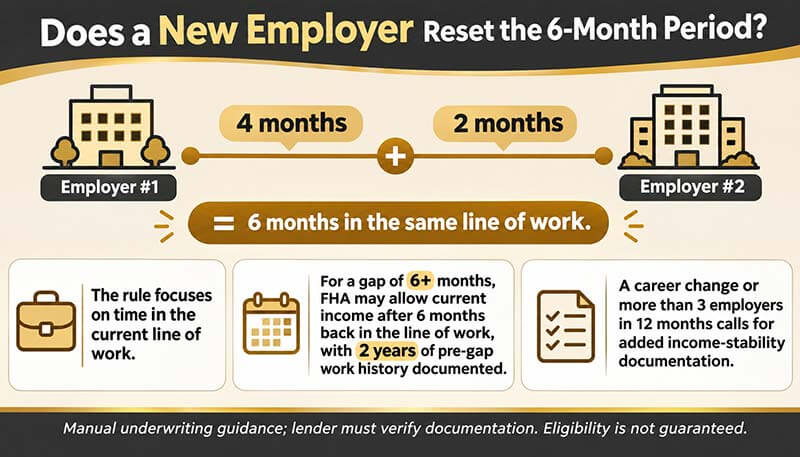
Not necessarily. HUD’s extended-absence rule refers to time employed in the current line of work, rather than six months with one company. For example, four months with one accounting firm followed by two months with another may satisfy the time in the current line of work, if the lender verifies both jobs and the other FHA requirements. This is an illustration, not an approval guarantee. A new career requires closer review. If you changed lines of work, or changed employers more than three times in the previous 12 months, FHA calls for additional documentation of income stability. Training or education that qualifies you for the new position, or employment records showing increases in income or benefits, may help. FHA recognizes that working for multiple employers is normal in some fields, including certain temporary and union jobs.
What If the New Job Pays Differently?
Getting back to work doesn’t mean that every single dollar on your new pay stub can be used to qualify. The lender will have to look at the type of income, its history, and whether it is likely to continue. New salary, variable hours, overtime, commissions, and part-time earnings may all require different calculations and documentation. For example, a borrower returning after a 5-month layoff to a salaried position is not subject to the FHA extended absence test. The lender still has to verify the job and determine whether the salary is acceptable. The length of the absence alone doesn’t resolve the income issue.
What Documents Should You Gather?
Start with a clear timeline showing when each job began and ended, and when you were unemployed. Depending on your situation, the lender may request recent pay stubs, W-2s, verification of current and previous employment, and an explanation of the gap. If you returned after an extended absence, records establishing the two-year work history before the gap are especially important. A career change may also call for training or education records. The exact documents depend on how you are paid and how your employment can be verified. A letter explaining unemployment can provide context, but it cannot replace the work history or qualifying income required under FHA guidelines.
What If a Lender Says You Must Wait Longer?
Ask whether the decision is driven by an FHA requirement, the inability to document qualifying income, or the lender’s own additional requirements. Some lenders will apply rules more stringent than HUD’s minimum requirements (so-called overlays). A different lender may well view the same employment history differently, but no lender can circumvent FHA’s applicable requirements. At Gustan Cho Associates, we look at the dates of the gap, your current line of work, your previous employment, and how you’re paid. That enables us to determine what can be documented at this stage and whether further time or income history is required.
FAQs About FHA Loans After Unemployment
What if I was Unemployed for Exactly Six Months?
A gap of exactly six months falls under FHA’s extended-absence rule. The lender must review your time back in the current line of work and your two-year work history before the gap before using your current employment income under that rule.
Can I Start the Mortgage Process Before I have Been Back at Work for Six Months?
Yes. You can have your employment timeline and documents reviewed earlier. If your gap was six months or longer, however, the required six months in your current line of work must be met by the time the FHA assigns a case number. An early review is not a promise of approval.
Can I Qualify if My New Job Pays Less Than My Old Job?
Possibly. A pay cut does not automatically disqualify you. The lender will determine which current income is eligible and whether it is sufficient to cover the mortgage payment and your other debts.
Can I Qualify After Returning to Work Part-Time?
Possibly. FHA has separate requirements for evaluating part-time income. The lender must determine whether your earnings meet those requirements, can be documented, and are sufficient to qualify. Merely starting a part-time job does not make all of its income usable.
Does School or Job Training Count Toward Six Months Back at Work?
No. Education or training may help explain a career change and demonstrate that you are qualified for a new position. It does not replace the six months of employment in the current line of work required after an extended absence.
Final Thoughts on FHA Loans After Unemployment
An employment gap does not automatically end your chance of getting an FHA loan. The key is to establish the length of the gap, your work history before it, how long you have been back in your current line of work, and which income the lender can use. Gustan Cho Associates can review that timeline with you before you rely on a proposed closing date.
This article about “FHA Loans After Unemployment: Employment Gap and New Job Guidelines” was updated on November 17th, 2026.