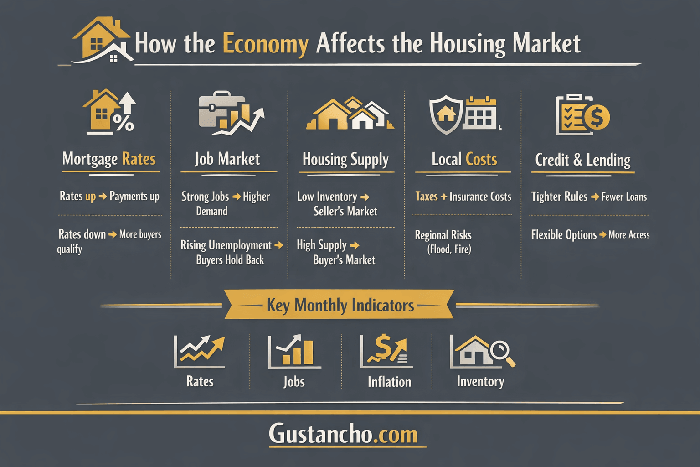
How does the economy affect the housing markets? If you’re wondering whether now is a good time to buy, sell, or invest, you don’t need complicated forecasts. You can easily track how the economy affects the housing markets through three key factors:
- Mortgage rates (the cost of borrowing)
- Jobs and wages (how confident buyers feel about their income)
- Inventory (how many homes are available vs. how many buyers are shopping)
Understanding how the economy affects the housing markets through these levers can help you make smarter decisions, regardless of the market cycle.
What’s the Biggest Driver Right Now?
For most households, mortgage rates move the market the fastest because they immediately change the monthly payment. A small rate change can mean hundreds of dollars per month, which can decide whether a buyer qualifies—or walks away.
The 3-Lever Framework
1) Mortgage Rates: The Payment Lever
Mortgage rates are shaped by inflation expectations, bond markets, and investor demand for mortgage-backed securities. When rates fall, buyers can afford more, and demand tends to rise. When rates rise, affordability drops, and activity usually slows—especially for first-time buyers.
What to do:
Ask your lender to show a simple side-by-side comparison of:
- Today’s rate vs. a temporary buydown (2-1 or 1-0)
- A permanent buydown (discount points)
- This helps you see what the payment could look like now—and what it would look like if rates improve later.
2) Jobs & Wages: The Confidence Lever
Even when rates are stable, the housing market can slow if layoffs rise or wage growth stalls. When people feel secure in their income, they shop and upgrade. When confidence drops, buyers hesitate, sellers negotiate more, and days on market increase.
What to watch: local hiring trends and wage growth—often a leading signal before housing headlines change.
3) Inventory: The Price Support Lever
Inventory is one of the simplest local indicators. When there are few homes for sale, prices can remain firm even with higher rates. When listings build, and homes sit longer, buyers gain leverage, and price reductions become more common.
Shortcut metric: “months of supply”
- Lower supply = seller-leaning market
- Higher supply = buyer-leaning market
What This Means for You (Choose Your Path)
- Buying: focus on payment strategy, not headlines—compare programs and incentives.
- Selling: price to today’s demand and offer smart credits when needed.
- Investing: underwrite conservatively and ensure the rent covers the payment.
Why the Economy and Housing Move Together
Housing moves when people feel confident about two things: income and monthly payment.
- Income confidence: When jobs are steady and wages are rising, more households feel safe taking on a mortgage and moving up. When layoffs increase, or hiring slows, buyers tend to wait—and sellers often have to be more flexible.
- Payment reality: Even if someone wants to buy, the monthly payment has to fit. That’s why mortgage rates (and taxes/insurance) can slow the market quickly.
Simple rule:
When income confidence is strong and payments are manageable, demand rises. When either one weakens, the market cools—usually first in sales activity, then in pricing.
What You’ll See in Real Life:
- Buyers pause → homes take longer to sell
- Sellers negotiate more → credits and price cuts increase
- Investors demand more yield → some deals stop penciling
This is why tracking rates, jobs, and inventory gives you a clearer signal than headlines.
Mortgage Rates: The Fastest Way the Economy Hits Your Payment
The most visible way the economy affects housing is through mortgage rates. Rates are influenced by inflation, bond yields, and investor demand for mortgage-backed securities. When rates fall, monthly payments usually drop, making more buyers eligible to qualify, which can support sales activity. When rates rise, payments increase, affordability tightens, and some buyers step back. Even a modest rate change can significantly affect what a buyer can afford. However, the exact impact depends on the loan amount, term, taxes, insurance, and overall monthly housing costs.
Smart move: Ask your lender to compare payment options with temporary buydowns (2-1, 1-0) and permanent buydowns (points). These tools turn the rate lever to your advantage and are a practical response to how the economy affects the housing market right now.
See how inflation and rates shape your payment
Model today’s pricing and forecasted scenarios so you can plan confidently
Inflation and Real Borrowing Costs
Inflation is another key channel through which the economy impacts the housing market. Higher inflation usually pushes rates up and squeezes affordability. When inflation cools, the pressure on rates often eases and buying power returns. Builders also watch inflation because higher costs for materials and labor raise new-home prices. If you’re learning how the economy affects the housing market, remember this: inflation changes both what you pay each month and what builders must charge to break even.
Jobs, Wages, and Confidence
Jobs and wages are the backbone of how the economy affects the housing markets. Buyers don’t stretch for a mortgage if layoffs look likely. When paychecks grow faster than home prices, affordability improves even if interest rates remain steady. Consumer confidence measures—how people feel about buying—often forecast next quarter’s activity. Keep an eye on employment trends to see how the economy affects the housing market before the headlines catch up.
Supply: Months of Inventory, Rate-Lock, and New Construction
Supply is one of the clearest ways to understand what’s happening in your local market. Even when rates are high, tight inventory can keep prices firm. When inventory builds, buyers gain leverage, and price cuts become more common.
Months of Inventory (Your Local “Market Tightness” Meter)
Months of inventory show how long it would take to sell all current listings at today’s sales pace.
- 2–3 months: Seller-leaning (competition is higher, prices tend to stay firmer)
- 4–6 months: More balanced (negotiations become normal)
- 7+ months: Buyer-leaning (more price reductions, more concessions)
Why it matters: Prices usually react to supply changes locally before national headlines catch up.
Existing Home Supply: The “Rate-Lock” Effect
Many homeowners have older mortgage rates that are much lower than today’s rates. That creates a rate-lock effect—owners hesitate to sell because moving could mean a much higher payment.
What You’ll See When Rate-Lock is Strong:
- fewer new listings
- more competition for “good” homes
- fewer move-up buyers entering the market
This is one reason inventory can stay tight even when demand cools.
New Construction: How Builders Add Supply (and Keep Sales Moving)
When resale inventory is limited, builders often help fill the gap. They also have tools to keep affordability workable—especially when rates are elevated.
Common builder incentives include:
- temporary rate buydowns (2-1, 1-0)
- closing cost credits
- upgrades or design credits
- price adjustments on select homes
Why it matters: Builder incentives can reduce the effective monthly payment even if the sticker price looks similar.
Permits → Starts → Completions (The New-Supply Pipeline)
New supply doesn’t show up overnight. The construction pipeline typically moves in stages:
- Permits: intent to build (early signal)
- Starts: actual construction begins (capital and labor committed)
- Completions: homes delivered to the market (real inventory added)
What slows the pipeline: financing costs, labor shortages, and materials pricing. That delay is why markets can stay short on homes even when demand shifts.
Quick Takeaway
To understand the supply in your zip code, track:
- months of inventory,
- new listings (rate-lock impact), and
- builder activity + incentives (new supply and affordability).
Credit Availability: When Approval Rules Tighten or Loosen
Mortgage rates are not the only thing that affects who can buy a home. Lending standards also matter. When the economy feels uncertain, lenders may become more cautious. That can mean:
- higher minimum credit scores
- lower debt flexibility
- more documentation requirements
- a larger amount of savings needed after closing
When the market is more stable, lenders may offer greater flexibility, allowing more borrowers to qualify.
What “Lender Overlays” Means
A lender overlay is an additional rule imposed by a lender on top of the standard loan program guidelines. For example, a loan program may technically allow a certain credit profile. However, a lender may still require a higher score, more reserves, or a lower debt-to-income ratio.
In simple terms: The loan program may say yes, but the lender may still add stricter conditions.
Why This Matters to Buyers
This is one of the less visible ways the economy affects the housing market. Even if home prices and rates stay the same, fewer people may qualify when lending rules tighten. When more buyers qualify, demand can increase.
Options for Self-Employed Borrowers and Investors
If you are self-employed, have variable income, or are buying an investment property, there may be flexible alternatives to standard mortgage approval.
- Non-QM loans are mortgage programs designed for borrowers who do not fit the traditional income-documentation model.
- DSCR loans are often used for investment properties. They focus more on whether the rental income can cover the mortgage payments than on the borrower’s personal income.
These options help in situations where a standard debt-to-income calculation does not fully capture the story.
Local Costs and Regional Changes Matter More Than National Headlines
National housing trends only tell part of the story. Real affordability is often shaped by local costs and local demand. Two markets can have similar home prices but very different monthly payments and buyer demand because of taxes, insurance, climate risk, and job growth.
Before you make a decision, review these four local factors:
1) Property Taxes
Property taxes can vary widely by county, city, and state. In some areas, taxes rise after a sale or reassessment, which can increase the home’s real monthly cost of ownership.
Why it matters: A home that looks affordable at first glance may cost much more each month once local taxes are fully factored in.
2) Homeowners Insurance
Insurance costs can change quickly based on location and risk. Coastal areas, flood zones, wildfire-prone regions, and storm-prone markets may have premiums much higher than buyers expect.
Why it matters: Higher insurance costs reduce affordability and can affect how much a buyer qualifies for.
3) Climate and Property Risk
Flood maps, wildfire exposure, storm patterns, and other environmental risks can influence both insurance pricing and long-term property costs. In some areas, climate-related concerns can also affect buyer demand over time.
Why it matters: Risk is not just about safety—it can directly affect monthly payment, resale value, and marketability.
4) Job Growth and Population Movement
Markets with strong employer growth, rising wages, or inbound migration often see stronger housing demand. Areas losing jobs or population may see slower sales, weaker pricing, or more concessions.
Why it matters: Local job and population trends often influence home values more than national headlines do.
Quick takeaway
Before buying, selling, or investing, look beyond the home price alone. Check:
- property taxes
- insurance costs
- climate-related risk
- job and population trends
These local factors often shape the real monthly payment—and the real market opportunity—more than national averages.
For Investors: How the Economy Changes Rental Deals
Investors feel economic shifts through rents, financing costs, and cash flow. When mortgage rates rise, monthly payments increase, and some deals become harder to justify. When rents are strong or financing improves, more properties can once again make sense.
What Investors Watch
- Rent levels: Higher rents can improve monthly cash flow.
- Financing costs: Higher rates can reduce returns, even if the purchase price stays the same.
- Operating costs: Insurance, taxes, repairs, and vacancies all affect the real numbers.
Why It Matters
When investor returns weaken, fewer rental buyers compete for entry-level homes. When returns improve, investors often become more active again—especially in lower-priced markets.
Flexible Financing Can Help
Some investors use DSCR loans, which focus more on whether the property’s rental income supports the payment than on the borrower’s personal income. This can help when a traditional income-based loan is not the best fit.
Buyer Playbook: What to Do in Any Market
1) Shop the Payment, Not Just the Rate.
Ask for side-by-side quotes showing: current rate, a temporary buydown (2-1 or 1-0), and a permanent buydown (points). Compare the monthly payment and cash-to-close.
2) Compare Loan Programs on One Page.
Review FHA, VA, Conventional, and any alternative options you qualify for. Small differences in mortgage insurance, down payment requirements, and credit rules can significantly affect affordability.
3) Stress-Test Your Budget.
Before you commit, confirm you’re still comfortable if:
- taxes or insurance rise, and/or
- the payment increases modestly due to rates or HOA changes.
4) Use Negotiation Tools Strategically.
When affordability is tight, seller credits can be more useful than price cuts because they can lower your monthly payment (through buydowns or closing costs).
5) Know Your Timeline and Lock Strategy.
If you’re buying new construction or have a longer closing, ask about lock options and whether extensions are available.
Seller Playbook: How to Attract Offers in Today’s Market
1) Price for Today’s Demand, Not Last Year’s Comps.
Watch local indicators like days on market, recent price reductions, and months of inventory. That tells you how sensitive buyers are right now.
2) Make the Home “Easy to Say Yes to.”
Small improvements that reduce buyer objections often outperform expensive upgrades:
- pre-inspection (or inspection-ready repairs)
- clean disclosure packet
- receipts for major repairs/updates
3) Offer Credits with a Purpose.
Instead of a broad “discount,” consider targeted concessions:
- Closing cost credit
- credit to buy down the buyer’s rate
- This can widen the buyer pool when payment is the main constraint.
4) Reduce Friction in the Process.
More certainty brings stronger offers. If possible:
- Has your title work started early
- Be ready to move quickly on repairs
- keep showing availability flexible during the first 10–14 days
5) Track Showings-to-Offers and Adjust Fast.
If showings are high but offers are low, the issue is price or terms. If showings are low, the issue is presentation or pricing. Make changes early rather than waiting weeks.
Investor Playbook: Underwrite for Resilience
1) Run Conservative Numbers First.
Model realistic expenses:
- insurance and taxes (with buffers)
- vacancy allowance
- maintenance and capital reserves
2) Validate Rent Assumptions.
Use market rent comps and consider seasonality. If the deal only works with best-case rent, treat it as higher risk.
3) Plan for Financing and Exit Flexibility.
Consider:
- fixed vs. adjustable terms
- prepayment penalties
- How long do you plan to hold
- Then match the loan structure to your hold period.
4) Add a Cushion to Your Exit Assumptions.
If you expect to sell later, model a slightly higher exit cap rate (or lower valuation multiple) so you’re not depending on perfect market timing.
5) Keep Liquidity in Mind.
The best deals survive surprises. Ensure you have adequate reserves for repairs, vacancies, and insurance changes.
Note: These playbooks translate the same economic levers—rates, jobs, and inventory—into practical steps you can use whether the market is hot, slow, or shifting.
Understand jobs data and housing demand
See how employment trends affect competition and pricing in your area
Simple Glossary
- How the economy influences the housing market: The cause-and-effect of rates, jobs, inflation, credit, and supply on prices, sales, and affordability.
- Months of supply: Active listings divided by monthly sales pace; market-tightness meter.
- DTI (debt-to-income): Monthly debts ÷ gross income; key approval limit.
- MBS spread: The extra yield that investors demand for mortgage bonds; a wider spread means higher mortgage rates relative to Treasuries.
- Non-QM / DSCR: Flexible programs for self-employed borrowers and rental properties when standard DTI falls short.
What to Watch Each Month
If you want to understand where your local housing market may be heading, track these five signals each month. Together, they give you a simple snapshot of affordability, demand, and competition.
1) Mortgage Rates
Rates affect the monthly payment faster than anything else. When rates rise, affordability tightens. When rates ease, more buyers may re-enter the market.
2) Inflation
Inflation influences borrowing costs over time and can also raise construction, repair, and household expenses. Cooling inflation may help affordability, while persistent inflation can keep pressure on payments.
3) Jobs and Wage Growth
Strong employment supports housing demand because buyers feel more secure about their income. Weak hiring or rising layoffs can slow demand before home prices fully react.
4) Inventory and New Listings
Watch months of supply, new listings, and days on market. These tell you whether buyers or sellers currently have more leverage.
5) Property Taxes and Insurance Costs
Local taxes and insurance premiums directly affect the real monthly payment. In many markets, these costs can change affordability just as much as price or rate changes.
Simple takeaway
If rates are high, jobs are weakening, and inventory is rising, the market may become more buyer-friendly. If rates stabilize, jobs stay strong, and inventory stays tight, prices may remain firmer than expected.
Final Takeaway and Next Steps
Now you can see how the economy affects the housing market through rates, jobs, inflation, credit, and supply—without the jargon. Use this framework to time your purchase, price your listing, or structure your investment so you win in any cycle.
Gustan Cho Associates can walk you through side-by-side options—FHA, VA, Conventional, USDA, Non-QM, and DSCR—with clear payment comparisons and buydown strategies. If you want a personalized plan aligned to how the economy affects the housing market today, we’re ready to help.
Borrowers who need a five-star national mortgage company licensed in 48 states with no overlays and who are experts on how the economy affects the housing market, please contact us at 800-900-8569, text us for a faster response, or email us at alex@gustancho.com.
Frequently Asked Questions About How the Economy Affects the Housing Market:
How do Interest Rates Affect the Housing Market?
When interest rates rise, mortgage payments usually go up, which can reduce the number of buyers who qualify and slow demand. When rates fall, payments drop, and more buyers can afford homes, increasing competition.
Do Higher Interest Rates Always Make Home Prices Go Down?
Not always. Higher rates can reduce demand, but prices don’t always fall quickly—especially if inventory is tight or sellers don’t have to move. The relationship is real, but it’s not guaranteed to yield a one-to-one outcome in every market.
How Does Inflation Affect Home Prices and Mortgage Rates?
Inflation can push borrowing costs higher over time, raising mortgage rates and squeezing affordability. Inflation also affects construction and labor costs, which can influence new-home pricing and supply.
What Happens to the Housing Market During a Recession?
Recessions often bring more uncertainty, which can slow buyer activity. Outcomes vary by region, but housing tends to respond through job and income confidence and credit availability—not just mortgage rates.
How Do Jobs and Unemployment Affect Housing Demand?
Housing demand usually strengthens when employment and wages are steady because buyers feel safer taking on long-term payments. When unemployment rises or job security weakens, households often delay buying or moving.
What are the Best Indicators to Watch for Where the Housing Market is Headed?
A simple monthly dashboard is: mortgage rates, inflation trend, jobs/wage growth, and local inventory (months of supply + days on market). These give a clearer signal than headlines because they tie directly to affordability and buyer behavior.
This article about “How The Economy Affects The Housing Markets: A Clear Guide” was updated on March 4th, 2026.
First-time buyer? Navigate shifting conditions
Plain-English guidance on programs, payments, and approvals right now