Buying a home in Illinois can feel out of reach when the down payment, closing costs, and moving expenses all come due at once. Illinois DPA mortgage programs can help eligible buyers reduce the cash needed to purchase a primary residence by pairing a first mortgage with down payment or closing cost assistance. The amount available, repayment terms, and qualification rules vary by program. Some assistance may be forgiven over time, while other options are repaid when you sell, refinance, or pay off the first mortgage. Before making an offer, review the program’s income limits, required buyer contribution, homebuyer education rules, and the full cost of the loan.
How Illinois Down Payment Assistance Works
Illinois DPA mortgage programs usually work alongside your main home loan. You first qualify for a mortgage, such as an FHA, VA, USDA, or conventional loan. The down payment assistance is then added to the transaction to help cover eligible down payment and closing-cost expenses.
The assistance is often set up as a second mortgage with its own terms. Some options are forgiven over time as long as you meet the program rules. Others do not require monthly payments but must be repaid when you sell, refinance, or pay off the first mortgage.
A repayable option may add a separate monthly payment, so it is important to review the full payment before choosing a program. Down payment assistance does not replace the normal mortgage approval process. You still need to meet the income, credit, property, and occupancy requirements for both the first mortgage and the assistance program. IHDA programs also generally require buyers to make a minimum contribution toward the transaction and complete homebuyer education before closing.
Current IHDA Down Payment Assistance Programs
Illinois Housing Development Authority programs pair a 30-year fixed-rate first mortgage with assistance for eligible down payments. The amount is based on a percentage of the purchase price, up to the program maximum. Each option has different repayment terms, so buyers should review what happens if they sell, refinance, or pay off the first mortgage early.
IHDA Access Home
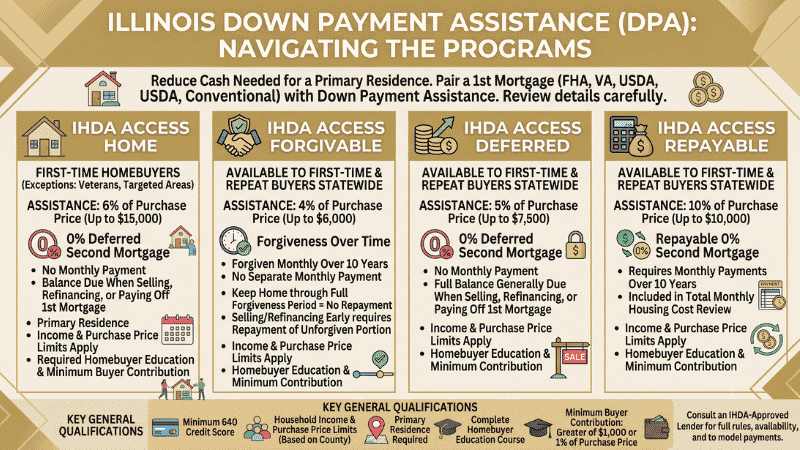
IHDA Access Home provides 6% of the purchase price, up to $15,000, for eligible down payment and closing costs. It is a 0% deferred second mortgage with no monthly payment. The balance is typically due when the borrower sells the house, refinances the mortgage, or pays off the primary loan. Access Home is intended for first-time homebuyers, with exceptions for qualified veterans and buyers purchasing in designated targeted areas. Buyers must use the home as a primary residence, meet the program’s income and purchase-price limits, complete homebuyer education, and make the required minimum contribution.
IHDA Access Forgivable
IHDA Access Forgivable provides 4% of the purchase price, up to $6,000, for eligible down payment and closing costs. The assistance is forgiven monthly over 10 years, with no separate monthly payment. A buyer who keeps the home through the full 10-year forgiveness period does not repay the assistance. However, selling or refinancing before that period ends may require repayment of the portion that has not yet been forgiven. This option is available to eligible first-time and repeat buyers statewide.
IHDA Access Deferred
IHDA Access Deferred provides 5% of the purchase price, up to $7,500, for eligible down payment and closing costs. It is a 0% deferred second mortgage, so it does not add a monthly payment to the borrower’s budget. The full assistance balance is generally due when the borrower sells the home, refinances the first mortgage, or pays off the first mortgage. Eligible first-time and repeat buyers may use this option statewide, subject to current IHDA income, purchase-price, credit, and occupancy rules.
IHDA Access Repayable
IHDA Access Repayable provides 10% of the purchase price, up to $10,000, for eligible down payment and closing costs. Unlike the other options, it is a 0% second mortgage that must be repaid through monthly payments over 10 years. This program may provide more upfront assistance, but the separate payment must be included when reviewing the total monthly housing cost. Eligible first-time and repeat buyers must still meet IHDA’s current credit, income, purchase-price, occupancy, and homebuyer education requirements.
Who May Qualify for IHDA Assistance
IHDA assistance is designed for buyers who meet the program’s income, credit, property, and occupancy rules. Applicants generally need a minimum 640 credit score, must meet household income and home purchase price limits, and must use the property as their primary residence. The limits are based on the county where the home is located, not the county where the buyer currently lives.
Buyers must contribute at least $1,000 or 1% of the purchase price, whichever is higher, and complete an approved homebuyer education course before closing. Both existing homes and eligible new-construction homes may qualify. A buyer must still be approved for the first mortgage and meet all underwriting requirements.
Regulations for first-time buyers differ based on the assistance option chosen. The IHDA Access Home program is typically designed for first-time buyers, qualified veterans, and those purchasing in designated areas. Both new buyers and those who have purchased before might be eligible for IHDA Access Forgivable, Access Deferred, and Access Repayable, provided they fulfill all existing program criteria. Fulfilling the basic guidelines does not guarantee approval, as factors like funding, program availability, and lender underwriting can influence the final decision. These factors are particularly relevant within Illinois DPA mortgage programs.
Find Out How Much Cash You May Need to Buy a Home
Down payment assistance may help, but you may still need funds for closing costs, reserves, or earnest money. Get a realistic cash-to-close estimate before you start shopping
How Much Cash You May Still Need at Closing
Down payment assistance can reduce the amount needed to buy a home, but it does not always eliminate all out-of-pocket costs. With an IHDA mortgage, buyers generally must contribute at least $1,000 or 1% of the purchase price, whichever is greater. Your actual cash to close may be higher or lower depending on the home price, loan type, earnest-money deposit, appraisal and inspection costs, prepaid taxes and insurance, and the amount of assistance approved. IHDA assistance can be used for eligible down payment and closing costs in Illinois DPA mortgage programs, but it may not cover all expenses in every transaction. Additionally, seller and lender credits can help reduce certain allowable costs, depending on the specific loan program and contract terms. A lender needs to provide a Loan Estimate early in the process and an updated Closing Disclosure before closing so you can clearly understand the total cash required. Before making an offer, review more than the advertised interest rate. Ask whether the assistance creates a second mortgage, whether it has a separate payment, what costs remain your responsibility, and what happens to the assistance if you later sell or refinance.
What Happens If You Sell, Refinance, or Pay Off the Mortgage
Before choosing an IHDA assistance option, understand that the help is usually recorded as a second mortgage against the home. The amount due later depends on which Illinois DPA mortgage programs you use and how long you keep the property.
With IHDA Access Home and Access Deferred, there is no monthly payment on the assistance. However, the full unpaid balance is generally due when you sell the home, refinance the first mortgage, or pay it off. Access Home has a 30-year term, so repayment is also due at the end of that term if it has not been paid earlier.
IHDA Access Forgivable is different because the assistance is forgiven monthly over 10 years. If you keep the home through the full forgiveness period, no repayment is generally required. If you sell or refinance before the 10-year period is complete, the portion that has not yet been forgiven may need to be repaid. IHDA Access Repayable requires monthly payments over 10 years. Selling or refinancing before the balance is paid in full may require a payoff as part of the transaction. Before you make plans to sell, refinance, or pay off your mortgage early, ask for a current payoff statement and review the terms of both your first mortgage and IHDA second mortgage.
How Down Payment Assistance Can Affect Your Costs and Payment
Illinois DPA mortgage programs can reduce the cash you need before closing, but they do not automatically reduce the mortgage payment. Your monthly housing payment is still based mainly on the purchase price, first-mortgage loan amount, interest rate, property taxes, homeowners’ insurance, mortgage insurance when required, and any homeowners association dues. The type of assistance matters. IHDA Access Home and Access Deferred do not require a separate monthly payment, while Access Forgivable is forgiven over time if you follow the program terms. IHDA Access Repayable provides more assistance upfront but adds a second-mortgage payment that is repaid over 10 years. That payment must be included when deciding whether the home fits your budget. Assistance can also affect your long-term costs. A deferred balance may need to be paid when you sell or refinance, while a forgivable balance may be reduced over time. Lender credits can further reduce cash-to-close, but they may come with a higher interest rate. Review the Loan Estimate carefully to compare the interest rate, monthly payment, closing costs, mortgage insurance, second-mortgage terms, and the amount you may need to repay later. The best option is not always the one with the largest assistance amount. A borrower planning to move or refinance soon may prefer different terms than someone who expects to stay in the home for many years.
Can Seller Credits and Lender Credits Be Used With DPA?
Seller credits and lender credits can often be used with Illinois DPA mortgage programs to reduce eligible closing costs. They may help pay for items such as lender fees, title charges, prepaid taxes and insurance, or discount points when allowed. The exact amount permitted depends on the first-mortgage program, occupancy, down payment, appraised value, and purchase contract.
These credits do not usually replace IHDA’s required buyer contribution. Buyers generally still need to contribute the minimum amount required by IHDA, which may include eligible earnest money, appraisal fees, prepaid homeowners insurance, and, in some cases, allowable gift funds.
Lender credits can reduce upfront costs, but they may come with a higher interest rate. Seller credits also cannot normally create extra cash back to the buyer at closing. Any unused credit may need to be applied to a principal reduction instead. Before writing an offer, review the Loan Estimate and ask which costs the DPA, seller credit, lender credit, and your own funds will cover.
How to Apply for Illinois Down Payment Assistance
Start by speaking with an IHDA-approved lender before you shop for a home. The lender can review your income, credit, monthly debts, available funds, and the county where you plan to buy. This early review helps identify whether you qualify and which Illinois DPA mortgage programs best fit your plans. Next, provide the documents needed for mortgage preapproval, such as income records, bank statements, identification, and information about any monthly debts. The lender will review current IHDA income and purchase price limits, your required buyer contribution, and whether the home must meet any location or first-time buyer requirements. You will also need to complete the required homebuyer education course before closing. Once you are preapproved and have selected an assistance option, you can make an offer on an eligible primary residence. After the offer is accepted, the lender completes underwriting, confirms program availability, reviews the appraisal and title work, and prepares the final closing documents. Before closing, review the Loan Estimate and Closing Disclosure carefully. Confirm the amount of down payment assistance, your total cash to close, whether there is a second mortgage, and the repayment terms if you later sell, refinance, or pay off the first mortgage.
Final Thoughts on Illinois DPA Mortgage Programs
Illinois DPA mortgage programs can reduce the upfront cost of buying a home, but the best option depends on more than the amount of assistance offered. Review whether the funds are forgiven, deferred, or repaid monthly, along with the interest rate, total payment, closing costs, and what may be due if you sell or refinance later. Before making an offer, compare the available IHDA options with your expected time in the home and your full cash-to-close estimate. An IHDA-approved lender can review the current program rules, availability, and repayment terms for your situation.
Frequently Asked Questions About Illinois DPA Mortgage Programs
What does “first-time homebuyer” mean for IHDA Access Home?
For IHDA Access Home, a first-time homebuyer is generally someone who does not currently own and has not owned a principal residence within the past 3 years. There are exceptions for qualified veterans and buyers purchasing a primary residence in an eligible targeted area. Married applicants should ask early about how a non-borrowing spouse’s prior homeownership may affect eligibility.
What Is an IHDA Targeted Area?
An IHDA targeted area is a location designated to encourage homeownership. Buying in one of these areas may allow some buyers to qualify for Access Home even if they are not first-time homebuyers. Targeted areas may also have different income and purchase price limits, so buyers should check the property address before making an offer.
Can I Buy a Duplex With Illinois DPA Mortgage Programs?
A two-unit property may qualify when the buyer will live in one unit as a primary residence. The property must meet the requirements of the first mortgage program, the appraisal, and IHDA guidelines. Rental income from the second unit may also be reviewed under the applicable mortgage rules.
Does IHDA Count a Roommate’s Income for the Income Limit?
IHDA generally reviews income from borrowers on the mortgage note or from others otherwise liable for the mortgage. A roommate or other household member who is not on the loan is not normally included. Access Home may have separate rules involving a legally married non-borrowing spouse, so a lender should review the household situation before preapproval.
Can I Pay Off an IHDA Assistance Loan Early?
Yes. IHDA assistance loans can generally be paid off early without a prepayment penalty. Before sending funds, request an official payoff statement to confirm the exact payoff balance, instructions, and deadline.
Do IHDA Mortgage Loans Take Longer To Close?
Not automatically. IHDA states that its mortgage programs do not take longer to close than a regular mortgage. However, timing can still depend on how quickly documents are provided, whether the property appraisal and title work are complete, and whether the lender can reserve program funds in time.
What Proof Does a Veteran Need To Qualify for IHDA Access Home?
A veteran who does not meet the first-time buyer definition may still qualify for Access Home as a qualified veteran. IHDA lists a Certificate of Eligibility or a DD214 showing an honorable discharge as documents that may support this exception. The lender will confirm which document is needed for the loan file.
This article about “Illinois DPA Mortgage Programs For First Time Home Buyers” was updated on June 29th, 2026.