Mortgage rules do not always stay the same. If you were approved by one lender last year, that does not always mean the same lender will approve you today. Credit score requirements, debt-to-income limits, down payment rules, income documentation, and loan program availability can change when lenders become more cautious. Understanding why mortgage guidelines change can help you avoid confusion after a denial. Sometimes, the actual rules for FHA, VA, USDA, conventional, or non-QM programs have not changed. Instead, the lender may have added stricter requirements due to market risk, investor rules, rising rates, or concerns about loan performance. That is why one lender may say no while another lender may still have a path to approval.
Why Mortgage Guidelines Change
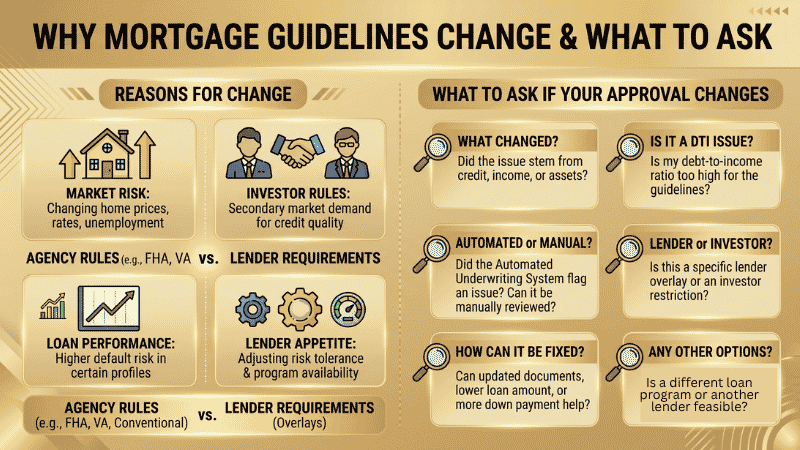
Mortgage guidelines change when lenders, agencies, or investors see more risk in the housing or lending market. A lender may become more careful when mortgage rates rise, home prices soften, unemployment increases, or borrowers begin falling behind on payments. These changes do not always mean every loan program has changed. Sometimes, the basic FHA, VA, USDA, conventional, or non-QM rules stay the same, but lenders tighten their own requirements.
Investor requirements also play a major role. Many lenders sell loans after closing to investors in the secondary mortgage market. If those investors want stronger credit scores, lower debt-to-income ratios, larger down payments, or more reserves, lenders may adjust their approval criteria to align with what investors are willing to buy.
Loan performance matters, too. If certain types of loans start showing higher default risk, lenders may pull back. This can affect borrowers with lower credit scores, recent late payments, high debt-to-income ratios, limited reserves, self-employment income, or recent bankruptcy, foreclosure, or collections. Lender appetite is another reason why mortgage guidelines change. One lender may continue offering a loan program while another lender pauses it, raises the credit score requirement, adds pricing adjustments, or stops accepting certain types of files. That is why a denial from one lender does not always mean you are out of options.
Agency Guidelines vs. Lender Requirements
Mortgage borrowers often hear about FHA, VA, USDA, conventional, and non-QM guidelines, but those are not always the only rules that matter. Agency guidelines are the basic rules set by the government agency, investor, or loan program. For example, FHA has its own credit score and down payment rules, VA has its own approval standards, and conventional loans follow Fannie Mae or Freddie Mac guidelines. Lender requirements are different. A lender may choose to be stricter than the basic agency rule. These extra rules are often called mortgage lender overlays. For example, FHA may allow a 580 credit score with a 3.5% down payment, but one lender may require a 620, 640, or higher score. VA may not set a single universal minimum credit score, but a lender may still require a specific score before approving the loan. This is one reason borrowers get confused after a denial. The loan program may allow the borrower’s situation, but the lender may not. That does not always mean the borrower is not qualified. It may only mean that the lender has stricter requirements than another lender. Understanding the difference between agency guidelines and lender requirements is important, especially when considering why mortgage guidelines change. Before concluding after a denial, borrowers should clarify whether the issue stemmed from the loan program’s rules or the lender’s specific requirements.
Why One Lender May Tighten Requirements Before Another
Not every mortgage lender responds to market shifts in the same way, which is often why mortgage guidelines change. One lender might keep a loan program active, while another could tighten requirements by raising credit score thresholds, lowering debt-to-income ratios, demanding higher reserves, or even suspending the program altogether. These variations occur because lenders sell their loans in different ways and collaborate with various investors after closing.
Some lenders keep loans in-house for a period of time. Others sell loans quickly to investors in the secondary mortgage market. If an investor becomes more cautious, that lender may tighten its rules before other lenders do. This is common when rates are volatile, home prices are uncertain, or certain types of loans carry greater risk.
Lenders also manage risk in different ways. A lender with more exposure to lower credit scores, high debt-to-income ratios, self-employed borrowers, or non-QM loans may become stricter sooner. Another lender with different investors or a broader loan product mix may still approve the same borrower. This is why one denial should not always end the mortgage process. The borrower may not be the problem. The issue may be that one lender changed its requirements, paused a loan program, or no longer has investor support for that type of file.
FHA Loan Guideline Changes Borrowers Should Watch
FHA loans offer a degree of flexibility; however, individual lenders may impose their own stricter requirements. This means that a borrower could meet the basic FHA guidelines yet still be denied if the lender has more stringent rules. This raises the question of why mortgage guidelines change, as lenders adapt their criteria in response to various factors.
Credit Scores
FHA allows eligible borrowers with a credit score of 580 or higher to buy with 3.5% down. Borrowers with credit scores between 500 and 579 may be required to make a 10% down payment. However, some lenders require higher scores, especially when the file has other risk factors.
Manual Underwriting
Manual underwriting may help borrowers who do not receive automated approval. This can apply to borrowers with no credit score, recent credit issues, high debt-to-income ratios, or prior mortgage denials. Not every lender offers manual underwriting.
Debt-to-Income Ratio
FHA may allow higher debt-to-income ratios when the rest of the file is strong. However, lenders may become stricter if the borrower has limited reserves, recent late payments, unstable income, or weak credit history.
Gift Funds
FHA allows gift funds for the down payment and closing costs. The gift must be documented. Borrowers should be ready to show who gave the gift, where the money came from, and that it does not need to be repaid.
Collections and Charge-Offs
Collections and charge-offs do not always stop FHA approval. Lenders may review the amount owed, the type of account, payment plans, and whether any disputed accounts must be resolved before closing.
Employment Gaps
A two-year history in the same job is not always required. However, lenders want stable and documentable income. Recent job gaps, job changes, variable hours, commission income, or self-employment income may need extra documentation.
Recent Late Payments
Late payments can make FHA approval harder, especially if they happened recently. Lenders may look closely at late payments on rent, mortgage, credit cards, auto loans, and installment debts. A clean recent payment history can help strengthen the file.
What Borrowers Should Do
If an FHA loan is denied, ask whether the issue came from FHA rules or the lender’s own requirements. A denial from one lender does not always mean FHA financing is no longer possible.
VA Loan Guideline Changes Borrowers Should Watch
 VA loans offer some of the most flexible mortgage options for eligible veterans, active-duty service members, and surviving spouses. However, this flexibility doesn’t guarantee automatic approval. Borrowers are still required to meet credit, income, residual income, and property criteria. Additionally, lenders may implement their own guidelines, especially when considering why mortgage guidelines change in response to increasing market risks.
Flexible Credit Standards
VA does not set one universal minimum credit score for all borrowers. Instead, lenders review the full credit profile, including payment history, recent late payments, collections, charge-offs, bankruptcy, foreclosure, and overall credit behavior. This flexible approach can help borrowers who do not fit into traditional conventional loan requirements.
Lender-Specific Credit Score Rules
Even though VA does not require one set minimum credit score, many lenders do. One lender may require a score of 620 or higher, while another may allow lower scores with strong compensating factors. This is why a VA borrower may be denied by one lender but still qualify with another.
Residual Income
Residual income is a major part of VA underwriting. It measures how much money remains after the borrower pays for the mortgage, debts, taxes, insurance, and other required obligations. A borrower with strong residual income may have a better chance of approval, even with a higher debt-to-income ratio.
Debt-to-Income Ratio
VA loans do not work the same way as conventional loans when it comes to the debt-to-income ratio. A higher debt-to-income ratio may still be acceptable if the borrower has strong residual income, stable employment, good payment history, and other compensating factors. However, some lenders may set their own debt-to-income limits to reduce risk.
Manual Underwriting
VA manual underwriting may help borrowers who do not receive automated approval. This can apply to borrowers with recent credit issues, limited credit history, higher debt ratios, or prior mortgage denial. Not every lender is comfortable with manual underwriting, so the lender matters.
Recent Late Payments
Recent late payments can make VA approval harder, especially if they involve rent, mortgage payments, auto loans, or other major debts. VA lenders want to see that the borrower has recovered and can handle the new housing payment. A clean recent payment history can help strengthen the file.
What Borrowers Should Do
If a VA loan is denied, borrowers should ask whether the denial was due to VA guidelines or the lender’s own requirements. VA financing may still be possible if another lender has more flexible credit score rules, stronger manual underwriting experience, or a better understanding of residual income.
Conventional Loan Guideline Changes Borrowers Should Watch
Conventional loans follow Fannie Mae and Freddie Mac guidelines, but approval is not always simple. Most conventional loans are reviewed through automated underwriting systems. Fannie Mae uses Desktop Underwriter, also called DU. Freddie Mac uses the Loan Product Advisor, also called LPA. These systems review the borrower’s full risk profile before giving an approval recommendation.
Automated Underwriting
Automated underwriting looks at more than the credit score. It may review credit history, income, assets, debt-to-income ratio, reserves, loan purpose, property type, occupancy, and loan-to-value ratio. When guidelines or risk settings change, a borrower approved earlier may not receive the same outcome later.
Credit Depth
Credit depth matters on conventional loans. A borrower with several open accounts, a long payment history, and low credit card balances may look stronger than a borrower with only one or two new accounts. Thin credit, recent late payments, high credit utilization, collections, or disputed accounts can make approval harder to obtain.
Reserves
Reserves are funds left over after closing. They can help strengthen a conventional loan file, especially when the borrower has higher debt-to-income ratios, multiple financed properties, investment properties, or a lower down payment. When lenders become more cautious, they may look more closely at whether the borrower has sufficient funds remaining after closing.
Mortgage Insurance
Private mortgage insurance is usually required for conventional loans when the down payment is less than 20%. Mortgage insurance approval is separate from the lender’s approval. A borrower may meet the lender’s basic requirements but still need approval for mortgage insurance when the loan-to-value ratio is above 80%.
Higher-Risk Borrower Profiles
Conventional loans can become harder for borrowers with layered risk. This can include lower credit scores, high debt-to-income ratios, limited reserves, recent late payments, unstable income, higher loan-to-value ratios, or multiple financed properties. One risk factor may not cause a denial, but several risk factors together can make approval more difficult.
What Borrowers Should Do
If a conventional loan is denied, borrowers should ask whether the issue came from DU, LPA, mortgage insurance, lender requirements, or missing documentation. Sometimes the solution is a stronger file, more reserves, a lower debt-to-income ratio, a larger down payment, or a different loan program.
Non-QM Loan Guideline Changes Can Happen Fast
Non-QM loan guidelines can change faster than FHA, VA, USDA, and conventional loan guidelines. This is because non-QM loans are often driven by investor appetite. If investors become more cautious, a lender may raise down payment requirements, increase credit score minimums, adjust pricing, require more reserves, or pause certain programs with little notice.
Bank Statement Loans
Bank statement loans are often used by self-employed borrowers who do not qualify with tax returns. Instead of using traditional income documents, the lender may review personal or business bank statements to calculate qualifying income. When non-QM guidelines tighten, lenders may require larger deposits, more months of statements, lower debt-to-income ratios, higher credit scores, or larger down payments.
DSCR Loans
DSCR loans are commonly used by real estate investors. Instead of qualifying primarily on personal income, the lender reviews whether the property’s rental income can cover the mortgage payment. When investor demand changes, DSCR requirements may become stricter. A lender may require a stronger debt service coverage ratio, better credit, more reserves, a lower loan-to-value ratio, or proof that the property can produce market rent.
Asset Depletion Loans
Asset depletion loans may help borrowers who have strong assets but limited traditional income. The lender uses eligible assets to calculate qualifying income. These programs can change quickly because the lender must be comfortable with the type of assets, account history, liquidity, and withdrawal assumptions. Borrowers may need larger verified assets, stronger reserves, or a lower loan amount when guidelines tighten.
Recent Bankruptcy or Foreclosure
One reason borrowers consider non-QM loans is that some programs may allow financing sooner after bankruptcy, foreclosure, short sale, or deed-in-lieu than agency loan programs do. However, this flexibility can change. A lender may require a longer seasoning period, a larger down payment, stronger credit recovery, or more reserves when the market becomes more cautious.
Larger Down Payment Requirements
Non-QM loans often require larger down payments than FHA, VA, USDA, or conventional loans. When investors perceive greater risk, down payment requirements can rise even further. Borrowers with lower credit scores, recent housing events, high debt ratios, or alternative income documentation may need more money down to qualify.
Why Borrowers Should Move Carefully
A non-QM pre-approval should be reviewed carefully because program rules, pricing, and investor requirements can change. Borrowers should ask whether the loan program is still available, what credit score is required, how income is calculated, how much reserve money is needed, and whether any recent bankruptcy, foreclosure, or late payments affect approval. Non-QM loans can be a strong option for borrowers who do not fit traditional guidelines, but they are not a one-size-fits-all option. The right lender, investor, documentation, and timing can make a major difference.
Mortgage Guidelines Changed? You May Still Have Options
A lender rule change does not always mean your loan is dead. We’ll review your credit, income, DTI, assets, and loan program to find the cleanest path to approval.Self-Employed Borrowers May Face More Documentation
Self-employed borrowers are often reviewed more closely when lenders tighten mortgage requirements. This is one reason why mortgage guidelines change can feel more frustrating for business owners, independent contractors, 1099 workers, and borrowers with variable income. Lenders usually want to confirm that the business is stable, active, and generating sufficient income to cover the new mortgage payment. For traditional FHA, VA, USDA, or conventional loans, you’ll need to provide personal and business tax returns, balance sheets, year-to-date profit and loss statements, bank statements, and proof of ongoing business operation.
Declining income can be a major issue. If a borrower earned more in the prior year but less this year, the lender may not use the higher income amount. The underwriter may average the income, use the lower year, or request additional documentation to explain the decline.
Year-to-date income also matters. A lender may compare current business income to prior tax returns to see whether the income is steady, improving, or falling. Strong bank deposits, organized records, and updated profit and loss statements can help support the file. Self-employed borrowers should prepare documents early. Waiting until underwriting to gather tax returns, bank statements, and business records can delay approval or create last-minute problems before closing.
What To Do If Your Lender Changed the Rules
If your lender has changed the rules or denied your loan, you’re not out of options just yet. The first step is to determine the exact reason behind the issue. Inquire whether the problem arose from the specific loan program guidelines, the lender’s own criteria, the automated underwriting system, mortgage insurance, investor rules, or missing documentation. Understanding why mortgage guidelines change can help clarify the situation and guide your next steps. If your loan was run through automated underwriting, ask for a clear explanation of the AUS findings. FHA, VA, USDA, conventional, and some non-QM loans may be reviewed differently depending on the borrower’s credit, income, assets, debt-to-income ratio, and property details. Knowing what the system found can help you understand what needs to be fixed. Next, gather updated documents before applying again. This may include recent pay stubs, W-2s, tax returns, bank statements, profit and loss statements, gift fund documentation, retirement or asset statements, letters of explanation, bankruptcy papers, foreclosure documents, or proof of paid collections. A cleaner, stronger file can make the next review easier. Avoid opening new credit, increasing credit card balances, changing jobs, making large, undocumented deposits, or taking on new debt before closing. Even small changes can affect your approval if the file is already tight. Get a second opinion before giving up. One lender may have changed its rules, paused a program, or added stricter requirements, while another lender may still approve the same borrower. Compare lenders, ask direct questions, and make sure the lender has experience with your type of loan file before starting over.
When Another Lender May Still Be Able To Help
A mortgage denial from one lender does not always mean every lender will deny the file. One reason why mortgage guidelines change can be confusing is that lenders do not all use the same investors, underwriting options, or risk requirements. A borrower may be declined by a bank, credit union, or mortgage company and still have a path to approval with a different lender.
Another lender may have access to different investors that accept lower credit scores, higher debt-to-income ratios, recent credit events, or alternative income documentation. This can be especially important for borrowers who need FHA manual underwriting, VA manual underwriting, bank-statement loans, DSCR loans, asset-depletion loans, or other non-QM mortgage options.
Some lenders also have fewer overlays than others. An overlay is an extra rule added on top of the basic loan program guideline. For example, one lender may require a higher credit score than the FHA or VA does, while another lender may follow the agency guidelines more closely. Gustan Cho Associates works with borrowers who have been denied by other lenders, but approval still depends on the full file. Credit history, income, assets, debt-to-income ratio, property type, loan program, and documentation all matter. The best next step is to have the file reviewed by a lender experienced with complex mortgage approvals before assuming home financing is no longer possible.
Final Thoughts: Mortgage Guideline Changes Do Not Always Mean You Are Out of Options
Changes to mortgage guidelines can be frustrating, particularly when you’ve been informed that you qualify, only to later discover that the lender has altered its requirements. A denial can feel like a definitive setback, but it’s not always the final outcome. Understanding why mortgage guidelines change is important, as the root cause may lie not in the loan program itself but in the lender’s policies, investor restrictions, automated underwriting results, or missing documentation. Before giving up, find out why the loan was denied or why the lender changed direction. Ask what requirement caused the problem and whether it came from FHA, VA, USDA, Fannie Mae, Freddie Mac, a non-QM investor, or the lender’s internal guidelines. The answer can help you decide whether to improve the file, change loan programs, or get a second opinion. Borrowers with low credit scores, high debt-to-income ratios, recent bankruptcies, collections, self-employment income, or prior mortgage denials still have options available. The right lender, stronger documentation, manual underwriting, or a different loan program can make a difference. Mortgage guidelines may change, but your ability to qualify depends on the full picture. If one lender says no, another lender may still be able to review the file and find a path forward.
FAQs About Why Mortgage Guidelines Change
Can Mortgage Guidelines Change After Pre-Approval?
Yes, mortgage guidelines can change after pre-approval, but the bigger risk is often a change in the borrower’s file. A pre-approval is not the same as final approval. The lender still needs to verify credit, income, assets, employment, debts, property condition, appraisal, title, and underwriting conditions before closing. If the borrower changes jobs, takes on new debt, misses a payment, increases credit card balances, or the property does not meet the requirements, the loan can still run into problems.
Can a Mortgage Lender Change Loan Terms Before Closing?
A lender may update loan terms before closing if something changes with the file, pricing, rate lock, loan program, property, credit, income, or required disclosures. Borrowers should review the Loan Estimate, Closing Disclosure, interest rate, fees, cash-to-close, and monthly payment carefully. If the terms are not what the borrower expected, the borrower should ask the lender to explain what changed before signing the closing documents.
How Often do Mortgage Guidelines Change?
Mortgage guidelines do not change on a fixed schedule. Agency guidelines, investor rules, pricing adjustments, automated underwriting findings, and lender requirements can change at different times. Some changes happen slowly through formal policy updates. Others happen quickly when lenders or investors adjust risk requirements because of market conditions, loan performance, or economic concerns.
Can You Switch Mortgage Lenders Before Closing?
Yes, borrowers can usually switch mortgage lenders before closing, but timing matters. Changing lenders late in the process can delay the closing because the new lender may need a new application, credit report, appraisal review, underwriting approval, title work, and closing disclosures. Borrowers should compare the risk of delay against the benefit of getting better loan terms or finding a lender that can approve the file.
Can a Rate Lock Protect Me From Changes to Mortgage Guidelines?
A rate lock may protect the interest rate for a set period, but it does not guarantee final loan approval. The borrower must still meet underwriting requirements, property requirements, documentation rules, and closing conditions. If the rate lock expires before closing, the loan may need to be relocked, extended, or repriced based on the lender’s current rules and market pricing.
Why do Mortgage Guidelines Matter More When Rates are High?
Mortgage guidelines can feel stricter when rates are high because higher rates increase the monthly payment. A higher payment can raise the borrower’s debt-to-income ratio and reduce buying power. Even if the borrower qualified at a lower rate, the same borrower may need more income, less debt, a lower purchase price, or stronger compensating factors when rates rise.
What Should I Ask My Lender if My Approval Changes?
Ask the lender what changed and whether the issue came from credit, income, assets, debt-to-income ratio, appraisal, title, mortgage insurance, automated underwriting, investor rules, or lender requirements. Also, ask whether the issue can be fixed with updated documents, a lower loan amount, a larger down payment, paid-down debt, a different loan program, or a manual underwriting review.
This article about “Why Mortgage Guidelines Change and How Borrowers Can Still Get Approved” was updated on July 9th, 2026.