
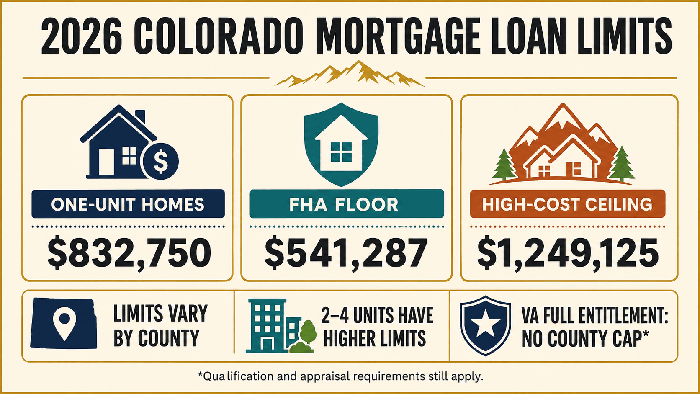
Colorado mortgage loan limits are not the same in every county. For 2026, the standard conforming limit for a one-unit home is $832,750, while the FHA limit starts at $541,287. Buyers in higher-cost areas of Colorado may be able to borrow more. The financing amount will vary based on the county, the property, and the mortgage type you select.
2026 Colorado Mortgage Loan Limits at a Glance
Colorado borrowers can have very different loan limits depending on where they buy. A home in Denver or one of the state’s higher-priced mountain counties may qualify for a larger loan amount than a similar property in a lower-cost county. For 2026, the baseline conforming limit for a one-unit home is $832,750, while the FHA floor is $541,287.
That difference is important in Colorado because housing costs can vary widely from one county to another. Buyers in Denver, Boulder, and some mountain communities may have higher loan limits available than buyers purchasing in more affordable parts of the state.
The applicable loan limit depends on the county. Buyers of duplexes, triplexes, or four-unit properties may also qualify for higher limits than those purchasing single-family homes.
How Colorado County Loan Limits Work
Colorado mortgage loan limits are based on the county where the property is legally located, not where the borrower currently lives. The applicable limit also depends on whether the property has 1, 2, 3, or 4 residential units. The Federal Housing Finance Agency sets conforming loan limits for mortgages eligible for purchase by Fannie Mae and Freddie Mac. Most Colorado counties use the national baseline, while designated high-cost counties have higher limits. HUD establishes FHA loan limits separately, so the FHA and conforming limits in the same county may be different. A county loan limit applies to the mortgage amount rather than the purchase price. A buyer may purchase a home above the applicable limit by making a larger down payment that reduces the loan amount. Staying below the limit does not guarantee approval; the borrower must still qualify based on income, credit, debts, assets, occupancy, and property requirements. Loan limits increase for duplexes, triplexes, and four-unit properties. However, higher limits do not eliminate program requirements. FHA borrowers must generally occupy one unit as their principal residence, and conventional financing requirements can vary by occupancy, property type, and number of units.
Buying With an FHA Loan in Colorado? Check the County Limit First
Colorado FHA loan limits vary by county and number of units. Before making an offer, confirm whether your target home fits FHA financing.2026 Colorado Conforming Loan Limits by County
The Federal Housing Finance Agency increased the 2026 baseline conforming loan limit to $832,750 for a one-unit property. Most Colorado counties use this baseline, while 20 counties have higher limits because of local housing costs. These Colorado mortgage loan limits apply to loans that Fannie Mae and Freddie Mac can purchase. A loan within the county limit is not automatically approved; it must also satisfy applicable credit, income, asset, property, occupancy, and underwriting requirements.
Colorado Counties Using the Baseline Conforming Limits
The following 44 counties use the 2026 national baseline limits: Alamosa, Archuleta, Baca, Bent, Chaffee, Cheyenne, Conejos, Costilla, Crowley, Custer, Delta, Dolores, El Paso, Fremont, Gunnison, Hinsdale, Huerfano, Jackson, Kiowa, Kit Carson, La Plata, Larimer, Las Animas, Lincoln, Logan, Mesa, Mineral, Montezuma, Montrose, Morgan, Otero, Ouray, Phillips, Prowers, Pueblo, Rio Blanco, Rio Grande, Saguache, San Juan, Sedgwick, Teller, Washington, Weld, and Yuma.
| Property units | 2026 baseline conforming limit |
|---|---|
| One unit | $832,750 |
| Two units | $1,066,250 |
| Three units | $1,288,800 |
| Four units | $1,601,750 |
Colorado Counties With Higher Conforming Loan Limits
| Colorado county or counties | One unit | Two units | Three units | Four units |
|---|---|---|---|---|
| Adams, Arapahoe, Broomfield, Clear Creek, Denver, Douglas, Elbert, Gilpin, Jefferson, and Park | $862,500 | $1,104,150 | $1,334,700 | $1,658,700 |
| Boulder | $879,750 | $1,126,250 | $1,361,350 | $1,691,850 |
| Grand | $883,200 | $1,130,650 | $1,366,700 | $1,698,500 |
| San Miguel | $994,750 | $1,273,450 | $1,539,350 | $1,913,000 |
| Moffat and Routt | $1,089,050 | $1,394,200 | $1,685,250 | $2,094,350 |
| Lake and Summit | $1,092,500 | $1,398,600 | $1,690,600 | $2,101,000 |
| Garfield and Pitkin | $1,209,750 | $1,548,975 | $1,872,225 | $2,326,875 |
| Eagle | $1,249,125 | $1,599,375 | $1,933,200 | $2,402,625 |
A mortgage above the applicable county limit is generally considered a nonconforming or jumbo loan. However, a buyer purchasing above the limit may be able to make a larger down payment and reduce the first mortgage to a conforming amount. High-balance loans made within the higher county limits remain conforming loans rather than jumbo mortgages. The limits are based on the county where the property is legally located and the number of residential units. Borrowers can verify the figures in the official FHFA 2026 county loan-limit list.
2026 Colorado FHA Loan Limits
FHA loan limits also change from one Colorado county to another. In 2026, the FHA floor for a one-unit property is $541,287. Counties with higher housing costs may have limits well above that amount.
Colorado FHA Baseline Counties
In many of the cheaper counties, the standard FHA limit applies, so buyers in those areas can obtain an FHA loan, which allows them to finance up to the county’s maximum, provided they meet the program’s requirements for credit, income, down payment, and underwriting.
Colorado FHA High-Cost Counties
Higher limits apply in parts of Colorado with higher home prices. This gives FHA borrowers additional buying power in certain metro areas and mountain communities without having to move to a different loan program solely because of the home price. Because FHA limits are set by county, borrowers should check the property location before assuming a particular maximum loan amount applies.
Important Differences Between FHA and Conforming Limits
FHA and conforming loan limits are not always the same, even when the property is in the same Colorado county. FHA limits are set by HUD, while conforming limits are established under FHFA guidelines for mortgages purchased by Fannie Mae and Freddie Mac. The difference between FHA loan limits and conforming loan limits can affect whether each loan program is suitable for individual borrowers. In counties where the FHA maximum is lower, certain borrowers might be able to obtain a higher conventional loan amount. However, other borrowers may go for FHA financing because it has more flexible down payment and credit requirements. It is important, when looking at the loan limits available under the Colorado FHA and conventional loan schemes, to take into account several factors in addition to the maximum loan amount: credit history, debt-to-income ratio, available assets, mortgage insurance requirements, and the type of property. All have a significant influence on deciding which loan option is most suitable
One- to Four-Unit Property Limits
If a property has more than one unit, the loan limits go up. For example, a duplex, triplex, or four-unit property can qualify for a higher conforming loan limit than a single-family home in the same Colorado county. These increased loan limits benefit buyers seeking to purchase small multifamily properties. Borrowers who meet occupancy and program requirements may obtain conventional financing for properties with up to four units. The applicable loan limit is determined by both the number of units and the county.
Denver County Financing Example
The following example is hypothetical and is provided only to show how the 2026 Colorado mortgage loan limits can affect the financing structure. It does not represent guaranteed approval, an interest rate, or final closing costs. Assume a borrower wants to purchase a one-unit primary residence in Denver County for $900,000. The 2026 one-unit conforming and FHA county limits are both $862,500.
Conventional Financing Example
With a 5% down payment, the calculation would be:
- Purchase price: $900,000
- Down payment: $45,000
- Proposed conventional loan: $855,000
- Denver County conforming limit: $862,500
The $855,000 mortgage is above the national baseline of $832,750 but below the Denver County limit of $862,500. Based on loan size, it could be structured as a high-balance conforming loan rather than a jumbo mortgage. The borrower must still meet the lender’s credit, income, asset, reserve, and automated underwriting requirements.
FHA Financing Example
With FHA’s standard 3.5% down payment, the calculation would be:
- Purchase price: $900,000
- Down payment: $31,500
- Proposed FHA base loan: $868,500
- Denver County FHA limit: $862,500
The proposed $868,500 base loan exceeds the Denver County FHA limit by $6,000. To reduce the FHA base mortgage to $862,500, the borrower would need to increase the down payment to at least $37,500, or approximately 4.17% of the purchase price. If the borrower finances the FHA’s 1.75% upfront mortgage insurance premium, approximately $15,094 could be added to the $862,500 base mortgage amount. The resulting total loan balance may exceed the published county limit because the limit applies to the FHA base mortgage before financed upfront mortgage insurance. The best structure would depend on the borrower’s complete financial profile, mortgage insurance costs, available funds, credit history, debt-to-income ratio, and underwriting findings.
What Happens If Your Loan Amount Exceeds the County Limit?
If the mortgage amount exceeds the county’s conforming limit, the loan may need to be structured as a jumbo mortgage. Another option may be to make a larger down payment so the final loan amount falls within the applicable limit.
With FHA financing, the loan amount generally cannot exceed the FHA maximum for the county where the property is located. A buyer purchasing above that amount may need additional cash at closing or may have to consider another loan program.
This is why checking Colorado loan limits by county early in the homebuying process can be helpful. Knowing the maximum before making an offer can prevent financing surprises later and make it easier to compare FHA, conventional, and jumbo options.
Colorado VA Loan Limits and VA Entitlement
VA borrowers with full entitlement are not restricted by a county loan limit. That means an eligible Veteran may finance above the conforming limit without a VA-required down payment, as long as the borrower qualifies for the mortgage and the appraisal supports the purchase price. County limits can still matter when a borrower has already used part of their VA entitlement, and it has not been restored. In that situation, the remaining entitlement amount is tied to the county loan limit in the county where the new property is located. Depending on the loan amount and entitlement available, a down payment may be required. Veterans who already have a VA loan should have their Certificate of Eligibility reviewed before making assumptions about how much they can finance on another property.
How to Find the Loan Limit for Your Colorado County
To find your loan limit, start by looking up the county where the property is located. FHA and conforming loan limits depend on the property address, not where you currently live.
For Colorado FHA limits by county, borrowers can check HUD’s official loan-limit lookup. Conforming limits are published by FHFA and may be higher in certain Colorado counties where housing costs are above the national average.
Before you make an offer, check the current county limit with a loan officer. This will help you know if your loan qualifies for standard conforming, high-balance, FHA, or jumbo financing.
Documents and Steps for Colorado Preapproval
A Colorado mortgage preapproval should review the borrower’s complete financial profile and the applicable county loan limit. The lender will typically request:
- Government-issued identification and Social Security number
- Recent pay stubs and two years of W-2 forms
- Federal tax returns when required
- Two months of bank and investment account statements
- Documentation for retirement, Social Security, disability, rental, or other qualifying income
- Statements for mortgages, auto loans, student loans, credit cards, and other debts
- Gift letters and evidence showing the transfer of gift funds
- Bankruptcy, foreclosure, divorce, child support, or credit-dispute documents when applicable
- Business and personal tax returns, year-to-date profit-and-loss statements, and business bank statements for self-employed borrowers
The process normally begins with a mortgage application and credit review. The loan officer then verifies income, employment, assets, debts, and available funds for the down payment and closing costs. The expected county, purchase price, property type, and number of units should be identified next. This allows the lender to confirm the correct Colorado mortgage loan limits and determine whether the proposed financing is FHA, standard conforming, high-balance conforming, VA, or jumbo. The preapproval should include estimated property taxes, homeowners’ insurance, mortgage insurance, HOA dues, and other housing expenses. After reviewing the complete file, the lender may issue a preapproval subject to an acceptable property, appraisal, title review, updated documents, and final underwriting approval. Borrowers should avoid opening new credit, increasing debt, changing employment, or moving large amounts of money without first speaking with their loan officer. Income, assets, credit, and county limits should be confirmed again once the borrower has a signed purchase contract.
Final Thoughts on Colorado Mortgage Loan Limits
Colorado mortgage loan limits can affect whether a borrower uses FHA, standard conforming, high-balance conforming, or jumbo financing. Because the limits vary by county and property size, buyers should verify the property’s legal location and number of units before making an offer. The county limit represents the maximum mortgage amount allowed under a particular program, not the amount a borrower is guaranteed to receive. Final approval depends on income, debts, credit history, assets, occupancy, appraisal, and underwriting findings. A complete preapproval should compare available loan programs and structure the financing around the borrower’s full financial profile.
Frequently Asked Questions About Colorado Mortgage Loan Limits
Do Colorado Loan Limits Apply to Mortgage Refinances?
Yes. The applicable conforming or FHA limit generally applies to the new mortgage amount on both purchase and refinance transactions. Cash-out, rate-and-term, and streamline refinances may also have separate loan-to-value, seasoning, equity, and closing-cost requirements.
Are Closing Costs Included in the County Loan Limit?
Closing costs paid in cash or covered by allowable lender or seller credits do not count toward the mortgage limit. However, when closing costs are added to a refinance balance, the resulting loan amount must remain within the applicable limit. Financed FHA upfront mortgage insurance is treated separately from the FHA base mortgage.
Do Conforming Loan Limits Apply to Second Homes and Investment Properties?
Conforming county limits can apply to eligible second homes and investment properties. However, these properties may have higher down payments, reserves, credit, pricing, and underwriting requirements. Second homes are generally limited to one-unit properties under Fannie Mae guidelines. FHA financing is generally restricted to principal residences.
Which Loan Limit Applies to a Condominium in Colorado?
An individual condominium unit normally uses the county’s one-unit loan limit. The condominium must also meet the applicable project eligibility requirements for FHA, Fannie Mae, Freddie Mac, VA, or the selected loan program. A higher county limit does not override condominium approval requirements.
Do Manufactured Homes Use Colorado County Loan Limits?
An eligible manufactured home classified as real property may use the applicable FHA or conforming county limit. The home must meet foundation, title, construction, appraisal, and program eligibility requirements. Manufactured homes financed as personal property or through FHA Title I follow different loan-limit rules.
Can CHFA Down Payment Assistance Increase the County Loan Limit?
No. Assistance from the Colorado Housing and Finance Authority can help with eligible down payment and closing cost needs, but it does not increase the FHA or conforming loan limits. CHFA can also impose its own income, purchase price, credit, education, and maximum loan requirements. Borrowers must satisfy both CHFA and first-mortgage guidelines.
How Often do Colorado Mortgage Loan Limits Change?
FHFA and HUD generally update their loan limits once each year. FHFA normally announces the next year’s conforming limits near the end of the preceding year, with HUD announcing FHA limits afterward. Limits may increase, remain unchanged, or occasionally decrease in individual counties, so borrowers should verify the applicable figures whenever a transaction crosses into a new calendar year.
This article about “Colorado Mortgage Loan Limits on FHA and Conforming Loans” was updated on August 19th, 2026.