Eligible veterans, active-duty service members, and qualifying surviving spouses may be able to obtain VA loans in Ohio borrowers can use to purchase or refinance a primary residence, even with imperfect credit. The Department of Veterans Affairs does not establish a universal minimum credit score, although individual lenders may impose their own minimums. Approval depends on the borrower’s credit history, qualifying income, debts, residual income, occupancy, available VA entitlement, and the property. A Certificate of Eligibility confirms access to the VA loan benefit but does not guarantee approval.
Who Is Eligible for VA Loans in Ohio?
Eligibility for VA loans in Ohio is based on federal VA service requirements, not separate Ohio rules. You may qualify if you are:
- A veteran who meets the applicable length-of-service requirements
- An active-duty service member
- An individual who is currently serving or has previously served in the National Guard or Reserve and fulfills VA criteria.
- Certain surviving spouses of deceased veterans
- A member of another limited group recognized by the Department of Veterans Affairs
Service requirements vary according to when and how the applicant served. Borrowers generally need a Certificate of Eligibility (COE), which the lender may obtain electronically. The COE confirms that the applicant is eligible for the VA home loan benefit and shows the available entitlement. A COE does not guarantee mortgage approval. The borrower must still meet the lender’s credit, income, debt, residual-income, occupancy, and underwriting requirements. The property must also meet applicable VA standards. VA purchase loans generally must be used for a home that the borrower intends to occupy as a primary residence, not a vacation home or investment property. Applicants who are uncertain about their eligibility can review the official VA home loan eligibility requirements or ask a VA-approved lender to request their COE.
Can You Get a VA Loan in Ohio With Bad Credit?
Most veterans might qualify for a VA loan in Ohio, even if their credit isn’t strong. While the VA itself doesn’t enforce a single required credit score, banks look at several things – like how much money comes in each month or whether bills were paid on time. Past payments matter just as much as current debts compared to earnings.
On top of that, leftover monthly income after major expenses plays a role too. Certain lenders apply tougher conditions beyond what the VA asks for. These added standards sometimes block approval, despite meeting official program terms.
Luckily, a poor credit rating might not block access entirely. When earnings stay consistent, latest bills go out without delay, leftover money feels sufficient, and documentation looks solid, veterans could see eligibility remain open. Approval paths sometimes shift toward human review if computer systems decline the request.
VA Loan Credit Score Requirements in Ohio
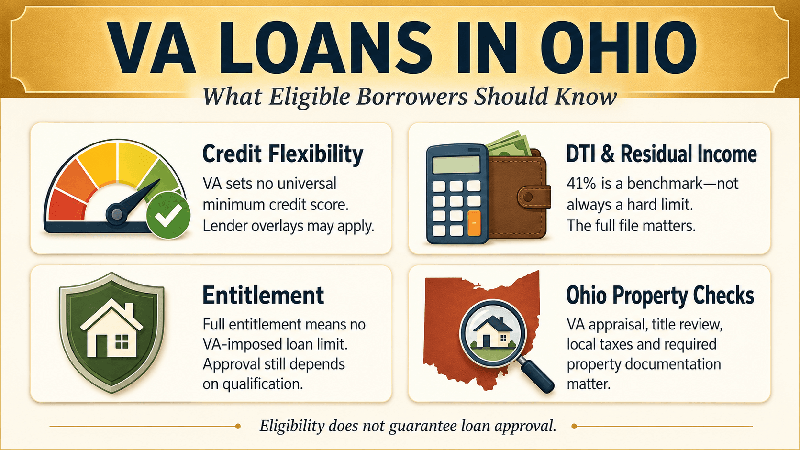
The VA does not set one minimum credit score for every borrower. However, each lender can have its own credit score rules. Some Ohio VA lenders may require a 620 or 640 score, while others may review lower scores if the rest of the file is strong. Credit score is only one part of the approval. Lenders also look at recent payment history, income, debt-to-income ratio, residual income, and whether the borrower receives automated approval. A lower score may still work if the borrower has steady income, recent on-time payments, and enough money left over each month after bills are paid.
What Does “No Lender Overlays” Mean?
Lender overlays are additional qualification rules that a mortgage lender imposes beyond the Department of Veterans Affairs’ minimum guidelines. For example, the VA does not establish a universal minimum credit score, but a lender may require a 620 score before approving its VA loans.
A lender offering VA loans in Ohio that borrowers can obtain with no lender overlays generally does not impose blanket credit score, debt-to-income, or other requirements beyond applicable VA guidelines. This can help an otherwise qualified borrower whose application was denied because of another lender’s stricter internal rules.
“No lender overlays” does mean no underwriting standards or guaranteed approval. Borrowers must still document their income, debts, credit history, residual income, occupancy, and VA eligibility. The property must meet VA requirements, and the complete loan file remains subject to underwriting and final approval. Certain investors, loan amounts, property types, or specialty programs may also have additional requirements.
How VA Lenders Evaluate Credit
VA lenders evaluate more than a borrower’s credit score. Because the Department of Veterans Affairs does not establish a universal minimum score, the lender reviews the borrower’s complete credit history to determine whether the borrower has demonstrated the willingness and ability to repay their debts. When reviewing applications for VA loans in Ohio, lenders commonly consider:
- Recent mortgage or rental payment history
- Late payments and how recently they occurred
- Collections, charge-offs, and disputed accounts
- Bankruptcy, foreclosure, or other major credit events
- Federal debts, tax liens, judgments, and delinquent child support
- Credit utilization and current monthly obligations
- Stable qualifying income and employment
- Debt-to-income ratio and VA residual income
- Automated underwriting findings and compensating factors
Older credit problems do not always prevent approval, especially when they resulted from documented circumstances and the borrower has since reestablished responsible credit. However, recent late housing payments, unresolved federal debt, or a continuing pattern of missed payments may require further documentation or prevent approval. If the loan does not receive an automated approval, it may be considered for manual underwriting when permitted. Manual underwriting does not waive VA requirements. The underwriter examines the borrower’s payment history, explanations for derogatory credit, residual income, cash reserves, and other strengths before making a decision. Approval is based on the complete loan file and is never guaranteed by a particular credit score.
VA Debt-to-Income and Residual-Income Requirements
VA lenders review both the borrower’s debt-to-income ratio and residual income. These measurements are related, but they serve different purposes when underwriting VA loans in Ohio.
The debt-to-income ratio, or DTI, compares the borrower’s total monthly debt obligations with gross monthly qualifying income. These obligations generally include the proposed housing payment, credit cards, vehicle loans, student loans, child support, and other recurring debts.
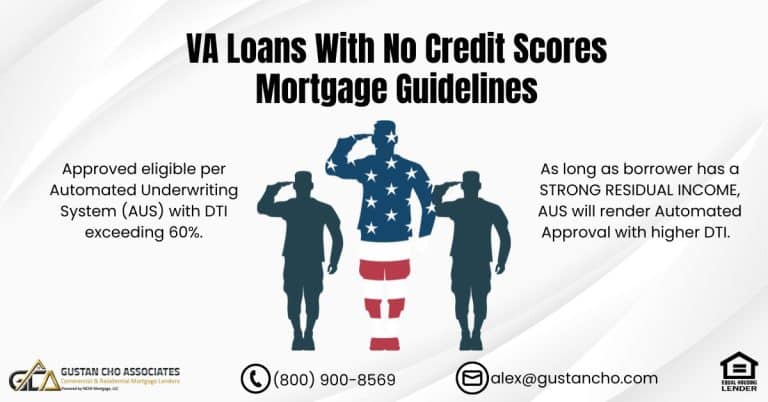
VA underwriting commonly uses 41% as a DTI benchmark, but this is not a universal maximum. A borrower may qualify with a higher ratio when the complete loan file supports approval. The lender may consider factors such as high residual income, stable employment, responsible recent credit, cash reserves, and favorable automated underwriting findings. Residual income measures how much qualifying income remains after deducting the proposed housing expense, monthly debts, taxes, and other required obligations. The VA assesses whether a household’s income is enough to meet essential living costs such as food, transportation, utilities, and healthcare. The required amount depends on:
- The property’s geographic region
- The number of people in the household
- The loan amount
- Applicable VA underwriting requirements
Ohio is in the VA’s Midwest region. For loan amounts of $80,000 or more, the standard Midwest residual-income guidelines range from $441 per month for a one-person household to $1,039 for a five-person household. Generally, an additional $80 is added for each household member over 5. A DTI above 41% may receive closer review. Under VA manual-underwriting guidance, residual income of at least 20% above the applicable requirement can help support a higher ratio, but it does not guarantee approval. The lender must still evaluate the borrower’s credit history, income stability, housing record, and overall ability to repay the mortgage. Automated underwriting findings, lender requirements, and the complete loan file ultimately determine whether the DTI and residual income are acceptable.
VA Manual Underwriting in Ohio
Some folks miss the automatic green light – manual review steps in then. Hand checks replace machine rules, one paper at a time. Income gets scanned, yes, but so do old late payments and credit hiccups. Debt stacked against earnings matters. So does leftover cash after bills. Repayment strength? That’s weighed too, person by person. Lending decisions by hand do not guarantee acceptance. Each case must fit within VA rules and look logical on paper. Solid proof of stability often matters – things like regular paychecks, bills paid without delay, savings tucked away, or rent records free of issues. Veterans in Ohio facing tough financial moments might find this route useful when credit is low, debts feel heavy, or old bankruptcies linger, so long as their current habits suggest responsibility.
VA Loans After Bankruptcy, Foreclosure, Collections, or Late Payments
 Bankruptcy, foreclosure, collections, or late payments do not automatically prevent a borrower from qualifying for VA loans in Ohio. Veterans and eligible service members may use them. However, the lender must review when the credit problem occurred, what caused it, whether it has been resolved, and how the borrower has managed credit since then.
VA Loans After Chapter 7 Bankruptcy
VA guidelines generally consider a borrower’s credit reestablished when at least two years have passed since a Chapter 7 bankruptcy discharge. Approval may be possible sooner when the bankruptcy resulted from documented circumstances beyond the borrower’s control and the borrower has demonstrated responsible credit afterward. A bankruptcy discharged less than one year before the application will ordinarily make approval difficult. Even after two years, approval is not automatic. The lender must evaluate the borrower’s current payment history, qualifying income, residual income, debts, and overall ability to repay.
VA Loans During or After Chapter 13 Bankruptcy
A borrower does not always need to wait until a Chapter 13 bankruptcy has been discharged to seek VA financing. A borrower currently in Chapter 13 may be considered after making at least 12 months of satisfactory plan payments. The borrower generally must obtain permission from the bankruptcy court or the trustee before assuming the mortgage. The lender will verify the payment history, include the required plan payment in the qualification analysis when applicable, and determine whether the borrower can afford both the mortgage and remaining obligations. After a Chapter 13 discharge, the lender must still review the reason for the bankruptcy and the borrower’s payment history during and after the repayment plan. Individual lenders may impose additional requirements.
VA Loans After Foreclosure
A borrower may be considered for a VA loan after a foreclosure, commonly once two years have passed. The lender must review the cause of the foreclosure and determine whether the borrower has reestablished satisfactory credit. A prior foreclosure involving a VA-guaranteed mortgage may also affect the borrower’s available entitlement. If the VA incurred a loss, the borrower may need to repay that loss to restore full entitlement. Some borrowers may still have enough remaining entitlement to obtain another VA loan without fully restoring it. A previous foreclosure does not guarantee approval or denial. The loan amount, remaining entitlement, recent credit history, residual income, and lender underwriting decision all matter.
VA Loans With Collections or Charge-Offs
VA guidelines do not automatically require every collection or charge-off to be paid before closing. The lender must evaluate:
- The type, amount, and age of the account
- Whether it represents an isolated event or a pattern of unpaid obligations
- The circumstances that caused the delinquency
- Any required monthly payment
- Whether the debt could affect the borrower’s ability to repay the mortgage
Medical collections may be evaluated differently from repeatedly unpaid consumer debts. Judgments, delinquent federal debts, tax obligations, and past-due child support require separate analysis. They may need to be resolved or placed under an acceptable repayment agreement. Borrowers should not pay or dispute collection accounts solely to improve a mortgage application without first discussing the potential effect with their loan officer. Changing an account can affect the credit report or automated underwriting findings.
VA Loans With Recent Late Payments
Late payments receive greater scrutiny when they are recent, repeated, or related to housing. A single late payment caused by a documented temporary problem may be treated differently from an ongoing pattern of missed payments. Lenders commonly examine the borrower’s recent:
- Mortgage or rental payments
- Chapter 13 plan payments
- Installment-loan payments
- Revolving-credit payments
- Child support and other court-ordered obligations
Recent mortgage or rent delinquencies can be especially serious because they may indicate that the borrower is not ready to manage a new housing payment. The lender may request a written explanation, proof that the cause has been resolved, and documentation of satisfactory payments since the delinquency. VA underwriting focuses on the borrower’s overall creditworthiness rather than on one event or credit score. Meeting a waiting period does not guarantee approval, and lender overlays may apply. Borrowers should have their complete credit, income, residual income, and housing payment history reviewed in accordance with the current VA Lenders Handbook.
VA Entitlement and Loan Limits
VA entitlement is the amount the Department of Veterans Affairs may guarantee on an eligible borrower’s loan. It is not a cash benefit, down payment, or maximum loan amount. The borrower’s Certificate of Eligibility (COE) shows whether entitlement is available and whether any portion is currently being used. Borrowers with full entitlement do not have a VA-imposed loan limit. They may be able to obtain VA loans in Ohio without a down payment, even when the loan exceeds the county’s conforming loan limit. However, full entitlement does not mean the borrower can obtain a loan of any size. The lender is required to assess whether the borrower has the financial capacity to pay the mortgage according to their income, debts, credit history, residual income, assets, and other underwriting requirements. The property’s purchase price and appraised value also affect the available financing. A borrower may have a partial or remaining entitlement after:
- Keeping a home financed with an existing VA loan
- Allowing another person to assume a VA loan without substituting entitlement
- Experiencing a foreclosure or short sale that caused a loss to the VA
- Paying off a previous VA loan without completing entitlement restoration
When a borrower does not have full entitlement, the applicable Federal Housing Finance Agency county loan limit is used to calculate the amount of entitlement that remains. If the available entitlement does not provide the guaranty required by the lender, the borrower may need a down payment. In many cases, the entitlement, down payment, or their combination must equal at least 25% of the loan amount. Eligible borrowers may be able to restore previously used entitlement after selling the property and paying off the VA loan. Restoration may also be available when another eligible veteran assumes the loan and substitutes their entitlement. A borrower who repays the VA loan but keeps the property may generally request a one-time restoration. Because entitlement calculations can be complicated, borrowers with an existing or previous VA loan should have the lender review their COE before making an offer. The official VA entitlement and loan limits guide provides additional information on full entitlement, remaining entitlement, restoration, and possible down payment requirements.
Ohio-Specific Property and Closing Considerations
Borrowers using VA loans in Ohio must meet VA property standards and local closing requirements. Procedures, costs, and responsibilities can vary by county and purchase contract.
VA Appraisal and Property Standards
A VA-approved appraiser will:
- Provide an opinion of the home’s value
- Evaluate the property against the VA Minimum Property Requirements
- Identify visible conditions that may require repairs before closing
The property generally must be safe, structurally sound, sanitary, and suitable for residential use. A VA appraisal is not a home inspection. Buyers should hire an independent inspector to check the roof, foundation, electrical system, plumbing, heating equipment, and other major components.
Wood-Destroying-Insect Inspection
Ohio properties may require wood-destroying-insect documentation under applicable VA requirements. The inspection checks for termites and other wood-destroying organisms. Active infestation or related damage may require treatment or repair before closing. The purchase contract and current VA rules determine who may pay the inspection and repair costs.
Ohio Title Work
Before closing, a title professional generally searches public records for:
- Ownership problems
- Unpaid liens
- Judgments
- Easements
- Other title defects
The lender usually requires a lender’s title insurance policy. Buyers may purchase a separate owner’s title insurance policy for protection against covered title problems.
County Recording Requirements
Ohio property transfers commonly involve two county offices:
- The county auditor processes conveyance documents and applicable fees.
- The county recorder records the deed and mortgage.
The title or settlement company normally coordinates these steps, pays existing liens, distributes funds, and submits the documents for recording.
Property Taxes and Escrow Payments
Ohio property taxes are administered locally and are usually prorated between the buyer and seller at closing. Tax rates, assessed values, exemptions, and billing schedules vary by county. Before closing, buyers should review the county auditor’s property record. Future property taxes and escrow payments may change because of:
- A recent sale
- Property reassessment
- New-construction valuation
- An expiring tax exemption
- Changes in local tax rates
Property-Tax Relief for Disabled Veterans
Certain veterans with qualifying service-connected disabilities may qualify for Ohio’s enhanced homestead exemption. This benefit is separate from VA loan eligibility. After purchasing and occupying the home, the veteran generally applies through the county auditor. Eligibility requirements should be confirmed through the Ohio Department of Taxation.
What Happens at Closing?
At closing, the borrower generally:
- Verifies their identity
- Signs the promissory note and mortgage
- Sign the settlement and title documents
- Provides any required funds to close
The lender must authorize funding before the settlement agent can distribute the money. The deed and mortgage are then submitted for recording. The purchase contract determines when the buyer receives possession and keys. This may not happen immediately after the documents are signed.
Documents Ohio Veterans Need Before Applying
Start by collecting your mortgage paperwork if you are a veteran in Ohio planning to apply for a VA loan. That way, the lender can move quickly through your application while catching problems right away. Usually required: proof you served – like a Certificate of Eligibility – plus a photo ID from the government.
Pay records from recent jobs matter too; include those last few pay stubs. W-2s go into the pile unless you work for yourself – then add tax returns instead. Bank account summaries help show financial stability. Any extra money coming in? Retirement checks, disability payments – bring paper that proves it.
Sometimes lenders want proof of rent payments or old bankruptcy filings, along with divorce records or paperwork showing child support. When VA benefits count as income, they will likely request the official award letter. For those serving full-time in the military, a current statement of service might be needed instead. Late payments or debts sent to collections? Be prepared to explain them clearly. Ready documents mean fewer holdups later – especially after choosing a house. Smooth processing often comes down to what you bring upfront.
What To Do If You Were Denied by Another VA Lender
Being denied by one VA lender does not always mean you cannot qualify for a VA loan. Many denials happen because the lender has extra rules, not because the borrower failed VA guidelines. Ask for the reason for the denial in writing so you know whether the issue was credit score, debt-to-income ratio, recent late payments, collections, bankruptcy, or missing documents. After that, have your full file reviewed by a lender experienced with VA loans, manual underwriting, and no lender overlays. Do not assume the denial is final until another lender reviews your Certificate of Eligibility, income, credit report, residual income, and payment history. A different lender may be able to approve the file if it meets VA guidelines and has enough strengths to support the loan.
Ohio VA Loan Example
Consider a hypothetical Ohio veteran who applies for a $225,000 VA loan. The veteran earns $4,800 per month from W-2 employment and receives $1,200 per month in VA disability compensation. Their credit score is 590 due to older medical collections and late credit-card payments following a period of unemployment.
The first lender denies the application because it requires a minimum 620 credit score for every VA borrower. This is the lender’s credit-score overlay—not a universal VA minimum-credit-score requirement.
The veteran then applies with a lender experienced in VA loans in Ohio without a blanket 620-score overlay. The new lender evaluates the complete file, including:
- Stable employment and qualifying income
- The veteran’s Certificate of Eligibility
- Twelve months of on-time rental payments
- The age and cause of the past credit problems
- Current debt-to-income ratio
- VA residual income
- Bank statements and available cash reserves
- Written explanations for the late payments
- Recent reestablished credit
The loan receives a Refer/Eligible finding and is reviewed through manual underwriting. The veteran provides rental verification, documentation showing that the period of unemployment ended, and evidence of satisfactory payments since returning to work. After reviewing the complete file, the underwriter determines that the borrower meets the applicable VA and lender requirements. The loan is approved, subject to the remaining property, appraisal, title, and closing conditions. ***This example shows how a borrower may be denied by one lender because of its overlay, but considered by another lender that uses the complete VA underwriting analysis. It is a hypothetical example for educational purposes. Approval is never guaranteed, and actual requirements depend on the borrower, property, underwriting findings, and lender.
Final Thoughts on VA Loans in Ohio With Bad Credit
Lending rules might surprise you when it comes to VA loans in Ohio. Even with poor credit, veterans who qualify aren’t automatically turned away. That’s because the Department of Veterans Affairs skips a fixed number requirement on scoring reports. Instead, banks look at how much money comes in each month compared to what goes out. They study past bills paid on time, total debt load, leftover cash after expenses, plus overall financial behavior. Every detail matters more than just a single digit. Lender overlays – extra rules some lenders add – can block approval even if you meet basic requirements. When one VA lender turns down an application, someone else might take a look using only the standard VA terms. Gustan Cho Associates helps eligible Ohio veterans explore VA loan options with no lender overlays. To speak with a loan officer, call 800-900-8569, text for a faster response, or email gcho@gustancho.com.
Frequently Asked Questions About VA Loans in Ohio
Can I Buy a Duplex or Multifamily Property with a VA Loan in Ohio?
Yes. A loan backed by the VA can be utilized to purchase a residential property that contains up to four units, as long as the borrower occupies one of the units as their main residence. Any expected rental income must be documented and evaluated in accordance with applicable underwriting requirements. The borrower must also qualify for the complete mortgage payment if required by the lender. VA purchase-loan guidance
Can I Buy an Ohio Condominium with a VA Loan?
Yes, but the condominium project generally must be approved by the Department of Veterans Affairs. If the project is not already approved, the lender or condominium association may be able to submit it for VA review. Project approval, appraisal, and borrower qualification must be completed before the loan can close.
Can I Purchase a Manufactured Home with a VA Loan in Ohio?
VA loans may be used to purchase an eligible manufactured home, including a manufactured home and lot. The home must satisfy applicable VA, lender, title, foundation, appraisal, and property-classification requirements. Because not every VA lender finances manufactured homes, borrowers should confirm program availability before making an offer.
Can an Unmarried Non-Veteran be a Co-Borrower on an Ohio VA Loan?
Possibly. A veteran and an unmarried non-veteran may apply for a VA joint loan, but the VA guaranty generally covers only the eligible veteran’s portion. This may create a down-payment requirement, and not every lender offers joint VA loans. A loan involving an eligible veteran and their spouse is generally treated differently. VA Home Loan Buyer’s Guide
Are VA Loans Assumable in Ohio?
Yes. A qualified buyer may assume an existing VA-backed mortgage with the required approval from the loan servicer or VA. The person assuming the loan does not always have to be a veteran. The seller should obtain a release from liability. If the buyer does not substitute their own VA entitlement, the original borrower’s entitlement may remain tied to the mortgage until it is repaid. VA borrower rights
Is Earnest Money Required when Using a VA Loan in Ohio?
No. The VA does not require an earnest-money deposit, although a seller may expect one under the purchase contract or local market practices. The mandatory VA escape clause allows the buyer to proceed without forfeiting earnest money when the established VA value is below the contract price. Refund rights for inspection problems, financing issues, or other cancellations depend on the contract’s additional contingencies.
Can I Buy Vacant Land with a VA Loan?
A standard VA purchase loan generally cannot be used to buy vacant land solely for future use. Land may be financed as part of an eligible construction transaction or with the purchase of an eligible manufactured home and lot. The completed home must become the borrower’s primary residence, and construction-loan availability varies among lenders.
Does an Ohio VA Loan have a Prepayment Penalty?
No. A lender cannot impose a prepayment penalty for paying off a VA-backed mortgage early. Borrowers may sell the home, refinance the mortgage, or make additional principal payments without a VA prepayment penalty. However, refinancing and selling can still involve ordinary closing, title, or transaction costs.
This article about “VA Loans in Ohio With Bad Credit And No Lender Overlays” was updated on July 21st, 2026.