
Buying a home in South Carolina is easier when you know which mortgage program fits your situation. Some buyers need a low down payment FHA loan. Veterans and eligible service members may qualify for a VA loan with no down payment. Buyers in eligible rural or suburban areas may be able to use a USDA loan with 100% financing.
Borrowers with stronger credit may choose a conventional loan, while self-employed buyers, investors, or buyers with unique income may need a Non-QM loan. Higher-priced homes may require a jumbo mortgage.
he best South Carolina mortgage loans depend on your credit score, income, debts, savings, military status, property location, and long-term goals. A first-time buyer in Greenville may need a different loan than a veteran buying near Columbia, a self-employed borrower in Charleston, or a rural buyer looking outside the city. Understanding your options before you apply can help you avoid delays, compare programs, and choose the loan that gives you the best chance of approval.
Why South Carolina Buyers Have More Loan Options Than Many States
South Carolina gives homebuyers several mortgage options because the state has a mix of cities, suburbs, small towns, rural areas, military communities, and higher-priced coastal markets. The right loan depends on where you are buying, how much money you have saved, your credit profile, your income, and whether you meet special program rules. FHA loans can help buyers who need a lower down payment or more flexible credit guidelines. VA loans can be a strong option for eligible veterans, active-duty service members, and qualifying surviving spouses because they may allow no down payment and no monthly mortgage insurance. USDA loans are an excellent choice for buying a home in eligible rural or suburban areas, and they require no down payment. Conventional loans may work better for buyers with stronger credit, stable income, and enough savings for a larger down payment. Non-QM loans may help self-employed borrowers, real estate investors, or buyers who cannot qualify with standard income documentation. Jumbo loans may be needed for higher-priced homes, especially in coastal areas or more expensive communities where the loan amount is above conforming loan limits. The objective isn’t merely to pick the most popular option among South Carolina mortgage loans. Instead, the aim is to select the mortgage program that aligns with your credit profile, income level, property location, down payment, and long-term goals.
How To Choose the Right Option Among South Carolina Mortgage Loans
Choosing among the different South Carolina mortgage loans begins with examining your complete financial situation, rather than focusing solely on the type of loan. A buyer with strong credit and savings is likely to benefit from a conventional loan. On the other hand, those with limited savings might need options such as FHA, VA, USDA, or down payment assistance loans. Additionally, self-employed individuals may need to consider a Non-QM loan if their tax returns do not reflect sufficient income. Ultimately, the ideal program will depend on your credit score, income, debts, down payment, property location, and your long-term financial goals.
Start With Your Credit Score
Your credit score helps determine which mortgage programs are available to you. FHA loans may be an option for buyers with lower credit scores, while conventional loans usually work better for borrowers with stronger credit. VA and USDA loans may also offer flexible credit guidelines, but lenders can still have their own requirements. Credit history matters too. Late payments, collections, charge-offs, bankruptcy, foreclosure, or high credit card balances can affect approval. A lender should review your full credit report before you choose a loan program, because the lowest advertised credit score does not always mean automatic approval.
Check Your Down Payment and Closing Costs
Your savings will help determine which loan fits best. FHA loans require a low down payment, while VA and USDA loans may allow eligible buyers to purchase with no down payment. Conventional loans may offer low down payment options, but stronger credit is usually needed for the best terms. Buyers should also account for closing costs, prepaid taxes, homeowners’ insurance, escrow setup, inspections, and moving expenses. Those considering South Carolina mortgage loans may find opportunities in SC Housing programs, local grants, seller concessions, or gift funds to help minimize the cash required for closing, depending on the loan program and lender guidelines.
Match the Loan Program to the Property Location
The home’s location can also affect which loan you can use. USDA loans require the property to be in an eligible rural or suburban area, and the borrower must meet income limits. VA loans can be used by eligible military borrowers in many parts of South Carolina, but the property must meet VA standards. FHA and conventional loans are widely available for primary residences, but the property still needs to meet appraisal and program guidelines. In higher-priced coastal markets, buyers may need a jumbo loan if their loan amount exceeds the conforming loan limit. On the other hand, those in smaller towns or rural counties may find more options available through USDA or SC Housing assistance. Before making an offer, it’s wise to verify that the property’s location, loan amount, and condition align with the South Carolina mortgage loans you intend to use.
Noteworthy Cities and Counties in South Carolina
South Carolina features diverse housing markets, including coastal communities, inland cities, small towns, and rural areas. While some inland and rural markets may offer lower purchase prices than coastal locations, buyers need to check current prices before committing. Home values can fluctuate rapidly due to factors like inventory, interest rates, local job growth, and buyer demand, especially when considering South Carolina mortgage loans.
Buyers looking for lower monthly payments may want to compare areas outside the most expensive coastal markets. Smaller cities and rural counties may offer more affordable homes. They may also qualify for USDA financing if the property is in an eligible area. This can be helpful for buyers who want a low or no down payment option.
Coastal areas near Charleston, Myrtle Beach, Hilton Head, and other high-demand markets may have higher prices, especially for homes close to the beach or in popular neighborhoods. Buyers in these areas may need stronger credit, more savings, or even a jumbo loan if the loan amount is above conforming loan limits. Before choosing a city or county, buyers should compare home prices, property taxes, homeowners’ insurance, commute times, school districts, flood zones, and loan program eligibility. The most affordable home is not always the best choice if the property has higher insurance costs, repair issues, or does not meet the loan program’s guidelines.
FHA Loans in South Carolina
FHA loans help South Carolina buyers who need a low down payment and more flexible credit guidelines. They are often used by first-time buyers, buyers with limited savings, and borrowers who may not qualify for conventional financing.
For an FHA loan, you typically need to put down at least 3.5% if your credit score meets the necessary requirements. FHA also allows gift funds, which may be used with certain down payment assistance programs.
The credit profile is more flexible than many conventional loans, but approval is not automatic. Lenders still review payment history, debt-to-income ratio, income, assets, collections, charge-offs, bankruptcy, foreclosure, and overall risk. The best use case for an FHA loan is a primary residence purchase where the buyer needs a lower down payment, has average or recovering credit, or wants more flexible underwriting. One downside to FHA loans is mortgage insurance, which can increase your monthly payments and stick around for the life of the loan unless you refinance later.
VA Loans in South Carolina
VA loans help eligible veterans, active-duty service members, certain National Guard and Reserve members, and qualifying surviving spouses buy or refinance a primary residence in South Carolina. The minimum down payment may be 0% for eligible borrowers, subject to VA guidelines, lender requirements, and entitlement. VA loans also do not require monthly private mortgage insurance, which can help lower the total monthly payment. The credit profile can be more flexible than many other loan types, but lenders still review the full file. Payment history, residual income, debt-to-income ratio, employment, assets, and recent credit events can all affect approval. The best use case for a VA loan is an eligible military borrower who wants to buy a primary home with little or no down payment and avoid monthly mortgage insurance. A possible drawback is that the property must meet VA appraisal and safety standards, and some borrowers may pay a VA funding fee unless exempt.
USDA Loans in South Carolina
USDA loans are a great way for folks with low to moderate incomes to buy homes in eligible rural and suburban areas of South Carolina. Many small towns and communities outside major cities may qualify under USDA property eligibility requirements.
The minimum down payment may be 0% if the borrower’s income and property meet USDA guidelines. Buyers still need to plan for closing costs, prepaid expenses, inspections, and possible out-of-pocket costs unless they receive seller concessions, gift funds, or approved assistance.
When it comes to USDA loans, the credit requirements can be pretty simple. You just need a steady income, a decent credit history, and the ability to pay the loan back. USDA also has household income limits, which means all eligible household incomes may need to be reviewed. The best use case for a USDA loan is a buyer purchasing a primary residence in an eligible area who wants a low-cost path to homeownership with no required down payment. A possible drawback is that the property location and household income must meet USDA rules, so not every South Carolina home or buyer will qualify.
Conventional Loans in South Carolina
Conventional loans are great for buyers in South Carolina who have solid credit, a steady income, and can meet the guidelines set by Fannie Mae or Freddie Mac. They can be used for primary residences, second homes, and investment properties. The minimum down payment can be as low as 3% for some qualified first-time buyers or eligible conventional loan programs. Other buyers may need 5% or more down, depending on the property type, occupancy, credit profile, and loan program. The credit profile usually needs to be stronger than that of an FHA loan. People with good credit scores, low debt relative to their income, steady jobs, and some savings might secure better loan terms. Private mortgage insurance may be required when putting down less than 20%. The best use case for a conventional loan is a buyer with solid credit who wants flexible property options, the option to cancel mortgage insurance later, or financing for a second home or investment property. A possible drawback is that conventional loans can be harder to qualify for if the borrower has lower credit scores, recent credit issues, or higher debt-to-income ratios.
Non-QM Loans in South Carolina
Non-QM loans cater to South Carolina borrowers who don’t meet the criteria for traditional FHA, VA, USDA, or conventional loan programs. These specialized South Carolina mortgage loans are ideal for self-employed individuals, real estate investors, business owners, 1099 workers, borrowers relying on bank statement income, or those who have experienced recent credit events.
The minimum down payment varies by lender, loan type, credit score, income documentation, and property type. Non-QM loans usually require you to put down a bigger down payment compared to government or regular loans.
The credit profile can be flexible, but that does not mean it is easy. Lenders may allow alternative income documentation, higher debt-to-income ratios, or recent credit issues, but they may also require stronger reserves, more equity, or higher interest rates. The best use case for a Non-QM loan is a borrower with strong real-world income or assets who cannot qualify through traditional documentation. A possible drawback is that Non-QM loans usually have higher rates, larger down payment requirements, and more lender-specific rules.
Jumbo Loans in South Carolina
Jumbo loans help South Carolina buyers finance higher-priced homes when the loan amount is above the conforming loan limit. These loans are more common in expensive coastal areas, higher-end neighborhoods, and larger home purchases. The minimum down payment varies by lender, loan size, credit score, property type, and your overall borrower profile. Jumbo loans typically require a larger down payment than conventional loans. The credit profile is usually stronger than other loan types. Lenders often look for higher credit scores, lower debt-to-income ratios, larger reserves, stable income, and strong documentation. Self-employed jumbo borrowers may need a more detailed income review. The best use case for a jumbo loan is a buyer purchasing a higher-priced primary home, second home, or investment property that exceeds standard conforming loan limits. A possible drawback is that jumbo loans may have stricter underwriting, larger reserve requirements, and higher cash-to-close requirements than FHA, VA, USDA, or standard conventional loans.
South Carolina First-Time Home Buyer Assistance
Assistance for first-time home buyers in South Carolina can help eligible individuals minimize the cash required to buy a home. These programs might offer down payment assistance, help with closing costs, fixed-rate mortgage options, or unique benefits for specific buyers. Since program rules can change, buyers need to confirm the current income limits, purchase price limits, credit score requirements, funding availability, and repayment terms before applying for South Carolina mortgage loans.
SC Housing Homebuyer Program
The SC Housing Homebuyer Program helps eligible South Carolina buyers purchase a primary residence with a 30-year fixed-rate mortgage. This program may be used with FHA, VA, USDA, or Conventional financing, depending on the borrower’s qualifications and the property. Buyers may also qualify for down payment or closing cost assistance. This program is often used by first-time buyers, but some exceptions may apply based on the county, buyer status, or program rules. Borrowers must meet SC Housing guidelines, lender requirements, income limits, and property requirements. Because assistance programs may require additional approval steps, buyers should get pre-approved before making an offer.
Palmetto Home Advantage
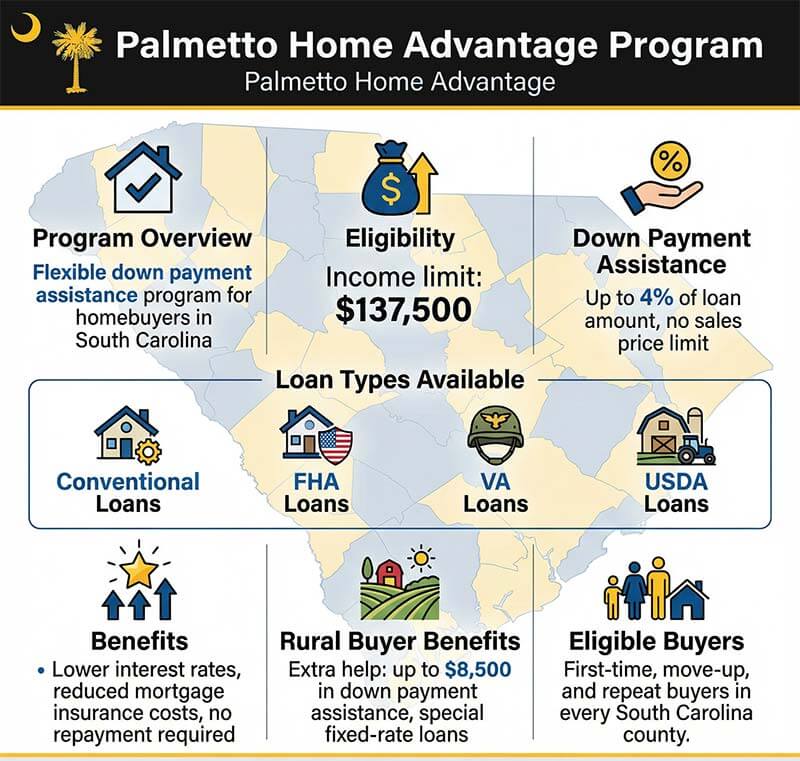
Palmetto Home Advantage is a flexible SC Housing option for buyers who may need help with the down payment but do not fit into a traditional first-time buyer program. According to SC Housing, Palmetto Home Advantage offers Conventional, FHA, VA, and USDA loan options for first-time, move-up, and repeat buyers, with no first-time home buyer requirement. This program may help buyers who have sufficient income to qualify for a mortgage but need help reducing the cash required to close. Borrowers still need to meet credit, income, occupancy, and lender guidelines. The amount and structure of assistance should be reviewed before applying because program terms can change.
County First Initiative
The County First Initiative is designed to support homeownership in certain rural or less-populated South Carolina counties. This can be helpful for buyers looking outside major metro areas who may qualify for additional assistance or favorable program terms. A buyer should not assume that every rural property automatically qualifies. The home, borrower, county, income, and loan type must all meet program guidelines. Buyers should confirm eligibility early, especially if they are comparing County First with USDA, FHA, VA, or Conventional financing.
Palmetto Heroes Program
The Palmetto Heroes Program is designed for eligible South Carolina buyers employed in qualifying public or community service roles. This program includes occupations such as teachers, law enforcement officers, firefighters, nurses, emergency medical workers, military personnel, veterans, and other approved professions, per current guidelines. Participants may benefit from South Carolina mortgage loans under this initiative. The program may offer down payment assistance and a fixed-rate mortgage for qualified buyers. Funding can be limited, and program details may change from year to year, so buyers should check current availability before relying on it. This program can be a strong option for eligible buyers, but approval still depends on income, credit, property, loan type, and SC Housing requirements.
South Carolina Home Loans When Credit Needs Work
Collections, late payments, or higher debt-to-income doesn’t automatically disqualify you. Get a quick review and the best loan path based on your real numbersHousing Assistance and Grants in South Carolina
Homebuyers in South Carolina may have access to housing assistance programs that can aid with down payments, closing costs, or both. These programs can be provided by SC Housing, local municipalities, nonprofit organizations, or employer-assisted housing initiatives. The specific assistance available will vary based on factors like the buyer’s income, household size, property location, loan program, and available funding, including options for certain South Carolina mortgage loans. It is important to understand the difference between minimum mortgage guidelines and assistance program overlays. FHA may allow a 580 credit score with a 3.5% down payment, but SC Housing, local assistance programs, or individual lenders may require higher credit scores for certain grants or down payment assistance options.
This does not mean FHA changed its basic rule. It means the assistance program or lender may have extra requirements.
The same idea can apply to VA, USDA, and Conventional loans. A buyer may meet the basic loan program rules but still need to meet separate income limits, purchase price limits, homebuyer education rules, property requirements, and credit score requirements for the assistance program. Some programs may also require the buyer to live in the home as a primary residence for a certain period. Before relying on a grant or forgivable loan, buyers should verify the availability of funds, determine whether the assistance requires repayment, and understand how the program might affect the interest rate or overall loan costs. A loan officer knowledgeable about South Carolina mortgage loans can assess the buyer’s credit, income, debt, and property location to help identify the best option.
Credit Score Requirements for South Carolina Mortgage Loans
Credit score requirements for South Carolina mortgage loans depend on the loan program, lender guidelines, down payment, debt-to-income ratio, and overall file strength. A credit score is important, but it is not the only factor used for approval. Lenders look at factors like your payment history, how steady your income is, your assets, how much credit you’re using, any past-due collections, charge-offs, and whether you’ve gone through bankruptcy or foreclosure. They also want to make sure you can actually handle the new housing payment.
FHA loans may allow buyers to qualify with a lower credit score than many conventional loan programs. FHA may allow a 580 credit score with a 3.5% down payment, but some lenders or assistance programs may require a higher score. Borrowers with scores below 580 may need a larger down payment and may have fewer lender options.
VA loans do not have one single minimum credit score set by the VA, but most lenders still set their own credit score requirements. Eligible veterans, active-duty service members, and qualifying surviving spouses may qualify with more flexible credit guidelines, especially when the file has strong income, stable employment, acceptable residual income, and a solid recent payment history. USDA loans can be flexible, but you’ll need to keep an eye on income limits, and your property must be in an eligible area. Some USDA lenders prefer higher credit scores, while others may review the full credit profile. Buyers with limited credit, recent late payments, or higher debt may need stronger compensating factors. Conventional loans usually require stronger credit than FHA, VA, or USDA loans. A higher credit score can help buyers qualify for better rates, lower mortgage insurance, and more loan options. Borrowers with lower scores may still qualify in some cases, but the loan may cost more or require higher income, lower debt, or a larger down payment. Non-QM and jumbo loans have lender-specific credit rules. Some Non-QM lenders may accept borrowers with recent credit events or alternative income documentation, but they may require a larger down payment, higher reserves, or a higher interest rate. Jumbo loans usually require stronger credit, larger savings, and a lower-risk financial profile because the loan amounts are higher. When considering South Carolina mortgage loans, buyers should avoid selecting a mortgage program solely based on credit score. Instead, it’s more effective to evaluate the entire financial profile first, then align the borrower with the loan program that provides the highest likelihood of approval and the most cost-effective long-term payments.
Which South Carolina Mortgage Loans Are Easier To Qualify For?
Some South Carolina mortgage loans may be more flexible than others, but no mortgage is automatically easy to get. Approval still depends on your credit score, payment history, income, employment, debt-to-income ratio, assets, property type, property location, and lender guidelines.
FHA loans may be easier for buyers with limited savings or lower credit scores because they allow a low down payment and more flexible credit guidelines than many conventional loans. However, borrowers still need enough income to support the payment, acceptable credit history, and a property that meets FHA standards.
VA loans may be easier for eligible veterans, active-duty service members, and qualifying surviving spouses because they may allow no down payment and no monthly mortgage insurance. VA loans can also be flexible with debt-to-income ratios, but lenders still review residual income, credit history, employment, assets, and VA property requirements. USDA loans may be easier for qualified buyers purchasing in eligible rural or suburban areas because they may allow no down payment. However, USDA loans have income limits, property location rules, and credit requirements. Not every South Carolina home or borrower will qualify. To determine the easiest path to securing South Carolina mortgage loans, it’s crucial to evaluate different loan programs based on your specific situation. A buyer eligible for military benefits might find the VA loan to be the most advantageous. Those purchasing in rural areas could benefit from the USDA loan. Buyers with lower credit scores or limited savings may qualify for an FHA loan, while those with stronger credit profiles might achieve greater savings with a conventional loan.
How To Get a Better Mortgage Rate in South Carolina
Securing a favorable mortgage rate in South Carolina begins even before you submit your application. Lenders review several factors, including your credit score, credit history, income, debt-to-income ratio, down payment, loan type, property type, and overall risk. When your financial profile is strong, you’re more likely to get an attractive rate on South Carolina mortgage loans. One of the best ways to improve your rate is to pay down credit card balances before applying. High credit card use can lower your credit score and make your file look riskier. Avoid opening new credit cards, taking out auto loans, or adding new debt before closing. Even one new monthly payment can affect your approval and rate. Your down payment can also affect your rate and total cost. A larger down payment may reduce lender risk, lower mortgage insurance, and improve loan options. However, some buyers may be better off using FHA, VA, USDA, or SC Housing assistance rather than depleting all their savings. The right choice depends on your cash-to-close, monthly payment, reserves, and long-term plans. Homebuyers in South Carolina should explore multiple loan options when considering South Carolina mortgage loans. FHA loans may be better for those with lower credit scores, while VA loans may offer favorable terms for eligible military personnel. USDA loans can assist qualified rural or suburban buyers by offering no down payment. For those with strong credit, conventional loans may yield better long-term savings. Additionally, non-QM and jumbo loans might suit buyers who need more flexible or higher balance financing. Rate locks also matter. A mortgage rate can change while your loan is being processed. Locking your rate can protect you from market changes before closing, but the lock period, cost, and expiration date should be reviewed carefully. Buyers should also compare lender fees, discount points, mortgage insurance, and closing costs because the lowest rate is not always the cheapest loan. SC Housing and local assistance programs may also help qualified buyers reduce upfront costs or access special mortgage options. Program rules, rates, income limits, and funding availability can change, so buyers should confirm current terms before relying on any assistance program.
Common Mistakes South Carolina Buyers Should Avoid
One of the most common errors buyers make in South Carolina is selecting a loan program before fully assessing their financial situation. South Carolina mortgage loans, whether FHA, VA, USDA, Conventional, Non-QM, or Jumbo, have varying rules and requirements. The ideal option hinges on your credit score, income, debts, down payment, property location, and long-term goals. Another common mistake is assuming that a low- or no-down-payment loan means no money is needed. VA and USDA loans may allow eligible buyers to purchase with no down payment, but buyers may still need money for closing costs, prepaid taxes, homeowners’ insurance, inspections, appraisal fees, and moving expenses. Seller concessions, gift funds, or assistance programs may help, but they must be approved under the loan guidelines. South Carolina buyers should also avoid making major financial changes before closing. Opening new credit cards, financing a car, changing jobs, depositing large, undocumented funds, or missing payments can create problems during underwriting. Even if you are already pre-approved, the lender may recheck your credit, income, assets, and employment before closing. Another mistake is failing to check property eligibility early. USDA loans need the home to be located in an eligible area. VA and FHA loans have property condition standards. Condos, manufactured homes, investment properties, and rural homes may have extra rules. Buyers should confirm that the property meets the loan program requirements before making a strong offer. Ultimately, buyers should avoid focusing solely on the lowest advertised rate when considering South Carolina mortgage loans. The best mortgage isn’t always the one with the lowest interest rate. Various factors, such as closing costs, mortgage insurance, discount points, assistance program details, loan type, and long-term objectives, all influence the true cost of the loan. An informed buyer compares the entire loan estimate rather than focusing solely on the interest rate.
Final Thoughts on South Carolina Mortgage Loans
South Carolina mortgage loans come in various options, but the ideal choice varies depending on the specific situation. Factors such as your credit score, income, debt, savings, military eligibility, property location, and long-term goals are crucial. Each type of loan—FHA, VA, USDA, Conventional, Non-QM, and Jumbo—caters to a specific borrower type. The key is to compare programs before choosing a home. A buyer in a USDA-eligible area may have a no-down-payment option. An eligible veteran may benefit from a VA loan. A buyer with stronger credit may save more with a conventional loan. A self-employed borrower may need a Non-QM loan if traditional income documents do not fully reflect their income. Buyers looking at higher-priced homes may need jumbo financing. Before applying, review your credit, estimate your cash to close, check property eligibility, and ask about South Carolina assistance programs. The right mortgage plan can help you avoid delays, reduce surprises, and choose a loan that fits your budget instead of forcing you into the wrong program.
Frequently Asked Questions About South Carolina Mortgage Loans
Can I Buy A House In South Carolina If I Am Not A First-Time Home Buyer?
Yes, you can buy a house in South Carolina even if you are not a first-time home buyer. FHA, VA, USDA, Conventional, Non-QM, and Jumbo loans may be available to repeat buyers, depending on your credit, income, debt, property type, and loan purpose. Some assistance programs are limited to first-time buyers, but others, such as Palmetto Home Advantage, may be open to move-up and repeat buyers who meet program rules.
Do South Carolina Mortgage Programs Have Income Limits?
Some South Carolina mortgage programs have income limits, while others do not. USDA loans and many assistance programs review household income to confirm eligibility. SC Housing programs may also have income limits based on the program, county, household size, and current guidelines. Standard FHA, VA, Conventional, Non-QM, and Jumbo loans may not have the same state-assistance income limits, but borrowers still need sufficient qualifying income to repay the loan.
Can Closing Costs Be Included In A South Carolina Mortgage?
Closing costs are not always added directly to the loan on a home purchase, but buyers may have options to reduce out-of-pocket costs. Seller concessions, lender credits, gift funds, and approved down payment assistance may help cover part of the closing costs. USDA loans may allow some costs to be financed in certain cases if the appraised value supports it, but this depends on program rules and lender approval.
Is A Home Inspection Required For A Mortgage In South Carolina?
A home inspection is usually not the same as a mortgage appraisal. The lender orders an appraisal to review value and basic property standards, but the buyer normally chooses whether to get a home inspection. Even when it is not required by the lender, a home inspection is strongly recommended because it can uncover roof, HVAC, plumbing, electrical, foundation, moisture, or pest issues before closing.
Can I Use Gift Funds To Buy A Home In South Carolina?
Yes, many mortgage programs allow gift funds, but the rules vary by loan type. FHA, VA, USDA, and Conventional loans may allow eligible gift funds from approved donors, but the lender must document the source of the funds and confirm that it is not an undisclosed loan. Gift funds can often help with the down payment, closing costs, or reserves, depending on the mortgage program.
How Long Does It Take To Close On A Mortgage In South Carolina?
The timeline varies widely depending on the lender, loan type, appraisal process, title work, borrower’s documents, and any issues with the property. A clean file can close faster, while USDA, down payment assistance, condo approvals, appraisal repairs, title problems, or missing documents can add delays. Buyers can help avoid delays by getting pre-approved early, sending documents quickly, and avoiding new debt before closing.
Can I Buy An Investment Home In South Carolina With A Low Down Payment?
Low down payment mortgage programs are usually designed for primary residences, not investment properties. FHA, VA, and USDA loans usually require you to actually live in the house as your primary home. Conventional and Non-QM loans may be used for investment properties, but they usually require more money down, stronger credit, and higher reserves than a primary home loan.
This article about “Best South Carolina Mortgage Loans for Buyers” was updated on June 3rd, 2026.
