Getting a mortgage denial after pre-approval can feel like the rug was pulled out from under you. You may already have a signed purchase contract, a closing date, inspection money spent, and an appraisal ordered. Then the lender calls and says the loan cannot move forward. This happens because a mortgage pre-approval is not the same as final loan approval. A pre-approval means the lender reviewed your basic credit, income, assets, and debts based on the information available at that time. Before closing, the underwriter still has to verify everything, review updated documents, inspect the property, confirm employment, clear conditions, and make sure nothing has changed. A mortgage denial after pre-approval can happen for various reasons, such as a drop in your credit score, new debt, or unverified income. Your debt-to-income ratio, low property appraisals, or issues with the property can affect your loan. Some lenders may have stricter requirements. If you get denied, it doesn’t mean you have no options. You can often change your application or ask another lender to review it.
Can a Mortgage Be Denied After Pre-Approval?
A mortgage denial after pre-approval can catch many homebuyers off guard, as they often assume pre-approval guarantees the loan, but this is incorrect. A mortgage pre-approval is conditional. It shows that the lender reviewed your credit, income, assets, and debts based on the information you provided at that time. However, the mortgage still needs to go through full underwriting before you get final approval.
Before closing, the underwriter must verify your documents, review the appraisal, confirm your employment, review your bank statements, clear any title issues, and make sure your financial situation has not changed. If something new comes up, the approval can change.
A new car payment, a lower credit score, a job change, a large unexplained bank deposit, a missed payment, or a higher debt-to-income ratio can cause problems before closing. This is why borrowers should treat pre-approval as an important first step, not the finish line. The loan is not final until all underwriting conditions are cleared and the lender issues a clear to close.
Pre-Approval vs Final Mortgage Approval
One big reason for mortgage denial after pre-approval is that borrowers often assume that all approvals are identical. However, this is not the case. The mortgage approval process occurs in distinct stages, and each stage involves a different level of scrutiny. Pre-qualification is the weakest step. It is often based on basic information you provide to the lender, such as income, debts, a credit estimate, and a down payment. The lender may not have reviewed your full documents yet. Pre-approval is stronger. The lender usually checks your credit, income documents, bank statements, debts, and loan application. But a pre-approval is still conditional. It is not a final yes. Underwriting approval means an underwriter has reviewed the file in greater detail. They check your income, credit, assets, debts, employment, and loan program rules. Conditional approval means the underwriter may approve the loan if certain items are cleared. These may include updated pay stubs, bank statements, letters of explanation, proof of earnest money, appraisal repairs, insurance, title documents, or employment verification. Clear to close is the strongest step before signing. It means the lender has cleared the major conditions and is preparing the final closing documents. The simple way to look at it is this: pre-approval starts the loan process, but clear-to-close gets you close to the finish line. Until the loan closes and funds are disbursed, changes in credit, income, debt, employment, assets, or the property can still cause problems.
Common Reasons a Mortgage Gets Denied After Pre-Approval
A mortgage denial after pre-approval usually happens because something changes or a new issue is discovered before closing. A pre-approval is based on the file at that moment. Final approval depends on what the underwriter finds later.
- Credit score drop: Your credit score could take a hit before closing if you miss a payment, pile up credit card debt, open new credit accounts, or have a new collection pop up. Even a small score drop can affect loan approval, interest rates, or mortgage insurance.
- New debt: A new car loan, credit card, personal loan, furniture account, or co-signed loan can raise your monthly debt. This can hurt your debt-to-income ratio and cause the lender to rework the approval.
- Undisclosed debt: Some borrowers forget to inform the lender about a payment that does not appear right away. This can include buy-now-pay-later accounts, private loans, business debt, or a debt paid by someone else. If the lender finds it before closing, the file may need to be reviewed again.
- Job change: Changing jobs during the mortgage process can create problems, especially if the new job has different pay, commission income, bonus income, overtime, self-employment income, or a probation period. Always talk to your loan officer before changing jobs.
- Unverifiable income: The lender must prove that your income is stable and likely to continue. If your employer will not verify your job, your pay stubs do not match your application, your tax returns show lower income, or your self-employed income cannot be documented, the loan can be denied.
- Debt-to-income ratio increase: Your debt-to-income ratio, also called DTI, compares your monthly debt payments to your gross monthly income. If your income decreases or your debts increase, your DTI may exceed the loan program’s limits.
- Appraisal problems: Sometimes the borrower qualifies, but the property does not. A low appraisal, safety repairs, missing utilities, peeling paint, roof problems, or property condition issues can delay or stop the loan.
- Title issues: The lender needs a clean title before closing. Old liens, unpaid judgments, ownership disputes, incorrect legal descriptions, unreleased mortgages, or estate issues can prevent the loan from moving forward.
- Assets not sourced: Large bank deposits must usually be explained and documented. If the lender cannot verify the source of the funds, those funds may not be allowed for the down payment, closing costs, or reserves.
- Tax issues: Unpaid taxes, tax liens, unfiled tax returns, or income that does not match the tax documents can create underwriting problems. Self-employed borrowers can run into this issue when tax write-offs lower the income the lender can use.
- Lender overlays: Sometimes the borrower meets the basic FHA, VA, USDA, conventional, or non-QM guidelines, but the lender has stricter rules. These extra rules are called lender overlays. A borrower may be denied by one lender but still qualify with another lender that has different guidelines.
The most important thing to remember is this: a mortgage denial after pre-approval does not always mean the loan is dead. It means the lender found an issue that must be fixed, explained, documented, or reviewed under a different loan program.
Why Lender Overlays Can Cause a Denial
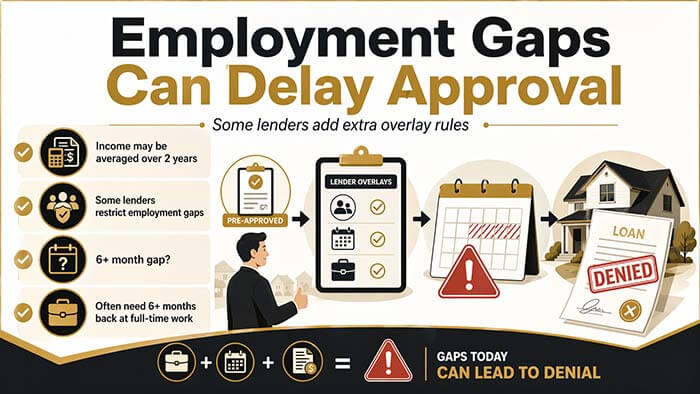 A mortgage denial after pre-approval does not always mean you failed the basic loan guidelines. Sometimes, the problem is the lender’s own extra rules. These extra rules are called lender overlays.
Plain and simple, an overlay is a rule a lender adds to FHA, VA, USDA, conventional, or non-QM loan guidelines. The loan program may allow something, but the lender may say no.
For example, FHA may allow a borrower to qualify with a 580 credit score for a 3.5% down payment, but one lender may require a 620 or 640 score. VA may not set a hard minimum credit score, but a lender may still require one. One lender may allow higher debt-to-income ratios, while another may cap DTI at a lower level. Overlays can also affect borrowers with recent late payments, collections, employment gaps, manual underwriting, lower credit scores, high DTI, or non-traditional income. This is why two lenders can look at the same borrower and give two different answers. This can be frustrating for homebuyers. You may be told you do not qualify, even though the real issue is not the loan program itself. The issue may be that the lender has stricter rules than the minimum agency guidelines. That’s why it’s important to ask one simple question after experiencing a mortgage denial after pre-approval: Was I denied because I do not meet the actual loan guidelines, or because of the lender’s overlay? The answer can clarify whether the loan is truly dead or whether another lender may still approve it.
What Underwriters Check Before Final Approval
A mortgage denial after pre-approval can happen when the underwriter finds something that was missed, changed, or not fully documented. Before final approval, the lender must make sure that the borrower, property, and loan meet the requirements.
- Credit: The underwriter reviews your credit report, credit score, payment history, credit inquiries, collections, charge-offs, judgments, and new debts. Some lenders may also refresh credit before closing to see if anything has changed.
- Income: The lender must confirm that your income is real, stable, and likely to continue. Pay stubs, W-2s, tax returns, 1099s, bank statements, profit and loss statements, or award letters may be reviewed depending on how you get paid.
- Assets: The underwriter verifies that you have sufficient verified funds for the down payment, closing costs, and reserves, if required. Large deposits usually need a paper trail so the lender knows where the money came from.
- Employment: The lender may verify your job before closing. A job change, reduced hours, unpaid leave, new commission income, or an employer verification issue can delay or hurt approval.
- Appraisal: The property must support the loan amount and meet the loan program’s property standards. A low value, required repairs, safety issues, or missing utilities can create problems before closing.
- Title: The lender needs a clear title before the loan can close. Old liens, unpaid taxes, ownership disputes, unreleased mortgages, judgments, or errors in the legal description can stop the file until they are fixed.
- Insurance: Homeowners insurance must be acceptable to the lender. For some properties, flood insurance, condo master insurance, or special coverage may also be required.
- AUS findings: AUS stands for automated underwriting system. The lender uses AUS findings to see what the loan program requires. If the file changes, the lender may need to rerun AUS, and the findings can change.
- Closing conditions: Even after conditional approval, the borrower must still clear final items. These can include updated bank statements, pay stubs, letters of explanation, proof of earnest money, title documents, insurance binders, appraisal repairs, or final verification of employment.
Final approval is not based on one item. It is based on the full file. Credit, income, assets, employment, property, title, insurance, AUS findings, and closing conditions all have to line up before the lender can issue a clear to close.
Pre-Approved Then Denied? Get a Second Opinion From True Experts
Reach out today and let us issue a fully documented pre-approval after your loan was denied in underwritingFHA Loan Denied After Pre-Approval
An FHA mortgage denial after pre-approval can happen even when the borrower thought they met the basic FHA rules. FHA loans are more flexible than many conventional loans, but they are still not automatic approvals. The borrower, property, credit, income, debts, and documents still need to pass underwriting.
FHA Credit Issues
FHA allows lower credit scores than many loan programs. Borrowers with a 580 credit score may be eligible for the 3.5% down payment option, while those with scores from 500 to 579 may need a 10% down payment. However, many lenders set their own higher credit score requirements. A borrower may meet FHA’s baseline credit requirements but still be denied due to a lender overlay.
Debt-to-Income Ratio
FHA loans can allow higher debt-to-income ratios when the automated underwriting system approves the file. However, that does not mean every borrower will qualify with a high DTI. If new debt appears, income is reduced, or the file must be manually underwritten, the allowed DTI may be lower.
Collections and Charge-Offs
FHA does not always require old collections or charge-offs to be paid off before closing. But collections still matter. Non-medical collections, disputed accounts, judgments, or recent negative credit can affect the approval. Some lenders may also require collections to be paid because of their own overlays.
Manual Underwriting
Some FHA files do not receive automated approval and may need manual underwriting. Manual underwriting is when a human underwriter reviews the full file rather than relying solely on automated findings. This can help some borrowers, but the rules are stricter. The underwriter may look closely at payment history, rent history, reserves, debt-to-income ratio, and compensating factors.
Lender Overlays
This is one of the most common reasons for an FHA mortgage denial after pre-approval. FHA may allow something, but the lender may have tougher rules. For example, one lender may require a higher credit score, lower DTI, fewer recent late payments, or no manual underwriting. An FHA denial does not always mean you cannot qualify for an FHA loan. It may mean the file needs to be reworked, more documents are needed, the DTI needs to be lowered, collections need to be reviewed correctly, or another lender with different overlays may need to look at the file.
Conventional Mortgage Denial After Pre-Approval
A conventional loan can be denied after pre-approval if the file no longer meets Fannie Mae, Freddie Mac, Desktop Underwriter, or lender requirements. Conventional loans can be stricter than FHA loans, especially when it comes to credit score, debt-to-income ratio, reserves, and income stability.
Credit Score
Many conventional loans require a minimum credit score of 620. However, a 620 score does not guarantee approval. The full file still matters. A borrower with a low score, high credit card balances, recent late payments, or thin credit may still run into problems before closing.
DU Findings
DU stands for Desktop Underwriter. It is Fannie Mae’s automated underwriting system. Even if a borrower was pre-approved, the lender may need to rerun DU if something changes. New debt, lower income, a different loan amount, a higher payment, or updated credit can change the findings.
Income Stability
Conventional underwriting looks closely at whether income is stable and likely to continue. A job change, lower hours, reduced overtime, commission income, bonus income, self-employment income, or inconsistent pay can cause the lender to question the income used for approval.
Reserves
Some conventional loans require reserves. Reserves are extra funds left over after closing. They may be required because of the property type, credit profile, loan amount, number of financed properties, or DU findings. If the borrower does not have enough verified reserves, the approval can be affected.
Debt-to-Income Ratio
Conventional loans can be sensitive to changes in DTI. A new car payment, a credit card balance increase, a personal loan, a student loan payment, or co-signed debt can push the DTI too high. Even a small payment change can matter if the file was already tight.
Lender Overlays
A borrower may meet basic conventional loan guidelines, but still get denied because the lender has stricter rules. One lender may require a higher credit score, lower DTI, more reserves, cleaner credit history, or stronger employment history than another lender. A conventional mortgage denial after pre-approval does not always mean the borrower cannot qualify. It may mean the file needs to be updated, restructured, rerun through DU, switched to a different loan program, or reviewed by a lender with fewer overlays.
VA or USDA Loan Denial After Pre-Approval
A VA or USDA mortgage denial after pre-approval happens if the file does not meet underwriting guidelines. These loan programs are helpful for eligible borrowers, but the approval still depends on the full file, the property, and the lender’s requirements.
For VA loans, one common issue is residual income. Residual income is the money left over each month after major bills are paid. VA loans look beyond the debt-to-income ratio. A borrower may have an acceptable DTI, but if the residual income is too low for the family size and location, the loan can run into problems.
VA loans can also be affected by credit issues, recent late payments, employment changes, unpaid debts, appraisal repairs, or lender overlays. Since VA loans are made by private lenders, one lender may have stricter rules than another. For USDA loans, both the borrower and the property must qualify. USDA has income limits based on household size and location. If household income is too high, the borrower may not be eligible. The property must also be in an eligible USDA area and meet USDA property standards.
A USDA mortgage denial after pre-approval may happen because of income eligibility, property location, appraisal repairs, debt-to-income ratio, credit issues, or changes found during underwriting.
VA and USDA pre-approval is still conditional. Final approval depends on credit, income, assets, employment, property eligibility, appraisal, title, and all underwriting conditions being cleared before closing.
What To Do If Your Mortgage Is Denied Before Closing
Getting denied before closing is stressful, but do not panic or start making random changes. A mortgage denial after pre-approval needs a clear plan. The first step is to find out exactly why the loan was denied.
Ask for the Reason in Writing
Do not rely only on a phone call. Ask the lender to explain the denial clearly. Was it credit, income, debt-to-income ratio, employment, appraisal, title, assets, AUS findings, or a lender overlay? You need the real reason before you can fix the problem.
Ask for the AUS Findings if Possible
AUS stands for automated underwriting system. FHA, VA, USDA, Fannie Mae, and Freddie Mac loans often depend on automated findings. If the file was denied because AUS changed or gave a refer result, knowing that can help another lender review the file correctly.
Do Not Open a New Credit
This is not the time to buy furniture, finance a new car, apply for a new credit card, or co-sign for someone else. New debt can make the problem worse and may lower your credit score or increase your debt-to-income ratio.
Gather Updated Documents
Be ready to provide your most recent pay stubs, bank statements, tax returns, W-2s, 1099s, letters of explanation, proof of deposits, divorce documents, bankruptcy papers, or payment histories. The faster you document the issue, the better your chance of saving the loan.
Ask if the loan can be restructured
Sometimes the file can still work with changes. The lender may be able to lower the loan amount, pay off a debt, add reserves, change the loan program, remove a borrower, add a non-occupant co-borrower if allowed, or adjust the down payment.
Find Out if the Issue is a Lender Overlay
A denial does not always mean you failed the actual loan guidelines. Sometimes the lender has stricter rules than those required by FHA, VA, USDA, Fannie Mae, or Freddie Mac. If the denial is due to an overlay, another lender may review the same file differently.
Get a Second Opinion Fast
If you are under contract, time matters. Send the denial reason, credit report if available, income documents, asset documents, purchase contract, appraisal status, and any underwriting conditions to a lender experienced with denied files. A second opinion can help determine whether the loan is truly dead or needs to be moved to the right lender or loan program. The key is to stay calm and work from facts. A mortgage denial before closing is serious, but it may still be fixable when you know the exact reason, avoid new financial changes, and get the file reviewed correctly.
Can You Switch Lenders After Being Denied?
Yes, you can switch lenders after experiencing a mortgage denial after pre-approval, but timing matters. If you are already under contract, each day counts. The new lender will need to review your credit, income, assets, debts, purchase contract, appraisal status, title work, and loan conditions to determine if your application can be salvaged.
Switching lenders may make sense if the denial was caused by a lender overlay, poor pre-approval review, missing documents, or a loan officer who did not structure the file correctly. A different lender may be able to approve the same borrower if they follow different guidelines or offer a better loan program.
The appraisal may also be transferable, depending on the loan type and the new lender’s rules. FHA and VA appraisals are often tied to the borrower and property, so a transfer may be possible. Conventional appraisals are not always transferable because the new lender may require the appraisal to be ordered through its own appraisal process. Even if an appraisal can be transferred, the new lender must accept it. Before switching, ask the new lender direct questions:
- Can they use the existing appraisal?
- Do they allow the issue that caused the denial?
- Can they meet the contract deadline?
- Will the file need to be rerun through AUS?
- Are there any overlays that could cause another denial?
Switching lenders can work, but it should be done quickly and with the right information. The faster the new lender receives the denial reason, income documents, bank statements, purchase contract, appraisal, and underwriting conditions, the faster they can decide whether the loan can still close.
How To Avoid Mortgage Denial After Pre-Approval
The best way to avoid mortgage denial after pre-approval is to keep your finances as stable as possible until the loan closes. A pre-approval looks at your credit score, income, debts, assets, and job status when the lender checks your info. If anything changes with those, your approval might change too.
Do Not Take on New Debt
Avoid opening credit cards, buying furniture, financing a car, taking out a personal loan, or co-signing for someone else. Even a small new monthly payment can raise your debt-to-income ratio and create problems before closing.
Do Not Change Jobs Without Checking First
A new job may sound like good news, but it can delay or hurt the loan if the pay structure changes. Salary, hourly, overtime, bonus, commission, part-time, contract, and self-employed income are reviewed differently. Always speak with your loan officer before changing jobs.
Do Not Make Large Bank Deposits Without a Paper Trail
Lenders need to know where your money came from. Large cash deposits, money from friends or family, business transfers, or undocumented funds can create underwriting issues. If money is being gifted, transferred, or moved, document it before it hits the account.
Keep Your Credit Stable
Pay bills on time, keep credit card balances low, and avoid new credit inquiries. Do not let a small mistake turn into a lower credit score before closing. Many lenders recheck credit before disbursing loan funds.
Respond Fast to Conditions
If the underwriter requests updated pay stubs, bank statements, letters of explanation, proof of deposits, insurance, or title documents, send them promptly. Slow responses can delay closing and may create more questions.
Do Not Move Money Around Without a Reason
Moving funds between accounts can create extra paperwork. If you need to transfer money for closing, ask your loan team how to do it so the funds can be sourced clearly.
Tell Your Lender About Changes Right Away
If your hours are cut, your job changes, a new debt appears, a large deposit hits your account, or your credit score changes, do not hide it. It is better to address the issue early than have the underwriter find it right before closing. The most important guideline to follow is simple: from the pre-approval stage to closing, avoid making major financial changes without consulting your loan officer first. Maintaining stability in your credit, income, assets, and debts is important; otherwise, you risk mortgage denial after pre-approval. It’s essential to keep everything steady until the loan has been closed and funded.
Final Thoughts on Mortgage Denial After Pre-Approval
A mortgage denial after pre-approval can feel overwhelming, but it does not always mean the home purchase is over. The first step is to find out the exact reason for the denial. Once you know whether the issue is credit, income, debt, employment, appraisal, title, assets, or lender overlays, you can decide what to do next.
Do not make quick financial moves without guidance. Avoid new debt, keep your credit stable, gather updated documents, and ask whether the loan can be restructured. If the denial was due to a lender overlay, another lender may be able to review the file under different guidelines.
Pre-approval is an important step, but it is not final approval. The loan is not safe until all conditions are cleared, the lender issues a clear to close, and the loan funds are received.
FAQs About Mortgage Denial After Pre-Approval
Can You Lose Your Earnest Money If Your Mortgage Is Denied?
You can lose your earnest money if your mortgage is denied and your contract doesn’t protect you. Many contracts have a financing contingency that allows you to cancel and keep the earnest money if the loan is denied before the deadline. If you miss the deadline or fail to comply with the contract terms, the seller can keep the deposit. Before making a decision, always have your contract reviewed by your real estate agent or attorney.
Can A Seller Cancel The Contract If My Loan Is Denied?
A seller may be able to cancel the contract if the buyer cannot close by the deadline and there is no approved extension. This depends on the purchase agreement, financing contingency, closing date, and state rules. If the loan is denied, tell your real estate agent right away so they can ask about an extension or explain your options under the contract.
Can A Mortgage Denial Be Reversed?
Sometimes, yes. A mortgage denial can be reversed if the issue is resolved and the lender is willing to review the file again. For example, the borrower may be able to provide missing documents, explain a large deposit, pay down debt, correct a credit report error, or switch to a different loan program. If the denial is final with one lender, another lender may still be able to review the file.
How Long Should You Wait To Apply Again After a Mortgage Denial?
There is no single waiting period after a mortgage denial. It depends on why the loan was denied. If the issue was missing documents or a lender overlay, you could apply with another lender right away. If the issue was late payments, low credit scores, unstable income, or excessive debt, you may need more time to address it before applying again.
Does Being Denied For A Mortgage Hurt Your Credit Score?
The denial itself does not directly hurt your credit score. However, the credit inquiry from the mortgage application may appear on your credit report. Your score may also be affected if the denial was connected to late payments, high credit card balances, new debt, collections, or other credit problems. The bigger issue is usually the reason behind the denial, not the denial by itself.
Can You Get Denied After Signing The Closing Documents?
It is rare, but a loan can still run into problems if it has not yet been funded. Signing documents does not always mean the loan is complete. Some loans still require final funding review, wire approval, or last-minute checks. Borrowers should avoid opening new credit, changing jobs, or moving money around until the loan has officially funded.
What Happens To The Appraisal If The Mortgage Is Denied?
The appraisal does not automatically disappear if the mortgage is denied. Whether it can be used again depends on the loan type, the lender, and appraisal transfer policy. FHA and VA appraisals may be transferable in some cases. Conventional appraisals may be harder to transfer because many lenders require appraisals to be ordered through their approved systems.
Should You Tell The Seller If Your Mortgage Is Denied?
Yes, but you should work through your real estate agent. The seller usually needs to know if the closing may be delayed or if the financing has fallen apart. Your agent can help explain the situation, request more time, ask for an extension, or protect your position under the purchase contract. Do not ignore the problem, because missed deadlines can make things worse.
This article about “Mortgage Denial After Pre-Approval? What To Do Next” was updated on June 11th, 2026.