Choosing the wrong listing agent can hurt your home sale before it even begins. Many homeowners make avoidable mistakes in the first few days of interviewing realtors, such as trusting the highest price estimate, skipping questions about marketing, or signing a listing agreement too quickly. Those early decisions can affect your asking price, days on market, negotiation leverage, and the amount you actually walk away with at closing.
If you want to sell for the best possible price and avoid unnecessary delays, it is important to know the most common mistakes sellers make choosing a realtor. The right agent can help you price the home correctly, attract serious buyers, manage showings efficiently, and negotiate offers with a clear strategy. The wrong one can lead to poor pricing, weak marketing, missed opportunities, and a more stressful sale.
This guide explains the top mistakes sellers make choosing a realtor, why those mistakes matter, and how to compare agents more carefully before you sign a listing agreement. Whether you are selling in a fast-moving or slower market, knowing what to ask upfront can help you protect your equity and make better decisions from day one.
Why Choosing the Right Realtor Matters When Selling a Home
Your listing agent does much more than put your home on the MLS. The realtor you hire helps shape your pricing strategy, listing presentation, buyer interest, offer quality, and negotiation outcome. In many cases, the success of a home sale depends on the decisions made before the property even goes live.
A strong realtor should be able to explain how they would price your home based on recent comparable sales, what improvements or staging steps may help it show better, how they plan to market it online, and how they would handle offers, inspection requests, and appraisal issues.
These are not minor details. They can directly affect how quickly your home sells and whether you end up accepting less than you should.
That is why understanding the common mistakes sellers make choosing a realtor is so important. A careful hiring decision can help you avoid overpricing, poor communication, weak negotiation, and contract problems later in the process.
Top Mistakes Sellers Make Choosing a Realtor
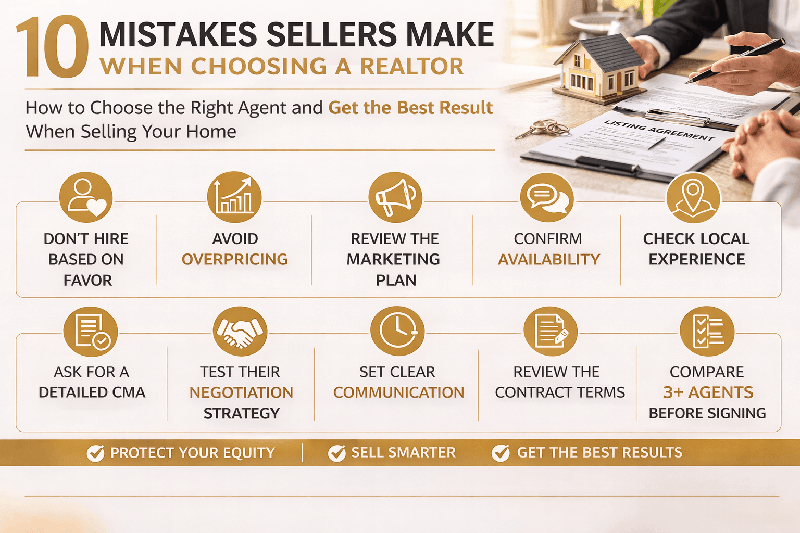
Mistake 1 – Hiring a Friend or Relative Without Comparing Other Agents
One of the most common mistakes sellers make choosing a realtor is hiring a friend, relative, neighbor, or casual acquaintance without interviewing anyone else. The problem is not that someone you know cannot be a great real estate agent. The real problem is that personal familiarity often causes sellers to skip the same due diligence they would normally do with any other professional.
Selling a home is too important to base on comfort alone. Before you hire someone you know, compare them with at least two or three other listing agents. Ask how many seller-side transactions they closed in the past 12 months, what price ranges they usually work in, how their listings perform on days on market, and whether they have recent experience selling homes in your neighborhood or ZIP code.
A friend may still be the right choice, but they should earn the listing based on strategy, communication, and results, not on the relationship.
A strong listing agent should be able to explain how they would price your home, market it, handle showings, manage negotiations, and guide you from listing to closing. If your decision is based mostly on loyalty or avoiding an awkward conversation, you may be setting yourself up for weak pricing advice, poor communication, or missed opportunities later.
Mistake 2 – Choosing the Agent With the Highest Price Instead of the Best Pricing Strategy
Many homeowners choose the agent who promises the highest listing price because it feels like the most optimistic and profitable path. In reality, this is one of the most expensive mistakes sellers make choosing a realtor. Some agents inflate the suggested price to win the listing, knowing the seller wants to hear the highest number. Once the home sits too long without activity, the price reductions begin, and the listing can quickly lose momentum.
A better way to judge an agent is to ask how they arrived at their recommended price. A strong realtor should walk you through a written Comparative Market Analysis, not just throw out a flattering number. A useful CMA should include recently sold homes, pending listings, relevant active competition, average days on market, recent price reductions, and adjustments for differences in condition, lot size, upgrades, layout, garage space, or unique features. It should also explain the realistic price range where your home is likely to attract showings and offers.
If an agent cannot clearly support the price with comparable sales and market reasoning, that is a red flag. Sellers do not just need a high number. They need a pricing strategy that balances visibility, buyer demand, appraisal support, and negotiation leverage. Pricing correctly from the start often matters more than starting high and chasing the market downward.
Mistake 3 – Accepting a Vague or Outdated Marketing Plan
Another major mistakes sellers make choosing a realtor is assuming all agents market listings the same way. They do not. Some agents still rely almost entirely on the MLS and yard sign. In contrast, others build a full launch strategy designed to maximize exposure in the first days on market.
A good marketing plan in 2026 should be specific, not vague. Your agent should explain how they would prepare the home before it goes live, including staging suggestions, decluttering guidance, repair recommendations, and photo readiness. They should also discuss professional photography, compelling listing copy, distribution to major home search platforms, mobile-friendly presentation, and, when appropriate, video walkthroughs or short-form social content.
Depending on the property and market, they may also have a strategy for open houses, agent-to-agent outreach, email marketing, and follow-up after buyer showings.
Ask to see examples of recent listings they marketed. Look at the quality of the photos, the writing, the presentation, and how well the home was positioned online. If the answer is basically “I’ll put it on the MLS and let it do its job,” that is not a strong marketing plan. Sellers should know exactly how their agent intends to attract attention, generate showings, and build momentum early.
Mistake 4 – Looking Only at Reviews Instead of the Full Track Record
Checking reviews is smart, but stopping there is one of the mistakes sellers make when choosing a realtor. Reviews are helpful, but they are only one part of the picture. A stronger evaluation looks at what the agent has actually done recently, especially on the listing side.
When interviewing agents, ask how many homes they sold in the last year, how many of those were listings rather than buyer deals, and whether they regularly work in your price range. Ask about average days on market, how close their listings tend to sell compared with list price, and what types of homes they most often represent. You want to know whether they have recent, relevant experience with homes like yours.
Reviews also matter more when you read them closely instead of just counting stars. Look for comments about communication, pricing advice, problem-solving, negotiation, and how the agent handled issues during inspection or closing. A smaller number of detailed, recent reviews can be more valuable than a larger number of generic ones. Sellers should look for proof of performance, not just polished online branding.
Mistake 5 – Not Confirming Availability, Response Time, and Who Will Actually Handle the Listing
Many articles say to avoid part-time agents, but the deeper issue is responsiveness and availability. One of the biggest mistakes sellers make choosing a realtor is assuming the person they meet at the listing appointment will always be the one actively managing the sale.
Before signing, ask practical questions.
How quickly do you respond to showing requests? Who answers if you are unavailable? Will I work directly with you or with a team member after I sign? How do you handle offers that come in at night, on weekends, or while you’re traveling? How often should I expect updates while the property is active?
The answers matter because home sales move quickly. A missed call, delayed response, or poorly coordinated showing can mean losing momentum with a serious buyer. Some full-time agents are overloaded and hard to reach, while some agents with fewer listings may provide excellent attention. The key is not simply whether the agent is full-time. It is whether your home sale will receive timely, professional handling when decisions need to be made fast.
Don’t Let the Wrong Realtor Cost You Thousands
We break down the top mistakes sellers make—and how you can avoid them when listing your home.
Mistake 6 – Failing to Set Clear Communication Expectations From the Start
Poor communication is one of the most common seller complaints in real estate. Yet many homeowners do not clarify their expectations before signing a listing agreement. This is one of the more subtle mistakes sellers make choosing a realtor because it does not show up until the home is already on the market.
A strong listing relationship should include a clear communication rhythm. Ask how often you will receive updates, whether feedback will be shared after showings, when the agent will discuss pricing adjustments if traffic is weak, and whether you should expect a weekly performance recap. Also, ask whether communication will come directly from the agent or from a team coordinator or assistant.
This matters because sellers often want different levels of contact. Some want quick text updates after every showing. Others prefer a weekly scheduled call with a summary of activity, buyer comments, and next steps. Neither preference is wrong, but both sides need to align before listing. A good agent should be able to explain how they communicate, how fast they respond, and how they keep sellers informed when the market response is stronger or weaker than expected.
Mistake 7 – Hiring an Agent Without Strong Knowledge of Your Neighborhood and Buyer Pool
Real estate is local, and one of the biggest mistakes sellers make choosing a realtor is hiring someone who speaks confidently about the broader market but cannot speak specifically about your neighborhood, property type, or likely buyer profile.
A knowledgeable local listing agent should be able to explain what buyers in your area care about most, which upgrades carry weight, what price points move fastest, and what recent comparable sales reveal about demand. They should understand local competition, school district appeal (where relevant), commute patterns, neighborhood amenities, lot characteristics, and whether your likely buyer is a first-time homeowner, a move-up buyer, a downsizer, or an investor.
Ask how many homes they have sold in your ZIP code or nearby neighborhoods. Ask what features they would emphasize in your listing and what concerns buyers may raise. If an agent speaks in broad metro-level terms but cannot discuss your specific micro-market, that can lead to weaker pricing, generic marketing, and missed selling points. The more local the knowledge, the stronger the positioning tends to be.
Mistake 8 – Focusing Only on Commission Without Considering Service, Strategy, and Support
One of the big mistakes sellers make when choosing a realtor is looking only at the commission rate or picking the cheapest option without knowing what they’ll get in return. Just because a realtor charges less doesn’t mean they offer less value, and paying more doesn’t always mean better service. What’s important is the whole package, including pricing advice, marketing, negotiation skills, and support throughout the sale.
When comparing realtors, ask what services are included in their listing fee. Do they offer professional photos, help with staging your home, digital marketing, support during open houses, contract negotiation, repair management, handling appraisal issues, and coordinating the closing? Are there any extra fees? Will the same agent handle important decisions, or will different people take over once the listing is signed?
Some lower-cost options might be a good fit for certain sellers and markets. The trouble starts when sellers compare commission rates without considering the actual services and strategies they provide. A cheaper listing can end up costing more if the home is priced too high, poorly marketed, not negotiated well, or requires repeated price cuts.
Mistake 9 – Not Testing the Agent’s Negotiation Strategy Before You Hire Them
Many sellers think negotiation only starts once offers come in, but one of the smartest things you can do before hiring a realtor is test how they think about negotiation in real-life situations. Too many sellers choose an agent based on personality, promises, or listing presentation without asking how they would actually handle pressure points in the transaction.
Ask how they respond to low offers, how they compare multiple offers beyond just headline price, how they handle inspection repair requests, and when seller credits make more sense than repairs. Ask how they address appraisal gaps, financing risk, or buyers’ requests for extensions.
A strong listing agent should be able to discuss price, terms, contingencies, timing, and fall-through risk in a calm, clear way.
Listen carefully to the quality of the answer. A weak response sounds vague, such as “I’m a great negotiator” or “We’ll cross that bridge when we get there.” A stronger response explains the decision-making process. For example, a good agent may say they review each offer based on price, financing strength, inspection terms, appraisal exposure, closing timeline, and the likelihood the buyer can actually get to the closing table. That is the kind of practical thinking sellers should look for.
Mistake 10 – Signing the Listing Agreement Without Reviewing the Full Contract Terms
A final mistake sellers make choosing a realtor is paying attention only to the listing term while overlooking the rest of the agreement. The length of the contract matters, but it is not the only term that can affect your flexibility and protection.
Before signing, review the listing period, cancellation or early termination language, protection period after expiration, commission structure, and whether any additional fees apply. Ask what marketing services are included, whether there are any out-of-pocket charges, and how disputes are handled if you are unhappy with performance. If the agent works on a team, ask whether you can shift to another team member if communication breaks down.
You should also ask how price reductions are typically handled during the contract period. A good agent should have a clear process for reviewing showing volume, feedback, online engagement, and buyer response if the home is not getting traction. Sellers should not wait until frustration builds to understand how strategic changes will be made. A listing agreement isn’t just a simple formality; it’s really important. It lays down the rules for one of the biggest financial deals that most people will ever make.
The most common mistakes sellers make choosing a realtor are not always obvious at first. Many happen before the home is even listed, during the first conversations about pricing, marketing, communication, and contract terms. The more carefully you compare agents upfront, the better your chances of pricing your home correctly, attracting qualified buyers, and protecting your equity throughout the sale process.
Seller Interview Scorecard: How to Compare Realtors Before You Sign
Instead of choosing a listing agent based on personality, the highest price suggestion, or the lowest commission, use a simple scorecard to compare realtors side by side. This helps you evaluate who has the strongest local experience, the clearest pricing strategy, the best marketing plan, and the communication style that fits your needs.
When you interview agents, score each one in the following categories.
1. Local Sales Experience
Find out how many houses the agent has sold in your area, ZIP code, or nearby neighborhood in the last year. Also, ask whether they primarily work with sellers or mostly represent buyers. A strong listing agent should understand local buyer behavior, competing inventory, and what features matter most in your area.
A strong answer includes recent seller-side experience, familiarity with similar homes, and confidence in discussing local pricing and buyer demand.
2. Pricing Accuracy and CMA Quality
Ask each agent to walk you through a written Comparative Market Analysis rather than just giving you a number. A useful CMA should include recently sold properties, pending listings, active competition, average days on market, and realistic pricing logic based on your home’s condition, size, updates, and location.
A strong answer shows clear comparable sales, explains any adjustments, and provides a realistic price range rather than just the highest estimate.
3. Marketing Process
Ask exactly how the home will be prepared, photographed, presented, and promoted once listed. You want to know whether the agent uses professional photography, staging guidance, strong listing copy, major home-search site distribution, social media exposure where appropriate, and a launch strategy designed to create early interest.
A strong answer includes specific marketing steps, examples of recent listings, and a clear plan for how the home will stand out online.
4. Response Time and Availability
Ask how quickly the agent responds to showings, offers, and seller questions. Also, ask who will handle the listing day to day if the agent works with a team. This matters because real estate moves quickly, and delays can cost you showings, leverage, and serious buyers.
A strong answer explains expected response time, how after-hours activity is handled, and whether you will work directly with the agent or with support staff.
5. Communication Style and Update Frequency
Find out how often you can expect updates from the agent while your home is listed for sale. Will they update you after every showing when feedback is available? Will you receive a weekly recap? Will communication be by text, phone, or email? These details matter because poor communication is one of the most common seller complaints.
A strong answer includes a clear update schedule and matches the level of communication you want during the listing period.
6. Negotiation Approach
Ask how the agent handles low offers, multiple-offer situations, inspection requests, repair credits, and appraisal issues. Do not settle for a vague claim like “I’m a great negotiator.” You want to hear how they think through real scenarios and protect your position.
A strong answer explains how offers are compared beyond just price, how terms affect net proceeds, and how the agent keeps deals together without giving away too much.
7. Contract Flexibility
Ask about the listing agreement length, cancellation options, protection period, and any extra fees. Sellers should understand how long they are committed for, what happens if the service is disappointing, and whether there is a reasonable path out of the agreement if expectations are not met.
A strong answer includes clear contract terms, realistic expectations, and flexibility rather than pressure.
Simple Realtor Comparison Scorecard
You can also turn your interviews into a simple rating system. Score each agent from 1 to 5 in the categories below:
- Local market experience
- Pricing strategy
- Marketing plan
- Response time
- Communication style
- Negotiation approach
- Contract flexibility
The agent with the highest score isn’t necessarily the right one, but this process can help you compare real strengths rather than making a rushed decision based on charm or promises alone.
How Gustan Cho Associates Helps You Find the Right Realtor
If you are comparing listing agents and want a second opinion, Gustan Cho Associates can help point you toward questions to ask and factors to compare before you sign with a realtor. The most important step is to interview agents carefully, review their pricing and marketing strategy, and choose the professional who best fits your goals and local market.
Conclusion: Avoid Common Mistakes Sellers Make Choosing a Realtor
Selecting the right realtor is one of the most crucial decisions you’ll face when selling your home. A skilled agent can assist you in accurately pricing your property, effectively marketing it, confidently managing negotiations, and preventing delays that could diminish your leverage.
Conversely, making a poor choice can lead to mistakes sellers make choosing a realtor, such as weak pricing, ineffective communication, unnecessary stress, and ultimately a lower net profit at closing. To avoid these pitfalls, it’s advisable to interview at least 3 listing agents using the questions and scorecard provided in this guide. Investing time in this process will help you make a more informed decision and safeguard your equity throughout the sale.
If you’re seeking a second opinion while evaluating your options, Gustan Cho Associates can offer valuable insights to help you identify the right questions to ask and the key qualities to look for in a realtor in your market.
Frequently Asked Questions About the Mistakes Sellers Make Choosing a Realtor:
How Many Realtors Should I Interview Before Selling My Home?
- Interviewing at least three listing agents is usually a smart way to compare pricing strategy, communication style, local market experience, and marketing plans. Speaking with multiple agents makes it easier to spot who is giving you real data and who is simply telling you what you want to hear.
What Should I Ask a Realtor Before Listing My Home?
- Before signing with a realtor, ask how they would price your home, what their marketing plan includes, how often they will update you, how they handle low offers or repair requests, and how long their listing agreement lasts. You should definitely find out how many homes they’ve sold recently in your area and price range.
How Do I Know if a Realtor is Pricing My Home Correctly?
- A good realtor should support the suggested listing price with a written comparative market analysis based on recently sold homes, active competition, and pending listings. If the price sounds much higher than what other agents recommend and the explanation is weak, that can be a sign the home is being overpriced to win the listing.
What Should a Good Real Estate Marketing Plan Include?
- A strong marketing plan should go beyond putting the home on the MLS. Sellers should look for professional photography, strong listing presentation, online exposure across major home-search sites, social media promotion where appropriate, and a clear plan for how the property will be prepared and launched.
Is it Better to Hire a Full-Time Realtor When Selling a Home?
- In most cases, sellers prefer an agent who is readily available to respond to showings, offers, and contract issues quickly. The bigger issue is responsiveness and whether your listing will get prompt attention, but many seller-focused resources still emphasize the value of working with a full-time real estate professional.
How Long Should a Listing Agreement with a Realtor Last?
- Many sellers are more comfortable starting with a shorter listing period and extending it if the relationship is working well. What matters most is understanding the contract terms clearly, including how long the agreement lasts, whether there is a cancellation option, and what happens if the home does not sell during the initial term.
This article about “Mistakes Sellers Make Choosing a Realtor (How to Avoid Them)” was updated on March 12th, 2026.
Before You List—Read This First
Not all agents are created equal. Learn the red flags and questions to ask before signing anything.