Quick Answer: FHA guidelines on late payments after bankruptcy vary depending on the account in question, how late the payment was, when it was late, and whether it’s an automated or manual underwriting loan. A single late payment on a credit card is not going to be assessed the same as a missed payment on a housing loan, an installment loan, or a Chapter 13 plan. Automated findings must still be FHA-compliant. Manual underwriting has its own set of payment history rules, and any exception will require supporting documentation. A higher score, a larger down payment, or an explanation letter will not automatically sort it. Missing a payment after bankruptcy will, of course, raise the question of whether you can still go ahead and buy a house. Some people will still qualify, but the answer to that question will depend on the actual payment history and the underwriting rules that apply.
Start With the Account, Date, and Payment Pattern
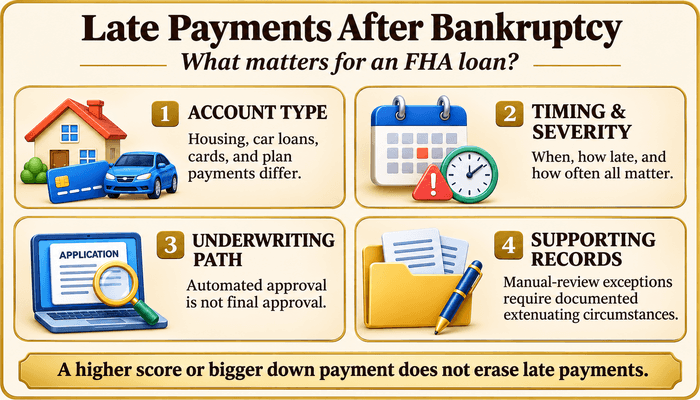
Before deciding what a late payment means for an FHA application, identify:
- The account: Rent, mortgage, vehicle loan, credit card, or Chapter 13 repayment plan.
- The severity: How many days late the payment was and whether the account remains past due.
- The timing: When the payment was due, when it was received, and how those dates relate to the bankruptcy.
- The pattern: Whether the problem was isolated or part of repeated missed payments.
A recent credit-report update is not necessarily the date of a new missed payment. Review the monthly payment history and account records rather than relying solely on an account’s last updated date. The bankruptcy itself must also meet FHA eligibility requirements. For that separate review, see FHA mortgage requirements after bankruptcy.
Why an Automated Approval Does Not Settle the Question
An automated underwriting recommendation does not mean that a borrower with late payments following bankruptcy will automatically qualify. The lender is still required to verify the information provided, satisfy FHA requirements, and determine whether manual underwriting is needed.
FHA uses its TOTAL Mortgage Scorecard via an automated underwriting system. HUD states that lenders are not permitted to approve or reject an FHA mortgage based solely on the TOTAL score. An Accept recommendation could still be subject to a manual downgrade in accordance with the relevant rules.
Mortgage-payment downgrade rules also differ by transaction. A purchase and a cash-out refinance should not be assumed to have identical payment-history requirements. Your loan officer needs to identify the correct rules before interpreting an automated result.
FHA Manual Underwriting Standards for Late Payments
Manual underwriting has defined satisfactory payment-history standards. It does not simply allow an underwriter to overlook recent delinquencies because other parts of the application are strong.
| Account category | FHA’s satisfactory-history benchmark for manual underwriting |
|---|---|
| Housing and installment debts | All housing and installment payments made on time during the previous 12 months, with no more than two 30-day late mortgage or installment payments during the previous 24 months |
| Revolving accounts, such as credit cards | No major derogatory credit during the previous 12 months; HUD includes payments made more than 90 days after the due date, or three or more payments made more than 60 days after the due date |
The 24-month allowance does not make late housing or installment payments acceptable within the most recent 12 months under that satisfactory-history benchmark. The requirements must be considered together. An isolated 30-day credit-card late payment does not automatically fall into the major-derogatory category described above. However, the underwriter still evaluates the overall payment pattern and the rest of the application.
What Happens When Payment History Falls Outside These Standards?
HUD requires additional analysis to determine why the delinquency occurred. Under this manual-underwriting provision, approval requires the underwriter to document that the delinquency was related to extenuating circumstances. The explanation and supporting records must be consistent with the rest of the file. A general statement that you experienced financial difficulty is not the same as a documented underwriting exception. These standards appear in HUD Handbook 4000.1, under the manual underwriting credit requirements.
Chapter 13 Plan Payments Need Separate Attention
A late Chapter 13 plan payment should not be regarded as a standalone late credit card payment. For FHA financing in an active Chapter 13, the lender must verify that there has been satisfactory performance over the most recent 12 months, with all payments due under the plan made on time. Bringing the plan up to date makes no difference if payments have already been made. You need to provide the trustee’s ledger and any court-approved variations that affect the payment history. Written court permission in itself does not obviate the requirement to make the payment.
Can Compensating Factors Offset Late Payments?
If you have verified reserves or a small increase in housing expenses that meet FHA rules, these can help your application. However, they do not automatically remove payment history requirements or count as an exception for special circumstances.
Similarly, making a larger down payment will not remove a past late payment. Even a higher credit score cannot replace a needed manual review or fix an unmet eligibility rule. For questions about credit scores, see FHA loans with low credit scores.
Not sure what the problem is? Gustan Cho Associates can review your payment history and explain which FHA rules apply to your situation. Call 800-900-8569 before you assume that a recent late payment will always lead to a denial or can be ignored.
Documents That Help Explain a Late Payment
A useful explanation connects the missed payment to specific dates, circumstances, and supporting records. Be prepared to provide:- Account statements or a payment ledger showing the delinquency and current status.
- Bank records or payment confirmations where the date of payment is in issue.
- Records demonstrating the nature and length of an income interruption or other claimed hardship.
- Documentation showing exactly how the problem was resolved.
- Trustee records and any relevant court orders where Chapter 13 plan payments are involved.
Examples of Post-Bankruptcy Late-Payment Reviews
The following examples are hypothetical. They illustrate why different payment problems require different reviews.
One Credit-Card Late Payment After Chapter 7
A borrower finished Chapter 7 bankruptcy three years ago and had one credit card payment reported as 30 days late eight months ago. Their housing and installment payments are up to date. The lender will look at the single late payment on the credit card, the borrower’s overall payment history, and the underwriting results. This situation is not the same as repeated late mortgage payments. However, approval still depends on a full review of the file.
An Auto-Loan Late Payment After Recent Chapter 13 Discharge
A borrower got a Chapter 13 discharge six months ago and had an auto loan payment reported as 30 days late four months ago. Because the discharge was recent, manual underwriting is needed. The late installment payment is also outside the usual on-time standard for the past 12 months. The underwriter must decide if there are documented extenuating circumstances that support approval. Having extra savings by itself does not meet this requirement.
A Missed Payment During an Active Chapter 13
A borrower is still in Chapter 13 and missed a required plan payment three months ago, but the account is now current. The lender needs to check the actual plan payment record and any court-approved changes. Making up missed payments does not prove that all payments were made on time during the review period. A higher credit score or larger down payment cannot substitute for the need to make on-time payments during an active plan.
What to Do Before Submitting an FHA Application
First, check the reported late payment against the account records. Deal with any current delinquency and get the documentation in place to explain when it was and why.
Then get your loan officer to tell you what the likely underwriting path is and what specific requirement must be met. Get that review done before relying on a pre-approval or committing to a closing date.
For a broader preparation plan, use the separate guide to re-establishing credit to qualify for an FHA loan. Opening new accounts should not be presented as a way to cancel out recent missed payments.
Final Thoughts on FHA Late Payments After Bankruptcy
The key is to figure out which payment-history rule applies to your case. Check your account type, dates, how late the payments were, and how your loan will be reviewed. Be ready to share records that explain your situation. This can help show whether your late payment was a one-time event, a reporting error, or a pattern that could affect your FHA approval. If you want to talk about your mortgage options, you can reach Gustan Cho Associates at 800-900-8569 or gcho@gustancho.com.FAQs About FHA Guidelines on Late Payments After Bankruptcy
Is a Mortgage Late Fee the Same as a Reported 30-Day Late Payment?
No. A contractual late fee, credit-report classification, and FHA housing-payment review are different matters. HUD considers a mortgage payment delinquent if it is not paid within the month due. Provide the actual payment records rather than relying only on whether a late fee was charged.
What If the Late Payment Is Reported Incorrectly?
Challenge any incorrect information with both the credit reporting agency and the origin of the data, supplying supporting documents. Tell your loan officer about the issue and any unresolved dispute. The CFPB explains the credit-report dispute process. Do not dispute accurate information to try to change underwriting results.
Does Paying the Account Off Remove the Late Payment?
Not automatically. Paying an account can resolve its balance, but accurate past payment history may remain on the credit report. The lender still needs to evaluate that history under the applicable requirements. Do not assume a payoff guarantees deletion or mortgage approval.
Does a New Late Payment Restart the Bankruptcy Waiting Period?
Bankruptcy timing and subsequent payment history are separate eligibility questions. A new delinquency can delay approval even when the bankruptcy timeline has been satisfied. Have the lender explain the payment-history requirement that applies rather than assuming every late payment creates the same new waiting period.
Can a Late Payment After Preapproval Affect Closing?
Yes. New credit information can affect the underwriting findings and final approval. Notify your loan officer promptly about a missed payment or newly reported delinquency so the lender can determine whether updated documentation, another underwriting review, or a change in timing is necessary.
This article about “FHA Guidelines on Late Payments After Bankruptcy” was updated on November 3rd, 2026.