In this blog, we will cover ARM versus fixed-rate mortgages. ARM stands for an adjustable-rate mortgage. An Adjustable-Rate Mortgage is when the mortgage interest rate is not fixed for the 30-year term; instead, it is fixed for an initial period, which is normally three, five, seven, or ten years. Dale Elenteny, NMLS 904444, says the following:
Compare ARM vs Fixed-Rate Mortgage and learn the differences among 5/6, 7/6, and 10/6 ARMs, rate caps, payments, risks, qualifying guidelines, and the refinancing process.
After the fixed-rate period has elapsed, it may change depending on the movement of the index the loan is based on Fixed-Rate Mortgages are loans that have the same fixed rate throughout the term of the loan; For example, on a 30-year fixed-rate mortgage, the interest rate will remain constant throughout the entire 30-year term of the loan. In the following paragraphs, we will cover the difference between ARM versus fixed-rate mortgages.
How Do You Distinguish an ARM from a Fixed-Rate Mortgage?
An adjustable-rate mortgage (ARM) has an interest rate set for several years, then adjusts after that period. An ARM’s interest rate can go up or down based on the loan’s index, margin, and rate caps.VA fixed-rate mortgage has the same interest rate for the length of the loan. An ARM is more appealing initially because of its lower starting payments. However, those payments can increase. The predictability of a fixed-rate mortgage can be appealing, despite a higher initial rate. Which option is better depends on how long you plan to own the home, the difference in rates, and payment volatility.
What is an ARM mortgage?
An ARM is an adjustable-rate mortgage. Unlike fixed-rate mortgages, the interest rate on an ARM is not set in stone. Most ARMs are hybrid ARMs. Since ARMs can have multiple stages, the interest rate in the initial stage of a hybrid ARM is fixed. The subsequent stage is where the interest rate becomes adjustable.
As an example of a hybrid ARM, imagine a borrower who gets a 30-year mortgage, but the first 5 years have a fixed interest rate. After the initial 5 years, the rate is subject to periodic changes.
It is important to note the Consumer Financial Protection Bureau’s recommendations regarding hybrid ARMs and adjustable-rate mortgages. Their recommendations emphasize the importance of knowing how high the interest rate can go, how often the rate will change, how soon the changes can take place, and whether a borrower can pay the maximum payment.
Does an ARM Have a Fixed Interest Rate at First?
Generally, yes. A hybrid ARM typically starts with a fixed-rate period ranging from three to ten years, although other terms may be specified. During this period, the interest rate remains unchanged, so a borrower experiences an ARM much as they would with a fixed-rate loan. However, the key distinction becomes clear when the initial fixed-rate period ends.
What Do 5/6, 7/6, and 10/6 Loans Mean?
The first part of the loan term specifies the fixed-rate period, while the second part indicates how often the loan will be up for adjustment.
As an Example:
- A 5/6 loan will have a fixed-rate period of five years and be up for adjustment every six months.
- A 7/6 loan is similar, although the fixed-rate period is seven years.
- A 10/6 loan will have a fixed-rate period of ten years and will be up for adjustment every six months.
- A 5/1 ARM will also have a fixed-rate period of five years, but the rate will adjust every year.
Borrowers Should Not Assume That the Adjustment Schedule Will Always Follow a One-Tear Term:
- Most conventional loans have a schedule for adjustments every six months.
- Freddie Mac currently recognizes ARMs with 3/6-, 5/6-, 7/6-, and 10/6-month SOFR.
- Fannie Mae also recognizes SOFR ARMs with a six-month adjustment time.
Why the Second Number in an ARM Matters
The second number indicates how often an ARM adjusts, and that will directly affect your payment.
Consider Two Loans That Both Have a Five-Year Period
- A 5/1 loan will be affected differently than a 5/6 loan, which will have a loan adjustment every six months.
- A 5/6 ARM may change interest rates every six months.
- Therefore, borrowers should consider more than just the initial rate offer.
How Does an ARM Interest Rate Change?
After the Predetermined Fixed-Rate Period, the Interest Rate of the ARM Will Depend Primarily on Two Things:
- Index + Margin = Fully Indexed Rate
- The rate will also depend on the terms of the loan documents, including the adjustment caps.
What Is the ARM Index?
- The index is a moving interest rate that ARMs rely on when financial market conditions change.
- For Fannie Mae conventional ARMs, the loan must be tied to the Secured Overnight Financing Rate (SOFR).
- Fannie Mae ARMs rely on the 30-day SOFR average published by the New York Federal Reserve.
- Other lenders may have their own versions of ARMs, so borrowers should check the index mentioned in their loan documents.
- The index is important because it is the only variable component in the ARM calculation.
What Is the ARM Margin?
The margin, unlike the index, is a fixed number of basis points that the lender adds to the index to determine the ARM adjustable interest rate.
Let’s Say an ARM Has:
- Index: 4.25%
- Margin: 2.50%
In This Case, the Fully Indexed Rate Would Become:
- 4.25% + 2.50% = 6.75%
While this shows the maximum fully indexed rate, the mortgage would not automatically adjust to 6.75%. Rate adjustments are subject to the mortgage’s rate caps and other provisions.
ARM vs Fixed Rate Mortgage: How Do They Work, and Which is Better?
Also known as the periodic rate cap, this limits the change in interest rate for subsequent adjustments. According to the CFPB, common subsequent adjustment caps are 1% and 2%.
Lifetime Adjustment Cap
This cap limits the change in interest rate for the entire term of the mortgage. Commonly, the cap for lifetime adjustments is 5%.
How to Read a 2/1/5 ARM Cap
This Means That in the Case of a 2/1/5 Cap Structure:
- The first adjustment cannot exceed 2%.
- Adjustments later cannot exceed 1 percentage point on each occasion.
- Over the life of the loan, the rate cannot increase by more than 5 percentage points over the starting-rate benchmark.
- Always check the cap language in the promissory note and the ARM disclosure.
What is a Fixed-Rate Mortgage?
A mortgage in which the interest rate remains constant throughout the term is called a fixed-rate mortgage. If a mortgage borrower secures a 30-year mortgage at a particular interest rate, that rate will not change over the life of the mortgage, even if other rates fluctuate. This type of mortgage provides a borrower with the stability of constant payments. With a fixed-rate mortgage, payment variability will arise from ownership costs that extend beyond principal and interest.
The Primary Difference is Therefore Simple:
Fixed-Rate Mortgage:
- The mortgage interest rate is fixed.
ARM:
- Initially, the rate is stable over a defined period, after which it may shift.
How Rates are Determined:
- Variable with an index, subject to a margin and a cap. Fixed.
- When a New Rate is available, refinancing is required to obtain it.
- Generally, requires refinancing to have a new rate.
- Simplicity of the Product: More complex. Less complex.
- Most ARMs offer an initial interest rate lower than comparable fixed-rate products.
- However, borrowers should not assume an ARM will always be less expensive.
- Many factors, including lender, product, borrower profile, market conditions, and points, influence the final cost.
See Your ARM and Fixed-Rate Payment Side by Side
The right choice depends on today’s rate, how long you plan to keep the home, and what happens if the ARM adjusts later. Get a realistic payment comparison before you decide.ARM Payment Example
Consider the hypothetical borrower taking out a 30-year mortgage for $400,000.
The Borrower is Contemplating the Following Two Options:
- A 30-year fixed-rate mortgage at 6.50%.
- An ARM with an initial rate of 6.00%.
This is a hypothetical example and does not represent current mortgage pricing.
At 6.50%, the Estimated Monthly Principal-and-Interest Payment Would Be Around:
- $ 2,528.
At 6.00%, the Estimated Monthly Principal-and-Interest Payment for the Initial ARM Would Be:
- $ 2,398.
This Would Make the Initial Payment Difference Around:
- $ 130.
This difference should be evaluated over the first five years. The borrower should account for the anticipated ARM conditions after the initial period. Even if the borrower benefits from a lower rate initially, the rate may rise later, offsetting early savings. In addition to the payments mentioned, the example does not include taxes, homeowners’ insurance, mortgage insurance, HOA dues, or other housing costs.
Can an ARM Mortgage Payment Increase?
The answer is yes. After the initial fixed period, changes in the index to which the ARM is tied could result in an overall increase in both the interest rate and the principal and interest payment, subject to the caps in the mortgage. This usually results in what is referred to as payment shock.
What is the Maximum Monthly Housing Payment Under a Mortgage That is an ARM?
Borrowers should focus on the maximum possible payment under the ARM, rather than just the introductory payment. The CFPB recommends that consumers avoid assuming they can sell or refinance the property before ARM adjustments occur. Changing market conditions could result in changes in their plans.
Can an ARM Interest Rate Decrease?
- Yes, ARM interest rates can decrease as underlying indices decline.
- Even if the index decreases, mortgage rates are not guaranteed to fall.
Many Factors Are Included in Calculating the Adjusted Rate Including, But Not Limited to, the Following:
- Mortgage margin
- Adjustment caps
- Rate floors
- The timing of the index measurements
- Rounding
- Other provisions in the mortgage documents
The CFPB notes that while some ARM payments decrease as market rates fall, this is not the case for all ARMs. For standard Fannie Mae ARMs, the interest rate cannot drop below the mortgage margin.
How Do Mortgage Lenders Qualify Borrowers for an ARM?
A low introductory rate on an ARM does not mean the lender will use that rate to qualify the applicant. Mortgage underwriting principles dictate that a rate higher than the introductory ARM rate be used to ensure the borrower can handle rate changes when they occur.
As an Example, Under the Current Fannie Mae Principles:
- For fixed-rate mortgages, the qualifying rate is the note rate.
- The qualifying rate for short-term ARMs in the range of one to five years is the maximum rate that could apply during the first five years of the term.
- For a five-year ARM, the qualifying rate is the fully indexed rate or the maximum rate that could apply during the first five years of the term.
- Qualification requirements for initial fixed-period ARMs are different.
- Calculations for qualification requirements will vary depending on the mortgage program, ARM structure, automated underwriting findings, loan characteristics, and applicable regulations.
Why ARM Qualifying Rules Matter for DTI
- A higher qualifying rate will result in a higher qualifying payment.
- This payment will increase the borrower’s DTI.
- Therefore, borrowers should not assume that an ARM with the lowest introductory payment will increase their borrowing capacity.
The mortgage loan officer should evaluate both the actual payment and the underwriting payment before presenting a strong recommendation for a particular loan structure.
Pros of ARM Mortgages
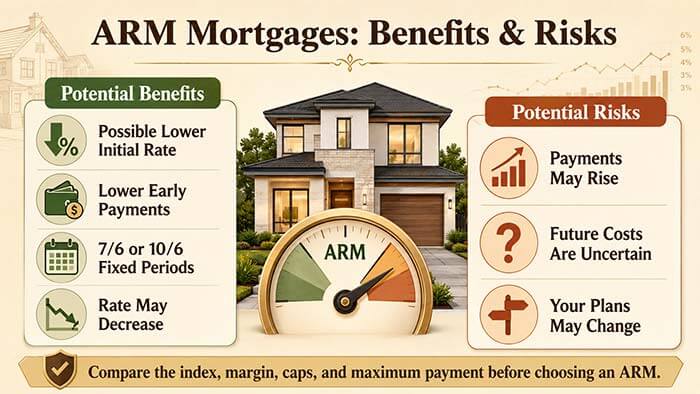 For certain borrowers, an ARM can be worthwhile.
ARM Potential Benefits Can Include:
Starting Lower Rate
- Initially, most adjustable-rate mortgages (ARMs) have an interest rate lower than that of most fixed-rate mortgages.
- This results in a lower payment of principal and interest.
A Lower Starting Monthly Payment
- An initial low rate on an ARM may even reduce a borrower’s payment during a fixed-rate period.
Potential of a Lower Initial Rate for Shorter Ownership Terms
- A borrower who sells the property before the rate becomes adjustable may obtain the benefits of a lower initial rate with no adjustment.
- Borrowers should not assume their ownership term will remain unchanged.
Potential for Rate Decrease
- An ARM can potentially lower if the applicable index also decreases and the mortgage terms allow a decrease.
Longer Initial Fixed Periods Are Available
- While a 30-year fixed rate may be too long, borrowers looking to lock in part of their rate may want to consider the 7/6 or 10/6 ARM when available.
Disadvantages and Risks of an ARM
- A lower introductory rate alone is not sufficient reason to accept the risks of an ARM.
The Potential Disadvantages Include:
- Uncertainty in Future Mortgage Payments
- They may go up.
- During the fixed period, the interest rate may remain constant;
- however, if the index increases, the mortgage rate and payment may also increase.
ARMs are More Complex
The Borrower Should Be Aware of These Variables:
- Initial rate
- Fixed rate period
- Index
- Margin
- Fully indexed rate
- Initial cap
- Subsequent cap
- Lifetime cap
- Rate floor
- Fixed-rate mortgages are simpler.
Refinancing is Not Guaranteed
ARM vs. Fixed-Rate—Which Mortgage Is Right for You?
Choosing between a stable rate or lower initial payments? We’ll help you decide. Get a Free Personalized Rate Comparison Today!This may be a major reason borrowers take out an ARM; however, there is no guarantee the borrower will be able to refinance before the first adjustment. The market may not be as favorable for the borrower to refinance.
Selling the Property is Not Guaranteed
A borrower may believe they want to sell their home; however, they could also decide not to sell and stay. The market may not be as favorable as they think for selling. The CFPB suggests determining whether borrowers could afford higher payments when considering ARM decisions.
When Could an ARM be Appropriate?
When Considering an ARM, There Are a Few Circumstances Where it May Be Warranted.
An ARM Can Be an Option for Someone Who:
- Expects to own the property for less than the initial fixed period
- Is relocating for work in the next few years
- Is purchasing a starter home
- Has a large amount of savings
- Can afford an increase
- Is achieving a significant rate advantage
- Understands the options he/she is agreeing to.
As noted, an ARM may be appropriate in certain situations.
Using an ARM in Place of a Fixed-Rate Mortgage May Be Worse for a Borrower Who:
- Will own the home for a long time
- Wants a stable monthly principal-and-interest payment
- Will not be able to afford an increase
- Will need to monitor the index
- Does not like to have to consider possible savings
- Does not receive any advantage from choosing an ARM
A borrower may prefer an ARM for a short period, but should carefully weigh whether the potential savings justify the risk.
- Is an ARM better when interest rates are high?
- What do you think?
When mortgage rates rise above what borrowers consider fixed, borrowers start looking at ARMs because, initially, their rates are lower.
Choosing an ARM Solely Based on Interest Rate Predictions is Not Recommended
Mortgage rates could go down, hold steady, or climb.
A Better Analysis is to Address the Following Questions:
- How much lower is the ARM rate?
- How much money will I save during the fixed period?
- How long do I intend to keep the property?
- When can the first adjustment occur?
- What is the potential maximum payment?
- Am I able to meet that potential payment?
- What happens if I can’t refinance?
Using the outlined criteria would shift the analysis away from predicting future financial markets.
Should First-Time Home Buyers Consider an ARM?
Being a first-time homebuyer is not a valid reason to choose an ARM, but some first-time homebuyers might benefit from considering one. An ARM might be useful to a first-time buyer who is likely to move in a few years. On the other hand, the constraints of a buyer with a tight budget might be better addressed with a fixed-rate mortgage. The primary focus should be the total cost of the mortgage, not just the lowest starting rate.
Can You Refinance an ARM Into a Fixed-Rate Mortgage?
Yes, as long as the borrower and the property meet the new requirements at that time, it should be possible to refinance the ARM into a fixed mortgage.
Homeowners Can Benefit from Thinking About Refinancing When the Following Occur:
- An ARM is about to adjust for the first time.
- Fixed-rate loans are looking advantageous.
- The borrower is more risk-averse and needs more payment stability.
- Credit score and credit report have improved.
- Income has improved.
- Equity in the home has increased.
- Borrower is planning to keep the home for a longer period of time than they initially expected.
Refinancing a home is almost like buying a new home. There can still be closing costs, new credit requirements, and additional application documents. Refinancing still has the same equity and appraisal requirements as buying a new home. You should never choose an ARM assuming you can just refinance later. The CFPB has specifically said borrowers should not assume they can sell or refinance their home before the first adjustment. To better understand how to compare an ARM and a fixed mortgage, you have to look beyond the advertised rate.
Compare the Loan Estimates Under the Following Sections:
- Interest rate
- APR
- Points and adjustments
- Lender credits
- Payments
- Insurance
- Cash needed for closing
- First fixed term
- Period of each adjustment
- Index for ARM
- Margin
- Initial limit for adjustments
- Limit for later adjustments
- Limit for all future adjustments
- Maximum payment under the terms of the loan
The CFPB says you should compare the caps offered by the two lenders if the introductory ARM rates are the same, because different cap structures can lead to very different future risks.
ARM Questions to Ask Before Signing
- What is my introductory ARM rate?
- For how long is that rate locked in?
- Is this a 5/6, 7/6, 10/6, 5/1 or some other ARM structure?
- What index does the loan use?
- What is the margin?
- What is the fully indexed rate?
- What are the initial, subsequent, and lifetime caps?
- What is the lowest rate under the loan?
- What is the highest rate that can be charged?
- What is the maximum monthly payment?
- What is the payment being used to qualify me?
- How is the ARM compared to the available fixed-rate mortgages?
- What savings can be expected with the ARM compared to the available fixed-rate mortgages?
- What happens if I can’t refinance the loan before the first change in the rate?
- borrower who can answer these questions can make better assessments of an ARM’s real value and risks.
There is not one mortgage type that is right for all borrowers. An ARM can reflect initial savings when a borrower expects a shorter term and a lower starting rate. A fixed-rate mortgage may be preferable for others when the long-term outlook of the loan payments needs to be determined. The entire loan structure should be compared rather than determining which loan has the lowest rate in an advertisement. Consider the introductory rate, the period over which the rate is fixed, the index, margin, caps, potential payment amounts, payment amounts that qualify the borrower, closing costs, expected length of ownership of the property, and potential changes to the payment.
Example ARM Decision
Let’s say a borrower expects to relocate for work in about 4 years. This borrower is considering a 30-year fixed mortgage and a 5/6 ARM. The 5/6 ARM has a lower starting rate and a fixed rate for 5 years.
Selling the home prior to the first adjustment makes the ARM an option. Even with the ARM, the borrower should consider whether the mortgage will be an affordable option if the relocation does not happen.
If the borrower expects to stay in the home for 15 or 20 years and does not want to risk a higher payment, a fixed-rate mortgage may be more financially prudent. This shows why the mortgage should be matched to the borrower’s financial plan rather than selecting it based on the starting rate.
Frequently Asked Questions about ARM Mortgages
Why are ARM Mortgages Good?
If you can save money with an ARM Mortgage, it’s a risk worth taking as long as you understand that your mortgage payments can increase. This is a good option if you expect to own your home for a short time. This is less advantageous for people who want a mortgage with fixed payments.
What is a 5/6 ARM Mortgage?
With a 5/6 ARM, lenders keep the interest rate fixed for 5 years. From the 6th year onward, the interest rate is adjusted every six months, subject to the index and margin, and limited by rate caps.
What Happens After the Fifth Year is Done?
Nothing happens after the fifth year is done. The period for which interest is fixed has ended; thereafter, the interest rate will adjust every 6 months in accordance with the loan guidelines.
Does an ARM Rate Drop?
Yes. The ARM rate will drop if the index rate linked to the ARM rate contract decreases. However, caps, floors, and margins that can be set on loans will limit how much the rate can change.
How High Can an ARM Rate Go?
The answer to this question depends on the ARM’s singular structure, but generally, an initial adjustment cap limits how much a rate can change when it first adjusts, a subsequent adjustment cap limits subsequent changes, and a lifetime adjustment cap defines the total increases that can occur on a loan.
Do ARM Mortgages Have More Stringent Processing Standards?
Maybe not. ARM loans may be processed with more stringent standards, but the qualifying rate is set higher than the introductory rate. Such a rate will result in a larger qualifying payment and possibly affect the debt-to-income ratio.
Can You Refinance Before an Adjustable Rate Mortgage Increases?
Borrowers can totally refinance an adjustable-rate mortgage before it increases, but refinancing is never guaranteed. Borrowers should not select an ARM loan with the expectation that refinancing will be done at a later date.
Which Is Safer, a 7/6 or 10/6 ARM, or a 5/6 ARM?
A 7/6 or 10/6 ARM has a longer initial fixed period than a 5/6 ARM. This means a 7/6 or 10/6 ARM has a longer period of time before the first possible rate change. The better loan will depend on the interest rate, costs, cap structure, expected ownership period, and the borrower’s financial goals.
Final Thoughts on Choosing an ARM or Fixed-Rate Mortgage
When making a decision between an ARM and a fixed-rate mortgage, today’s interest rate is only the starting point. A mortgage must complement your budget and income, the expected time you want to own a home, your ability to tolerate changes in monthly payments, and the impact those changes may have on long-term financial goals. There may be situations where savings can be achieved with an ARM, but only when a significant differential exists between the two mortgage rates.
The borrower has to understand the conditions surrounding the rate changes, the potential for an increase in the payment, and how much it could potentially increase.
When long-term payment stability is the goal, a fixed-rate mortgage would be the more prudent choice. If a borrower cannot decide which mortgage scenario is more appropriate for their situation, a comparison market analysis of both can be performed prior to a final decision. Gustan Cho Associates will review the available ARM and fixed-rate mortgage options, allowing for comparison of qualifying payments, debt-to-income ratios, and the overall loan structure. If you have mortgage questions, please call Gustan Cho Associates at 800-900-8569 or email gcho@gustancho.com. Their existing page indicates that the team is available seven days a week, including evenings, weekends, and holidays.