A prior loan modification does not automatically prevent FHA approval. FHA guidelines on mortgage after loan modification depend on the requested transaction and the borrower’s payment history. Purchase, no-cash-out, cash-out, and streamline transactions have different requirements. The lender must determine which payment history and seasoning rules apply, verify performance under the applicable agreements, and identify any forbearances or subordinate liens affecting the transaction.
Documents Required After a Loan Modification or Forbearance
When a mortgage reflects payments under a modification or forbearance plan within the 12 months before FHA case number assignment, the lender must obtain the applicable agreement and evidence of payment amounts and dates.
Required Underwriting Evidence
- Executed permanent modification agreement or applicable forbearance plan: Include the effective date and required payment schedule.
- Evidence of payment amounts and dates: Provide the servicer’s payment history and any supporting records needed to verify performance under the agreement.
HUD provides an exception to the requirement to obtain the forbearance plan document when the forbearance resulted from the COVID-19 National Emergency. That exception does not eliminate payment-history verification or an applicable modification-agreement requirement.
Helpful Documents to Gather Early
Depending on the planned transaction, also gather:
- Confirmation of when the forbearance ended, if applicable.
- Partial-claim or other subordinate-lien documents and balance information.
- Current payoff statements for all liens involved in a sale or refinance.
These additional documents help identify outstanding obligations and avoid closing delays. Some may also be required for the specific transaction.
FHA Purchase After Loan Modification
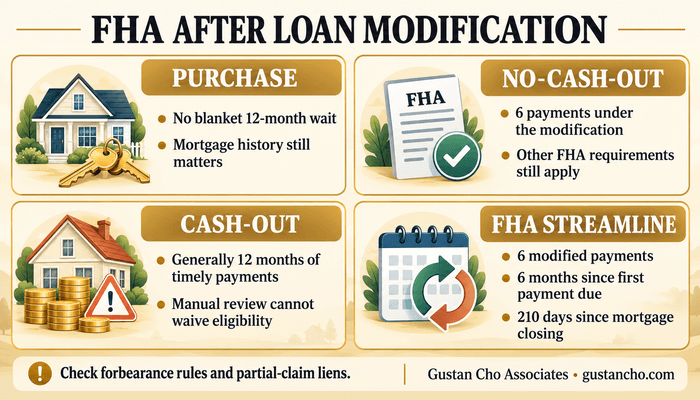
The FHA does not require everyone to wait 12 months after a loan modification before buying another home. Still, getting a modification does not erase your past mortgage payment history.
Lenders look at how you made payments during the modified period based on the agreement. They also check for any late payments from before and within the review period. If you have had recent payment issues, it could affect your loan approval.
If you sell or pay off the modified home, any earlier late payments still count in the review. You also need to meet all FHA requirements for income, credit, debts, assets, living in the home, and the new property itself.
FHA No-Cash-Out Refinance After Loan Modification
When the existing mortgage has been modified, FHA requires the borrower to have made at least six payments under the modification agreement before qualifying for a no-cash-out refinance. Payment performance during the modified period is evaluated against the terms of that agreement. Count payments made under the permanent modification agreement after it becomes effective. Payments made under the original mortgage terms before that effective date do not count toward this requirement. Six payments satisfy this modification-related requirement; they do not establish complete refinance eligibility. The lender must still review qualifying income, credit, debts, mortgage payment history, and applicable property and loan-amount requirements.
Rate-and-Term vs. FHA Simple Refinance
The available option depends partly on the existing loan:
- FHA rate-and-term refinance: Can refinance an FHA or non-FHA mortgage. Proceeds pay eligible existing mortgage liens and transaction costs.
- FHA simple refinance: Refinances an existing FHA-insured mortgage. Proceeds pay the existing FHA mortgage and eligible transaction costs.
Before choosing either option, have the lender verify the modification’s effective date, the six qualifying payments, and any separate requirements resulting from prior forbearance or subordinate liens.
FHA Cash-Out Refinance After Loan Modification
For an FHA cash-out refinance, mortgage payments during the modified period are evaluated according to the modification agreement. The borrower must also satisfy the separate cash-out payment-history requirements. HUD requires that all mortgage payments be made on time for the past 12 months or since the borrower obtained the mortgage, whichever period is shorter. Properties with mortgages must have at least six months of mortgage payments. These requirements apply to both TOTAL and manually underwritten loans.
Recent Mortgage Delinquencies Can Prevent Cash-Out Eligibility
A current mortgage delinquency or a delinquency within the 12 months before FHA case number assignment requires a manual downgrade. Manual underwriting does not waive FHA’s cash-out eligibility requirements. A borrower with a recent mortgage delinquency may need to establish the required timely payment history before qualifying. If the subject mortgage was in forbearance, separate completion and post-forbearance payment requirements also apply. Review the full servicing history before ordering an appraisal or committing to refinance costs.
FHA Streamline Refinance After Loan Modification
An FHA streamline refinance is available only when the existing mortgage is FHA-insured. If that mortgage was modified, the following seasoning requirements must be satisfied by the date of FHA case number assignment:
- Six payments under the modification agreement: Count the required payments made under the agreement after it becomes effective.
- Six full months since the existing mortgage’s first payment due date: Measure from the first payment due date of the mortgage being refinanced, not the first modified payment’s due date.
- At least 210 days since the existing mortgage closed: Measure from that mortgage’s closing date, not the date the modification was signed.
These are separate tests. An older FHA mortgage may already satisfy the six-month and 210-day requirements, while a recent modification still requires six payments under its agreement. If the mortgage was assumed, the borrower must also have made at least 6 payments since the assumption. Meeting the seasoning requirements does not establish complete streamline eligibility. The loan must also satisfy applicable mortgage payment history, forbearance, and net tangible benefit requirements.
Buying a New Home After a Loan Modification?
FHA underwriters may review when the modification was completed, how you paid afterward, and whether your recent housing history shows stability. Get your timeline reviewed before you apply.Mortgage Payment History After a Loan Modification
The modified payment terms apply only during the period covered by the modification agreement. A modification does not erase earlier delinquencies within the applicable underwriting review period. For example, if the modified payment becomes $1,600 beginning July 1, the lender evaluates payments from that date under the new terms. Earlier payments are evaluated under the terms applicable when they were due, including any approved forbearance arrangement. The lender reviews the relevant history before and after the modification to determine whether it meets the payment-history requirements for the requested FHA transaction.
Loan Modification vs. Mortgage Forbearance
A loan modification permanently alters one or more terms of a mortgage. Forbearance temporarily permits reduced or suspended payments and may include repayment arrangements.
Payments During Forbearance
Borrowers who continue making the full payments required by the original note are treated as if they were not in forbearance, provided the plan ends at or before closing. Borrowers who follow an approved reduced-payment or suspended-payment plan are not automatically considered delinquent for credit underwriting. However, that treatment does not eliminate requirements for the next FHA loan.
FHA Eligibility After the Plan Ends
The next step depends on the transaction and underwriting path:
- Purchase and no-cash-out loans assessed through TOTAL: Fewer than three consecutive payments after completed forbearance requires a manual downgrade. This is not a universal three-month purchase waiting period; the file must meet applicable manual underwriting requirements.
- Manually underwritten rate-and-term and simple refinances: The subject property’s forbearance must be completed, followed by at least three consecutive monthly payments made within the month due.
- Cash-out after reduced or suspended payments: The subject property’s plan must be completed, followed by at least 12 consecutive monthly payments made within the month in which they are due.
For purchase and no-cash-out transactions, a forbearance on a mortgage remaining open after closing must end at or before closing.
FHA Partial Claims After Loss Mitigation
An FHA partial claim is a separate, interest-free obligation secured by a subordinate lien on the home. Its balance affects available equity and must be included in sale or refinance planning.
When a Partial Claim Becomes Due
Under HUD’s servicing policy, repayment generally becomes due when the first applicable event occurs:
- The first mortgage reaches maturity.
- The property is sold or transferred.
- The mortgage is assumed.
- The first mortgage is paid off, subject to the streamline subordination exception.
- FHA insurance terminates if the partial-claim note includes that repayment trigger.
Payoff vs. Streamline Subordination
Payoff is when you repay the partial-claim balance. Subordination allows the lien to remain in place behind the new first mortgage. HUD allows partial-claim subordination with an FHA streamline refinance, so you do not always have to pay off the balance in that situation. The debt stays in place; subordination only changes the lien’s order, not how much you owe. Before you move forward, ask the lender and title company to locate the correct subordinate note, verify its balance, and confirm whether the deal requires a payoff or subordination. Doing this early helps you know your equity and gives you time to gather the right paperwork.
Manual Underwriting After a Loan Modification
 For FHA manual underwriting, the lender must verify the previous 12 months of housing payment history. Documenting that history does not make it acceptable. The underwriter has to determine whether that history satisfies the applicable payment history requirements. The approval decision also considers:
- The broader credit pattern: The timing, severity, and frequency of the delinquencies and the evidence that the borrower has in fact sorted out the underlying financial problems.
- Qualifying income: Whether documented, stable income supports the proposed payment.
- Debts and debt-to-income ratios: Whether existing obligations and the new housing payment meet manual-underwriting limits.
- Other applicable requirements: Required reserves, compensating factors when applicable, and eligibility rules for the specific purchase or refinance transaction.
FHA TOTAL is a credit risk scorecard used within the AUS (automated underwriting system). It is not in itself a decision to approve or deny. Where manual underwriting is required, the underwriter will assess the file in accordance with FHA’s manual underwriting standards and the transaction’s eligibility criteria.
FHA Guidelines vs. Lender Overlays
Lender overlays are underwriting requirements which are more stringent than FHA’s minimums. An additional waiting period imposed by an individual lender should be identified as that lender’s policy.
If a lender tells you you have to wait, ask them which specific written requirement that is and whether it’s to do with FHA eligibility, manual underwriting standards, an automated underwriting decision or a lender overlay.
That explanation leads us to the next step which is to either provide the missing evidence, establish further payment history or obtain a review from another lender. A second review would still be subject to the FHA requirements for the transaction in question.
Illustrative FHA Scenarios After Loan Modification
These hypothetical examples show how the transaction, payment timeline, and unresolved issues affect the underwriting review.
Scenario 1: Six Modified Payments, but a Lower Appraisal
A permanent modification becomes effective January 1, 2026. The homeowner makes each required monthly payment on time from January through June and requests an FHA rate-and-term refinance in July. The six payments satisfy the modification-related payment requirement. However, the appraisal comes in below the homeowner’s expected value. What still needs review: Whether the property value supports the proposed loan amount, eligible payoffs, and refinance costs. Income, credit, and the remaining payment history requirements also need to be reviewed. Completing six modified payments does not resolve a loan-amount problem.
Scenario 2: Successful Modification Payments Followed by a Late Payment
A mortgage is modified starting January 1, 2026. The borrower pays on time from January to June, but makes the July payment late, in August. In September, the borrower applies for an FHA cash-out refinance. Eligibility issue: The July payment was late and falls within the cash-out review period. Six on-time modified payments are not enough to meet the separate cash-out payment history rules. Even with a manual downgrade, these requirements still apply. The borrower must show the required payment history before moving forward.
Scenario 3: A Streamline Refinance With a Partial Claim
An FHA homeowner gets a loan modification and a $20,000 partial claim in November 2025. In August 2026, the homeowner requests an FHA streamline refinance and believes the partial claim must be paid off. Next steps: The lender and title company need to find the correct subordinate note and confirm the right subordination process. HUD allows a partial claim to stay behind the new first mortgage in an FHA streamline refinance. Streamline eligibility must also be checked on its own.
Common Problems That Delay FHA Approval After a Modification
Address these issues early to avoid delays:
- Missing agreement: Ask the current servicer for the executed modification agreement. Make sure it contains the effective date and the required payment terms.
- Credit report is at odds with the modified terms. Check the credit report against the agreement and servicing records. Get the lender to confirm whether further verification or a reporting correction is required.
- Unknown partial claim balance: get the subordinate note and balance. Ask the lender and the title company whether the transaction requires a payoff or a subordination.
- Unclear denial reason: find out which FHA requirement, automated underwriting finding, manual underwriting standard, or lender policy led to the decision. The next step will be dependent on that explanation.
- Outdated payoff: get the current payoff on the liens that are being paid off and the verified balances on the liens that will remain.
If you’re buying another property, then it’s worth having these issues looked at before you make an offer, if at all possible. If it’s a refinance, it’s important to resolve any documentation and lien issues before incurring unnecessary upfront costs.
FAQs About FHA Guidelines on Mortgage After Loan Modification
Does a Conventional Mortgage Modification Affect an FHA Application?
Yes. FHA’s housing-payment review includes relevant conventional mortgages. Provide the modification agreement and payment records so the lender can evaluate the history in accordance with the applicable terms.
Can a Modified Investment-Property Mortgage Affect My FHA Purchase?
Yes. Its payment history and ongoing obligation can affect underwriting. Any rental income used to qualify must meet FHA’s documentation and calculation requirements.
What if My Co-Borrower had the Modified Mortgage?
If that person is applying for the new loan, their credit and obligations must also be reviewed. The lender determines who was liable for the modified mortgage and evaluates each applicant’s qualifying information.
Can I Keep the Modified Home and Purchase Another Home with an FHA Loan?
Possibly. The lender must evaluate the retained mortgage payment and new occupancy. If the retained loan is FHA-insured, FHA’s restrictions and exceptions for having multiple FHA loans also apply.
What if I Cannot Obtain the Modification Records?
Request them from the current servicer and provide any copies you already have. The lender must confirm that required documentation is complete; missing mandatory records can prevent the file from proceeding.
Is a Loan Modification Treated Like a Short Sale?
No. A modification changes an existing mortgage’s terms. A short sale involves selling for less than the amount owed with the lender’s approval and has separate FHA eligibility rules.
Final Thoughts on FHA Guidelines on Mortgage After Loan Modification
To see if you are ready, look at three things: the type of transaction you want, your verified payment history, and how any outstanding liens are handled. Check which requirements you have already met and which still require paperwork or additional payment history.
If you plan to sell or refinance, remember to include any secondary debts when calculating your available equity and the funds you will need to complete the process.
Send your modification agreement and payment history to Gustan Cho Associates for review before you decide to buy or refinance. Let us know if you want to sell, keep, or refinance your current property. Our team will review your loan options and highlight any remaining requirements, so you can make your next move with a clearer understanding of what to expect.
This article about “FHA Guidelines on Mortgage After Loan Modification: Purchase and Refinance Rules” was updated on October 13th, 2026.