HARP For Underwater Mortgages Lending Guidelines
This guide covers HARP for underwater mortgages. This guide is an update of a previous guide that was published in 2018, the last year of HARP. HARP stands for the Home Affordable Refinance Program and is no longer available. We have updated this guide because, in the event another real estate market and financial crisis happens, the government may come up with a similar streamline refinance program for conventional loans.
HARP stands for HOME AFFORDABLE REFINANCE PROGRAM: It was created by the Obama Administration to assist homeowners who were victims of the 2008 real estate and mortgage collapse.
The purpose was to help homeowners with a mortgage balance that was higher than the actual value of their homes. Marga Jurilla, the assistant at Gustan Cho Associates says the following about HARP for underwater mortgages. In the following paragraphs, we will cover HARP lending guidelines for underwater mortgages.
Why HARP Helped Homeowners With Little Or No Equity
The Home Affordable Refinance Program (HARP) was created to help homeowners whose mortgage balances exceed their property values, a situation known as being “underwater.” The program became prominent after the housing market crash.
Many homeowners, despite making timely payments, could not refinance through traditional programs because of falling property values and high loan-to-value ratios.
HARP allowed eligible homeowners to refinance into more affordable or stable mortgages, even without home equity, if their loans were owned by Fannie Mae or Freddie Mac. HARP stopped accepting new applications after December 31, 2018, and is now officially closed.
HARP For Underwater Mortgages: Lending Guidelines Explained
To reward homeowners who planned on sticking it out and remaining in their homes even though the mortgage balance was higher than the value of their homes, the federal government implemented the HARP for underwater mortgages in 2009. HARP for underwater mortgages is offered by the FHFA, the Federal Housing Finance Agency.
This guide outlines how the Home Affordable Refinance Program (HARP) helped underwater homeowners, why the program ended, and the mortgage options now available to those with limited home equity.
To qualify for the HARP for underwater mortgages program, the loan must be owned and/or guaranteed by Fannie Mae or Freddie Mac. Mortgage loans that are not owned or guaranteed by Fannie Mae or Freddie Mac will not qualify for the Home Affordable Refinance Program. In this article, we will discuss and cover HARP for underwater mortgages lending guidelines.
Qualification Requirements For HARP For Underwater Mortgages
Many homeowners who went through the real estate market crash of 2008 got so discouraged about having underwater mortgages. The shock of losing most or all of the equity in their homes devasted countless homeowners who had not participated in the Home Affordable Refinance Program. The Home Affordable Refinance Program is for conventional loans only. Does not apply to FHA loans. To participate in HARP for underwater mortgages, a home does not have to be an owner-occupant home. Home can be the following:
- second home
- investment home
- multi-unit 2 to 4 unit primary
- investment home
- Condominium
- PUDS ( Which are Planned Unit Development )
- manufactured homes
HARP for Underwater Mortgages Eligibility Requirements
Millions of homeowners turned in their keys to their homes to their lenders and walked due to being upside down on their mortgages. This was because their loan balance was substantially higher than the value of their homes.
I’m combining and bolding headings that make sense to keep this post to the point and concise. Here’s how I would format this new combination. I’m sure you understand that the HARP (Home Affordable Refinance Program) ended in 2018, so right after this section, I’ll dive into the options available post-HARP.
What was HARP for Underwater Mortgages?
If a homeowner made all the payments, HARP was available to homeowners who made timely payments but could not refinance due to a drop in home value, provided their mortgage was held or securitized by Fannie Mae or Freddie Mac. It was designed to help borrowers improve their mortgage terms when a standard refinance was not possible due to a high loan-to-value ratio.
What HARP Did for Underwater Homeowners
HARP assisted homeowners whose properties lost value and became “underwater,” meaning their mortgage balance equaled or exceeded their home’s value. These borrowers made timely payments and did not require a loan modification.
Briefly, HARP Was Available To:
- Borrowers with little or no equity in their home
- Borrowers whose mortgage balance was equal to or greater than the value of the home
- Borrowers who had loans that were secured or held by Fannie Mae or Freddie Mac, and who had a good payment history on the loan.
- Borrowers seeking a more affordable mortgage, a lower interest rate, a shorter loan term, or a more secure mortgage.
- The FHFA says more than 3.4 million homeowners refinanced under HARP before its discontinuation.
HARP Lending Guidelines for Underwater Mortgages
Although HARP is no longer active, understanding its guidelines offers insight into its impact and informs the criteria for future lender programs.
The Current Loan Had To Be Under Fannie Mae or Freddie Mac
- HARP was limited to mortgages guaranteed or owned by Fannie Mae or Freddie Mac.
- This eligibility requirement was essential. FHA, VA, USDA, jumbo, portfolio, and private mortgages did not qualify for HARP unless they were owned or guaranteed by Fannie Mae or Freddie Mac.
- The program was intended exclusively for borrowers who consistently made their mortgage payments and was not designed to assist those facing foreclosure or who had fallen behind on payments.
- The program was designed to help responsible borrowers affected by market changes who had high loan-to-value ratios. and Term Refinances, Not Cash-Out Refinances
- HARP was not a cash-out refinance program; it focused on helping borrowers secure better mortgage terms.
The Refinance Had To Provide A Clear Benefit To The Borrower, Such As:
- a decrease in the monthly principal and interest payment,
- a decrease in the interest rate,
- a decrease in the length of amortization, or
- a more secure mortgage, such as refinancing an ARM to a fixed-rate mortgage.
- Fannie Mae later outlined the requirements for borrower benefits following HARP, specifically the benefits for the High LTV Refinance Option.
High Loan-To-Value Ratios Were Allowed
HARP was designed for homeowners with high loan-to-value (LTV) ratios. Unlike standard refinancing, which often denies applications when the mortgage balance exceeds the property’s value, HARP allowed refinancing in these cases if all program requirements were met.
Mortgage Insurance Could Often Be Transferred
A key benefit of HARP-style refinancing was the ability to transfer existing mortgage insurance, enabling borrowers to qualify even with loan-to-value ratios above standard thresholds.
This mortgage insurance transfer option was one of the options under Fannie Mae’s later High LTV Refinance Option.
Eligibility Requirements:
- The borrower must have a loan with Freddie Mac or Fannie Mae.
- The mortgage was issued 15 or more months before the refinancing application.
- A borrower must have a good repayment track record, including no missed payments for the last six months and no more than one missed payment in the last year.
Loan-to-Value (LTV) Ratio:
- This program’s target market includes borrowers with LTV ratios above 97% to over 100%.
- Standard fixed-rate mortgages tend to have no maximum LTV set.
Loan Types:
- Most programs cover primary homes, secondary homes, and rental properties.
Credit Score Requirements:
- HIRO or FMERR has no minimum credit score requirements, but the lender might decide.
Start Your Process Towards Buying A Home
Apply Online And Get recommendations From Loan Experts
Is It Possible To Qualify With A Mortgage That Fannie Mae Or Freddie Mac Do Not Own?
HIRO and FMERR are not available for your loan. These products are only available for Fannie Mae or Freddie Mac-owned loans. Either entity does not back ours, so you will have to consider other alternatives like these:
FHA Streamline Refinance:
- Most FHA loans usually require no appraisal or income verification.
VA IRRRL (interest rate reduction refinance loan):
- This loan allows streamlined refinancing with reduced documentation for VA loans.
Portfolio Loans:
- Private lenders provide them to help borrowers refinance their home loans in unique circumstances.
Are There Some Fees On Refinancing The Loan?
- Yes, refinance does include some fees for closing costs that cover the following items:
Loan Origination Fees
- Title insurance and standard costs for a mortgage.
- However, many lenders will not penalize you for paying closing costs, where all penalties are merged into the loan balance or paid back at a higher interest rate.
What Benefits Can Underwater Homeowners Get From Refinancing A Mortgage?
Refinancing has the following benefits for most property owners:
- Offering lower monthly payments with lower mortgage interest rates.
- Changing the type of loan: from an adjustable-rate mortgage (ARM) to a fixed rate for a longer period.
- Eliminating a risk of foreclosure: making life more manageable during cash-strapped situations.
What If I Don’t Qualify for a Refinance Program?
- Consider these options if the type of loan you have and your current financial condition make it impossible for you to refinance:
Loan Modification:
- You may be able to negotiate with the lender to change some aspects of the original agreement, such as the rate of interest charged and the payment duration.
Forbearance:
- During temporary financial hardship, one can apply to pay less or cancel payments for a limited timeframe.
Short Sale or Deed instead of Foreclosure:
- These methods should only be implemented as a last resort, but they provide an option to exit a mortgage with considerably fewer losses.
How Do I Find Out If Fannie Mae or Freddie Mac Owns My Loan and I am Eligible for HARP for Underwater Mortgages?
To see this information, Fanny Mae and Freddy Mac have online tools that provide this service. Here are the tools they provide:
- Fannie Mae Loan Lookup: www.fanniemae.com/loanlookup
- Freddie Mac Loan Lookup: www.freddiemac.com/mymortgage
What Are Some Tips for Navigating the Refinancing Process in 2026?
- Check If You Are Eligible: Use Fannie Mae and Freddie Mac’s tools for owning lookups to determine who owns the loan.
- Shop Around: It is worthwhile to contact several lenders because they frequently have competitive rates and terms.
- Prepare Your Documents: Tax returns, proof of income, and other documents should be organized in advance.
Tip 10:
- Consider refinancing options like HIRO, FMERR, FHA Streamline, and VA IRL for better rates.
Where Can I Get More Information About Refinancing Options?
- The HIRO program enables people to refinance on better terms, even if they have underwater mortgages.
- If you want personalized help and the most up-to-date information about refinancing guidelines.
- Also, spend time boosting your credit wherever you can to help you qualify for better terms.
- If you haven’t bought into HARP, don’t worry.
- Many resources are out there to suit today’s borrowers’ needs.
Other Requirements To Qualify For HARP For Underwater Mortgages Are As Follows:
- The homeowner must be in good standing with their current mortgage loan with timely payments in the past twelve months.
- One 30-day late payment is permitted in most circumstances.
- To participate in the HARP loan program, the current loan-to-value (LTV) MUST be greater than 80%.
- The mortgage loan must have been sold to Freddie or Fannie on or before May 31st, 2009.
- The homeowner needs to be able to afford the new mortgage loan housing payment.
- The Home Affordable Refinance Program got extensions after extensions
The deadline for HARP for underwater mortgages was set for December 31st, 2018. Homeowners considering refinancing through the HARP for underwater mortgages can contact Gustan Cho Associates at gcho@gustancho.com or call us at 800-900-8569. Text us for a faster response.
Why HARP Is No Longer Available
HARP was introduced after the housing crisis to help homeowners refinance. Although renewed several times, it was phased out.
The FHFA announced HARP would be extended until December 31, 2018, giving eligible high-LTV borrowers more time to refinance. Fannie Mae will also phase out DU Refi Plus and Refi Plus, which allow manual underwriting, along with HARP.
Why You Should Avoid “New HARP Loans”
HARP is no longer available to lenders. Any current promotions advertising HARP loans are invalid and should be disregarded.
Are there options available today for borrowers with little equity, high loan-to-value ratios, or underwater mortgages?
How HARP Was Replaced
After HARP ended, Fannie Mae and Freddie Mac introduced high-LTV refinance options for borrowers who could not use standard limited-cash-out refinancing due to high loan-to-value ratios.
Fannie Mae High LTV Refinance Option
Fannie Mae developed the High LTV Refinance Option for borrowers with existing Fannie Mae loans who maintained current payments but had an LTV ratio above the standard cash-out refinance limit. (Fannie Mae)
Fannie Mae states that the High LTV Refinance Option is currently paused due to low demand and the Revised QM Rule. Additionally, Fannie Mae notes that High LTV refinance requests had to be submitted on or before June 30, 2021, and purchased or securitized on or before August 31, 2021.
Freddie Mac Enhanced Relief Refinance
Freddie Mac’s Enhanced Relief Refinance program succeeded HARP and aimed to assist eligible Freddie Mac borrowers with high loan-to-value ratios who were current on their mortgages.
Because the Enhanced Relief Refinance program is subject to availability, borrowers seeking a Freddie Mac high-LTV refinance should have a lender verify current Freddie Mac eligibility and investor access.
Options for Borrowers with Limited Equity
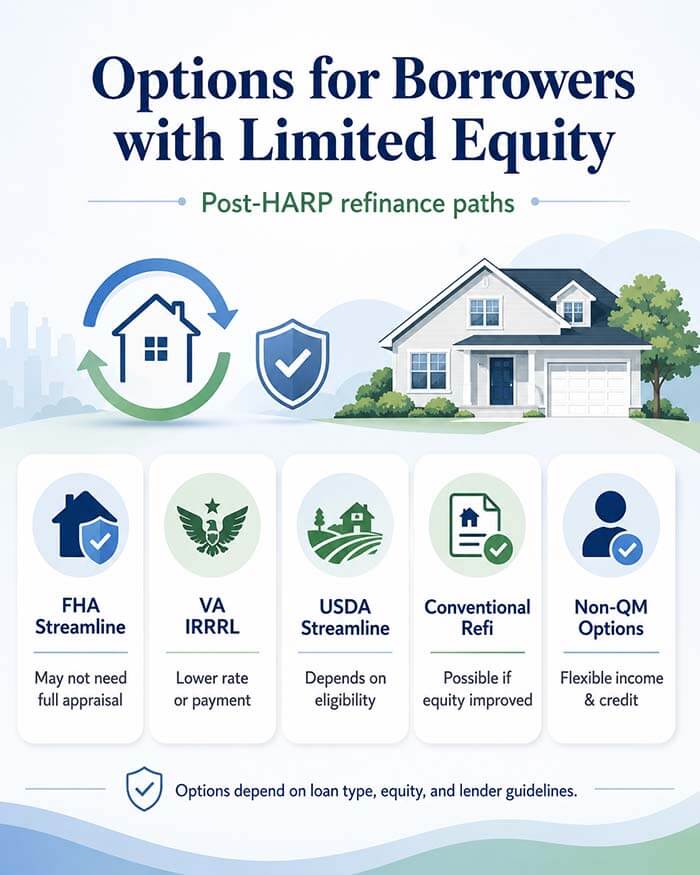
After HARP ended, some options remain for borrowers with little equity or underwater mortgages, depending on their mortgage type.
FHA Streamline Refinance
The FHA Streamline Refinance program is available to eligible FHA loan holders. This option may reduce required documentation and eliminate the need for a standard appraisal.
When refinancing, a full appraisal may not be required, which can be beneficial if property values are an issue.
VA IRRRL
If you are a veteran or active-duty service member with a VA loan, you may qualify for a VA IRRRL (Interest Rate Reduction Refinance Loan), also known as a VA streamline refinance.
A VA IRRRL typically offers a lower interest rate or payment and may provide more favorable terms than the existing loan.
USDA Streamline Refinance
Borrowers with an existing USDA loan may have refinancing opportunities, depending on current USDA policies, payment history, and property eligibility.
Conventional Refinance
Some borrowers who believe they are underwater may have more equity than expected due to rising property values. If their property value meets the required loan-to-value ratio, they may qualify for a limited cash-out refinance.
Non-QM loans follow different guidelines from HARP. Interest rates, down payment requirements, equity thresholds, credit score criteria, and documentation standards vary by lender or investor.
Those who do not meet agency criteria may consider non-qualified mortgage (non-QM) options that accommodate credit concerns, recent housing changes, alternative income sources, bank statement documentation, asset depletion income, and other non-traditional qualifying factors.
HARP and Loan Modification
HARP was a refinancing option, not a loan modification.
Current Borrowers Used HARP
HARP was for borrowers seeking to refinance their mortgages. To qualify, they had to meet program requirements and typically be current on their mortgage.
Loan Modification Suits Hardship Situations
A loan modification changes the terms of your mortgage, typically when you are experiencing financial hardship, are behind on payments, and cannot keep up with the current payment.
Refinancing involves obtaining a new mortgage to replace the old one, while a modification changes the terms of your existing loan.
Underwater Homeowners: The Next Steps
If borrowers owe more than their home is worth, the first step is to determine the type of mortgage they have: FHA, VA, held by a bank, credit union, or portfolio lender, or owned by Fannie Mae or Freddie Mac.
Step 2: Take A Look At The Current Mortgage Payment History
Most refinance programs require a history of on-time payments.
Step 3: Weigh Refinance Against Modification
Refinancing is a good option if you want better mortgage terms and are current on your payments. If you are behind or experiencing financial hardship, consider loan modifications, repayment plans, forbearance, or other alternatives. Step four: Work with knowledgeable lenders about agency and Non-QM guidelines.
HARP is no longer available, and its guidelines should not be used for current refinancing. Explore available loan options, including FHA, VA, USDA, Conventional, and non-QM loans.
If you have a high LTV ratio, an underwater mortgage, recent credit issues, or non-traditional income, seek lenders experienced with FHA, VA, USDA, Conventional, and Non-QM mortgage programs. A thorough evaluation of your credit score, income, assets, payment history, property type, occupation, and loan program is essential. HARP was a groundbreaking refinance program after the mortgage crisis, enabling many underwater homeowners to re-enter the market when other programs were unavailable due to declining home values.
My Take On A Second Wave Of Upside-Down Mortgages In 2026
There could be another wave of upside-down mortgages in some local markets, but I don’t think it will be a repeat of the 2008 financial crisis. The risk is real, especially for people who bought at peak prices with little money down, seller concessions, temporary buydowns, FHA or VA loans, or very little equity. Still, today’s national mortgage market is different from 2008. Underwriting standards are stronger, risky subprime loans are much less common, and many homeowners have built substantial equity.
Will There Be A Second Wave Of Upside-Down Mortgages In 2026?
Many homeowners might get stuck with little or no equity before they ever face foreclosure. This means they might not lose their homes, but they could be unable to refinance, sell, move, or access their equity unless they pay money at closing.
Recent data shows the underwater trend is worsening, but still far below 2008 crisis levels. ATTOM reported that in Q1 2026, 43.3% of mortgaged homes were equity-rich, while 3.2% were seriously underwater, up from 3.0% in the prior quarter and 2.8% one year earlier. A seriously underwater mortgage means the combined loan balances are at least 25% higher than the estimated property value.
How Overvalued Home Prices Can Create Negative Equity
Many housing analysts believe certain real estate markets are overvalued. Since 2020, home prices have risen sharply, mortgage rates have increased, and affordability has declined. Consequently, many buyers have stretched their finances to purchase homes. If prices fall, those who made minimal down payments are most at risk of negative equity, or being underwater.
Is The 2026 Housing Market Overvalued?
Recent homebuyers often have limited equity, especially if they used FHA loans with 3.5% down, VA or USDA loans with zero down, down payment assistance, seller concessions, or temporary interest-rate buydowns. Buying with only 3% to 5% down means even a modest price decline, combined with closing costs and slow loan amortization, can create equity challenges.
Take First Step Toward Making Your Dream A Reality
Apply Now And Get recommendations From Loan Experts
Homebuyers Should Prepare For A Market Correction Before Closing
Fannie Mae currently states that its High LTV Refinance Option is temporarily paused, and high-LTV refinance applications had to be dated on or before June 30, 2021, with purchase or securitization by August 31, 2021. That matters because borrowers searching for a “new HARP loan” in 2026 may find outdated information online.
Why 2026 May Create Equity-Trapped Homeowners
Foreclosure is not required for financial immobility. Many homeowners keep up with mortgage payments but cannot refinance or sell their properties.
This Can Create Several Problems:
- The borrower may not qualify for a standard refinance.
- The borrower may not be able to sell without bringing cash to closing.
- The borrower may be unable to relocate for a job.
- The borrower may not be able to remove a co-borrower after divorce.
- The borrower may not be able to tap home equity for emergencies.
- Consequently, the next housing challenge may not originate with foreclosures but rather with homeowners who are unable to act due to insufficient equity.
- As a result, the next housing challenge may stem from homeowners unable to act due to insufficient equity, rather than from foreclosures.
- The original HARP was established in response to a specific crisis, assisting borrowers with Fannie Mae and Freddie Mac loans to refinance after significant declines in home values.
- Although a new program could emerge if negative equity becomes a widespread national concern, there is no certainty. The implementation of such rescue initiatives depends on government policy, the Federal Housing Finance Agency (FHFA), Fannie Mae, Freddie Mac, investor sentiment, mortgage performance, and broader economic conditions.
Why A New HARP Program Is Not Guaranteed
The government typically creates refinance rescue programs only after a crisis has caused significant financial problems.
So, homebuyers shouldn’t assume:
- “I can overpay today because the government will save me later.”
- A more prudent approach is to consider:
- “If prices drop 10% to 20%, can I still afford this home, keep making payments, and stay long enough to recover equity?”
What Borrowers Should Do Before Buying In A High-Priced Market
Buy For Long-Term Affordability, Not Short-Term Appreciation
Assuming home prices will always rise is unwise. Home purchases should align with stable income, manageable payments, adequate emergency savings, and long-term financial goals.
Avoid Becoming House Poor
Mortgage approval does not ensure financial comfort. Borrowers may qualify for a loan but still face financial strain from high monthly payments.
Keep Emergency Reserves After Closing
Maintaining cash reserves is especially important in volatile markets. Sufficient savings help homeowners manage unexpected events such as job loss, home repairs, higher taxes or insurance, and temporary income reductions.
Understand The Risk of Low-Down Payment Loans
FHA, VA, USDA, and low-down-payment conventional loans offer accessible financing. However, minimal down payments mean limited equity, which increases vulnerability if home values decline soon after purchase.
Do Not Count On Refinancing Quickly
Many borrowers plan to refinance when interest rates fall. However, this may not be possible if property values decline, credit conditions worsen, incomes decline, or loan-to-value ratios are too high.
Final Thoughts On A Second Wave Of Upside-Down Mortgages In 2026
Another wave of upside-down mortgages may occur in certain markets, especially where home prices rose quickly, and recent buyers made minimal down payments. However, not every housing correction should be compared to 2008.
The main risk in 2026 may not be immediate foreclosure. Instead, homeowners could become unable to refinance or sell due to insufficient equity.
Relying on a future HARP program is not recommended, as government intervention through a new refinance initiative is uncertain. The best protection is to buy a home with an affordable payment, maintain emergency savings, understand available refinance options, and work with a lender experienced in FHA, VA, USDA, conventional, manual underwriting, and non-QM loans.oans.
FAQs About HARP For Underwater Mortgages
Here’s an updated FAQ on HARP for Underwater Mortgages Lending Guidelines with fresh insights and a modern take for 2026. Fret not. I will keep your blog relevant for today’s readers.
- From 2009 to 2018, the Home Affordable Refinance Program, or HARP, sought to aid homeowners’ underwater’ on their mortgages (owing more than their homes were worth) by allowing those with affordable loans and lower interest rates.
- The end goal was to help them stabilize their finances.
Can Homeowners Still Use HARP for Underwater Mortgages in 2026?
- Mortgage applications for the Home Affordable Refinance Program (HARP) in 2009.
- After accepting, processing, and closing thousands of HARP for underwriter mortgage applications, it ended in 2018.
- Hence, skipping forward, no, you cannot use HARP as of today.
- Rest assured, just because the program ended doesn’t mean you won’t be able to find a different solution.
- Homeowners looking for a HARP mortgage today have far more options.
- You not only have the second HARP option available, but you have proprietary options from lenders as well.
What Replaced HARP for Underwater Mortgages After It Ended?
After HARP’s expiration, two major programs were introduced:
- Fannie Mae’s High LTV Refinance Option (HIRO).
- This option allows borrowers with Fannie Mae-owned loans to refinance their loans even if the loan-to-value (LTV) ratio exceeds traditional limits.
Enhanced Relief Refinance (FMERR) by Freddie Mac:
- Anyone can benefit from this program if they have existing Freddie Mac loans.
- It is ideal for homeowners with high LTVs, enabling them to refinance at superior rates.
- All these programs are designed to help homeowners who are unable to refinance their ever-increasing LTV ratio.
What Are the Current Guidelines for Refinancing Underwater Mortgages?
- Broadly defined, here are some guidelines that apply regardless of the program in question (e.g., HIRO, FMERR):
Is HARP Still Available For Underwater Mortgages?
- No, HARP is no longer offered for additional mortgage applications.
- While FHFA extended HARP through December 31, 2018, the program was completely terminated afterward.
What Was The Purpose Of HARP?
- The Home Affordable Refinance Program (HARP) was created to help homeowners refinance underwater mortgages.
- It targeted those who made timely payments but could not refinance because their loans were underwater.
Who Qualified For A HARP Loan?
- Borrowers with a mortgage guaranteed or owned by either Fannie Mae or Freddie Mac were eligible for HARP.
- In addition, the borrower needed to demonstrate a good payment history and meet the program qualifications.
Could You Get Cash Out With HARP?
- No. HARP did not. HARP did not permit cash-out refinancing.
- Its goal was to help eligible homeowners refinance and obtain better or more sustainable mortgage terms.HARP?
- Following the conclusion of HARP, Freddie Mac and Fannie Mae implemented high-LTV refinance programs.
- As for now, Fannie Mae states that its High LTV Refinance Option is currently temporarily paused.
Can I Refinance If I Am Underwater On My Mortgage Today?
- Yes, possibly. Eligibility depends on mortgage type, payment history, property value, and available refinance programs.
- Options may include FHA Streamline, VA IRRRL, USDA refinancing, conventional refinancing, or Non-QM refinance.
Is HARP A Loan Modification?
- HARP is not a loan modification.
- HARP was a refinance program, not for borrowers who were behind on payments or facing financial hardship.
- A loan modification changes the terms of your current mortgage.
What Can I Do If My House Value Is Declining?
- Begin by reviewing your loan type, payment history, credit score, income, and property value.
- Then consult a mortgage lender familiar with non-QM and agency guidelines to determine whether refinancing or a loan modification is best for you.
Will Homeowners Become Underwater If The Housing Market Crashes?
- Yes, certain homeowners may experience negative equity if property values decrease and mortgage balances surpass home values.
- Recent buyers with minimal down payments are typically at the greatest risk.
Is 2026 Like The 2008 Housing Crisis?
- Not entirely.
- The 2008 housing crisis resulted from risky lending practices, widespread subprime and stated-income loans, and a collapse in credit markets.
- In contrast, the primary risks in 2026 include affordability challenges, overvalued markets, elevated mortgage rates, and financial immobility for borrowers with limited equity.
Will There Be Another HARP Program?
- There is no assurance that another HARP program will be introduced.
- Prospective buyers should not expect the government to implement a new refinance rescue initiative in the future.
Can You Refinance If Your Mortgage Is Underwater?
- It depends on your loan and what programs are available.
- FHA, VA, and USDA borrowers might have streamline refinance options.
- Conventional borrowers may have fewer choices if high-LTV refinance programs aren’t offered.
What Happens If You Owe More Than Your Home Is Worth?
- If mortgage payments are maintained and there is no immediate need to sell, homeowners may be able to wait for equity to recover.
- Challenges typically arise when refinancing, selling, relocating, or divorcing becomes necessary, or when accessing home equity is required.
Are FHA And VA Borrowers More Likely To Become Underwater?
- FHA and VA borrowers may face a higher risk of negative equity, as FHA loans permit low down payments and VA loans allow zero down payment.
- While these loan products are not inherently problematic, they provide less equity protection if property values decline.
- The decision depends on personal finances, local market conditions, rental costs, income stability, and long-term goals.
- Timing the market is not recommended, and borrowers should avoid overextending themselves financially.
What Is The Safest Way To Buy A Home In An Overvalued Market?
- The most prudent approach is to purchase a home below the maximum approved amount, maintain post-closing savings, avoid relying on future price appreciation, and ensure affordability even if taxes, insurance, or living expenses rise.
This Guide On HARP For Underwater Mortgages Was Updated On May 20, 2026
Clarify Your Doubts With Our Loan Officers And Finalize Your Mortgage Loans
Apply Online And Get recommendations From Loan Experts