This blog will cover Fannie Mae Collection Guidelines on Conventional loans. Fannie Mae and Freddie Mac are the two mortgage giants that regulate agency guidelines on conventional loans. The two mortgage giants are the largest buyers of mortgages on the secondary market. Fannie Mae typically requires a minimum credit score for conventional loans. Credit scores may vary depending on the individual mortgage program and other factors.
Borrowers are generally required to have a certain debt-to-income ratio to qualify for a conventional loan. This ratio compares the borrower’s monthly debt obligations to their gross monthly income.
Fannie Mae, the Federal National Mortgage Association, sets rules for the loans it buys or sells to other companies. These rules cover a lot of things, like who can borrow money, what kinds of property are okay, and what papers are needed for the loan. The rules can. It might vary depending on the type of loan and other factors. In this guide, we will discuss the rules Fannie Mae has for conventional loans. We will focus on Fannie Mae’s collection guidelines for loans.
Introduction to Fannie Mae Collection Guidelines
A collection account on a credit report often causes concern for borrowers applying for a conventional mortgage. There is a common misconception that all collection accounts must be paid in full before they can be closed. However, this requirement does not apply to all Fannie Mae conventional loans.
Fannie Mae collection guidelines are determined by several factors, including the type of collection, property type, underwriting method, and Desktop Underwriter findings.
Medical collections are treated differently from non-medical collections. Collection accounts for homes are treated differently from those for investment properties. Automated and manual underwriting each has its own requirements. There are factors considered when evaluating a mortgage application. The presence of collection accounts is one such factor. Not having all the evidence does not mean an application will be declined. The mortgage application process considers things. Collection accounts are one part of it. Lack of evidence will not lead to a decline.
Appraisal and Private Mortgage Insurance (PMI) on Conventional Loans
Fannie Mae typically requires a home appraisal to determine the property’s value and ensure it meets the agency’s requirements. The property financed with a conventional loan must meet Fannie Mae’s standards. This includes requirements related to the property’s condition, occupancy, and value.
Borrowers who make a down payment of less than 20% may be required to pay private mortgage insurance to protect the lender in the event of default.
Fannie Mae has various loan programs with different down payment requirements. Conventional loans often require a down payment between 3% to 20% of the home’s purchase price. Fannie Mae establishes maximum loan limits for conventional loans, which vary by location and property type.
Underwriting Standards on Conventional Loans
Fannie Mae has specific underwriting standards that lenders must follow when evaluating loan applications. This includes assessing the borrower’s creditworthiness, ability to repay the loan, and the overall risk associated with the loan. Fannie Mae also establishes guidelines for loan servicing, including procedures for handling payments, escrow accounts, and delinquencies.
Fannie Mae collection guidelines for conventional loans: What do medical collections and charge-offs mean? What are the DU rules? What are the closing requirements?
It’s important to note that while Fannie Mae sets these guidelines, individual lenders may have additional requirements or overlays. Borrowers should work closely with their lenders to understand and meet all the requirements for a conventional loan. In the following paragraphs, we will discuss Fannie Mae’s collection guidelines for conventional loans.
Conventional Loan Collection and Charged-Off Account Requirements and Guidelines

Borrowers must provide various documents to verify their income, assets, and other financial information as part of the loan application process.
Many assume that all collection and charged-off accounts must be paid to qualify for conventional loans. This is not the case. It is correct that conventional loans have higher lending standards than government loans. Borrowers can qualify for conventional loans with less-than-perfect credit. Conventional loan guidelines do not require outstanding collections or charged-off accounts to be paid to qualify for conventional loans.
Getting an Approve/Eligible Per Automated Underwriting System on Conventional Loans with Bad Credit
Borrowers can qualify for Conventional Loans with outstanding collections and charge-off accounts. This only holds true if the borrower can get approved/eligible per the automated underwriting system (AUS). Fannie Mae Collection Guidelines for primary home loans differ from those for investment conventional loans.
Fannie Mae Collection Guidelines apply to primary, second homes, two- to four-unit, and investment property conventional loans.
There are specific guidelines on collection and charged-off accounts depending on the type of conventional loan program. Mortgage agency guidelines on collection and charged-off accounts differ on primary owner-occupant mortgages, second homes, and investment properties.
What Are the Collection Guidelines of Fannie Mae?
Fannie Mae’s collection guidelines are the rules that outline the circumstances under which a borrower must pay collection accounts to obtain a Fannie Mae-approved conventional loan.
A collection account generally involves a debt that was not paid and was either transferred or sold to a collection agency. A charge-off refers to a debt that the original creditor has written off as a loss.
A charge-off, which is considered unpaid, can still be reported and will have an impact on an applicant’s credit report and loan file. Fannie Mae has different approaches for different collection accounts. The policies and procedures will differ based on whether an account is a non-medical or medical debt, whether the financing is for a primary residence, a second home, or an investment property, and whether the loan is approved by Desktop Underwriter or is subject to manual underwriting.
Effect of Collection Accounts on Conventional Loans
Collection accounts can negatively impact a conventional loan application in several ways. They may lower the borrower’s credit score and reflect a history of poor credit management. In some cases, borrowers may be required to pay off these accounts as a condition for closing. A collection account does not automatically result in denial during automated approval. The underwriter reviews the entire file.
Older collections in the context of an otherwise strong credit profile may be assessed more favorably than recent collections combined with a poor credit history.
The timing of a debt collection is significant. Collection accounts reported several years prior are generally less concerning than those reported recently. Recent collections may prompt further scrutiny, as they can indicate challenges in meeting current financial obligations.
Fannie Mae Desktop Underwriter Collection Guidelines
Fannie Mae Collection Guidelines for Second Homes require that any collections and charge-off accounts greater than $5,000 be paid at and before closing. The maximum number of outstanding and charge-off accounts that borrowers can have on their credit report when buying a second home is 5. Here is what Fannie Mae states on Fannie Mae Collection Guidelines On 2 To 4-Unit Properties:
Fannie Mae Collection Guidelines for two- to four-unit multifamily properties require that any outstanding collections and charge-off accounts greater than $5,000 be paid off.
This is not the case when qualifying for a primary one-unit home. Per Fannie Mae Collection Guidelines, borrowers with outstanding collection and charged-off accounts do not have to pay them off if they qualify for a one-unit primary owner-occupant home.
Worried About Collections on Your Credit Report?
We’ll help you navigate Fannie Mae’s guidelines and determine if you can qualify without paying off collections.Fannie Mae Guidelines on Collections and Charge-Offs on Two-To-Four-Unit Homes
Fannie Mae Collection Guidelines on Second Homes require any collections and charge-off accounts greater than $5,000 to be paid at and before closing. The maximum outstanding and charge-off account borrowers can have on their credit report is $5,000 when buying a second home. Here is what Fannie Mae states on Fannie Mae Collection Guidelines On 2 To 4-Unit Properties:
Fannie Mae Collection Guidelines on two to four-unit multi-family properties require any outstanding collections and charge-off accounts greater than $5,000 to be paid off.
This is not the case when qualifying for a primary one-unit home. Per Fannie Mae Collection Guidelines, borrowers with outstanding collection and charged-off accounts do not have to pay them off if they qualify for a one-unit primary owner-occupant home.
Does Older Outstanding Collections Count Towards Debt-To-Income Ratio Calculations
In this paragraph, we will compare the FHA Collection Guidelines with the Fannie Mae Collection Guidelines. Here are HUD Guidelines on collections and charge-off accounts on FHA loans: Outstanding collections and charge-off accounts do not have to be paid to qualify for FHA loans. Collections that are old should not be overlooked by the borrower in regard to the purchase of a secondary home.
HUD vs Fannie Mae Collection Guidelines on Old Debts and Charged Off Accounts
While a collection may not affect a primary home mortgage, it can be a problem with a second-home conventional loan. Medical collections and charge-off accounts are exempt from the 5% rule. This holds true regardless of the size of the outstanding balance on the medical collection and charged-off account. However, for non-medical outstanding collections with a balance over $2,000, HUD requires mortgage underwriters to treat 5% of the outstanding collection balance as a hypothetical monthly debt. This holds true even though borrowers do not have to pay. This only holds true on non-medical collections.
Fannie Mae Collection and Charged-Off Account Guidelines on Single-Unit Owner-Occupant Primary Homes
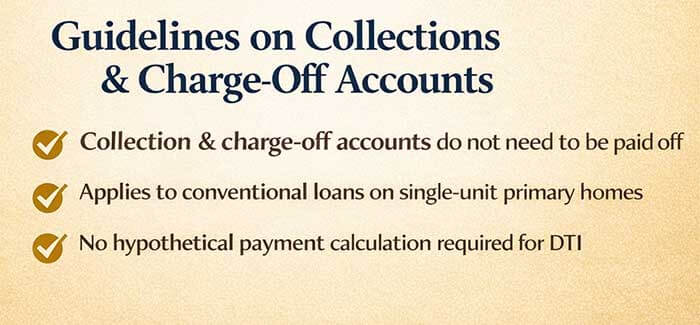 Fannie Mae Guidelines on collections and charge-off accounts on Single-Unit Primary Owner-Occupant Conventional loans. Outstanding collection and charge-off accounts do not have to be paid on primary owner-occupant one-unit conventional loans. Fannie Mae Collection Guidelines on primary single-family homes are very lenient.
For primary single-family properties, borrowers do not have to pay outstanding collections accounts to qualify for conventional loans.
Borrowers are not required to pay outstanding charged-off accounts either on the owner-occupant primary home financing. In the following paragraphs, we will cover what Fannie Mae States with Regards to Fannie Mae Collection Guidelines:
One-Unit Primary Residence Collections Guidelines
When underwriting through DU, Fannie Mae has no requirement for collections or charge-off accounts to be settled for one-unit primary residence loans. Marga Jurilla, the assistant at Gustan Cho Associates says the following:
It is important for borrowers to understand this. Those purchasing or refinancing a one-unit primary residence will likely be able to close with DU, even if collections are present, provided the lender has no additional requirements.
This does not mean collections are insignificant. They can affect credit scores and risk profiles and may change terms, influencing lenders’ approval and comfort levels. In this regard, Fannie Mae’s DU rule for a one-unit primary residence is more accommodating than many realize.
Fannie Mae and Freddie Mac Collection and Charged Off Guidelines on Two-to-Four Unit Multi-Family and Investment Homes
Investment properties have stricter guidelines regarding outstanding collections and charge-off accounts. This is because investment properties are riskier.
Mortgage rates on investment properties are substantially higher than those on owner-occupant primary homes due to the layered risks associated with investment properties.
Here are the guidelines for collections and charge-off accounts for investment properties: If the borrower has outstanding collections and charged-off accounts totaling over $250, the unpaid balance must be paid in full to qualify for investment conventional loans. If the borrower has $1,000 or more in total collections and charge-offs on their credit report, they need to be paid off to qualify for investment property loans.
One-Unit Owner-Occupied Property Collection Guidelines
The same does not apply to two- to four-unit owner-occupied properties. For purchases and refinances of these properties, collections and non-mortgage charge-offs of $5,000 or more must be paid in full before or at closing.
Borrowers considering a multi-unit property should be proactive and get an early credit review, especially since collections often approach or exceed the threshold. The loan officer can help assess the need for client resources before closing.
This policy is much more rigid, as multi-unit properties, even when the borrower occupies one unit, are inherently more complex. All multi-unit properties come with their own challenges, including leasing, maintenance, and calculating a vacancy reserve.
Second Home Collection Guidelines
Second homes follow the same collection rules as two- to four-unit owner-occupied properties under DU. If collections and non-mortgage charge-offs total more than $5,000, they generally must be paid in full at or before closing. A secondary home is different than a primary residence. Since the borrower has another living obligation or residence, Fannie Mae and lenders might be more cautious about the file. The borrower has to qualify for all obligations, including the new secondary home mortgage.
Medical Collection Accounts and Fannie Mae Conventional Loans
Fannie Mae offers better treatment for medical collection accounts than for other collection accounts. Fannie Mae does not require medical collection accounts to be paid in full prior to or at closing for any amount under both DU and manual underwriting. This benefits many borrowers who often have collection accounts from billing errors, insurance disputes, and unplanned medical expenses.
A collection may hurt the credit score; however, it is beneficial that medical collections are treated more favorably under Fannie Mae’s policy than other collections.
Borrowers should check their medical collection accounts to ensure they are accurate. If the account is reporting in error, the borrower may need to contact the credit reporting agencies, the medical provider, or the collection agency. However, starting a dispute during the mortgage process should be approached with caution, as active disputes may delay underwriting.
Non-Medical Collection Accounts and Conventional Loans
Accounts that do not involve medical collections include unpaid credit cards, loans, utility bills, retail accounts, collection accounts, and other similar debts. These accounts may be subject to more favorable treatment depending on the property type and underwriting method.
For a one-unit primary residence under DU, non-mortgage collection accounts and charge-offs do not need to be paid in full, regardless of amount. For two- to four-unit owner-occupied properties and second homes, the total balance may be assessed. For investment properties, even small balances may be assessed.
An underwriter will analyze what is reported on credit accounts. The lender may consider how the debt is aging, if it is in a collection, charged off, disputed, or registered with a judgment or lien. An unpaid collection is less severe than a debt that is a legal lien against a borrower or property.
Fannie Mae Manual Underwriting Collection Guidelines
There are big differences between DU underwriting and Manual underwriting. A conventional loan that is manually underwritten will be underwritten by the underwriter, applying Fannie Mae’s manual underwriting rules, and will be assessed independently of DU.
For manually underwritten conventional loans, non-medical and non-mortgage collection accounts and charge-offs do not need to be settled if each account is under $250 or the total is $1,000 or less.
If balances exceed these thresholds, accounts must be settled before or at closing. Manual underwriting for conventional loans is less common than automated underwriting. It may be harder to qualify for because files are assessed more strictly. Borrowers usually have more success with a strong DU approval, even with collections, low credit scores, high debt-to-income ratio, and limited reserves.
Charge-Offs versus Collections on Conventional Loans
Collections and charge-offs are related to each other, but not the same. A collection means that the account has been transferred to the collection’s agency. A charge-off means that the creditor has absorbed the loss for accounting purposes and charged off the account.
What Does a Charged Off Account Mean in the Mortgage Process
A charge-off does not mean that a borrower is free from their debt. Charge-offs may still be sold. Charge-offs may still be collected or reported. In a mortgage file, non-mortgage charge-offs will likely be reviewed alongside collection accounts for payoff.
For non-medical outstanding collections with a balance of over $2,000, Fannie Mae does NOT require underwriters to take 5% of the collection balance and treat it as a hypothetical monthly debt, as FHA loans do.
Charge-offs for mortgages will be treated differently and are likely to be viewed as a serious derogatory credit event. Charge-off mortgage accounts associated with a foreclosure, deed-in-lieu, short sale, or pre-foreclosure sale will be subject to a waiting period. A borrower should not assume that a mortgage charge-off will be treated the same as a credit card collection. Borrowers do not have to pay anything on charged-off and/or collection accounts. The 5% hypothetical debt-to-income ratio rule does not apply to conventional loans.
Active Loan Accounts with Past-Due Balances
A past-due loan account is not the same thing as a collection. If an open account is past due, Fannie Mae, in most cases, will require the account to be made current. This is applicable to credit cards, installment loans, mortgage accounts, and other active debts.
Accounts with past-due balances can be viewed as a more serious derogatory credit event than a collection, as they indicate an account that is currently in default.
Although a borrower may have a very good credit standing and a strong asset profile, an open account with recent past-due balances can affect the overall credit file. Past-due loan balances can also affect credit scores and the extent of credit underwriting. A borrower should thoroughly check all active accounts prior to closing. If an account is past due, the borrower should contact their mortgage counselor to determine the best course of action, as making a payment or settling the account may negatively impact mortgage approval.
Judgments, Tax Liens, and Other Liens vs Conventional Collections
Collection accounts are past-due balances that have been sold to collection agencies. These include judgments, tax liens, mechanic’s liens, and other legal liens. Other lien obligations must be more or less settled by release, subordination, or an acceptable repayment agreement prior to closing. A lien interferes with the lender’s position on the asset or with the borrower’s ability to repay the loan.
Fannie Mae and the lender must be assured that the new loan will be in the proper lien position and that there are no outstanding legal debts that will create a title or credit impediment.
While judgments and tax liens create voluntary obligations, the borrower must self-disclose them earlier in the process. The title search and closing are bound to be delayed by the late self-disclosure. A knowledgeable loan officer will strive to examine the lien, payment agreement, and exit settlement agreement prior to the closing.
Should Borrowers Pay Collections Before Applying?
Generally, borrowers should not pay off collections before applying for conventional loans. Paying collections can be counterproductive. It can reduce cash on hand, generate account activity, or negatively affect the credit score.
If the collection needs to be paid off, it can be paid at closing. In this situation, the settlement statement will reflect a payoff, and the process will remain documented. Assessing the situation on a case-by-case basis is best.
It is recommended that a mortgage professional first analyze the credit report. The loan officer has the best insight into whether the account must be paid to meet Fannie Mae requirements, if a payoff is needed in DU, and if the borrower has enough closing funds after paying the collection.
How Collection Accounts Affect Borrower’s Debt-To-Income Ratio Calculations
Gustan Cho Associates is a mortgage broker licensed in 48 states with a national reputation for originating mortgage loans that other lenders cannot. Over 80% of our borrowers could not qualify with other lenders due to overlays, stress testing, last-minute loan denials, or a lack of mortgage products.
How Gustan Cho Associates Help Borrowers on Conventional Loans with No Overlays
Gustan Cho Associates helps borrowers understand how collection accounts may affect their eligibility for a conventional mortgage. Many mortgage loan borrowers assume they will not qualify for conventional loans with collection accounts. However, some only need to pay off specific accounts to meet requirements.
An early credit report review identifies these needs and prevents unexpected issues during the loan process. The goal is to prepare the file thoroughly before underwriting.
At Gustan Cho Associates, we only market existing mortgage loans that are possible at competitive rates. In addition to government and conventional loans with no lender overlays, we offer hundreds of non-prime mortgage programs, including non-QM and non-prime mortgages.
Mortgage Lenders for Bad Credit with No Overlays
For more information about this blog or other mortgage-related topics, please contact Gustan Cho Associates at 800-900-8569 or text us for a faster response. Or email us at gcho@gustancho.com. The team at Gustan Cho Associates is available seven days a week, evenings, weekends, and holidays. The team at Gustan Cho Associates, a team of veteran mortgage professionals, is ready to answer any questions home buyers or homeowners have about mortgage inquiries.
The mortgage industry is so complex, with constantly changing regulations. New rules and regulations are being implemented, and our goal is to present the opinions of industry experts and offer our own. Company NMLS 376205 Branch NMLS 2885337. Gustan Cho Associates is a national mortgage company with no lender overlays on government and conventional loans. Over 80% of our borrowers at Gustan Cho Associates could not qualify at other lenders due to their lender overlays. We also offer dozens of non-QM and alternative financing mortgage programs.
What Are Conforming Versus Non-Conforming Mortgage Loans?
Conventional loans are often referred to as conforming loans. This is because conventional loans must conform to Fannie Mae and Freddie Mac agency guidelines for the two giant Government Sponsored Enterprises (GSE) to purchase mortgages.
The two GSEs only buy mortgages that conform to their guidelines. Any mortgages that do not meet Fannie/Freddie Guidelines are called non-conforming loans.
Fannie Mae and Freddie Mac have specific conforming loan guidelines for collections and charged-off accounts, depending on whether the loan is for an owner-occupant primary residence, a second home, or an investment property.
Common Questions Regarding Fannie Mae’s Collection Policies
Is It Possible For A Borrower With Collections To Close On A Conventional Loan?
A borrower may likely close a conventional loan with collections, depending on the type of collections, the collateral, the loan underwriting, and the underwriting results. Fannie Mae Desktop Underwriter may permit cases with collections and non-mortgage charge-offs for a primary one-unit residence. For other property types, the Payoff policy may be more restrictive.
Are Collections of a Medical Nature Treated the Same as Collections of a Non-Medical Nature?
Under Fannie Mae policies, collections of a medical nature are not treated the same as collections of a non-medical nature. Medical collections are not required to be paid in full prior to or at loan closing. While medical collections might impact a borrower’s credit score and may still be listed on the credit report, the flexibility of the payoff policy is more liberal when compared to other collections that are not of a medical nature.
Do Charge-Offs Require Payment for a Fannie Mae Conventional Loan?
For non-mortgage charge-offs, payment is at the lender’s discretion, depending on the property type and underwriting method. For a one-unit primary residence with DU, for example, a payoff may not be required. For investment properties and/or other property types, a payoff may be required if balances exceed Fannie Mae’s thresholds and/or DU mandates payment.
Should You Pay Collection Accounts Before Applying for a Mortgage?
Not necessarily. In some instances, paying a collection account may be beneficial. However, it may deplete liquid assets available for closing and alter how the account is reported. Borrowers should have their collection accounts evaluated by a mortgage professional to determine whether the payments are necessary to facilitate loan approval.
Can a Lender Require Collection Accounts to be Paid Even if Fannie Mae Does Not?
Yes, this is referred to as a lender overlay, which is an example of a lender having stricter requirements. In certain instances, Fannie Mae may not require a collection account to be paid; however, to mitigate their risk, a lender may require payment. This is why it is important to work with a lender who has a comprehensive understanding of the agency guidelines.
What if a Collection Account is Turned Into a Judgment or Lien?
A collection account becoming a judgment or lien is a more significant issue than most collection accounts. It may impact the title or the lender’s lien position and will likely need to be paid. To avoid delays during closing, borrowers should disclose judgments, tax liens, and other legal collection debts as early as possible.
Last Updated
Last updated: June 8, 2026