

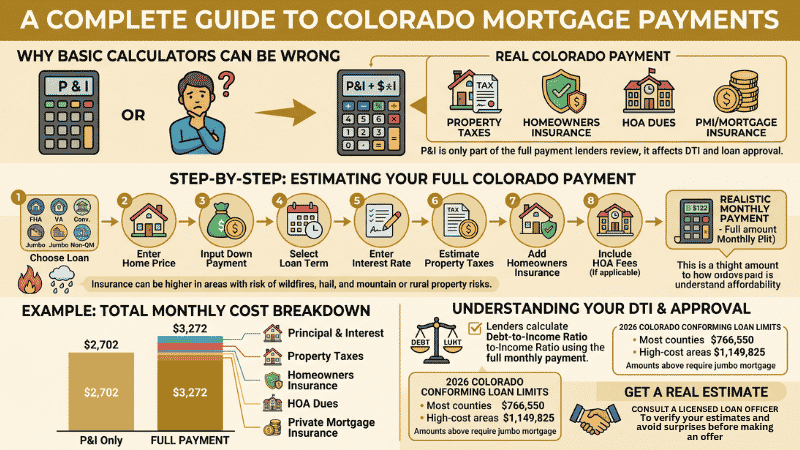
Many Colorado homebuyers are surprised when the payment shown on a basic online mortgage calculator does not match the one the lender uses. The reason is simple: principal and interest are only part of the monthly cost. A real Colorado mortgage payment may also include property taxes, homeowners’ insurance, HOA dues, private mortgage insurance, FHA mortgage insurance, and other escrow items. In some areas of Colorado, insurance can be higher due to wildfire, hail, mountain, or rural property risks. In higher-cost counties, the loan amount may also affect whether the mortgage is conforming or jumbo. That is why buyers should not rely on a calculator that only shows the loan amount, rate, and term. A complete Colorado mortgage calculator should help estimate the full payment before you make an offer, apply for a loan, or assume you qualify
for a certain price range. The goal is not just to see a lower number. The goal is to understand the payment a lender may use when reviewing your debt-to-income ratio and mortgage approval.
Why Basic Mortgage Calculators Can Be Wrong in Colorado
Many online mortgage calculators only show principal and interest. That number can be helpful, but it is not the full payment a lender will review when you apply for a mortgage.
In Colorado, the real monthly payment can change once property taxes, homeowners’ insurance, HOA dues, mortgage insurance, and other escrow items are added. This matters because those costs can affect your debt-to-income ratio, your loan approval, and the price range you can safely afford.
For example, a buyer may feel comfortable with the principal-and-interest payment on a Denver, Aurora, Colorado Springs, or Boulder-area home. But after taxes, insurance, HOA dues, and PMI or FHA mortgage insurance are included, the payment may be several hundred dollars higher each month. Insurance can also vary by property location. Homes in mountain areas, wildfire-risk areas, rural locations, or parts of Colorado with higher hail exposure may have higher insurance premiums. HOA dues can also make a major difference, especially in condos, townhomes, planned communities, and resort-style neighborhoods. That is why a complete Colorado mortgage calculator should include more than the loan amount, interest rate, and loan term. It should help estimate the full housing payment so you can compare loan options, check affordability, and avoid surprises before making an offer.
Step-By-Step: How to Use the Colorado Mortgage Calculator
Using our calculator is simple. Here’s what you’ll need to input:
- Select Loan Program: FHA, VA, Conventional, Jumbo, or Non-QM
- Enter Home Price: The property’s purchase price
- Down Payment: Either percentage or dollar amount
- Loan Term: 15, 20, or 30 years
- Interest Rate: Use today’s average or a lender’s quote
- Property Taxes: Auto-estimated or custom entry
- Homeowners Insurance: Annual or monthly
- HOA Fees: If applicable
- Other Debts: To calculate DTI
The result gives you a realistic monthly payment—not just a teaser number.
A Colorado Mortgage Calculator Is Only an Estimate
A Colorado mortgage calculator can help you get a better idea of your monthly payment, but it cannot confirm final loan approval. The number you see on the calculator is only an estimate based on the information entered.
A calculator cannot review automated underwriting findings, manual underwriting requirements, credit history, income documentation, cash reserves, loan-level pricing adjustments, mortgage insurance pricing, escrow setup, or lender overlays.
It also cannot confirm whether the homeowners’ insurance quote, property tax estimate, or HOA dues are final. This is why buyers should use the calculator as a planning tool, not a final approval decision. The estimate can help you compare payments, adjust your down payment, and understand your debt-to-income ratio. However, the final numbers should still be reviewed by a licensed loan officer before you make an offer or assume you qualify for a certain price range.
Example: Colorado Mortgage Payment Scenario
Here is a simple example of how to use the Colorado mortgage calculator to check the full Colorado mortgage payment can look once the extra costs are added. Let’s say a buyer is looking at a home in Aurora, Colorado, priced at $450,000. The buyer puts down 5% ($22,500). That leaves an estimated loan amount of $427,500. If the buyer chooses a 30-year fixed mortgage at a 6.5% interest rate, the principal and interest payment would be about $2,702 per month. That is not the full payment yet. The buyer may also need to add estimated monthly costs such as property taxes, homeowners’ insurance, HOA dues, and private mortgage insurance. In this example, the estimated monthly costs may look like this:
- Principal and interest: about $2,702
- Property taxes: about $250
- Homeowners insurance: about $100
- HOA dues: about $40
- Private mortgage insurance: about $180
That brings the estimated full monthly payment to about $3,272. This is why a basic mortgage calculator can be misleading. A buyer may first see the $2,702 principal-and-interest payment and think the home fits their budget. But the lender may review a payment closer to $3,272 when calculating the borrower’s debt-to-income ratio. These numbers are only examples. The actual payment can change based on the interest rate, credit score, loan program, property taxes, homeowners’ insurance quote, HOA dues, mortgage insurance cost, and final lender approval.
Colorado Property Taxes: Use the Actual Tax Bill When Possible
Colorado property taxes are often lower than many buyers expect, but they vary by county. Your tax bill depends on the property’s assessed value, the local mill levy, and the county, city, school district, and special taxing districts.
That means two homes with the same purchase price can have different property tax bills. A home in Denver may not have the same tax cost as a home in Boulder County, El Paso County, Douglas County, Jefferson County, or a mountain community.
A Colorado mortgage calculator can use a rough property tax estimate, but that number should only be treated as a starting point. For the most accurate mortgage payment, use the actual annual property tax amount from the property listing, seller’s tax statement, county treasurer, or county assessor’s website.
Here is the simple way to estimate the monthly tax amount: Divide the annual property tax bill by 12. For example, if the annual property tax bill is $3,600, the estimated monthly tax amount is $300. That monthly amount should be added to your principal, interest, homeowners’ insurance, HOA dues, and mortgage insurance when estimating the full payment. Buyers can usually find property tax information through the MLS listing, county assessor, or county treasurer. For official property tax information, check the Colorado Division of Property Taxation, the City and County of Denver property tax search, Boulder County property tax resources, or the El Paso County Assessor’s Office.
The key is simple: do not rely only on a statewide average. Use the actual property tax bill whenever possible so your Colorado mortgage calculator estimate is closer to the payment a lender may use for approval.
Colorado Homeowners Insurance Can Change Your Payment
Homeowners insurance can make a big difference in a Colorado mortgage payment. A basic calculator may use a rough estimate of insurance, but the actual premium can vary depending on the property, location, roof condition, coverage amount, deductible, and insurance company. This is especially important in Colorado because some areas may have higher insurance costs due to wildfire risk, hail exposure, mountain locations, rural access, or distance from fire services. A home that looks affordable based on principal and interest may have a higher total payment once the real insurance quote is added. Insurance can also affect loan approval. Lenders usually require acceptable homeowners’ insurance before closing. If the insurance premium is much higher than expected, it can increase the borrower’s monthly payment and debt-to-income ratio. Buyers should get a homeowner’s insurance quote for the property before using a calculator estimate. This will give a more accurate idea of the mortgage payment and help avoid surprises before closing.
Debt-to-Income Ratio: Why the Full Payment Matters
Your debt-to-income ratio (DTI) measures your monthly debts against your gross monthly income before taxes. Lenders use DTI to see if you can afford the mortgage payment.
This is why a complete Colorado mortgage calculator matters. A lender does not usually review only principal and interest. The lender may also count property taxes, homeowners’ insurance, HOA dues, PMI, FHA mortgage insurance, and other required housing costs.
For example, a buyer may look affordable when only principal and interest are used. But once taxes, insurance, HOA dues, and mortgage insurance are added, the full payment may push the borrower’s DTI above the threshold. There is no single DTI number that works for every borrower. Approval depends on the loan program, credit profile, down payment, cash reserves, income stability, monthly debts, and automated underwriting findings. Some files may also require manual underwriting, which can have stricter requirements. FHA, VA, conventional, jumbo, and Non-QM loans may all review DTI differently. VA loans also look closely at residual income, which is the money left over after major monthly expenses. Conventional and jumbo loans may be more sensitive to higher DTI, lower credit scores, lower reserves, and overall risk. A higher DTI does not always mean denial, but it should never be treated as automatic approval. The safest step is to estimate the full payment first, then have a licensed loan officer review the complete file before making an offer.
Why County-by-County Differences Matter in Colorado
Colorado mortgage payments can vary by county, even when two homes have the same purchase price. Property taxes, HOA dues, homeowners’ insurance, and loan limits can all change depending on where the home is located. For example, a buyer comparing homes in Denver, Boulder, Colorado Springs, Aurora, Fort Collins, Pueblo, Grand Junction, or a mountain community should not assume the monthly payment will be the same. One home may have higher HOA dues. Another may have higher insurance costs. Another may fall into a different county loan-limit category. County loan limits also matter when deciding whether a mortgage is conforming or jumbo. If the loan amount exceeds the conforming loan limit for that county, the borrower may need jumbo financing, which may have different credit, reserve, down payment, and debt-to-income requirements. To evaluate a property safely, focus on its specific details instead of just the city or state. Use the actual tax bill, HOA dues, insurance quote, loan amount, and county loan limit whenever possible.
Ready to Stop Renting and Start Owning?
Owning a home could be easier than you think! Contact us today to learn about the mortgage options available and start building equity with your own home.Colorado Mortgage Programs You Can Compare
Colorado buyers have several mortgage options, but the right program depends on more than the down payment and credit score. The county, home price, loan amount, HOA dues, property taxes, and homeowners’ insurance can all change, so which loan makes the most sense?
FHA Loans in Colorado
FHA loans assist buyers in Colorado seeking a reduced down payment or requiring more flexible credit options. The maximum loan amount varies by county. This means the limits are different in places like Denver, Boulder, El Paso County, Douglas County, Jefferson County, and Eagle County. This matters because a buyer may qualify for an FHA loan based on credit and income, but the home price may still need to fit within the FHA loan limit for that county. Buyers should also include FHA mortgage insurance, property taxes, insurance, and HOA dues when estimating the full payment.
VA Loans in Colorado
VA loans are a great choice for eligible veterans, active-duty service members, and qualifying surviving spouses. They often require no down payment and do not include monthly PMI, but it’s important to consider the overall payment. In higher-priced markets like Colorado, VA buyers must understand VA entitlement, especially if they already have another VA loan or are buying above certain price limits. Keep in mind that property taxes, homeowners’ insurance, and HOA fees can impact the debt-to-income ratio and residual income.
Conventional Loans in Colorado
Conventional loans are popular among Colorado buyers with good credit, steady income, and a sufficient down payment. While some programs permit low down payments, private mortgage insurance is usually necessary if the buyer puts down less than 20%. Conventional loan limits can also vary by county. If the loan amount exceeds the county conforming loan limit, the buyer may need jumbo financing rather than a standard conventional loan. This is why buyers should check the county loan limit before assuming a loan is conforming.
Jumbo Loans in Higher-Cost Colorado Markets
Jumbo loans are often available in higher-cost areas of Colorado, such as the Denver metro, Boulder County, Eagle County, and resort communities where home prices are elevated. Jumbo loans often have stricter requirements for credit, reserves, income documentation, debt-to-income ratio, and down payment. Insurance costs, HOA dues, and property taxes can make a big difference because jumbo loans are usually reviewed more carefully.
Non-QM Loans in Colorado
Non-QM loans may help Colorado buyers who do not fit traditional lending rules. These may include self-employed borrowers, real estate investors, bank statement borrowers, DSCR borrowers, asset-depletion borrowers, or buyers with recent credit events. Non-QM loans can be helpful, but they differ from FHA, VA, and conventional loans. They might need higher down payments, higher interest rates, more savings, or different paperwork. Buyers should consider the full monthly payment and the total cost before choosing this option. The key takeaway is clear: the loan program is just one aspect of the decision-making process. A Colorado mortgage calculator can help buyers compare payments for FHA, VA, conventional, jumbo, and Non-QM loans by accounting for total housing costs, rather than just principal and interest.
Current Conforming Loan Limits in Colorado
Conforming loan limits in Colorado are:
- Most counties: $766,550
- High-cost areas (Boulder, Denver Metro, Eagle): up to $1,149,825
If your loan exceeds these amounts, you’ll need a jumbo mortgage. The calculator automatically shows payment differences.
Verify Your Colorado Mortgage Estimate With a Loan Officer
A Colorado mortgage calculator can help you estimate your monthly payment, but it cannot confirm final loan approval. After you estimate the payment, verify the numbers with a licensed loan officer.
A calculator cannot review automated underwriting findings, manual underwriting requirements, mortgage insurance pricing, property tax escrows, homeowners insurance quotes, HOA documents, credit history, income documentation, or lender overlays. Those details can change the final payment and affect whether the borrower qualifies.
This is especially important for Colorado buyers comparing FHA, VA, conventional, jumbo, or Non-QM loans. A buyer may look approved based on a calculator estimate. However, the full file still needs to be reviewed by underwriting. Before making an offer, ask a loan officer to check the full payment, debt-to-income ratio, loan program, county loan limit, estimated cash to close, and any conditions that may affect approval.
Colorado-Specific Mortgage Affordability Factors
Colorado affordability can change from one property to the next, even when two homes have the same purchase price. That is why buyers should compare the actual listing price, HOA dues, property taxes, homeowners’ insurance quote, and loan program before relying on a calculator estimate.
A basic mortgage calculator may show a payment that looks affordable, but the real number can change once all housing costs are added. HOA dues can make a big difference in condos, townhomes, planned communities, and resort areas.
Property taxes can vary by county, city, school district, and special taxing district. Homeowners’ insurance can also vary depending on the property location, roof condition, wildfire risk, hail exposure, and other insurance factors. This is especially important in Colorado, where housing costs can vary widely across different areas. A buyer comparing homes in Denver, Colorado Springs, Boulder, Aurora, Fort Collins, Pueblo, Grand Junction, or a mountain community should not assume the payment will work the same way in every location. Before making an offer, use the most accurate numbers available. Check the property tax bill, ask for the HOA dues and what they include, get a homeowners insurance estimate, and confirm whether the loan amount fits within the correct county loan limit. Two homes priced the same can have different monthly payments when costs are considered.
What To Check Before You Make an Offer
Before making an offer on a Colorado home, buyers should confirm the numbers that can change the full monthly payment. A calculator estimate is helpful, but it should be updated with real property information whenever possible. Start with the actual annual property tax bill from the listing, the seller, the county assessor, or the county treasurer. Then confirm the HOA dues and ask what those dues include. Some HOA fees may cover certain services, while others may cover little beyond community maintenance. Next, get a homeowners’ insurance quote for the actual property. This is important in Colorado because insurance can vary based on wildfire risk, hail exposure, mountain location, roof condition, and other property details. Buyers should also ask the lender for an updated rate quote, an estimate of mortgage insurance, an estimate of cash to close, and a review of the full payment used in the debt-to-income ratio calculation. This step can help avoid payment shock and reduce the chance of problems after the offer is accepted.
Final Thoughts: Know the Real Payment Before You Make an Offer
A Colorado mortgage calculator is useful when it shows the full payment, not just principal and interest. The number that matters most is the payment a lender may use when reviewing your debt-to-income ratio.
Before making an offer, try to confirm the actual property taxes, HOA dues, homeowners’ insurance quote, estimated mortgage insurance, current interest rate, and county loan limit. These details can change your monthly payment and may affect which loan program fits best.
The goal is not to guess what you can afford. The goal is to understand the full housing cost before you fall in love with a home, submit an offer, or move too far into the loan process. Use the Colorado mortgage calculator as a starting point. Then have a licensed loan officer review your full file, including credit, income, debts, down payment, reserves, loan program, and property details. That extra review can help you avoid payment shock and make a better homebuying decision.
Frequently Asked Questions About Colorado Mortgage Calculator:
Can A Colorado Mortgage Calculator Tell Me How Much House I Can Afford?
A Colorado mortgage calculator is a great way to get a rough idea of what you can afford, but don’t rely on it as your only resource when figuring out your budget. Your true affordability depends on your income, monthly debts, down payment, credit profile, interest rate, loan program, and comfort level with the full monthly payment. A lender can review your complete file and help confirm a safer homebuying budget.
What Is The Difference Between A Mortgage Calculator And A Home Affordability Calculator?
A mortgage calculator usually estimates the monthly payment based on a home price, down payment, interest rate, and loan term. A home affordability calculator works from the other direction. It looks at income, debts, and available funds to estimate a price range. Colorado buyers may want to use both tools before shopping for homes.
Should I Use The Listing Price Or The Offer Price In A Mortgage Calculator?
Use the price you expect to offer, not just the listing price. If you plan to offer above or below the asking price, the calculator should reflect that number. Even a small price change can affect the loan amount, down payment, monthly payment, mortgage insurance, and cash needed to close.
How Does My Down Payment Change My Colorado Mortgage Payment?
A larger down payment usually lowers the loan amount and the monthly principal-and-interest payment. It may also reduce or remove private mortgage insurance on a conventional loan, depending on the size of the down payment. A smaller down payment may help buyers keep more cash available, but it can lead to a higher monthly payment.
Should I Include Closing Costs In A Colorado Mortgage Calculator?
Most mortgage calculators focus on the monthly payment, not the full cash needed to close. Closing costs are still important because they affect how much money you need before buying the home. Buyers should ask for a loan estimate that shows the down payment, lender fees, title fees, escrow amounts, prepaid items, and the total estimated cash to close.
Why Does My Lender’s Estimate Look Different From An Online Mortgage Calculator?
Your lender’s estimate may include details that a basic calculator does not know, such as credit score, exact loan program, mortgage insurance pricing, escrow setup, taxes, insurance, HOA dues, rate lock, lender credits, discount points, and underwriting requirements. Online calculators are useful for planning, but lender estimates are usually more detailed.
Is It Better To Use A 15-Year Or 30-Year Mortgage In The Calculator?
A 15-year mortgage usually has a higher monthly payment but can reduce total interest paid over the life of the loan. A 30-year mortgage usually has a lower monthly payment, which may help with affordability and debt-to-income ratio. Colorado buyers should compare both options based on monthly comfort, long-term goals, and the strength of their loan approval.
This blog about “Colorado Mortgage Calculator – Get Your Real Payment Fast” was updated on June 8th, 2026.
