
Many homeowners went into mortgage forbearance during COVID or another financial hardship because they needed time to catch up. Now the question is simple: can you refinance after a mortgage forbearance, or will the past hardship still hold you back?
The answer depends on where your loan stands today. Lenders will look at whether your mortgage is current, how the missed payments were handled, how many on-time payments you made after forbearance, and what refinance program you are applying for. Some homeowners may qualify for a rate-and-term refinance, a cash-out refinance, an FHA refinance, a VA refinance, or a conventional refinance after forbearance. Others may need more time to rebuild payment history before moving forward. A past hardship does not always mean you are stuck with your current loan forever. The key is knowing what lenders check, what documents they may ask for, and when refinancing makes sense based on your payment, equity, credit, and long-term goals.
Can You Refinance After a Mortgage Forbearance?
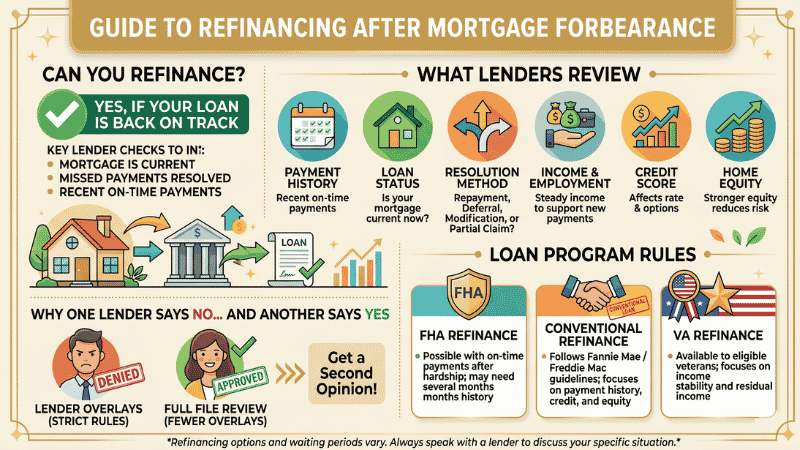
Yes, you may be able to refinance after a mortgage forbearance, but the lender will want to see that your loan is back on track. In most cases, you need to be current on your mortgage before a refinance can move forward. If you are still behind, still in an active forbearance plan, or have unresolved missed payments, the lender may ask you to fix those issues first. The lender will consider factors beyond just your credit score. They will review your recent mortgage payment history, current income, employment, home equity, debt-to-income ratio, and how the forbearance was resolved. Missed payments may have been paid back, moved to the end of the loan, placed into a deferral, handled through a repayment plan, or included in a loan modification. How those payments were handled can affect which refinance options are available.
What Mortgage Forbearance Means
Mortgage forbearance lets you pause your full mortgage payments for a while. However, it does not cancel the debt you owe. The lender or loan servicer may allow you to pause payments or make a smaller payment for a set period due to a hardship, but the missed amount still has to be repaid later.
After forbearance ends, the loan servicer will tell you how the missed payments must be repaid. Some homeowners repay the amount over time through a repayment plan. Others may have missed payments deferred to the end of the loan.
FHA borrowers may be eligible for a partial claim. Some borrowers may need a loan modification if the original payment is no longer affordable. The important thing to understand is that forbearance is not loan forgiveness. It is a temporary payment relief option. Before you refinance after a mortgage forbearance, the new lender will want to know whether the forbearance is finished, whether the loan is current, and how the missed payments were resolved.
How Lenders Look at Your Loan After Forbearance
After a mortgage forbearance, lenders want to see that the hardship is over and the loan is back on track. They are not only looking at what went wrong. They are looking at where you stand today. Lenders usually review these main areas:
- Payment history after forbearance: They want to see if you made your mortgage payments on time after the forbearance ended. A clean, recent payment history can help your refinance approval.
- Whether the loan is current now: If the mortgage is still behind, still in active forbearance, or has unresolved missed payments, you may need to address those issues before refinancing.
- How the missed payments were handled: Missed payments may have been repaid, deferred to the end of the loan, placed into a partial claim, or included in a loan modification. The lender needs to know which one applies.
- Current income and employment: Lenders want to see that you have a regular paycheck coming in to cover the new payment. If you changed jobs, had a job gap, became self-employed, or lost income, they may ask for extra documents.
- Credit score: Your credit score can affect your refinancing options, the interest rates you qualify for, and the overall costs of your loans.
- Home equity: More equity can make the refinance stronger because the lender has less risk.
- Debt-to-income ratio: Lenders compare your monthly debt payments to your income. This helps them decide if the new mortgage payment is affordable.
- Loan program rules: FHA, VA, conventional, USDA, and non-QM refinance programs may treat forbearance, late payments, and loan modifications differently.
This is why one lender may deny the refinance while another lender may have a path forward. The right answer depends on your payment history, current loan status, income, equity, credit, and the refinance program being used.
Refinance Waiting Period After Mortgage Forbearance
The waiting period to refinance after a mortgage forbearance varies by homeowner. It can depend on the type of loan you have, the refinance program you want, the investor behind the loan, your recent payment history, and how the missed payments were resolved.
Some refinance programs may require several on-time payments after forbearance before the loan can close. Others may have different rules if the missed payments were paid back, deferred to the end of the loan, placed into a partial claim, or handled through a loan modification.
This is why it is important to know exactly how your servicer closed out the forbearance plan. Lenders will usually want to see that your mortgage is current before approving a refinance. If you are still in active forbearance, still behind, or still working through unresolved missed payments, the lender may ask you to complete the plan first. If your loan is current and you have made on-time payments after the hardship, you may have more refinance options. A repayment plan, deferral, partial claim, or loan modification can each be treated differently. For example, a borrower who paused payments and then brought the loan current may be reviewed differently from a borrower who changed the loan terms through a modification. A cash-out refinance may also be reviewed more carefully than a rate-and-term refinance because the lender is giving the borrower new money from home equity. The best approach is to collect your mortgage statement, forbearance exit letter, repayment plan, deferral notice, partial claim documents, or modification agreement before you apply. Having these documents on hand will help the lender understand your situation and whether your loan is current, which is important when you plan to refinance after a mortgage forbearance.
Refinancing After a COVID Hardship
A COVID hardship may still matter when you apply for a refinance, but it does not always stop you from getting approved. What matters most is how the hardship affected your mortgage, income, credit, and current ability to repay the loan. Some homeowners had no late payments during COVID but used forbearance to protect their finances. Others had missed payments, experienced job gaps, had reduced hours, suffered business losses, or undergone a loan modification after the hardship. Lenders will look at what happened, how long ago it happened, and whether your finances are stable now. If COVID caused late mortgage payments, the lender may review how recent those late payments were and whether you have made on-time payments since then. If COVID caused a job loss or income drop, the lender may want to see that you are working again and earning a stable income. If your loan was placed into a repayment plan, deferral, partial claim, or modification, the lender will need documents showing how the missed payments were handled. The old pandemic refinance problems, such as appraisal delays, drive-up closings, and overloaded lenders, are no longer the main issue for most homeowners. Today, the bigger question is whether the hardships left behind by mortgage delinquencies, unresolved forbearance, lower credit scores, or income problems still affect refinance approval. Experiencing a past COVID hardship does not automatically disqualify you from refinancing. Lenders will primarily consider your current situation. If your mortgage payments are up to date, your income is consistent, your credit score has improved, and the forbearance or modification was properly managed, you may still have options to refinance after a mortgage forbearance.
Refinancing After Late Mortgage Payments
Late mortgage payments can complicate refinancing, particularly if they occurred recently. When considering a request to refinance after a mortgage forbearance, lenders pay special attention to any 30-day, 60-day, or 90-day late payments, as these reflect the borrower’s management of their existing loan before seeking a new one.
A late mortgage payment can raise concerns, especially if it’s 30 days late. A 60-day or 90-day late payment is an even bigger issue. Lenders want to know why you missed the payment, whether it was a temporary issue, and whether your mortgage is now up to date. I
f the late payment happened during or after a forbearance period, they may ask for documents showing how you resolved the hardship. Recent late payments can significantly lower your chances of being approved for refinancing. Some refinance programs need a clean payment history for a specific time before they can close your loan. Others may be more flexible depending on the type of loan, the amount of equity you have, your credit score, income, and the overall strength of your application.
One denial does not mean you don’t have other options. Some lenders have stricter rules called lender overlays. These overlays can require higher credit scores, longer waiting times, or a better payment history than the basic loan program needs.
Another lender may look at the same application differently if you meet their specific guidelines. If you have experienced late mortgage payments, be prepared to explain the circumstances and how you addressed them. When you plan to refinance after a mortgage forbearance, providing a brief letter of explanation, proof that your loan is currently up to date, and a solid recent payment history can help the lender grasp your situation. Your objective is to demonstrate that your financial difficulties are resolved and that you are capable of managing the new mortgage payments moving forward.
Refinancing After a Repayment Plan, Deferral, or Loan Modification
After a mortgage forbearance, the missed payments must be addressed before a refinance can proceed. The way those payments were resolved can affect your refinance options.
Repayment Plan
A repayment plan means you pay back the missed payments over time. Your servicer may add an extra amount to your regular mortgage payment until the past-due balance is brought up to date. A lender may want to see that the plan is completed or that you have made the required payments on time.
Deferral
A deferral means the missed payments are moved to the end of the loan. You may not have to pay the full amount you missed right away, but the balance may become due when you sell, refinance, or pay off the mortgage. If you refinance, the lender needs to know how much is deferred and whether it must be paid off with the new loan.
Loan Modification
A loan modification adjusts the terms of your mortgage. The servicer may adjust the payment, interest rate, loan term, or past-due balance to make the loan more affordable. Some refinance programs may require several on-time payments after a modification before the new loan can close. These options are not all treated the same. A borrower who has completed a repayment plan may be treated differently from a borrower with a recent loan modification. A borrower with a deferral may also need enough equity to pay off the deferred balance through the refinance. Before you refinance after a mortgage forbearance, gather your repayment plan letters, deferral notices, partial claim documents, or loan modification agreements. These documents help the lender understand how the forbearance ended and whether the loan is ready to refinance.
Worried About Your Mortgage Payments During a Crisis? Refinancing Can Help!
Reach out today to discuss your options for refinancing during this challenging time.FHA Refinance After a Mortgage Forbearance
An FHA refinance after a mortgage forbearance is possible if the hardship is resolved and the borrower meets FHA refinance guidelines. In most cases, the lender will want to see that the mortgage is current, the borrower has made the required on-time payments, and the missed payments from forbearance were properly handled.
FHA refinance options may include a rate-and-term refinance, cash-out refinance, or FHA Streamline Refinance. A rate-and-term refinance may help lower the payment, extend the loan term, or convert to a new FHA loan.
A cash-out refinance may allow the borrower to use home equity, but it can be reviewed more closely because the borrower is taking cash from the property. An FHA Streamline Refinance may be an option for those who currently hold an FHA loan. This program is often simpler than a regular refinance because it may require less documentation, but the borrower still needs to meet FHA payment history rules and show that the refinance has a clear benefit. FHA may allow refinance after a mortgage forbearance, but the details matter. A borrower who is current and has made on-time payments after forbearance may have a better chance than a borrower who is still behind or has recently modified the loan. The lender will also review credit, income, equity, the debt-to-income ratio, and the reason the forbearance ended before approving the new loan.
Conventional Refinance After Mortgage Forbearance
A conventional refinance after a mortgage forbearance may be possible, but the rules for loans can vary based on whether they follow Fannie Mae or Freddie Mac guidelines. Lenders will check how the forbearance ended, if the mortgage is up to date, and whether the borrower has made the required on-time payments after facing hardship. Payment history is one of the biggest factors. If the borrower has recent late mortgage payments, the refinance may be harder to approve. If the loan is current and the borrower has a clean recent payment history, the file may be stronger. Credit score and home equity also matter. Conventional loans often rely heavily on credit, loan-to-value ratio, and overall risk. A borrower with stronger credit and more equity may have more refinance options than a borrower with lower credit, high debt, or limited equity. The lender will also look at how the missed payments were resolved. If the payments were deferred, included in a repayment plan, or handled through a loan modification, the lender may need documents showing the terms of the deferral, repayment plan, or loan modification. Some conventional refinance programs may require several on-time payments after forbearance or modification before closing. Fannie Mae and Freddie Mac guidelines may not always be applied consistently by every lender. Some lenders add overlays, such as higher credit score requirements or stricter payment history rules. This is why a borrower may be denied by one conventional lender but still have a possible path with another lender.
VA Refinance After Mortgage Forbearance
Eligible veterans, active-duty service members, and surviving spouses may still qualify for a VA refinance after a mortgage forbearance. The lender will focus on whether the hardship is over and whether the borrower can afford the new loan. VA lenders usually review these key areas:
- Current mortgage status: The loan must be current before a VA refinance can proceed. If the borrower is still behind or still in active forbearance, the lender may require those issues to be resolved first.
- Recent payment history: On-time payments after forbearance can help strengthen the file. Recent 30-day, 60-day, or 90-day late payments may make approval harder.
- Income and employment: The lender will review stable income to make sure the borrower can afford the new mortgage payment.
- Residual income: VA loans consider residual income. This is the money left over each month after major bills are paid. Strong residual income can help show the borrower has enough room in the budget.
- Credit and debt-to-income ratio: VA does not have the same minimum credit score rule that many borrowers expect, but lenders may still apply their own credit score overlays. The lender will also review monthly debt payments relative to income.
- How the forbearance ended: The lender may request documents confirming whether the missed payments were repaid, deferred, included in a repayment plan, or handled through a loan modification.
If the borrower already has a VA loan, a VA IRRRL may be an option. A VA IRRRL is a streamlined refinance for an existing VA loan. It may help lower the payment, lower the rate, or move from an adjustable-rate loan to a fixed-rate loan. A past forbearance does not automatically stop a veteran from refinancing. The main question is whether the mortgage is current, the hardship is resolved, the income is stable, and the new loan provides a real benefit.
Cash-Out Refinance After a Mortgage Forbearance
A cash-out refinance after a mortgage forbearance may be possible, but it can be harder to approve than a regular rate-and-term refinance. With a rate-and-term refinance, the borrower usually replaces the old loan with a new one to lower the payment, change the term, or improve the loan terms. With a cash-out refinance, the borrower is taking new money from the home’s equity, so the lender may review the file more carefully.
The lender will look closely at recent mortgage payment history. If the borrower had forbearance, late payments, a repayment plan, a deferral, or a loan modification, the lender will want to know how the issue was resolved. A clean payment history after the hardship can help show that the borrower is back on track.
Home equity is also important. A cash-out refinance depends on the home’s value and the amount owed on the current mortgage. If there is enough equity, the borrower may have more options. If equity is limited, the refinance may not work or may not provide enough cash after closing costs and payoff amounts. Credit score and debt-to-income ratio also matter. Since the lender is giving the borrower access to home equity, they want to see that the new loan is affordable. High credit card balances, new debt, lower credit scores, or unstable income can make a cash-out refinance harder to approve. Borrowers should also think about whether taking cash out is worth it. Cash-out refinancing can be a great way to pay off high-interest loans, make home repairs, or cover major expenses, but it also increases the mortgage balance. The best choice depends on the borrower’s equity, payment, interest rate, closing costs, and long-term plans for the home.
When Refinancing May Make Sense After Forbearance
A refinance after a mortgage forbearance may make sense if the new loan helps your budget or gives you a stronger long-term plan. The refinance should have a clear benefit, not just a new loan. Here are common reasons it may make sense:
- Lower monthly payment: A lower payment can give you more breathing room after a hardship, especially if your income has changed or your budget is tighter.
- Remove mortgage insurance: If your home’s value has increased or you’ve built sufficient equity, refinancing can eliminate private mortgage insurance or reduce your mortgage insurance costs.
- Consolidate high-interest debt: A cash-out refinance can help you pay off credit cards or personal loans that have high payments. This can help monthly cash flow, but it also moves that debt into a mortgage tied to your home.
- Switch from an adjustable-rate to a fixed-rate mortgage: A fixed-rate mortgage helps keep your payments steady, making it easier to budget and plan ahead.
- Get out of a repayment plan: A refinance may help pay off the old loan, including deferred amounts, partial claims, or past-due balances, depending on the program and available equity.
- Improve long-term loan stability: A refinance may be worth reviewing if it gives you a safer payment, clearer loan terms, or a better path after financial hardship.
If the savings are small, the closing costs are high, or you plan to sell soon, waiting may be the better choice.
When Refinancing May Not Be Worth It
A refinance after a mortgage forbearance is not always the right move. Even if you can qualify, the new loan still needs to make financial sense. A refinance may not be worth it if the costs are too high, the savings are too small, or your finances are not stable enough yet.
Closing costs are among the first items to review. A refinance usually comes with lender fees, title fees, appraisal costs, recording fees, and possible discount points. If the monthly savings are small, it may take too long to recover those costs.
The new interest rate also matters. If the new rate is not much better than your current rate, refinancing may not help enough to justify starting over with a new loan. A lower payment can look good at first, but the total cost over time may not always be better. Refinancing may also be a poor choice if you plan to sell the home soon. If you move before reaching your break-even point, you may not keep the loan long enough to benefit from the savings. Some borrowers may also need more time to recover financially after forbearance. If your income is still unstable, your credit scores are lower, your mortgage history is recent, or your debt is too high, waiting may put you in a stronger position later. A refinance after a mortgage forbearance should help you move forward, not create more pressure. Before applying, compare the new payment, closing costs, loan balance, interest rate, and the length of time you plan to stay in the home.
Refinance Costs, Discount Points, and Break-Even Point
Refinancing is not free, so the cost of the new loan matters just as much as the new payment. A refinance may include lender fees, title fees, appraisal costs, recording fees, credit report fees, escrow setup, prepaid taxes, homeowners’ insurance, and possible discount points. Some costs may be paid at closing, while others may be rolled into the new loan if the program allows it. Discount points are fees paid to get a lower interest rate. One point usually equals 1% of the loan amount. For example, on a $300,000 loan, one point would cost $3,000. Paying points may lower the monthly payment, but it only makes sense if the savings are worth the upfront cost. This is where the break-even point matters. The break-even point tells you how long it takes for your monthly savings to cover the refinance costs. If your refinance costs $6,000 and saves you $200 per month, it would take about 30 months to break even. If you plan to keep the home longer than that, the refinance may make sense. If you plan to sell or refinance again before then, it may not be worth it. Before you refinance after a mortgage forbearance, compare the new payment, total closing costs, interest rate, loan balance, and break-even point. A lower payment is helpful, but the loan’s full cost should still make sense for your long-term plans.
Documents Needed To Refinance After Forbearance
A refinance after a mortgage forbearance may require more paperwork than a standard refinance. The lender needs to understand what happened during the hardship, how the missed payments were handled, and whether your loan is current now. Before applying, gather these documents:
- Mortgage statement: This shows your current loan balance, payment amount, due date, and whether the loan is current.
- Forbearance exit letter, if available: This can show when the forbearance ended and what option was used to resolve the missed payments.
- Repayment plan, deferral, or modification documents: These papers explain how the missed payments were handled. The lender may need to know if the balance was repaid, moved to the end of the loan, placed into a partial claim, or changed through a loan modification.
- Pay stubs: Recent pay stubs help verify your current income and employment.
- W-2s or 1099s: These show your income history and help the lender review how you are paid.
- Tax returns, if needed: Self-employed borrowers, business owners, commission-based borrowers, or borrowers with rental income may need tax returns.
- Homeowners insurance policy: The lender needs proof that the property is insured.
- Bank statements: You might need bank statements to check on your assets, reserves, closing costs, or any big deposits you’ve made.
- Photo ID: A driver’s license, state ID, or passport is usually needed to verify identity.
- Letter of explanation, if requested: If the hardship caused forbearance, late payments, job loss, reduced income, or a loan modification, the lender may ask for a short written explanation.
Having these documents ready can make the refinance after a mortgage forbearance process smoother. It also helps the lender review your file faster and avoid delays caused by missing paperwork.
Why One Lender May Deny You and Another May Approve You
A refinance denial after forbearance does not always mean every lender will say no. Some lenders have extra rules called lender overlays. These are stricter requirements added on top of FHA, VA, conventional, USDA, or non-QM guidelines.
For example, one lender may require a higher credit score, a longer clean payment history, or more time after forbearance before approving the refinance. Another lender may follow the actual agency guidelines, with fewer overlays and a full-file review.
It can help to get a second opinion, especially if your mortgage is current, your income is stable, and the forbearance was properly resolved. The right lender will look at the full picture, not just the fact that you had a hardship in the past.
How To Improve Your Chances of Refinance Approval
You can improve your chances of refinance approval after forbearance by showing the lender that your finances are stable again. The goal is to prove that the hardship is behind you and that the new mortgage payment will be affordable.
- Get current on the mortgage: If your loan is still behind, work with your servicer to bring it current or resolve the missed payments before applying.
- Make several on-time payments: A clean recent mortgage history can help. Some refinance programs may require several on-time payments after forbearance before closing.
- Save for closing costs or reserves: Having funds set aside can strengthen your file. It may help cover closing costs, prepaid items, or reserves if the lender asks for them.
- Avoid new debt: Do not open new credit cards, finance furniture, buy a car, or take on new monthly payments before refinancing. New debt can raise your debt-to-income ratio.
- Pay down credit cards: Lowering credit card balances may help improve your credit score and reduce monthly debt payments.
- Keep income stable: Lenders want to see steady income. Try to avoid job changes, reduced hours, or major income changes before applying, unless you have already checked how they affect your approval.
- Gather hardship documents: Keep your forbearance exit letter, repayment plan, deferral notice, partial claim documents, loan modification agreement, and any proof that your mortgage is current.
- Ask for a second opinion before giving up: A denial from one lender does not always mean you cannot refinance. Some lenders have stricter overlays than others, so another lender may review the file differently.
Final Thoughts About a Refinance After a Mortgage Forbearance
Mortgage forbearance does not always block you from refinancing forever. Many homeowners can refinance once the hardship is over, the mortgage is current, and the missed payments have been properly handled.
The key is how the forbearance ended. Lenders will assess whether the missed payments were repaid, deferred, placed in a partial claim, included in a repayment plan, or handled through a loan modification. They will also review your recent payment history, income, credit, equity, and the refinance program rules.
If you were denied by one lender, do not assume every lender will give the same answer. A second review may help you understand whether you qualify now or what steps you need to take before refinancing.
FAQs About Refinance After a Mortgage Forbearance
Does Mortgage Forbearance Show up on My Credit Report?
Mortgage forbearance may show on your credit report, but the bigger issue is whether the lender reported missed or late payments. If your payments were paused under an approved forbearance plan, the reporting may differ from what it would be if you stopped paying without approval. Before applying for a refinance, review your mortgage history on all three credit reports and check for errors.
Do I have to Pay Back All Skipped Mortgage Payments Before Refinancing?
Not always. Some borrowers repay the missed amount over time, while others may have the balance deferred, placed into a partial claim, or handled through a loan modification. Whether the amount must be paid off during the refinance depends on the loan program, servicer records, equity, and how the forbearance was closed.
Can I Refinance if My Servicer Says My Loan is Current?
Being current is a strong starting point, but it does not guarantee approval for a refinance. The new lender may still review how the forbearance ended, whether any payments were late, how many on-time payments were made afterward, and whether the refinance program allows the file to move forward.
What if My Credit Score Dropped After Forbearance?
A lower credit score can affect your refinance options, interest rate, and loan pricing. It does not always mean you cannot refinance, but it may limit the programs available to you. To improve your credit file before applying, pay down credit cards, avoid new debt, fix credit report errors, and make on-time payments.
Can I Sell My Home Instead of Refinancing After Forbearance?
Yes, selling may be an option if refinancing does not make sense or if the home no longer fits your budget. If you sell, any deferred balance, partial claim, past-due amount, or payoff balance may need to be handled at closing. The title company and loan servicer can confirm the payoff amount before the sale closes.
Will Mortgage Forbearance Affect My Escrow Account?
It can. If your servicer paid property taxes or homeowners’ insurance while payments were paused, your escrow account may need to be reviewed after the forbearance ends. Some homeowners may later see an escrow shortage or a change in payment. Before refinancing, ask your servicer for the current escrow balance and payoff details.
Can I Refinance if I Stayed Current During Forbearance?
You may have more options if you were in an approved forbearance plan but continued making your mortgage payments on time. Lenders may still ask for proof of forbearance status and payment history, but staying current can make the file stronger than that of a borrower who missed payments.
Should I Remove Myself from Forbearance Before Applying for a Refinance?
In many cases, the lender will want the forbearance to be resolved before the refinance can close. Do not cancel or change a forbearance plan without first speaking with your loan servicer. Make sure to ask how they’ll deal with missed payments, get everything in writing, and save copies of all the exit documents before you apply.
This article about “Refinance After a Mortgage Forbearance: Avoid Denial” was updated on June 16th, 2026.