Student loan credit reporting errors can stop a mortgage file before it gets to final approval. A late payment, incorrect forbearance status, or a student loan balance that does not match the current statement can lower credit scores, raise underwriting questions, or require the lender to request additional proof before closing. This became a bigger issue during the COVID student loan payment pause, when some federal student loan borrowers saw confusing or incorrect reporting on their credit reports. Even today, borrowers may still find old student loan errors showing on Equifax, Experian, or TransUnion. A mortgage lender cannot ignore what appears on the credit report, even when the borrower says the loan is current. For home buyers, the problem is not only the student loan itself. The bigger issue is how the loan is reported, how the monthly payment is counted, and whether the account shows current, deferred, in forbearance, or past due. Before applying for a mortgage, borrowers should review all three credit reports, compare them with their student loan servicer statement, and fix any reporting errors as early as possible.
Can Student Loan Credit Reporting Errors Affect Mortgage Approval?
Yes. Student loan credit reporting errors can affect mortgage approval when incorrect information alters the borrower’s credit score, payment history, or debt-to-income ratio. A lender reviews the credit report as part of the mortgage file. If the report shows a late payment, a past-due balance, an incorrect deferment, an incorrect forbearance status, or a higher payment than the borrower actually owes, the underwriter may need additional documentation before the loan can move forward. A credit reporting mistake on a student loan does not always mean the borrower will be denied. The lender needs to see verified documents.
For example, if the credit report shows a student loan as late but the loan servicer says the account is current, the borrower may need to provide the current statement, payment history, and proof of the error. Sometimes, the lender may request a credit supplement to check the updated status of the account.
The biggest concern is when the error affects the borrower’s qualifying numbers. A wrong monthly payment can raise the debt-to-income ratio. A reported late payment can lower the credit score. A past-due federal student loan can also create problems with government-backed loans if the borrower appears delinquent on federal debt. These issues should be fixed or documented before the file reaches final underwriting. Borrowers should check all three credit reports before applying for a mortgage. Student loan credit reporting errors may not be reported consistently across Equifax, Experian, and TransUnion. If one bureau shows the wrong status, the borrower should dispute the error with that bureau and contact the student loan servicer for written proof of the correct loan status.
Why Student Loans Matter When Buying a Home
Student loans matter because mortgage lenders count them as part of the borrower’s monthly debt. The lender does not only look at the loan balance. A borrower may owe $80,000 in student loans and still qualify if the monthly payment fits inside the debt-to-income ratio. Another borrower may owe less but have a larger required payment, pushing the file over the limit. The monthly payment on the credit report is one of the first numbers a lender reviews. If the student loan shows a $350 payment, that amount is usually added to the borrower’s car payment, credit card minimums, personal loans, and future housing payment. The total debt is then compared to the borrower’s gross monthly income. That calculation can decide whether the loan receives automated approval or needs a different plan. Student loans also matter because the account history affects credit. A late student loan payment can lower the middle credit score used for mortgage qualifying. A recent delinquency may also raise questions in underwriting, especially when the borrower is applying for an FHA, VA, USDA, or conventional loan. If the late payment is wrong, the borrower should gather proof before the lender submits the file to underwriting. Federal student loans can create another issue if they are past due or in default. Government-backed mortgage programs may require federal debt problems to be resolved before closing. A borrower who is current on all other bills can still face a mortgage delay if the student loan record shows a federal delinquency that has not been resolved. The best time to review student loan credit reporting errors is before submitting the mortgage application. Borrowers should check the loan balance, payment amount, account status, and payment history on all three credit reports. They should also compare those details with the student loan servicer’s online statement. Any mismatch should be disputed early, not after the purchase contract is signed.
What Happened During the COVID Student Loan Payment Pause
The COVID student loan payment pause began in 2020, when the federal government suspended payments on many federally held student loans. Eligible borrowers were not required to make monthly payments during the pause, and interest on covered federal student loans was temporarily set at 0%. The pause was designed to keep borrowers from being reported late when payments were not required. The CARES Act also included credit reporting protections for eligible federal student loan borrowers. Covered accounts were supposed to be treated as current for credit reporting purposes if the borrower was current at the time the payment pause began.
A borrower who was not required to make a payment should not have been reported as newly late because of the payment pause.
Some borrowers later found student loan credit reporting errors. In some cases, accounts showed deferment or forbearance language when borrowers expected to see normal on-time reporting. Some borrowers worried that the wording could lower credit scores or create problems during a mortgage application. For mortgage borrowers, the issue was not only the payment pause itself. The problem was whether the credit report matched the student loan servicer’s records. If the report showed an incorrect status, payment history, or delinquency, the lender could ask for proof before approving the file. That proof could include a current student loan statement, payment history from the servicer, or a written explanation showing the account was covered by the federal payment pause. The payment pause has ended, but student loan credit reporting errors can still matter if they remain on a credit report. Borrowers applying for a mortgage should check whether each student loan shows the correct status, balance, monthly payment, and payment history. If the loan was part of the COVID payment pause, the borrower should retain any servicer records showing the account was not past due during that period.
How Student Loan Credit Reporting Errors Can Lower Approval Chances
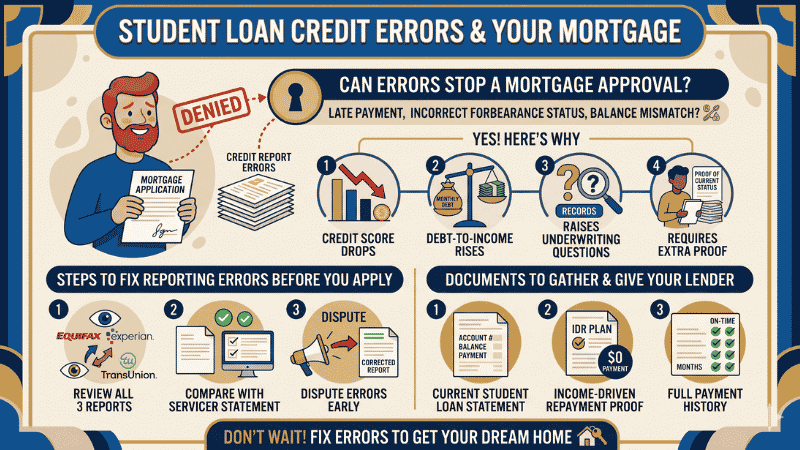
Student loan credit reporting errors can hurt a mortgage file if they change the borrower’s credit score, monthly debt, or account status. For example, if there’s a fake late payment, that could drop your middle credit score, which lenders look at for approval. A wrong monthly payment may raise the debt-to-income ratio and reduce the approved loan amount. The biggest issue is when the report shows the student loan as past due, in default, or with a payment that is higher than the borrower actually owes. For FHA, VA, and USDA loans, unresolved federal debt can delay or stop approval until the borrower proves the account is current or has been resolved. Some student loan credit reporting errors do not cause a denial but still create extra conditions. If the credit report shows the loan as deferred, transferred, or in forbearance, the lender may ask for a current student loan statement, payment history, or proof of the correct monthly payment.
Deferred, Forbearance, Late Payment, and Current: What These Statuses Mean
The wording on the credit report matters. “Deferred,” “forbearance,” “current,” and “past due” do not mean the same thing. Borrowers should compare the credit report with the student loan servicer’s statement before applying for a mortgage.
Current Student Loan
A current student loan means the borrower is not past due based on the loan servicer’s records. This is the cleanest status for a mortgage file because the lender can usually count the required monthly payment and move on.
Deferred Student Loan
A deferred student loan means payments are postponed for a set reason, such as school enrollment, military service, or another approved deferment. Deferred does not automatically mean the borrower is late. For mortgage approval, the lender still needs to know what payment must be counted if the credit report does not show one.
Forbearance
Forbearance is when the loan servicer lets you take a break from making full payments or even cut back on them for a certain period. A forbearance is not the same as forgiveness. The balance still exists, and the lender may request proof of the current payment plan or the payment due when the forbearance ends.
Late Payment
A late payment means the borrower missed a required payment, and the servicer reported it as past due. This can lower the credit score and create underwriting problems, especially if the late payment is recent. If the late payment is incorrect, the borrower should get a payment history from the student loan servicer and dispute the error with the credit bureau.
Mortgage Delayed by Student Loan Reporting? Get a Second Opinion
If your lender is counting the wrong payment or your credit report shows incorrect student loan data, we’ll review your scenario and map the cleanest path forward.
How Mortgage Lenders Review Student Loans
Mortgage lenders review student loans in three places: the credit report, the borrower’s loan application, and the student loan servicer statement. The credit report usually shows the balance, monthly payment, account status, and payment history. If student loan credit reporting errors are found, the lender may ask for additional documents before approving that account.
The monthly student loan payment matters more than the total balance. A borrower with a large student loan balance may still qualify if the required payment fits inside the debt-to-income ratio. A borrower with a smaller balance may run into problems if the credit report shows a high payment or an incorrect payment amount.
If the credit report shows a $0 payment, the lender cannot always ignore the loan. Some loan programs require the lender to count a calculated payment unless the borrower proves no payment is due or provides documents showing the correct repayment terms. The required documents may include an income-driven repayment plan, a current billing statement, or a letter from the student loan servicer. Lenders also check whether the student loan is current, deferred, in forbearance, transferred, past due, or in default. A current account is easier to document. A past-due or defaulted federal student loan can create a serious problem, especially on FHA, VA, and USDA loans. Borrowers should give the lender the most recent student loan statement before the underwriter asks for it. The statement should show the account number, balance, payment amount, due date, and loan status. If the credit report is wrong, the borrower should also provide proof from the servicer showing the correct information.
FHA Student Loan Rules
FHA lenders count student loans when calculating the borrower’s debt-to-income ratio. If the credit report lists a monthly payment, the lender can use that amount unless FHA rules specify otherwise. If the student loan shows a $0 payment, deferment, or forbearance, the lender usually cannot exclude it from the debt-to-income ratio. FHA may require a calculated payment based on the outstanding balance when no usable monthly payment is documented. This is why a current student loan statement matters before the file goes to underwriting. A borrower on an income-driven repayment plan should provide proof of the actual payment. The statement should show the payment amount, repayment plan, balance, and account status. If the payment on the servicer statement is lower than the payment on the credit report, the lender may need the updated documentation to use the correct figure. FHA approval can get tricky if your student loan is late or in default. A federal student loan issue may need to be resolved before closing, as FHA loans are government-backed. Borrowers should check for incorrect late payments, wrong balances, and old student loan credit reporting errors before applying.
Conventional Student Loan Rules
Conventional loans follow Fannie Mae or Freddie Mac guidelines. The lender reviews the student loan payment on the credit report first, then checks whether that payment can be used for qualifying. When your credit report lists a monthly payment, that payment typically gets added to your debt-to-income ratio. If the credit report shows $0, deferment, or forbearance, the lender may need a student loan statement or repayment plan before deciding what payment to use.
Fannie Mae and Freddie Mac do not always treat student loans the same way. One program may allow a documented income-driven repayment, while another may require a calculated payment when the credit report does not show a usable amount.
A borrower should not assume a $0 student loan payment will be ignored. The lender may still count a payment unless the file has documents showing the actual repayment terms. This matters when the borrower is close to the debt-to-income limit. Student loan credit reporting errors can also affect conventional approval. A wrong late payment may lower the credit score used by Desktop Underwriter or Loan Product Advisor. A wrong monthly payment may raise the debt ratio and reduce the approved loan amount.
VA and USDA Student Loan Rules
VA loans count student loans when the payment affects the borrower’s debt-to-income ratio and residual income. If the credit report shows a payment, the lender reviews whether that payment can be used. If the loan is deferred or the payment is missing, the lender may need to calculate a payment or document that payments are not due for a long enough period. VA approval is not based only on the debt-to-income ratio. The lender also checks residual income, which is the money left over after major monthly debts are paid. A wrong student loan payment can lower residual income on paper, even when the borrower’s real payment is lower. USDA loans also count student loan payments toward the borrower’s monthly debt. If the credit report does not show a usable payment, the lender may need a current student loan statement or may calculate a payment based on program rules. An incorrect payment can push the USDA file over the debt-to-income ratio limit. Past-due or defaulted federal student loans can create problems with both VA and USDA loans. These are government-backed programs, so unresolved federal debt may need to be fixed before closing. Borrowers should correct wrong late payments, wrong balances, and default reporting before the lender submits the file for final approval.
What To Do If Your Student Loans Are Reported Wrong
Start by checking all three credit reports. Student loan information may be reported correctly by one bureau and incorrectly by another. Look at the loan balance, monthly payment, account status, payment history, and any late payments listed under each student loan account.
Compare the credit report with your student loan servicer statement. The statement should show the current balance, the required monthly payment, the due date, the repayment plan, and whether the account is current. Save a PDF copy or screenshot from the servicer’s website before you contact the credit bureaus.
Challenge the credit bureau for showing the wrong info. The dispute should be specific. For example, write that the student loan is reporting as late for March 2021 even though the loan was current, or that the credit report shows a $600 payment when the servicer statement shows a $125 income-driven payment. Contact the student loan servicer at the same time. Ask for written proof of the correct account status, payment history, and monthly payment. If the servicer caused the reporting error, ask them to send corrected information to Equifax, Experian, and TransUnion. Tell the mortgage lender about the issue before underwriting finds it. Send the lender the credit report page, current student loan statement, dispute confirmation, and any letter from the servicer. If the file is already in process, the lender may be able to order a credit supplement or ask underwriting for the documents needed to keep the loan moving.
Documents To Gather Before Mortgage Application
Borrowers with student loans should gather their student loan documents before the lender pulls conditions from underwriting. The most important document is a current student loan statement showing the account number, balance, monthly payment, due date, repayment plan, and loan status. If you’re on an income-driven repayment plan, the lender might ask you to show proof of those payments. The document should show the approved monthly amount, not just the loan balance. A borrower with a $0 payment should also keep proof showing why no payment is due and for how long that payment status will remain in place. Borrowers should also save a full payment history from the student loan servicer. This matters when the credit report shows a late payment that the borrower believes is wrong. The payment history should show the month in question, the amount due, the amount paid, and whether the account was current. If the student loan was deferred, in forbearance, transferred, or part of the COVID payment pause, keep any servicer letter that explains the status. A short letter from the servicer can help when there are student loan credit reporting errors and the credit report wording does not match the borrower’s records. Borrowers disputing an error should keep copies of the dispute confirmation, credit bureau response, corrected credit report, and any written response from the student loan servicer. These records provide the lender with a paper trail if the issue arises during underwriting.
Can You Still Get Approved With Student Loan Issues?
Yes, borrowers can still get approved with student loan issues, but the file must be documented correctly. A student loan balance alone does not prevent mortgage approval. The lender needs to know the correct monthly payment, the current account status, and whether any late payments or defaults are accurate. A borrower with deferred student loans may still qualify if the lender can count the required payment under the loan program. A borrower on an income-driven repayment plan may qualify using the documented payment if the program allows it.
A borrower with an incorrect payment on their credit report may need a current student loan statement before the lender can apply the correct amount.
The harder cases involve recent late payments, past-due federal student loans, or default reporting. If the late payment is accurate, the lender may need an explanation and proof that the borrower has reestablished on-time payments. If the late payment is wrong, the borrower should provide payment history from the servicer and dispute the error with the credit bureau. One lender’s denial does not always mean the borrower cannot qualify. Some lenders have overlays that are stricter than FHA, VA, USDA, Fannie Mae, or Freddie Mac guidelines. A file with student loan credit reporting errors, high debt-to-income ratios, or manual underwriting may need a lender that reviews the full file instead of stopping at the first issue.
Final Thoughts on Student Loan Credit Reporting Errors
Student loan credit reporting errors can delay a mortgage, but they do not always stop approval. The big question is whether the lender can verify that the payments are correct, the account is in good standing, and the payment history is clear before wrapping things up. Borrowers should review all three credit reports before applying for a home loan. If a student loan shows the wrong balance, payment, late payment, deferment, forbearance, or default status, gather proof from the student loan servicer and start the dispute process early. A mortgage file with student loan issues may need extra documentation, a credit supplement, or a lender that understands FHA, VA, USDA, conventional, and manual underwriting guidelines. The sooner the error is found, the easier it is to document the file before underwriting.
FAQs About Student Loan Credit Reporting Errors
How Long Does it Take to Fix Student Loan Credit Reporting Errors?
Most credit bureau disputes take about 30 days to investigate. Borrowers should not wait until they are under contract to start a dispute, as the mortgage lender may need a corrected report, a credit supplement, or written proof from the student loan servicer before final approval.
Can Accurate Student Loan Late Payments be Removed from a Credit Report?
Accurate late payments cannot be removed just because the borrower later caught up. If the late payment’s an error, the borrower can challenge it with the credit bureau and show proof from the student loan servicer. If the late payment is accurate, the borrower may need time and an on-time payment history to reduce the impact.
Why does One Credit Bureau Show My Student Loan Differently from Another?
Student loan information may not be updated across Equifax, Experian, and TransUnion at the same time. One bureau may show the correct payment, while another still shows an old balance, a transferred account, a deferment, or a late payment. Borrowers should dispute the error with the bureau showing the wrong information and contact the student loan servicer to correct the reporting.
Can You Remove Student Loans from a Credit Report?
Student loan information is usually not removed from a credit report if it is accurate. Open, paid, and closed student loans can remain on the report under credit reporting rules. Incorrect student loan information may be corrected or removed if the borrower disputes it and provides proof that the reporting is wrong.
Does Disputing a Student Loan Hurt Mortgage Approval?
A dispute itself does not automatically deny a mortgage, but it can create extra review during underwriting. Some lenders may require the dispute to be resolved, removed, or fully documented before the file can close. Borrowers should inform the loan officer of any active disputes early so the lender can decide how to handle the file.
What if My Student Loan were Transferred to a New Servicer?
A transferred student loan can show as closed with one servicer and open with another. That is not always an error. The problem starts when the balance is duplicated, the payment history is wrong, or both accounts look active at the same time. Borrowers should provide the lender with the transfer notice and the current servicer statement if the credit report is confusing.
Can a Student Loan Credit Error Lower My Pre-Approval Amount?
Yes, a student loan credit error can lower the pre-approval amount if it raises the monthly debt or lowers the qualifying credit score. For example, a wrong $600 student loan payment may reduce buying power compared to a documented $125 income-driven payment. The lender may need updated proof before recalculating the approval.
Who Should I Contact First if My Student Loan is Reported Incorrectly?
Start with the credit bureau that shows the wrong information and file a dispute with clear proof. Contact the student loan servicer at the same time and request written confirmation of the correct balance, payment status, and payment history. If the mortgage is already in process, send both the dispute confirmation and the servicer proof to the lender.
This article about “Stop Student Loan Credit Reporting Errors Before Closing” was updated on June 16th, 2026.
Stop Student Loan Credit Reporting Errors Before Closing
Student loan reporting mistakes can change your DTI, credit score, and approval status. Get a quick review before closing so errors do not delay or derail your mortgage.