Bad credit doesn’t automatically disqualify you from a home loan in Indiana. Options for bad credit home loans in Indiana, such as FHA, VA, USDA, and certain conventional loans, may still be accessible based on your credit history, income, debts, down payment, property type, and underwriting results.
A denial from one lender does not always mean every lender will reach the same decision. Some lenders add stricter internal rules, called lender overlays, such as higher credit score requirements, lower debt-to-income limits, or restrictions on manual underwriting.
Before paying off a collection, opening new credit, or applying again, find out why the first lender said no. The right next step depends on whether the issue was your recent payment history, debt-to-income ratio, income documentation, property, automated underwriting findings, or a lender overlay.
Can You Buy a Home in Indiana With Bad Credit?
It is possible to obtain bad credit home loans in Indiana, even if you have a less-than-ideal credit score. Approval hinges on a comprehensive review of your entire financial situation rather than solely your credit score. Lenders will consider factors such as your income, debt-to-income ratio, down payment, recent payment history, and the specific loan program you’re applying for. FHA loans are often more flexible for borrowers with lower credit scores. VA loans may also help eligible Veterans and service members. If one lender denied you, another lender may still approve the file if the denial was due to lender overlays.
How Mortgage Lenders Review Low Credit Scores
A low credit score does not automatically mean you cannot qualify for a mortgage. Lenders use your score as one part of the review, but they also look at the information behind it. This includes recent late payments, collection accounts, charge-offs, credit card balances, new debt, and how long you have managed credit responsibly. Your credit report and score can affect both approval and the interest rate available to you.
Lenders also review whether you can afford the new housing payment. They compare your monthly debt payments to your gross monthly income, review your employment and income documents, and verify the availability of funds for the down payment, closing costs, and required reserves.
This is part of confirming that you have a reasonable ability to repay the mortgage. For borrowers seeking bad credit home loans in Indiana, recent payment history often matters more than older credit problems. A past collection or low score may be easier to overcome when you have a stable income, manageable debt, documented assets, and a recent pattern of paying obligations on time. On the other hand, recent mortgage lates, new collections, high credit card balances, or unexplained deposits can make approval more difficult. Many lenders also use an automated underwriting system to review the overall risk of the loan. An automated approval is helpful, but it is not a final mortgage approval. The lender must still review your documents, verify your income and assets, confirm the property meets program rules, and clear any underwriting conditions. Different lenders may also apply their own stricter rules, called lender overlays. For example, one lender may require a higher credit score or lower debt-to-income ratio than another lender offering the same FHA, VA, USDA, or conventional loan program. The VA does not establish a minimum credit score; however, individual lenders may have their own credit criteria.
FHA and VA Loans for Indiana Buyers With Bad Credit
FHA and VA loans may give Indiana buyers with past credit problems more options than some conventional mortgages. However, no loan program approves borrowers based on credit score alone. Income, monthly debts, recent payment history, available funds, property eligibility, and underwriting findings all matter when applying for bad credit home loans in Indiana.
FHA Loans
FHA loans are often used by buyers with lower credit scores, limited down payment funds, or older credit problems. Under FHA’s standard rules, borrowers with a 580 credit score or higher may qualify with a 3.5% down payment, while borrowers with scores from 500 to 579 may need at least 10% down. Individual lenders can set stricter credit standards, so meeting FHA’s minimum rules does not guarantee approval. An FHA lender will still review your income, debt-to-income ratio, recent late payments, collections, and assets. FHA loans are for primary residences, and mortgage insurance is generally part of the monthly payment. Before choosing FHA, compare the full monthly payment and closing costs with other available loan options.
VA Loans
VA loans may be a strong option for eligible Veterans, active-duty service members, and qualifying surviving spouses. The VA does not set one minimum credit score for every borrower, but lenders may have their own score requirements. A lower score doesn’t disqualify you if your recent payment history, income, debts, and remaining monthly income can support the mortgage payment. Many eligible borrowers can buy with no down payment. However, they may still need funds for closing costs, prepaid expenses, or required reserves. A VA lender also reviews the home’s appraisal, your Certificate of Eligibility, occupancy plans, income, debt-to-income ratio, and residual income before making a final decision.
USDA and Conventional Loans
USDA loans may help buyers purchase a primary residence in an eligible rural or suburban area of Indiana. The program can offer 100% financing for qualified borrowers, but household income limits and property-location rules apply. USDA does not publish a required minimum credit score for every applicant. However, borrowers with a score below 640 may receive a more detailed credit review. Conventional loans may work when your credit has improved, your debt-to-income ratio is manageable, and you have enough money for the down payment and closing costs. Some conventional programs offer low-down-payment options, but lower credit scores can limit approval options or raise the cost of the loan. Compare the full payment, mortgage insurance, interest rate, and closing costs before deciding which program fits your situation.
Low Credit Score? FHA May Be an Option
FHA loans can be more flexible for Indiana buyers with lower scores, past credit issues, or limited savings. Get a clear review before you assume you cannot qualify.How Lender Overlays Can Cause a Mortgage Denial
Lender overlays come into play when a lending firm sets stricter conditions than standard loan programs like FHA, VA, USDA, or computer-based approval systems. A single lender might insist on a 640 credit score even if the FHA permits someone with a 580 credit score and just a 3.5% down payment. While official rules open doors, individual lenders can raise the bar behind the scenes.
One lender could demand higher income proof, while another follows baseline policies closely. These hidden layers shape who is actually approved, even when they meet program minimums.
One reason lenders in Indiana vary in their approval decisions is that the same borrower can receive different outcomes. Meeting standard criteria alone might not suffice if additional conditions hinder the process. For instance, some banks may require higher credit scores, while others insist on reducing debt levels. A clean credit history could be weighed more heavily by some lenders than others. The length of time since past issues also plays a role—some may take longer to give approval. The status of collections, whether settled or not, can also sway the decision. Ultimately, many approvals for bad credit home loans in Indiana depend on who is reviewing the applications behind closed doors.
Collections, Charge-Offs, and Disputed Accounts
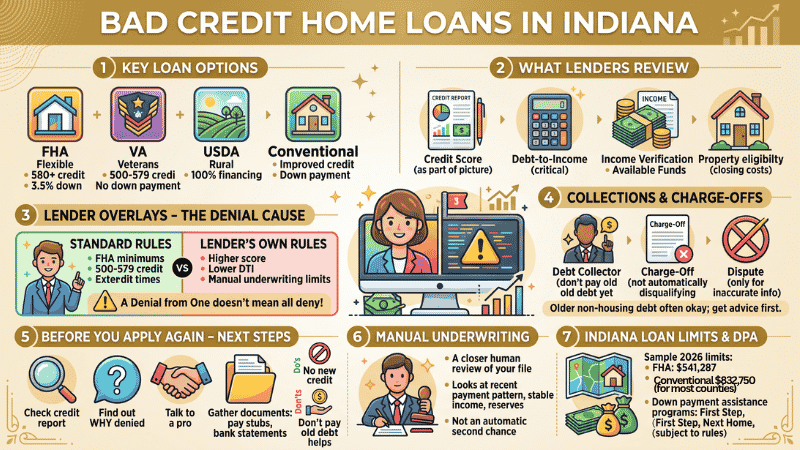 Collections, charge-offs, and disputed accounts do not always prevent mortgage approval. However, lenders review the type of account, balance, age, payment history, and the account’s impact on your overall credit profile.
Collection Accounts
A collection account is a debt that was not paid and was sent to a collection agency. Some mortgage programs may allow unpaid collections, especially when they are older and unrelated to housing. However, the lender may still need to include a payment in your debt-to-income ratio or ask for more documentation. Do not assume every collection must be paid before applying. Paying or settling an account can affect your credit report and may require proof of the source of funds.
Charge-Off Accounts
A charge-off means the original creditor stopped treating the account as active for accounting purposes. It does not always mean the debt disappeared or that you no longer owe it. Older non-mortgage charge-offs may be treated differently from recent charge-offs, tax liens, judgments, or unpaid housing-related debts. Recent delinquencies and accounts with large balances usually receive closer underwriting review.
Disputed Accounts
Only dispute an account when the information is inaccurate, incomplete, or does not belong to you. Mortgage lenders may need to review the reason for the dispute and determine whether you are responsible for the debt. You may need documents such as a settlement letter, proof of payment, canceled checks, or evidence that the account was reported incorrectly.
What To Do Before Applying
Before applying for bad credit home loans in Indiana, review your full credit report with a mortgage professional. Gather paperwork for collection accounts, charge-offs, and disputes before making changes. Avoid paying old debts, disputing accounts, opening new credit, or moving large amounts of money until you understand how those actions may affect your mortgage approval.
When Manual Underwriting May Be an Option
Manual underwriting is a closer review of a mortgage file by a human underwriter, rather than relying solely on an automated underwriting system. It may be an option when an FHA or VA loan does not receive automated approval, but the borrower still meets the program’s manual underwriting requirements. FHA’s current Single Family Housing Policy Handbook includes the rules lenders must follow for manually underwritten FHA mortgages.
When a File May Need a Manual Review
A manual review may be considered when a borrower has a lower credit score, limited credit history, a recent credit issue, or a debt-to-income ratio that warrants closer review. It may also be used when the automated system returns a result that requires the lender to review the file more carefully. Manual underwriting is not an automatic second chance after a denial. The loan still must meet the applicable FHA or VA guidelines, and the lender must be willing to offer manual underwriting. Some lenders do not allow manual underwriting on certain loan types or may apply stricter internal requirements.
What the Underwriter Reviews
The underwriter looks beyond the credit score to determine whether the borrower can reasonably manage the new housing payment. This may include recent payment history, stable income, employment history, monthly debts, available assets, and the source of funds used for the down payment and closing expenses. For Indiana buyers with past credit problems, a strong recent payment pattern can be important. The underwriter may review whether rent, utilities, installment loans, credit cards, and other obligations have been paid on time. A borrower with older credit problems but stable income and a solid recent payment history may present a stronger file than someone with new late payments or growing debt.
Factors That Can Strengthen a Manual Underwrite File
A manual underwrite may be stronger when the borrower has stable, documented income and manageable monthly debt. Other helpful factors can include verified rent payments, cash reserves after closing, a larger down payment, and proof that the borrower has handled similar housing payments responsibly. For VA loans, lenders also review residual income, which is the money left each month after major debts and the proposed housing payment are considered. VA lender training identifies credit underwriting as part of the review process for VA-backed mortgages.
When Manual Underwriting May Not Help
Manual underwriting may not address issues such as recent late mortgage payments, unstable income, insufficient funds, major undisclosed debts, or a debt-to-income ratio that remains too high under the program rules. It also cannot overcome property problems, missing documents, or eligibility issues. Before applying for bad credit home loans in Indiana, ask whether manual underwriting is available for your situation and what documents the lender will need. Gathering pay stubs, W-2 forms, tax returns when required, bank statements, rental payment records, and documents related to past credit issues can help prevent delays during review.
Indiana Loan Limits and Down Payment Assistance
Loan limits set the maximum amount available through certain mortgage programs. They do not mean you automatically qualify for that amount. Your approved loan amount still depends on your income, debts, credit profile, down payment, assets, property value, and underwriting review.
2026 FHA and Conventional Loan Limits in Indiana
For 2026, the FHA loan limit for a one-unit property in most Indiana counties is $541,287. The standard 2026 conforming loan limit for a one-unit conventional mortgage is $832,750. Loan limits are higher for two-unit, three-unit, and four-unit properties. The limit applies to the loan amount, not simply the home’s purchase price. For example, a buyer making a larger down payment may be able to purchase a home priced above the local loan limit without needing a jumbo mortgage. Because limits can change each year and may vary by county, confirm the correct limit before making an offer. FHA publishes an official county lookup tool, and FHFA provides an annual map of conventional conforming loan limits.
Indiana Down Payment Assistance Programs
The Indiana Housing and Community Development Authority, or IHCDA, offers homeownership programs that may provide down payment assistance to eligible buyers. These programs do not replace mortgage approval, but they may reduce the upfront cash needed to buy a home. The IHCDA First Step Program is designed for eligible first-time homebuyers or buyers purchasing in certain targeted census tracts. It may be paired with a 30-year FHA or conventional mortgage and includes a down payment assistance option. The IHCDA Next Home Program may be available to qualifying buyers who do not meet the First Step requirements. It offers down payment assistance of 2.5% or 3.5% of the purchase price, subject to the program’s current rules and appraisal limits.
What To Check Before Using Assistance
Down payment assistance is not the same as free cash at closing. Depending on the program, it may involve a second mortgage, repayment terms, occupancy requirements, income limits, purchase price limits, homebuyer education, or restrictions on selling or refinancing the property. IHCDA updates its program limits and requirements over time. Its current income and acquisition-limit materials are dated May 25, 2026, so buyers should confirm eligibility with an approved participating lender before relying on assistance in an offer. For buyers seeking bad credit home loans in Indiana, down payment assistance can help with upfront costs, but it will not overcome recent late payments, excessive debt, unstable income, or a mortgage denial caused by unresolved underwriting issues.
What To Do After a Mortgage Denial in Indiana
If your mortgage application is denied, there may still be opportunities for homeownership in Indiana, even with bad credit home loans. Begin by investigating the reasons for the rejection. Was it related to your credit score, your debt-to-income ratio, recent missed payments, collections on your accounts, insufficient proof of income, lack of available funds, issues with the property itself, or additional requirements imposed by the lender?
Hold off on clearing collections just yet. Closing old accounts might backfire – timing matters more than it seems. New credit lines? Not a step to take lightly right now. Shifting cash across banks could raise questions later. A small shift today may ripple into bigger issues at review time.
Best path: let someone scan everything first – the loan paperwork, your credit history, paycheck records, bank activity, plus what the system already flagged. The lender’s rejection might be due to their own additional criteria. Another lender could assess your situation based on standard FHA, VA, USDA, or typical guidelines. It’s essential to determine whether you were truly unqualified or if it was simply a matter of one company’s stricter limits that obstructed your chances, especially when considering bad credit home loans in Indiana.
Your Next Step Before Applying Again
A mortgage denial does not always mean you need to wait months or years before trying again. Start by getting the exact reason for the denial in writing. Find out whether the problem involved your credit score, recent late payments, debt-to-income ratio, income documents, assets, the property, or a lender overlay. Before submitting another application, review your full credit report, pay stubs, W-2 forms or tax returns when required, bank statements, and details for any collections, charge-offs, or disputed accounts. This helps identify problems that can be addressed before another lender reviews the file. Avoid opening new credit accounts, financing big purchases like cars or furniture, making large deposits without a clear source, or transferring money between accounts without proper documentation. These actions can hurt your debt-to-income ratio and raise inquiries during the underwriting process. For buyers looking for bad credit home loans in Indiana, the best next step is a full mortgage review based on the complete file. A different loan program or lender may be worth considering if the first denial was due to stricter lender rules rather than the basic FHA, VA, USDA, or conventional loan guidelines.
Frequently Asked Questions About Bad Credit Home Loans in Indiana
Can a Co-Borrower Help Me Qualify for a Mortgage if I have Bad Credit?
Possibly. A co-borrower may add income, improving the combined debt-to-income ratio. However, the lender reviews both applicants’ credit, debts, income, and assets. A co-borrower with strong credit can help in some situations, but a co-borrower with significant debt or credit problems can also hurt the application. Both borrowers are fully responsible for repaying the mortgage.
Will a Mortgage Preapproval Hurt My Credit Score?
A mortgage preapproval usually involves a credit check. One inquiry generally has little impact, and the Consumer Financial Protection Bureau says that multiple mortgage credit checks within a 45-day window are recorded as a single inquiry. This allows you to compare lenders and review multiple Loan Estimates without being penalized for each mortgage application.
Can I Buy a House in Indiana After Bankruptcy if I Still have Bad Credit?
The answer depends on the type of bankruptcy, whether the case was discharged or dismissed, the loan program, and how much time has passed. You must also meet the lender’s current income, debt, credit, and asset requirements. Conventional mortgage guidelines have different waiting periods for different bankruptcy events, and other loan programs may use different rules.
Can Self-Employed Borrowers Qualify for a Mortgage with Bad Credit?
Yes, self-employed borrowers may qualify when they can document stable, qualifying income. Lenders often review signed federal tax returns and may request business records or additional documents to confirm that the income is likely to continue. A low credit score can still affect the file, but self-employment alone does not prevent mortgage approval.
Why is the Mortgage Credit Score Different from the Score in My Banking App?
You can have more than one credit score because different scoring models and credit-reporting companies may use different information. Most mortgage lenders use FICO scores, often review reports from Equifax, Experian, and TransUnion, and commonly use the middle score for a single borrower. The score shown in an app may be an educational score rather than the mortgage score a lender uses.
How Quickly Can I Improve My Credit Score Before Applying for a Mortgage?
There is no guaranteed timeline. Credit scores may change after creditors report lower balances, on-time payments, or corrected errors. Paying down credit card balances, keeping payments current, and avoiding new debt can help over time, but major credit rebuilding may take months. Do not make changes based only on a hoped-for score increase without reviewing how they may affect your mortgage file.
Should I Pay Off Credit Cards Before Applying for a Mortgage?
Paying down high credit card balances may help by decreasing your credit utilization and lowering your monthly debt obligations. However, using all your savings to pay cards down may leave too little for the down payment, closing costs, or reserves. Do not close a credit card just because it reaches a zero balance unless you understand how that choice may affect your credit profile.
This article about “Bad Credit Home Loans in Indiana: Options and Requirements” was updated on July 7th, 2026.