
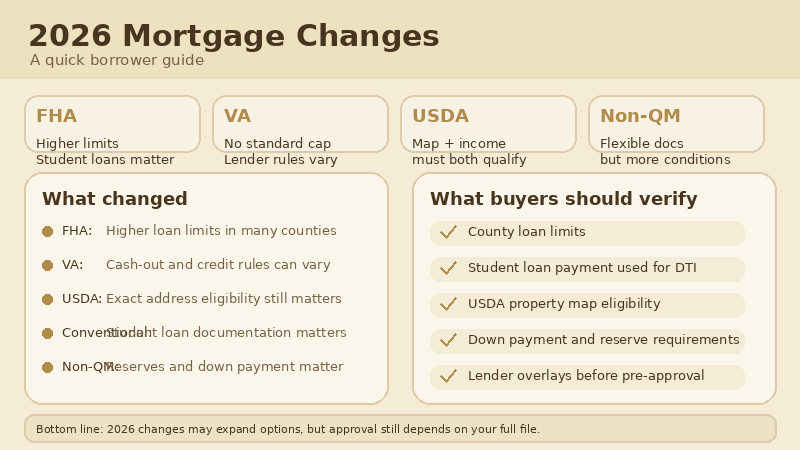
Changes in mortgage lending in 2026 are occurring in several significant ways, particularly for borrowers who are mindful of loan limits, student loan calculations, down payment options, and flexible qualification programs. Updates to FHA, VA, USDA, conventional, and Non-QM lending could influence how much home buyers qualify for, how debt-to-income ratios are calculated, and which loan program is the most suitable.
For many borrowers, the most impactful changes in mortgage lending for 2026 include increased conforming and FHA loan limits, more lenient treatment of specific student loan payments, revised USDA eligibility thresholds, and the continued expansion of Non-QM options for self-employed borrowers and real estate investors. Understanding these changes can empower buyers to compare loan options more confidently and prevent surprises during the pre-approval process.
In this guide, we detail the most significant changes in mortgage lending for 2026, identify who they affect, and highlight what home buyers should focus on before applying.
Key Takeaways About Mortgage Changes in 2026
Several mortgage updates in 2026 may affect how much borrowers can qualify for and which loan programs are available to them. The most important changes involve annual loan limit increases, updated treatment of some student loan payments, USDA eligibility adjustments, and continued growth in flexible Non-QM options.
- FHA and conventional loan limits increased for 2026, which may expand financing options in many counties, especially where home prices have risen.
- Student loan repayment calculations have become more flexible in some loan scenarios, including cases where income-driven repayment documentation can be used instead of a higher estimated payment.
- VA loans still offer strong no-down-payment benefits for eligible borrowers, though cash-out refinance limits and lender requirements can vary.
- USDA eligibility rules continue to depend on household income and property location, with annual updates that may open or close access in certain areas.
- Non-QM programs remain an option for self-employed borrowers, investors, and applicants with nontraditional income, but guidelines vary widely by lender.
In short, the biggest mortgage changes in 2026 are not one-size-fits-all. Borrowers need to compare program rules, county limits, and lender guidelines before assuming they qualify for more financing.
Why Are There So Many Changes in Mortgage Lending?
Mortgage lending rules change every year to keep up with rising home prices, inflation, and shifting interest rates. They also adapt to government housing policies and borrowers’ needs, like offering lower down payment options and more flexible credit choices.
These changes in mortgage lending can be confusing for borrowers. But the good news is that some updates make it easier to qualify for a home loan, while others may tighten requirements.
At Gustan Cho Associates, we keep track of these updates so you don’t have to.
What are the Changes to FHA Loans?
Condo Approval
FHA financing may be available in some condo situations even when the entire project is not broadly approved. However, condo eligibility still depends on project-level requirements, lender review, and property-specific documentation.
Student Loan Treatment
For borrowers with student loans, an FHA qualification may allow the use of documented payment information in certain situations, including some income-driven repayment plans. However, how the payment is calculated depends on current agency guidance, available documentation, and lender underwriting requirements.
Credit Score Requirements
FHA is known for its flexible credit standards, but borrowers should not assume that the lowest published score automatically means full approval. Down payment, recent credit history, debt-to-income ratio, and lender overlays can all affect final eligibility.
What Are the VA Loan Changes?
No Loan Limits for Eligible Borrowers
Eligible VA borrowers with full entitlement are not subject to traditional loan limits in the same way many conventional borrowers are, although qualification still depends on income, residual income, credit profile, and lender approval.
Cash-Out Refinance Limits
VA cash-out refinance rules can vary by lender, especially when it comes to maximum loan-to-value limits. Borrowers should confirm current cash-out policies directly with the lender they plan to use.
Credit and Underwriting Flexibility
VA loans are often considered more flexible than many other mortgage options, but lender-specific credit requirements still apply. Borrowers should not assume that one lender’s minimum score or underwriting approach is universal across the market.
Funding Fee Considerations
VA funding fees depend on factors such as down payment, loan purpose, and prior use of VA benefits. Some borrowers may also be exempt, including certain veterans with qualifying service-connected disability status.
What Are the USDA Loan Changes?
Property Eligibility Still Depends on the USDA Map
USDA loan availability continues to depend on whether a home is located in an eligible area, as defined by the current USDA property map. Some buyers may find eligible properties outside traditional rural expectations. However, eligibility is still determined by the specific address, not by general assumptions about a city, suburb, or county.
Income Limits Also Matter
USDA loans are designed for income-eligible households, so property location alone does not guarantee approval. Borrowers must also meet household income limits and standard loan qualification requirements.
What Are the Conventional Loan Changes?
Student Loan Calculation Can Affect Conventional Approval
For borrowers with student debt, conventional underwriting may be more flexible than many buyers expect, especially when documented repayment information is available. In some cases, lenders can use documented student loan payments rather than relying on higher estimates, which can improve debt-to-income calculations.
Documentation Still Matters
How student loans are counted for a conventional mortgage depends on the current agency guidelines, the payment shown in the file, and whether the loan is in repayment, deferred, or reporting a low or zero payment. Because of that, borrowers should not assume all conventional lenders will evaluate student loans the same way.
What Non-QM Loans Mean in 2026
Non-QM loans continue to expand for borrowers who may not qualify easily under standard agency guidelines, including self-employed applicants, real estate investors, and higher-income borrowers with more complex documentation. These loans are not one single program. Instead, they include several different mortgage types with varying credit, reserve, down payment, and income-documentation requirements.
Bank Statement Loans
Bank statement loans are often used by self-employed borrowers who want to qualify based on personal or business bank deposits rather than tax returns.
DSCR Loans
DSCR loans are commonly used by real estate investors and focus more on the property’s rental cash flow than the borrower’s personal income.
Jumbo Non-QM Loans
Some jumbo Non-QM options are available for borrowers seeking larger loan amounts with flexible income documentation, but qualification standards can vary widely based on occupancy, loan size, credit profile, reserves, and down payment.
Comparison of Changes in Mortgage Lending
| Loan Program | 2026 General Update | Down Payment | Credit / Qualification Notes | Important Considerations |
|---|---|---|---|---|
| FHA | Higher loan limits in many counties | 3.5% possible with qualifying credit | Flexible credit profile standards, but lender overlays may apply | Student loan treatment and condo eligibility depend on documentation and lender review |
| VA | No standard loan cap for eligible borrowers with full entitlement | 0% possible | Credit requirements vary by lender | Cash-out refinance limits and underwriting standards may differ by lender |
| USDA | Annual updates to income limits and eligible areas | 0% possible | Approval depends on full file strength and lender review | Property must be in an eligible area and household income limits apply |
| Conventional | Higher conforming loan limits for 2026 | 3% possible for some first-time buyers | Stronger credit profiles usually improve options | Student loan treatment depends on agency guidance and documentation |
| Non-QM | Continued growth in flexible documentation options | Often higher than agency loans | Varies widely by lender, program, and occupancy | Bank statement, DSCR, and jumbo Non-QM loans all have different standards |
***These are general comparisons, not universal approval rules. Loan terms and eligibility vary by lender, borrower profile, property type, and current underwriting guidelines.
How the 2026 Changes in Mortgage Lending Affect Homebuyers
For many homebuyers, the biggest mortgage changes in 2026 may hinge on borrowing power, qualification flexibility, and program choice. Higher loan limits may help some borrowers finance more expensive homes, while updated student loan treatment may improve debt-to-income ratios for buyers using income-driven repayment plans.
At the same time, not every change makes qualifying easier. Program rules still vary, property eligibility still matters for USDA loans, and lender guidelines can differ even when the loan program itself appears flexible. That is why homebuyers should compare loan options carefully rather than assume every lender will apply the same standards.
How Mortgage Lending Changes Helped a First-Time Homebuyer in 2026
Example Scenario: A First-Time Buyer With Student Loans
Consider a first-time homebuyer in Illinois with federal student debt and an income-driven repayment plan.
Sarah is 29, works as a nurse, and carries $45,000 in federal student loans. For years, she thought homeownership was out of reach because lenders counted her full student loan balance when calculating her debt-to-income (DTI) ratio.
The Challenge
In the past, FHA and Conventional lenders required 1% of the total student loan balance to be included in the monthly payment calculation. For Sarah, that meant $450 a month was added to her DTI — even though her actual income-driven repayment (IDR) plan required only $95 a month.
That inflated number pushed her DTI too high and caused multiple denials.
The Change That Helped
With FHA and Conventional rule updates, IDR payments are now accepted for qualifying. That means Sarah’s actual $95 monthly payment could be used instead of the inflated $450.
The Result
- Loan Type: FHA Loan
- Credit Score: 602
- Down Payment: 3.5%
- Student Loan Payment Used: $95 (instead of $450)
- Outcome: She was able to qualify for an FHA loan that fit her budget and target price range
Why It Matters
Because of the changes in mortgage lending, Sarah was able to buy her first home instead of just renting. Without this update, she would have had to keep waiting and couldn’t have made her dream of homeownership come true.
Final Thoughts on Mortgage Changes in 2026
In 2026, changes in mortgage lending continue, but the biggest updates are not equally important for every borrower. Higher loan limits may increase financing options in many areas, updated student loan treatment may improve qualification for some buyers, and flexible programs such as VA, USDA, and Non-QM loans may open doors for borrowers with different financial profiles.
The most important step is to verify how current guidelines apply to your specific situation. Loan limits, student loan calculations, property eligibility, down payment requirements, and lender overlays can all affect approval. Buyers who understand these moving parts early are more likely to choose the right program and avoid surprises during pre-approval.
Frequently Asked Questions About Changes in Mortgage Lending:
What are the Biggest Mortgage Changes in 2026 for Homebuyers?
- The biggest mortgage changes in 2026 include higher FHA and conforming loan limits in many areas, continued attention to how student loan payments affect qualification, and ongoing borrower interest in FHA, VA, USDA, and Non-QM options depending on credit, income, and down payment. For many buyers, the most important issue is not just the headline change, but how current loan limits, debt-to-income calculations, and lender guidelines apply to their file.
What is the 2026 FHA Loan Limit for a One-Unit Home?
- For 2026, FHA’s nationwide forward mortgage limit for a one-unit property ranges from $541,287 in lower-cost areas to $1,249,125 in high-cost areas. The exact limit depends on the county where the home is located, so buyers should check the address against HUD’s FHA mortgage limits search tool.
What is the 2026 Conforming Loan Limit for a Conventional Mortgage?
- In most parts of the U.S., the 2026 conforming loan limit for a one-unit property is $832,750. Higher-cost counties have higher limits, which is why conventional buyers should verify the county-specific number before assuming a home will fit within standard conforming financing.
Can You Get a Mortgage in 2026 if You Have Student Loans?
- Yes. Having student loans does not automatically prevent mortgage approval. What matters most is how the monthly student loan obligation is counted in your debt-to-income ratio, and whether your income, assets, and overall credit profile still support repayment.
How do I Check Whether a Home is USDA-Eligible?
USDA eligibility should be checked by the exact property location, not by assuming an entire city, suburb, or county qualifies. Buyers should verify both the property area and the applicable household income limits using USDA resources, because eligibility depends on more than just wanting a rural loan.
Is an FHA Loan Better Than a Conventional Loan in 2026?
- It depends on the borrower’s credit profile, down payment, and long-term goals. FHA loans may help borrowers who need more flexible qualifications, while conventional loans may be a better fit for buyers with stronger credit or those looking to avoid FHA mortgage insurance. The right choice depends on the full loan file, not just one factor like credit score or down payment.
This article about “Changes In Mortgage Lending And How It Affects Buyers” was updated on March 19th, 2026.
Get a lender with no overlays on your side
Work with experts who adapt quickly to changes and close on time.