A co-signed loan payment may be excluded from your mortgage debt-to-income (DTI) ratio when the applicable loan program’s requirements are satisfied. Eligibility depends on who actually makes the payments, whether that person must also be legally obligated on the debt, and what payment history the lender must document. The rules on exempt debts of co-signed loans differ among FHA, VA, USDA, Fannie Mae, and Freddie Mac, so another person making the payments does not automatically qualify the debt for exclusion. Excluding the DTI payment does not release you from legal responsibility for the loan if the other borrower stops paying.
How Co-Signed Debt Affects Mortgage Qualification
Co-signing a loan will generally be counted in your debt to income ratio. It therefore will impact the amount of the mortgage you are eligible for, even if someone else is actually paying the loan. That said, the lender may well choose to exclude that payment if you can provide the appropriate documentation to demonstrate that the mortgage program’s requirements have been met. Exclusion affects how the payment is treated for mortgage qualification. It doesn’t cancel the debt or release you from the loan. If the other borrower stops making payments, the creditor can come after you, and the missed payments will obviously impact your credit.
What Mortgage Underwriters Look for
Before excluding a co-signed debt, the underwriter needs to determine:
- Who is legally obligated for the debt?
- Who has actually been making the payments?
- Whether the payment history meets the applicable mortgage program requirement.
- Whether any payments were late.
- Whether the debt is a mortgage or a non-mortgage obligation.
- Whether acceptable documentation supports the payment history.
The requirements are not identical for FHA, VA, USDA, Fannie Mae, and Freddie Mac. That is why a debt excluded under one loan program may not receive the same treatment under another.
Rules for Excluding Co-Signed Debt by Mortgage Program
The requirements depend on the mortgage program and whether the obligation is a mortgage or another type of debt.
FHA Guidelines
FHA generally includes co-signed payments in the borrower’s monthly obligations unless the lender documents that another legally obligated party has made timely payments for the previous 12 months. Someone voluntarily paying a loan held solely in the borrower’s name does not satisfy this exception. An exclusion may also apply when the lender verifies that the creditor cannot pursue the borrower if the other party defaults. When responsibility arises from a divorce decree or other court order, FHA does not require the usual 12-month payment history; the lender must obtain the applicable order. These contingent-liability provisions address both co-signed obligations and mortgage assumptions without a release of liability.
Fannie Mae Guidelines
Fannie Mae allows certain non-mortgage payments, including auto loans, student loans, revolving accounts, and leases, to be excluded when another person has made the most recent 12 months of payments without delinquencies. That person does not have to be legally obligated on the debt but cannot be an interested party to the new transaction, such as the seller or real estate agent.
Hypothetical auto-loan example: An applicant co-signed a $650 monthly auto loan for an adult child. The child has paid directly from their own account for the most recent 12 months without delinquencies. After reviewing the required payment records, the lender may exclude the $650 payment from the applicant’s DTI under Fannie Mae’s debts paid by others provision. Mortgage debt has additional requirements. To exclude the full monthly housing expense, the person making the payments must also be legally obligated on the mortgage debt. The most recent 12 months must show no delinquencies, and the applicant cannot use rental income from that property to qualify under this exclusion. For both mortgage and non-mortgage debts, the lender must obtain the other payer’s most recent 12 months of canceled checks or bank statements documenting the required payment history. Where Fannie Mae’s financed-property counting rules apply, the property must still be included in that count even when its payment is excluded from DTI.
Freddie Mac Guidelines
Freddie Mac allows certain installment debts, revolving accounts, and lease payments to be excluded when documentation establishes that another person made timely payments for the most recent 12 months. For these non-mortgage obligations, the payer does not have to be legally obligated on the debt.
Student loans: co-signed versus individually held debt: Suppose a parent has made the most recent 12 months of timely payments on a student loan held solely in the applicant’s name. Fannie Mae or Freddie Mac may allow exclusion when the payment history and other applicable requirements are documented, even though the parent does not owe the debt. FHA and USDA’s ordinary co-signed-debt exceptions generally require the payer to be another legally obligated party. A parent’s voluntary payments alone do not satisfy that condition. If the parent also signed the student loan, evaluate the obligation under the chosen mortgage program’s co-signed-debt requirements. When excluding a mortgage payment, the person making the payments must also be obligated on the mortgage note. Any mortgage payments or other property-related expenses being excluded—including taxes, insurance, and homeowners association dues—must have the required documented 12-month history of timely payments by another party. For both non-mortgage debts and mortgage/property-expense exclusions, the payer cannot be an interested party to the subject real estate or mortgage transaction.
VA Guidelines
VA applies a different contingent-liability standard. A co-signed payment may be excluded when evidence establishes that someone else is making the payments, the obligation is current, and there is no reason to expect the borrower to participate in repayment. This provision does not impose a blanket 12-month payment-history requirement. The lender must still document that the circumstances support exclusion.
USDA Guidelines
USDA generally includes a co-signed payment in the applicant’s monthly debts unless another legally obligated party has successfully made the payments for the most recent 12 months. Acceptable evidence includes the co-obligor’s canceled checks, money-order receipts, or bank statements. Late payments during that period require the obligation to be counted. The 12-month payment history is not required when the creditor provides conclusive evidence that it will not pursue collection against the applicant if the other party defaults. Debt assigned to another person by court order may also be excluded when the lender retains the order documenting that person’s legal responsibility for payment. Simply having a parent pay an auto or student loan held solely in the applicant’s name does not satisfy USDA’s co-signed-debt exception. The payment generally remains part of the applicant’s DTI. For a mortgage transferred without releasing the applicant from liability, USDA generally requires evidence that the remaining legally obligated party successfully made the most recent 12 months of payments. Court-assigned mortgage debt receives separate treatment under the documented court-order provision.
Documents Needed to Exclude a Co-Signed Payment From DTI
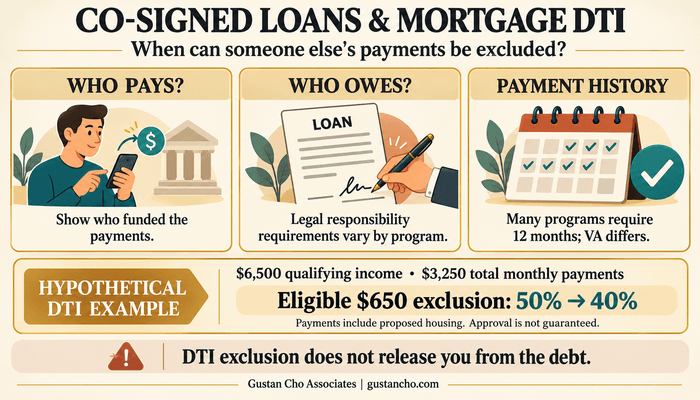 The documentation must establish who owes the debt, who funded the payments, and whether those payments were timely. Different records answer different questions:
- Who owes the debt: Loan agreements, promissory notes, or creditor confirmation can establish whether the applicant and the person making the payments are legally obligated.
- Who funded the payments: The other payer’s bank statements or canceled checks can identify the source of payment. Records should clearly link that person’s funds to the debt under review.
- Whether payments were timely: Creditor or servicer payment histories can establish payment dates and account status. However, those records may not identify whose money funded the payments.
For Fannie Mae’s debts-paid-by-others provision, the lender must obtain the other payer’s most recent 12 months of canceled checks or bank statements documenting a payment history without delinquencies. A creditor payment history alone does not replace that specific documentation requirement. If another person transfers money into the applicant’s account and the applicant then pays the creditor, additional records may be needed to establish who funded the payments. A deposit alone does not necessarily connect those funds to a particular loan payment or satisfy the program’s exclusion requirements. Court-assigned debts also require the applicable decree or court order. Business-paid obligations require records supporting payment from company funds and the applicable business cash-flow analysis.
Co-Signed Loan Payments Affecting Your DTI?
In some cases, a co-signed debt payment may be excluded from your debt-to-income ratio when you can document that someone else has made the payments. Review the requirements and records that may apply to your mortgage program.Debt Paid by the Borrower’s Business
Under Fannie Mae guidelines, a debt appearing on a self-employed borrower’s personal credit report may be excluded from personal DTI when the account has no history of delinquency, the business documents payment from company funds, and the lender’s business cash-flow analysis accounts for the obligation. Paying through a business account alone does not satisfy all three conditions. For related situations, see our guide to excluding debts from DTI calculations.
Debt Assigned in a Divorce or Court Order
Fannie Mae permits debt assigned to another person by court order, such as a divorce decree, to be excluded from the borrower’s recurring monthly obligations. The lender must document the assignment. Payment history before the assignment remains relevant, but the lender need not evaluate the assigned debt’s payment history after its effective date. This underwriting exclusion does not release the borrower from the original loan agreement. If the creditor has not granted a release, it may still pursue repayment from the borrower. For more information, see getting a mortgage during and after divorce.
What Happens if the Other Person Misses a Payment?
A missed payment can prevent a debt from being excluded when the mortgage program requires a clean payment history. For example, Fannie Mae requires a documented 12-month payment history with no delinquent payments when using its debts-paid-by-others provision. FHA similarly requires 12 months of timely payments when relying on the other legally obligated party to exclude a co-signed liability.
The Credit Impact Is Separate
A late payment on a co-signed account can also appear on the mortgage borrower’s credit report because the borrower remains legally responsible for the account. Even if the debt later becomes eligible for exclusion from DTI, the late payment may still affect the borrower’s credit history and underwriting.
Hypothetical Mortgage Qualification Examples
Consider an applicant with $6,500 in qualifying monthly income and $3,250 in total monthly qualifying obligations, including the proposed housing payment and a $650 co-signed auto loan payment. Before any exclusion, the applicant’s DTI is 50%, calculated by dividing $3,250 by $6,500.
If the lender verifies that the $650 payment qualifies for exclusion under the applicable mortgage program, the qualifying obligations decrease to $2,600. Dividing $2,600 by $6,500 produces a 40% DTI—a reduction of 10 percentage points.
This hypothetical example illustrates the calculation; it does not establish mortgage approval. The applicant must still satisfy the program’s remaining requirements, including credit, income, assets, and property eligibility.
What to Do When a Co-Signed Payment Is Counted in DTI
If a co-signed payment is factored into your DTI, then you need to ask your loan officer for the reason. The next step from there will depend on exactly what the file requires:
- Missing or incomplete payment history: Get the required payment history and find out if that covers the relevant review period. If there are late payments on the account, then get the lender to explain how that would impact exclusion.
- Unverified legal responsibility: Provide the loan agreement, promissory note, or creditor statement that identifies who the debt is owed to. The lender can then determine whether the payer meets the requirements of the selected program.
- Unclear payment source: Supply bank statements or canceled checks to show the other person’s funds were transferred to the creditor for payment. You need to explain the transfers between accounts and provide the supporting documentation.
- Incorrect debt classification: determine whether the obligation is a mortgage or a non-mortgage debt. In the case of mortgage debt, you must disclose the related housing costs and any rental income being used to qualify.
- Incomplete business payment evidence: provide the company’s payment records and have the lender confirm how the liability was treated in the business cash flow analysis.
Also ask whether the payment is being counted due to a mortgage program requirement, insufficient documentation, or a lender overlay. An overlay is an additional lender requirement beyond the program’s minimum standards. Missing agency-required records means the file has not yet satisfied the agency’s documentation standard. Another lender may apply a different overlay policy, but changing lenders does not eliminate the mortgage program’s eligibility or documentation requirements.
How to Prepare Before Applying for a Mortgage
Borrowers with co-signed debt should address it before mortgage pre-approval rather than waiting for underwriting. Start by identifying every obligation on the credit report for which someone else is making the payment. Then, determine which mortgage program to use, as the documentation and eligibility rules differ.
FAQs About Exempt Debts of Co-Signed Loans
Do I Need to Disclose a Co-Signed Loan That Is Missing From My Credit Report?
Yes. Disclose co-signed obligations for which you remain legally responsible. The lender evaluates known liabilities, including debts absent from the credit report, and determines whether each payment must be counted or qualifies for exclusion.
What if the Other Person Has Only Made 10 Months of Payments?
If the applicable exclusion requires 12 months of documented payments, 10 months generally will not satisfy it. The payment may need to remain in DTI unless another provision applies. VA requires separate evaluation because its contingent-liability provision does not impose the same blanket 12-month requirement.
Can I Pay Off a Co-Signed Loan Before Closing Instead?
Potentially. The lender must verify the payoff and determine whether the payment can be excluded from qualifying obligations. Before using funds for repayment, confirm that you will still have enough for the down payment, closing costs, and any required reserves.
Does Excluding the Payment Remove the Account From My Credit Report?
DTI exclusion impacts mortgage qualification, not credit reporting. The account may remain on your credit report, and unpaid payments will continue to affect your credit while you are responsible for it.
Can I Remove Myself as a Co-Signer Before Applying for a Mortgage?
Only if the creditor releases you from the obligation. Depending on the loan, this may require refinancing, repayment, or satisfying the creditor’s co-signer release conditions. The lender reviewing your mortgage application cannot simply remove your name from an unrelated loan.
Final Thoughts on Exempt Debts of Co-Signed Loans
Whether a co-signed payment can be excluded from the mortgage DTI is going to turn on the particular program, whether the payer is also legally obligated and what the available evidence of payment is. The records must establish who made the payment and whether the payment history meets the requirements for that particular exclusion. The only other issue is whether the borrower is eligible with the payment included or qualifies under the documented exclusion. That would be a case of assessing the proposed housing payment, the other outgoings and the remaining requirements of the mortgage program. A lower DTI may well improve eligibility but it will still be a case of eligibility on the full application.
This article about “Exempt Debts of Co-Signed Loans: How Mortgage Lenders Exclude Payments From DTI” was updated on October 22nd, 2026.