When the stock market drops sharply, many homebuyers, homeowners, and real estate investors immediately ask the same question: Will mortgage rates go down, too? It is a fair question because market volatility often creates major shifts in borrowing costs, consumer confidence, and housing affordability.
Understanding how a stock market correction affects
is important for anyone thinking about buying a home, refinancing a mortgage, or timing a real estate decision. While mortgage rates and the stock market are connected, they do not move in a simple one-to-one pattern.
A correction in the stock market can put downward pressure on mortgage rates, but it does not guarantee lower rates in every situation.
The reason is that mortgage rates are influenced by more than stock prices. They are affected by investor behavior, Treasury yields, inflation expectations, bond market performance, Federal Reserve policy, and overall economic outlook. When stocks fall, money often moves into safer investments such as bonds. That shift can help lower mortgage rates. But if inflation is rising or investors are worried about other risks, mortgage rates may not fall as much as borrowers expect.
In this guide, we will explain how a stock market correction affects mortgage rates, why mortgage rates sometimes drop during periods of market stress, why they do not always fall, and what this means for homebuyers and homeowners in the real world.
What Is a Stock Market Correction?

A stock market correction usually means the market drops by at least 10% from its recent peak. These corrections can occur in big indexes like the Dow Jones, the S&P 500, or the Nasdaq. They are a normal part of financial markets, even though they often create fear and uncertainty among investors.
A correction does not necessarily mean the economy is collapsing. Sometimes it is simply a pullback after stock prices rise too far too fast. In other cases, a correction may be caused by serious concerns such as inflation, geopolitical tension, recession fears, weak earnings reports, global instability, or shifts in monetary policy.
For borrowers, the important point is not just that the stock market is falling. The more important question is why it is falling. The cause of the correction often determines whether mortgage rates are likely to move lower, stay flat, or even rise.
Why People Connect the Stock Market to Mortgage Rates
Many consumers assume that when the stock market falls, mortgage rates automatically fall as well. That idea comes from the fact that both markets respond to economic news and investor sentiment. Mortgage rates aren’t really linked to the Dow Jones or the S&P 500.
Mortgage rates are more closely linked to the bond market, especially U.S. Treasury yields and mortgage-backed securities. Still, the stock market matters because large selloffs can shift where investors allocate their money. When investors become nervous about stocks, they often move funds into safer assets. That shift can influence yields and eventually affect mortgage pricing.
So while the stock market does not set mortgage rates directly, a correction can create the conditions that make lower mortgage rates more likely.
Stock Market Correction? See What It Means for Your Mortgage Rate
Market sell-offs can shift bond yields and influence mortgage rates—but not always in a straight line. Get a quick rate and payment check based on today’s market and your goals
How a Stock Market Correction Affects Mortgage Rates
The main connection between a stock market correction and mortgage rates is what investors do when fear increases. When the stock market gets really wobbly, many investors start looking for safer bets. This is often referred to as a flight to safety.
When investors sell stocks and buy bonds, bond prices usually rise. As bond prices rise, bond yields typically fall. Since mortgage rates often move in the same direction as key bond yields, especially the 10-year Treasury and mortgage-backed securities, mortgage rates may also move lower.
This is the basic pattern behind the idea that a stock market correction lowers mortgage rates. It is not the stock decline itself that lowers mortgage rates. It is the money flowing out of risky assets and into safer fixed-income investments.
In simple terms, fear in the stock market can increase demand for bonds, and stronger bond demand can help lower mortgage borrowing costs.
The Flight to Safety Explained
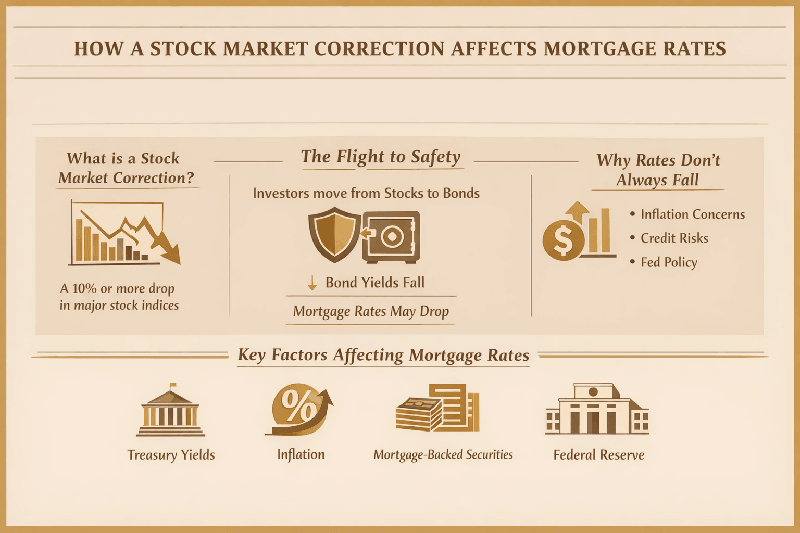
To better understand this relationship, it helps to examine investor psychology. Stocks are considered risk assets. Bonds, particularly U.S. Treasury securities, are often viewed as safer investments. When markets are calm and investors feel confident, money may flow into stocks in search of higher returns. But when fear rises, preserving capital becomes more important than chasing gains.
That is when investors often buy Treasury bonds and mortgage-backed securities. More demand for these safer assets pushes prices upward. The prices of bonds and their yields have an inverse relationship: as bond prices increase, yields decrease.
Mortgage lenders and investors closely monitor these yield changes. When yields fall enough and market conditions support it, mortgage pricing can improve. As a result, homebuyers and refinancing borrowers may see lower interest rates from lenders.
This is one of the clearest ways a stock market correction affects mortgage rates in practice.
Why Mortgage Rates Do Not Always Fall When Stocks Drop
Although many people expect rates to drop during a market selloff, that outcome is not guaranteed. This is one of the biggest misunderstandings consumers have about the mortgage market.
A stock market correction affects mortgage rates differently depending on the broader economic environment. If investors believe the correction signals slower growth or recession, rates may fall because the market expects weaker demand and easier monetary policy. But if the correction occurs during a period of stubborn inflation, rising oil prices, or financial system stress, mortgage rates may remain elevated.
For example, if inflation is high, bond investors may demand higher yields even while stocks are falling. In that case, lenders may keep mortgage rates higher because inflation erodes the value of future bond payments. Likewise, if mortgage-backed securities are under pressure or liquidity is tight, rates may not improve as quickly as Treasury yields suggest.
That is why borrowers should not assume every stock market correction leads to a better mortgage rate environment. The relationship is real, but it is not automatic.
The Role of the 10-Year Treasury Yield
One of the most important indicators for mortgage rates is the 10-year Treasury yield. Mortgage rates do not exactly match the 10-year Treasury, but they often move in the same general direction. This is why financial professionals watch the Treasury market closely when discussing mortgage rate trends.
When a stock market correction pushes investors into Treasuries, the 10-year yield may decline. Lower Treasury yields often create favorable conditions for mortgage rates to ease. However, mortgage rates typically remain somewhat higher than Treasury yields because lenders and investors must price in credit risk, servicing costs, loan-level pricing adjustments, and market spreads.
Even so, the 10-year Treasury remains one of the best real-time gauges for whether a stock market correction may influence mortgage rates.
If Treasury yields are falling during a correction, mortgage borrowers may benefit. If Treasury yields are rising despite weak stock performance, mortgage rates may remain stubbornly high.
Mortgage-Backed Securities and Their Impact on Rates
Another major factor in how a stock market correction affects mortgage rates is the performance of mortgage-backed securities (MBS). These are bundles of home loans sold to investors in the secondary market. Mortgage-backed securities help determine the pricing lenders can offer borrowers.
If investors view mortgage-backed securities as attractive during periods of market stress, demand can rise, and yields can improve. That can help lenders offer lower mortgage rates. But if investors are wary of prepayment risk, inflation risk, or volatility in the housing finance market, MBS pricing may not improve as much as borrowers hope.
This is why there can be a difference between what people see in the headlines and what lenders actually offer. The stock market may be down sharply, yet mortgage rates do not always drop right away because mortgage-backed securities have their own trading dynamics.
The Federal Reserve’s Indirect Influence
The Federal Reserve does not directly set mortgage rates, but it strongly influences the interest rate environment. During a stock market correction, investors often start speculating about what the Fed may do next. If markets believe the correction could weaken the economy, investors may expect future Fed rate cuts or a more accommodative stance.
That expectation can help lower Treasury yields and, in turn, support lower mortgage rates. On the other hand, if the Fed remains focused on fighting inflation, mortgage rates may not decline much even if the stock market is under pressure.
This is why mortgage rate movements often depend on the market’s expectations for Federal Reserve policy, not just on what the stock market is doing on any given day.
What a Stock Market Correction Means for Homebuyers
For homebuyers, a stock market correction can create opportunities but also create uncertainty. If mortgage rates fall during market volatility, monthly payments may become more affordable. A lower mortgage rate can increase buying power, reduce long-term interest costs, and make homeownership more accessible.
At the same time, buyers should stay realistic. Lower rates are helpful, but they are only one part of the affordability picture. Home prices, property taxes, homeowners’ insurance, income stability, down payment funds, and debt-to-income ratios still matter.
A stock market correction can also affect confidence. Some buyers may worry about job security or future economic conditions and choose to wait. Others may see falling rates as a reason to move quickly. The right decision depends on personal finances, not just market headlines.
Financially prepared borrowers, have stable income, and plan to stay in the home long term may still benefit from buying during periods of volatility if rates improve.
Get Pre-Approved So You Can Move Fast
In uncertain markets, the best deals go to prepared buyers. Get a strong pre-approval and a clear budget so you can act quickly when the right home appears
What a Stock Market Correction Means for Refinancing
Homeowners considering a refinance also closely monitor market corrections. If mortgage rates drop enough, refinancing may reduce a monthly payment, shorten a loan term, or help consolidate debt through a cash-out refinance.
However, refinancing only makes sense when the numbers work. Closing costs, loan balance, break-even period, current interest rate, and long-term goals all matter. A stock market correction may open a window for refinancing. However, homeowners should still review the full financial picture before acting.
Many homeowners make the mistake of focusing only on rate headlines. A better strategy is to compare actual lender offers and calculate whether the refinance creates meaningful savings.
Why Lender Overlays and Borrower Profile Still Matter
Even when the market supports lower mortgage rates, not every borrower gets the same rate. Lenders price loans based on many factors, including credit score, loan type, occupancy, property type, loan-to-value ratio, debt-to-income ratio, and whether the transaction is a purchase, rate-and-term refinance, or cash-out refinance.
A stock market correction can affect mortgage rates overall, but the specific rate you get depends on your financial situation and the lender you choose.
Some lenders also add overlays that make qualification harder or pricing less competitive. That is why borrowers should shop carefully and not assume every lender will react the same way to improving market conditions.
The Biggest Mistake Borrowers Make
One of the biggest mistakes borrowers make is assuming a stock market correction guarantees a huge drop in mortgage rates. Sometimes rates improve modestly. Sometimes they improve quickly. Sometimes they barely move. And sometimes they rise despite falling stocks.
The better approach is to understand the mechanism. Watch the bond market, follow Treasury yields, monitor mortgage-backed securities, and review actual daily lender pricing rather than relying solely on stock market news.
A stock market correction matters, but it is only one piece of the mortgage rate puzzle.
Final Thoughts on How a Stock Market Correction Affects Mortgage Rates
A stock market correction can affect mortgage rates by changing investor behavior. When investors shift from stocks to safer assets such as Treasury bonds and mortgage-backed securities, yields may fall, and mortgage rates may decline. That is why mortgage rates often decline during periods of stock market stress.
But the relationship is not guaranteed. Inflation, Federal Reserve expectations, bond market conditions, and overall economic uncertainty all influence whether rates actually move lower. The cause of the stock market correction matters just as much as the correction itself.
For homebuyers and homeowners, the smartest strategy is not to assume that falling stocks automatically mean the perfect time to lock a mortgage. Instead, focus on your financial readiness, watch the bond market, compare lender pricing, and understand how broader market forces shape mortgage rates.
When you understand how a stock market correction affects mortgage rates, you can make more informed decisions and avoid reacting emotionally to market headlines.
Frequently Asked Questions About Stock Market Correction:
Do Mortgage Rates Always Go Down During a Stock Market Correction?
- No. A stock market correction can put downward pressure on mortgage rates, but rates do not always fall. Inflation, bond yields, mortgage-backed securities pricing, and Federal Reserve expectations also play major roles.
Why Do Mortgage Rates Sometimes Fall When Stocks Fall?
- Mortgage rates sometimes fall when investors shift money from stocks into safer assets, such as Treasury bonds and mortgage-backed securities. That increased demand can lower yields and help improve mortgage pricing.
Does the Federal Reserve Control Mortgage Rates?
- The Federal Reserve does not directly set mortgage rates. However, Fed policy affects the broader interest rate environment, investor expectations, and bond market behavior, which can, in turn, indirectly influence mortgage rates.
Is a Stock Market Correction Good for Homebuyers?
- It can be, especially if mortgage rates improve, making monthly payments more affordable. But buyers should also consider home prices, job stability, savings, and their long-term financial goals.
Should I Wait for a Stock Market Correction Before Buying a Home?
- Not necessarily. Waiting for a correction does not guarantee lower mortgage rates or better affordability. The right time to buy usually depends more on your finances, income stability, and readiness for homeownership than on short-term market headlines.
What Market Should Borrowers Watch if They Care About Mortgage Rates?
- Borrowers should watch the 10-year Treasury yield, mortgage-backed securities performance, inflation reports, and Federal Reserve guidance. These often have a more direct effect on mortgage rates than the stock market alone.
This article about “Stock Market Correction: What It Means for Homebuyers” was updated on March 23rd, 2026.
Not Sure How This Market Impacts You? Get a Quick Review
Tell us your price range, down payment source, and timeline. We’ll give you a clear next-step plan with zero pressure