If you’re buying or refinancing a home during a federal funding lapse, you’ll quickly discover that government processes touch almost every step of a loan—from income transcripts to program endorsements. This comprehensive guide explains what a shutdown is, how it affects each loan type, and the specific steps borrowers, agents, and lenders can take to keep files moving. Throughout this guide, we’ll use the phrase’ government shutdown mortgage’ to describe the practical, on-the-ground issues that arise when Washington goes dark.
Key Takeaways (Read this first)
- A partial shutdown doesn’t close every agency. The impact of a government shutdown on mortgages varies by program (USDA is hit hardest, VA least).
- The biggest universal bottleneck is often IRS income verification (4506-C), which many lenders require before or at closing.
- USDA loans require a second sign-off by a government underwriter, which stops when USDA staff are furloughed
- FHA/HUD can operate at a reduced capacity; case numbers and endorsements may continue, but service levels will slow, which could impact the timeline for a government shutdown mortgage.
- Conventional loans (Fannie/Freddie) continue to run smoothly. However, third-party verifications tied to federal agencies can still cause delays in closings.
- Smart contract language, early verifications, and clear contingency plans are the best way to “shutdown-proof” your government shutdown mortgage file.
Know what still moves during a shutdown
See which steps (appraisal, title, lock) continue and which may pause
What a Shutdown Really Means for Housing
A shutdown happens when Congress doesn’t pass funding bills (or a continuing resolution). Agencies stop non-essential operations and furlough employees. In housing and mortgages, that means:
- Open but slower: Some functions remain “excepted” and continue, but with skeletal staffing—typical in FHA/HUD operations relevant to a government shutdown mortgage.
- Open and normal: Independent entities, such as the Federal Reserve, continue to function; so do Fannie Mae and Freddie Mac.
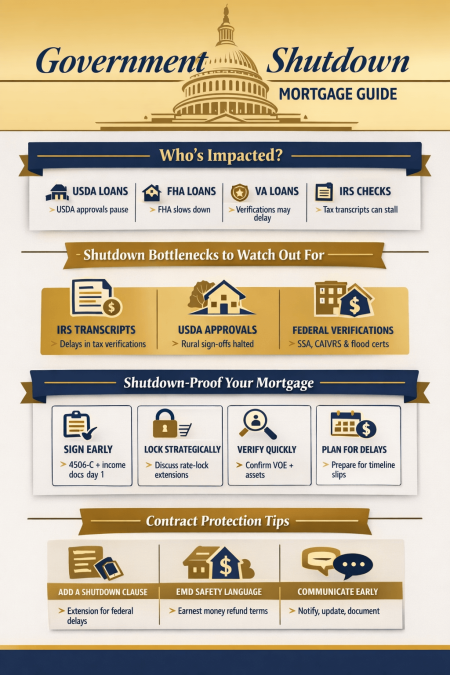
- Closed/limited: Certain IRS transcript services, USDA underwriting sign-offs, and support desks may be unavailable—major pain points for any government shutdown mortgage in process.
Program-by-Program Impact
1) USDA (Rural Development)
Why USDA is hit hardest: USDA loans use two layers of underwriting—first by the lender, then a required USDA Rural Development sign-off. During a shutdown, that second approval can stall if USDA staff are furloughed.
Practical effects of a government shutdown on the mortgage (USDA):
- Files can stack up in the queue with no ability to get the final commitment.
- Closing dates may require extensions, and rate locks may need to be re-locked if they expire.
- Sellers and agents must be prepped for timeline risk.
Borrower tips:
- Get all borrower docs pristine so your lender can submit to USDA on day one when operations resume.
- Build a contract addenda acknowledging longer timelines for a government shutdown mortgage that includes USDA.
2)FHA (HUD) During a Government Shutdown: What Can Slow Down—and What Usually Doesn’t
FHA loans run through HUD systems. During a partial shutdown, HUD often keeps core systems operating, but staffing and support functions can slow down. The key is knowing what can delay your closing date versus what impacts the lender after closing.
FHA Shutdown Impacts That Can Affect Your Closing (Pre-Closing)
These are the FHA-related items most likely to create timeline risk during a shutdown:
- FHA Case Number Timing (when it matters): If your lender hasn’t pulled an FHA case number yet, don’t wait. Getting it early reduces risk if processing slows.
- FHA Condo Approval / Project Review: If the property is a condo, approvals or project reviews can become a bottleneck—especially if a condo needs FHA eligibility confirmation or additional documentation.
- Underwriting Support & Escalations: When staffing is limited, getting answers on edge cases (manual underwriting questions, unusual documentation, condo nuances) can take longer. That doesn’t stop the loan from moving, but it can slow “exception” or “clarification” turn times.
- Any FHA-related validation steps that require extra review: Certain files need more back-and-forth—think repair requirements, documentation clarifications, or property eligibility questions. Limited staffing can make these take longer to clear.
How Borrowers Can Reduce Pre-Closing Risk
-
Get VOE/VOI, asset docs, gift docs, and credit documentation in immediately.
-
If buying a condo, confirm FHA condo status early (don’t wait until after appraisal).
-
Avoid last-minute changes: job change, new debt, large unexplained deposits.
FHA Shutdown Impacts That Usually Do NOT Stop Closing (Post-Closing)
This is the part borrowers often worry about unnecessarily:
FHA Endorsement / Insuring Delays
-
FHA loans are typically endorsed/insured after closing as part of the lender’s post-closing process.
-
If HUD endorsement processing slows, the main impact is often on the lender’s pipeline and post-closing timelines, not on the borrower’s ability to sign and get keys—assuming the lender has already issued “clear to close.”
What it Means for You as the Borrower
-
In most cases, you still close on schedule if your loan is cleared and all pre-closing conditions are satisfied.
-
The endorsement delay is typically a lender operational issue, not a borrower problem—unless a lender/investor policy requires something HUD-linked before funding in your specific case.
FHA “Shutdown-Proof” Strategy (Simple Checklist)
To keep an FHA loan moving even if HUD support slows:
-
Pull the FHA case number early
-
If condo: verify FHA approval / eligibility ASAP
-
Front-load: income docs, assets, gifts, VOE, and explanations for any credit events
-
Clear appraisal/property items early (repairs, documentation, eligibility questions)
-
Build in contract flexibility if timelines are tight (especially condos)
3)VA (Department of Veterans Affairs) During a Shutdown: Usually Stable, But Verifications Can Still Slow Things Down
VA loans are often the least disrupted during a federal shutdown because many VA loan functions and systems typically remain available. In most cases, the VA process itself keeps moving—but your timeline can still be affected by federally linked verifications that some lenders require to close.
What Usually Continues Normally (VA Side)
- VA loan processing systems typically remain available
- VA appraisal ordering and completion generally continues (appraisers are not federal employees)
- Common VA workflow items like appraisal-related processes and required forms usually keep moving
(The VA portion of the loan is typically not the main bottleneck.)
What Can Still Delay a VA Closing During a Shutdown (Lender/Investor Side)
Even if VA systems are operating, lenders may still need third-party or federal-linked validations before funding, such as:
- IRS Income Verification (Form 4506-C / transcripts): Many lenders require transcripts or transcript-related validation, especially for self-employed or complex income. If transcript turn times slow, a VA loan can still be delayed close to closing—despite VA systems being online.
- Federal-linked checks and validation tools (varies by lender/investor): Depending on the file, the lender/investor may require or trigger checks connected to federal data sources, such as:
- CAIVRS (federal default database—more commonly associated with FHA/USDA, but can be relevant in certain validations)
- SSA-related validation or fraud/identity tools that reference government data (when triggered by the lender’s process)
- Other third-party verifications that rely on federal availability
Bottom line: VA itself is usually not what stalls the file; verification requirements can be.
Borrower Tips to “Shutdown-Proof” a VA Loan
- Pull your COE early (don’t wait until underwriting)
- Sign the 4506-C on day one and upload income docs immediately
- Keep pay stubs and bank statements current so your lender can use alternative documentation if needed (when allowed)
- Avoid last-minute job changes, new debts, or large unexplained deposits
4) Conventional (Fannie Mae / Freddie Mac) During a Shutdown: Usually Smooth—But a Few Verifications Can Still Slow Things Down
Fannie Mae and Freddie Mac are not funded through annual congressional appropriations, so their systems generally continue operating normally during a shutdown. That means:
- AUS findings (DU/LP) keep running
- Conventional underwriting and closing processes usually stay on track
However, even a conventional loan can be delayed if a required third-party verification depends on federally linked data sources or if vendors experience a backlog.
The Most Common Conventional “Shutdown Bottlenecks”
- IRS transcripts / 4506-C (if your lender requires them): Some lenders require transcript validation for certain income types or risk profiles. If IRS turn times slow, the file can stall near the finish line.
- SSA-related verification (when this applies): This is not required on every file, but it can appear when: A lender’s process runs name/SSN validation or identity checks, a fraud-prevention tool triggers additional verification, or the borrower uses Social Security or disability income, and the lender needs benefit income verification (requirements vary by lender/investor).
- Flood certification (when this applies): Flood certs are required when: The property is in a mapped flood zone that requires coverage (your lender will order a flood determination), flood documentation must be validated through the lender’s vendors, and most of the time, this runs smoothly, but delays can happen if a vendor relies on impacted data sources or if there’s a surge in requests.
Borrower Tips for Conventional Loans During a Shutdown
- Ask your lender on day one: “Do you require IRS transcripts to close?”
- Keep current pay stubs and complete bank statements ready in case alternatives are needed (when permitted)
- If the home is in a flood zone, order insurance early and confirm your agent can issue the required policy promptly
- Respond quickly to lender conditions to avoid stacking delays late in the process
The Big Cross-Program Bottleneck: IRS Transcripts (Form 4506-C)
When headlines mention a shutdown, one of the biggest mortgage slowdowns is often income verification tied to the IRS—specifically, tax return transcripts requested using Form 4506-C. Not every loan requires transcripts, but many lenders and investors use them as a standard validation tool.
Agency Baseline vs. Common Lender Practice (Read this first)
Agency Baseline (program rules):
- IRS transcripts are not a universal “USDA/FHA/VA/Conventional rule.”
- They are typically a lender/investor verification requirement used to validate the income used to qualify.
Common Lender Practice (real-world underwriting):
- Many lenders order transcripts early and may require receipt/verification before closing or before funding, depending on the loan type, risk profile, and investor.
- Some lenders may proceed using document alternatives when transcripts are delayed—but this is case-by-case and depends on investor rules, AUS findings, and the strength of the file.
Bottom line: Your lender can usually submit your file and keep processing during a shutdown, but if transcripts are required for final approval or funding, the closing date may need to move.
When 4506-C Transcripts Are Most Likely to Be Required
Transcripts are more commonly required when any of the following are true:
- Self-employed / 1099 / business income (Schedule C, K-1s, partnerships, S-corp, etc.)
- Variable income (overtime, bonus, commission) that must be averaged
- Multiple jobs or complex income sources
- Recent tax filing changes or amended returns
- Higher-risk layered files (thin credit, high DTI, limited reserves, multiple red flags)
- Investor overlays or QC requirements for certain channels
Even on “plain vanilla” W-2 files, some lenders still pull transcripts as part of their standard process.
What Lenders May Do If Transcripts Are Delayed
If IRS transcript turn times slow down during a shutdown, lenders may choose one of these paths—depending on loan type, AUS results, and investor policy:
- Wait for transcripts before funding
- This is the most common approach when transcripts are required by policy.
- Use acceptable alternative documentation (if permitted)
- Examples can include a combination of:
- Complete signed tax returns (all schedules)
- W-2s/1099s and year-to-date paystubs
- Written Verification of Employment (VOE)
- CPA letters (in limited circumstances and only when allowed)
- Proof of tax filing/acceptance (varies by investor; not a blanket substitute)
- Post-closing conditions (rare; investor-dependent)
- In some cases, an investor may allow funding with a post-closing requirement to obtain transcripts later, but this is not typical and is not available on all loans.
Important: “Alternatives” do not mean “no verification.” They mean different verification, and only when the investor/underwriter allows it.
What Borrowers Should Do (Best Practices)
To keep your file moving even if transcript timing slows:
- Sign the 4506-C on day one (don’t wait until underwriting asks)
- Upload complete tax returns (all pages + schedules), plus W-2s/1099s
- Keep current pay stubs and complete bank statements ready
- Avoid last-minute changes (job changes, new debts, unexplained deposits)
- If you’re self-employed, have P&L and business bank statements available (if requested)
Quick FAQ: “Do I Need IRS Transcripts to Close?”
Sometimes, depending on the lender/investor policy and your income type.
The safest plan is to assume transcripts may be required and get the 4506-C signed. The supporting documents are uploaded immediately, so you don’t run into a surprise delay right before closing.
Verify employment the resilient way
VOE strategies for furloughed/contracted or federal employees
Rate Locks, Extensions, and Costs
A government shutdown mortgage can last for an extended period. If your rate lock expires:
- Extension fees may apply (often measured in basis points).
- Re-locking at the market could increase your payment if rates rose.
- Consider longer initial locks if a shutdown looks likely.
Pro move: Ask your lender whether a float-down option exists in case rates fall while your government shutdown mortgage is in limbo.
Appraisals, Title, and Insurance During a Shutdown
- Appraisals: VA, FHA, and Conventional orders continue. Appraiser scheduling—not federal funding—drives timing. Still, an overwhelmed AMC can push a government shutdown mortgage out a week or two.
- Title & Closing: Private industry continues to operate; title searches, E&O, and CPLs should be readily available. If municipal offices reduce hours, retrieving certain records might delay a government shutdown mortgage closing.
- Flood Insurance: If NFIP pauses → ask lender if private flood is acceptable and whether it meets guidelines
If renewal/new purchase timing matters → order early
Contract Language & Negotiation Tips (Protect Your Earnest Money Deposit)
A government shutdown can create delays beyond the buyer’s control, such as IRS transcript turnaround times or USDA’s second sign-off. You may be able to reduce your risk by adding clear, written protections to your purchase contract before deadlines hit.
Note: Contract rules vary by state and by the exact wording of your agreement. Use the examples below as discussion starters with your real estate agent and, if needed, your attorney.
Contract Addendum Goals (What you’re trying to accomplish)
- Acknowledge that federal service delays can impact the mortgage timeline
- Allow automatic extensions if delays are caused by unavailable government processing
- Clarify what happens to closing dates, rate-lock extensions, and contingency periods
- Strengthen your position so you’re not forced into default due to a delay you didn’t cause
Sample Language to Discuss With Your Agent (Not Legal Advice)
1) Shutdown / Federal Services Delay Addendum
Purpose: Adds a defined “shutdown delay” category so timeline changes are clear.
Sample clause:
“If a federal funding lapse or government service interruption delays required mortgage-related verifications or approvals (including, but not limited to, IRS transcript processing, USDA Rural Development approval, or other federally-linked services), Buyer and Seller agree to extend applicable mortgage and closing deadlines for ____ days, or until services resume, whichever occurs first.”
2) Automatic Extension Clause (10–14 Days)
Purpose: Prevents last-minute renegotiations and protects deadlines.
Sample clause:
“In the event mortgage processing is delayed due to a documented federal service interruption, the parties agree to an automatic extension of the closing date by ____ days upon written notice from Buyer’s lender.”
3) Earnest Money Deposit (EMD) Protection Language
Purpose: Avoids blanket statements like “EMD is refundable” and instead ties outcomes to the contract contingencies.
Sample clause (discussion starter):
“If Buyer is unable to obtain final loan approval by the closing date due to delays caused by a government service interruption affecting required mortgage verifications or approvals, Buyer may cancel under the financing contingency terms of this agreement, subject to the contract’s notice requirements.”
(This keeps the focus on using the contract’s contingency language properly, rather than guaranteeing EMD treatment.)
4) Communication & Documentation Requirement
Purpose: Sets expectations so the seller isn’t surprised and you have a paper trail.
Sample clause:
“Buyer agrees to provide prompt written updates and, when available, lender documentation evidencing the cause of delay. Seller agrees to reasonably cooperate with timeline extensions caused by federally-related processing delays.”
Practical Tips (What helps in real life)
- Get the addendum in before contingency deadlines—not after a shutdown is announced
- Have your lender provide a short written note if a federal delay is impacting your file
- Don’t let deadlines lapse quietly—submit extension requests in writing and on time
Borrower Checklist: How to “Shutdown-Proof” Your File
Use this list the moment funding drama hits the headlines:
- Complete disclosures and e-consents day one so your lender can front-load verifications for your government shutdown mortgage.
- Sign 4506-C immediately and upload W-2/1099s, complete tax returns, paystubs, and bank statements.
- Lock strategically (consider longer locks; discuss extension costs for a government shutdown mortgage scenario).
- Stay documentation-ready: Any new deposits, gifts, or job changes must be fully paper-trailed.
- Avoid big financial moves (new credit lines, car loans) that could derail AUS findings on a government shutdown mortgage.
- Coordinate gift funds early and have donors ready for quick re-verification.
- Keep your phone on—rapid responses to lender conditions are key to winning during a government shutdown mortgage delay.
- Loop in your agent so contract extensions are filed before deadlines.
Lender Playbook: Keeping Pipelines Moving
For mortgage pros managing a surge of government shutdown mortgage files:
- Front-load VOE/VOI, SSA, flood, IRS, and any condo/HOA docs.
- Prioritize USDA submissions ahead of potential furloughs.
- Use contingency closings (where allowed) and set post-closing stips for transcripts.
- Daily borrower updates help keep expectations anchored and minimize the impact of a government shutdown on a mortgage pipeline.
- Maintain a rate-lock dashboard that includes expiration dates, extension costs, and renegotiation policies to ensure timely updates.
What We Learned From the 2019 Shutdown (Mini Case Study)
The last major example borrowers still remember is the partial federal shutdown that ran from late December 2018 into January 2019. It created a real-world stress test for mortgage timelines—especially for loans that depend on federal verification or a government sign-off.
What Happened in 2019
During that shutdown, many buyers and lenders ran into delays because:
- USDA loans stalled when the required second approval (USDA/Rural Development sign-off) couldn’t be completed during furloughs
- Income verification tied to the IRS became harder to obtain or took longer than usual for some files
- Closings that were scheduled tightly often needed contract extensions, and some borrowers faced rate-lock extension costs if timelines slipped
What We Do Differently Now
Shutdowns don’t have to derail a purchase—but they punish “last-minute” files. Since 2019, the best practice playbook has become:
- Front-load verifications early (especially 4506-C authorization and income documentation)
- Identify “federal dependency risk” on day one (USDA sign-off, condo approvals, transcript-driven income)
- Build a contract extension plan up front so deadlines don’t sneak up
- Track rate locks with a clear extension strategy instead of hoping timelines hold
What You Should Do Today (If Shutdown Headlines Start)
If you’re buying or refinancing and funding drama hits the news, do these immediately:
- Sign 4506-C and upload complete income documents on day one
- If USDA: aim to get submitted as early as possible and plan for potential queue time
- If FHA condo: confirm project eligibility early (don’t wait until the end)
- Ask your lender: “Do you require transcripts to fund?” and “What’s our backup plan if turn times slow?”
- Have your agent prepare a simple shutdown-delay extension addendum before deadlines
The takeaway from 2019: the borrowers who closed fastest weren’t “lucky”—they were prepared and fully documented before the system got backed up.
How Gustan Cho Associates Helps You Navigate a Shutdown
At GCA, we specialize in complex, time-sensitive scenarios, including manual underwriting, borrowers with recent credit events, and multi-layered documentation. In a government shutdown mortgage environment, we:
- Front-load verifications (IRS/SSA/VOE) at application.
- Engineer alternatives when transcripts stall, where investor rules allow.
- Coordinate your contract strategy with your agent to ensure your government shutdown mortgage remains protected.
- Communicate daily so you never guess what happens next.
Call Gustan Cho Associates at 800-900-8569 or start your application to build a shutdown-ready plan for your government shutdown mortgage today.
Plan for income interruptions
Pay histories, reserves, and letters of explanation to maintain eligibility
Final Word
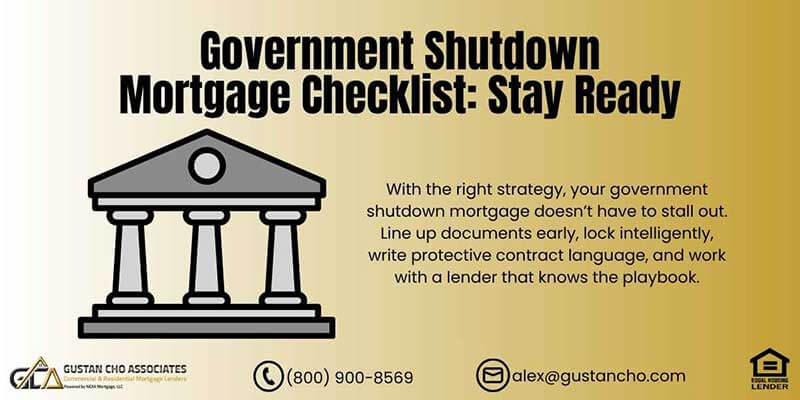
You can’t control Washington, but you can control preparation and communication. With the right strategy, your government shutdown mortgage doesn’t have to stall out. Line up documents early, lock intelligently, write protective contract language, and work with a lender that knows the playbook.
Ready to move forward even if the headlines get noisy?
Call 800-900-8569, or email alex@gustancho.com—and we’ll map your government shutdown mortgage from start to clear-to-close.
Frequently Asked Questions About Government Shutdown Mortgage:
Will a Government Shutdown Delay My Mortgage Closing?
It can—mainly when your file depends on a federal-linked verification or approval (like IRS transcript processing or USDA’s required sign-off). Conventional loans often keep moving, but shutdown-related bottlenecks can still affect timing near the end of the process.
Can You Close on a USDA Loan During a Government Shutdown?
Sometimes, but USDA is usually the most impacted. If USDA staff are furloughed, new conditional commitments/guarantees may pause, and loans needing USDA’s final action can stall. If you already have a valid conditional commitment, some closings may proceed, depending on the lender’s risk tolerance and USDA contingency rules.
Are FHA Loans Affected by a Shutdown, or Can They Still Close?
FHA often continues core functions, but service levels can slow. Case numbers may still be available, and FHA can continue endorsing single-family loans, but endorsement turn times may extend—this is typically more of a lender post-closing issue unless your file needs extra FHA/HUD review pre-closing.
Are VA Loans Impacted During a Government Shutdown?
VA systems and VA loan operations are often less disrupted, but your closing can still be delayed if your lender requires IRS transcript-related income validation or other third-party checks that slow down during a shutdown.
Does a Government Shutdown Stop Appraisals or Home Inspections?
Usually no. Appraisals are performed by independent appraisers and AMCs, so scheduling and local market demand drive timing more than federal funding. Inspections are private and generally continue.
Can a Government Shutdown Affect Flood Insurance and Delay a Closing?
Yes—especially if the property is in a flood zone and the loan requires coverage tied to the National Flood Insurance Program (NFIP). If NFIP activity is disrupted, insurance timing can impact closings (some borrowers may use private flood if allowed).
This article about “Government Shutdown Mortgage Checklist: Stay Ready” was updated on March 3rd, 2026.
Get a shutdown-savvy lending team
No-overlay guidance, proactive communication, and on-time closings