Do I Have to Pay Collection Accounts for FHA Loan Approval?
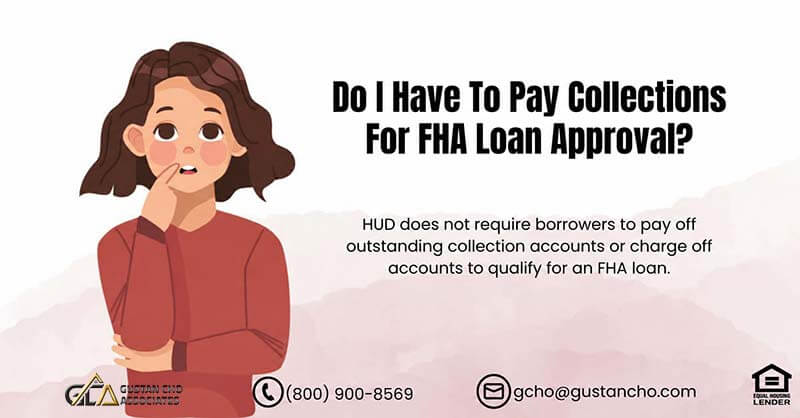
A frequently asked question by people who have had credit problems in the past is whether they have to pay off the collections to get an FHA loan. In most cases, the answer is no, since the presence of unpaid collection accounts does not automatically disqualify you from obtaining an FHA mortgage. That said, FHA lenders can’t ignore collections.
Is payment to collectors required for an FHA loan? Find out about FHA rules regarding collections, the $2,000 rule, the 5% DTI calculation, medical collections, charge-offs, and the various payment-plan alternatives.
This guide covers the frequently asked question: Do I have to pay collections for FHA loan approval. We will discuss the topic of whether I have to pay collections for FHA loan approval. A large percentage of our borrowers are folks who were turned down by other mortgage companies because they had outstanding collection accounts or charge-off accounts. Most of our borrowers at Gustan Cho Associates are familiar with FHA guidelines on collection accounts.
How Is Outstanding Collection Accounts Viewed by Mortgage Lenders
The amount you owe, the type of collection, whether the account is disputed, how the loan was underwritten, and your overall credit history all affect how the collection must be handled.
For most borrowers, a balance of $2,000 in applicable outstanding collection amounts is the key figure. When applicable collections reach that amount, HUD, the parent of FHA, usually requires the lender to take the debt into account when assessing your eligibility.
It doesn’t necessarily mean settling the collections. In some cases you could leave the accounts unpaid and have a calculated payment taken into account when working out your debt-to-income ratio, or you could arrange to make payments with the creditor. If you know your options before paying off an old debt, you’ll be able to save money and will also be able to avoid unnecessary changes to your mortgage qualification.
Is Payment Required Towards Collections if I Want to Get an FHA Loan Approved?
You are not usually required to pay off each existing collection account in full if you want to qualify for an FHA loan. When applicable, outstanding collection balances totaling $2,000 or more, the lender generally needs to address them in one of three ways. The entire amount can be paid either before or at the closing ceremony. It is possible to enter into an arrangement with the creditor that is properly documented, and the monthly payment required under that arrangement can be included in your debt-to-income ratio.
If no acceptable payment arrangement can be obtained, the lender can treat 5 percent of the outstanding collection balance as a monthly obligation for the purpose of working out your debt-to-income ratio.
Under the HUD agency mortgage guidelines, medical collections and charge-off accounts are treated differently and generally handled differently from ordinary nonmedical collections. The key thing to note is that a debt being unpaid doesn’t mean you have to send a check to the collection agency before applying for an FHA mortgage.
Can One Obtain an FHA Loan if They Have Collections?

Right. People applying for FHA financing can have their collection accounts still unpaid and qualify. FHA mortgages were intended to give people with less-than-excellent credit access to homeownership; as a result, the FHA underwriting process takes into account that an old collection can appear on a credit report.
A group of loans collected several years ago could reflect a completely different credit situation than the many recent unpaid accounts that have arisen from repeated payment delays.
A lender can look at the amount that is owed, the time when the problem took place, the cause of the problem, the borrower’s most recent payment history, the consistency of their income, their debt-to-income ratio, and whether or not the loan gets an automated underwriting approval or instead requires manual underwriting. The fact that there is a collection account by itself doesn’t give the whole picture.
What FHA Considers a Collection Account
A debt is considered a collection account when the creditor has either handed it over to or sold it to a collection agency after the first obligation became delinquent. Typical examples include unpaid credit card bills, personal loans, utility bills, cell phone bills, debts related to apartments, and other consumer debts. The way the account is handled during mortgage underwriting is, in part, determined by the type of debt it involves.
How the FHA $2,000 Collection Rule Works
The $2,000 figure is one of the most important guidelines that FHA borrowers need to understand regarding collections. If the credit reports used in the underwriting process show cumulative outstanding collection balances of $2,000 or more, the lender is required to address those accounts in accordance with FHA requirements. This is a total calculation.
For Example, Suppose a Borrower Has:
- A $700 collection account.
- A $600 collection account.
- A $900 collection account.
- The total amount collected under the relevant collection is $2,200.
- Even if no single collection exceeds $2,000, the total of the applicable balances still reaches the threshold.
- This is why borrowers should not think that possessing a number of ‘small’ collections means the FHA collection rule will not apply.
What Takes Place When the Total Amount of the Collections is Less Than $2,000?
Collection balances of less than $2,000 usually do not trigger this specific FHA capacity-analysis requirement. It by no means implies that the accounts vanish from underwriting. The lender continues to review the entire credit profile, and additional FHA requirements may apply depending on whether the loan receives automatic approval or requires manual underwriting. A lender might also set its own underwriting requirements that are more stringent than the FHA’s minimum standards.
Three Ways FHA Collections Can Be Addressed
Wherever applicable, collections exceeding the FHA level can be addressed in more than one way. It is important to understand the differences, since paying off a debt in full is not always the best choice for someone preparing to buy a home.
Option One: Pay the Collection in Full
A borrower may pay the relevant collection in full before the closing date or settle it as part of the closing transaction, if permitted. The lender will require satisfactory documentation that shows how the collection case was settled and, where necessary, confirmation of the source of the funds.
It makes sense to pay off the balance if the amount owed is fairly small or if doing so greatly improves the borrower’s qualifying figures.
Borrowers should consult their loan officer before making payments to a collection agency while going through the mortgage process. The money used to pay off old debts of several thousand dollars might reduce the amount available for the down payment, closing costs, prepaid expenses, or financial reserves.
Option Two: Establish a Payment Arrangement
A further possible solution would be to enter into a payment agreement with the collection agency or the creditor. If there is an acceptable, properly documented monthly payment, the lender can usually use that payment to calculate the borrower’s monthly obligations rather than the 5% figure.
- For borrowers with large balances subject to collection, this can make a significant difference.
- For instance, a borrower who has $20,000 in applicable collections would have a monthly obligation of $1,000 if a 5% rate is applied.
- If a payment agreement that is considered acceptable sets a considerably lower monthly payment, then the amount recorded in the agreement could result in a much more manageable debt-to-income ratio.
- The lender should look over the payment arrangement before the borrower uses it when applying for the loan.
Option Three: Use 5% of the Collection Balance
If no payment plan is available, the FHA guidelines allow the lender to determine a monthly obligation amounting to 5 percent of the outstanding applicable collection balance. The borrower does not, in fact, make this hypothetical payment to the collection company. It is used instead for mortgage qualification. For example, consider a borrower with $10,000 in outstanding collections that are applicable. Five percent of ten thousand dollars is five hundred dollars. The lender might therefore have to include $500 in the borrower’s monthly obligations when calculating the debt-to-income ratio. In this instance, collection accounts can affect FHA approval, even if the FHA does not necessarily require them to be paid off.
How Collections Affect Your Debt-to-Income Ratio
For most people who take out mortgages, the main problem isn’t the presence of a collection account; it’s the effect the collection has on their debt-to-income ratio, usually referred to as DTI. The DTI involves comparing qualifying monthly debt obligations to qualifying gross monthly income. A hypothetical amount owed on a payment could constitute a significant portion of the income available for the mortgage payment in question.
Example of FHA Collections Affecting DTI
Suppose the person with outstanding balances of $30,000 in applicable collection accounts has no qualifying payment arrangement; this means a lender will treat $1,500 per month as an obligation when qualifying a mortgage. It does not follow that the person who borrowed the money is actually paying the collection agencies $1,500, but the sum can still be taken into account when assessing the borrower’s ability to service the proposed mortgage. If the $1,500 raises the debt-to-income ratio above the acceptable limit, establishing a payment plan—such as paying off or settling certain accounts, reducing other monthly debts, increasing eligible income, or modifying the suggested housing payment—may well affect the result. There is not a single solution that applies to all borrowers.
Do I Have to Pay Collections for FHA Loan Approval?
Don’t guess—let an expert review your credit and FHA optionsDo Medical Collections Have to be Paid for an FHA Loan?
Medical collections receive different treatment. HUD guidelines on FHA loans usually do not include medical debts when calculating the amount of obligation based on the collection account. It therefore follows that the $2,000 collection rule should not be applied to a large medical collection in the same way as to an unpaid credit card or personal loan collection. For people who have a large amount of medical debt, the difference can be of great importance. It does not follow that borrowers will think the lender will ignore their overall credit record just because the debt arose from medical treatment. The lender continues to look at the mortgage application as a whole.
How Does HUD Treat Charge-Off Accounts on FHA Loans?
Something to be considered regarding charge-off accounts on an FHA loan? A charge-off is not the same as a collection account. A charge-off usually occurs when a creditor determines that a delinquent debt cannot be recovered and removes the account from its books for accounting purposes. Under FHA guidelines, charge-off accounts generally do not have to be included as monthly liabilities, unlike qualifying collection accounts. It doesn’t mean that a charge-off is unknown to underwriting.
A charge-off is still considered derogatory credit information and can be relevant when the underwriter assesses the borrower’s entire credit history, especially for a manually underwritten loan.
The point is important because some borrowers are told they must pay off all their charge-offs to obtain an FHA mortgage. However, that is not a requirement that applies universally. That is not a universal FHA requirement. People should not mistake a regular collection account for a court judgment. A collection usually refers to an unpaid debt that is being chased by a creditor or a collection agency.
Can You Qualify and Get Approved for an FHA Loan with a Judgment?
A judgment is the court’s decision that establishes a legally enforceable obligation owed by the borrower. Since the legal status differs, the FHA underwriting requirements for judgments differ from those applicable to ordinary collection accounts. A borrower with a judgment should have the lender review it separately; the same principle applies to federal debt, tax obligations, liens, child-support arrears, and other kinds of debt. In these instances, there may be requirements that go beyond the standard FHA collection guidelines.
HUD Guidelines on Manual Underwriting on FHA Loans
A more thorough examination of collections may be carried out when an FHA loan has to be manually underwritten. In the case of manual underwriting, the underwriter reviews the borrower’s credit history directly rather than relying entirely on the automated underwriting system’s recommendation. The underwriter may consider whether the collection account. The failure to fulfill one’s current obligations.
HUD Guidelines on An Inability to Meet Existing Obligations
There are other events recorded regarding the borrower. When undergoing manual underwriting, borrowers may be required to submit a letter explaining any overdue collection accounts, along with the relevant supporting documents. An explanation letter that is useful should be based on facts, be brief, and align with the documentation in the loan file. It must set out what took place, when it took place, whether the circumstances have been settled, and why the situation is unlikely to affect the borrower’s ability to make the new mortgage payment.
The letter must not include any unnecessary details or explanations that conflict with the credit report, bank statements, income documents, or any other information provided to the lender.
The documentation should be provided when requested by the underwriter. Can having disputed collections cause problems with an FHA loan? Yes, the FHA underwriting rules apply to the disputed derogatory accounts. A borrower should therefore refrain from immediately disputing every negative credit item before applying for a mortgage. When a loan is assessed using FHA’s TOTAL Mortgage Scorecard, disputed derogatory credit entries can influence whether the loan continues to qualify for automated underwriting and remains eligible for automated underwriting.
HUD Guidelines on Credit Disputes on FHA Loans
Certain disputed derogatory balances totaling $1,000 or more can cause the loan to be downgraded and require manual underwriting. Certain medical disputes and cases that qualify as identity theft are excluded from that calculation. That is why a borrower should have a mortgage professional review the disputed accounts before removing them, opening new disputes, or attempting credit repair as part of the loan process.
Collections Belonging to a Non-Borrowing Spouse
Community-property states present another important factor for the FHA. When determining the total amount of collections and assessing the borrower’s ability to repay, collection accounts belonging to a spouse who is not the borrower may need to be taken into account. It depends on state law and on the FHA requirements that apply to the loan. People who are taking out a loan or living in a community-property state should let the lender know about their spouse and allow the mortgage team to decide which obligations to take into account.
Is it Advisable to Pay Off Collections if You are Applying for an FHA Loan?
Not automatically. A major error made by people who are borrowing is settling their collection accounts before deciding whether or not this actually benefits their mortgage application. The money paid on the loan might reduce the cash reserves available for buying a home, and such a payment might not be necessary if the account does not need to be settled to qualify for FHA financing.
Before Paying Anything, Have the Lender Determine:
- The way the account is categorized.
- It is being medical or nonmedical.
- Either it is a collection or a charge-off.
- It is to be determined whether the cumulative threshold of $2,000 applies.
- Which payment method will be used for the DTI?
A payment arrangement could help. The fact is that paying the account will affect cash-to-close or reserves. The loan being considered for approval will be handled either through automated or manual underwriting. The appropriate strategy should not be based solely on the collection balance but should also take into account the entire mortgage file.
Will Paying Off Your Collections Help to Improve Your Credit Score Before You Apply for an FHA Loan?
Paying off a debt and having a better credit rating are two different matters. The fact is that having a paid collection does not ensure an increase in your mortgage credit score.
Credit-scoring models take into account a number of factors, such as payment history, credit utilization, account age, recent activity, account type, and how information is reported.
Because of that, people who are borrowing should be careful about making major changes to their credit right before or during the mortgage process. The lender should begin by reviewing the mortgage credit report to determine whether any credit action is necessary.
What Reason Would a Lender Have for Requiring That Collections be Paid if the FHA Does Not?
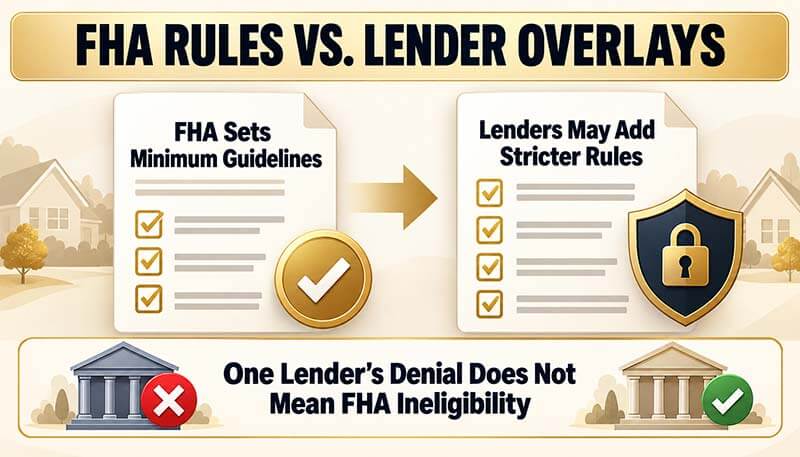 The FHA sets out the minimum requirements for the program, but individual mortgage lenders may choose to apply more stringent underwriting standards. They are usually known as lender overlays.
For instance, a lender could set limits on the amount of bad credit history they are willing to accept, even though the FHA has provided an alternative way to handle the debt.
That is why one lender might reject a borrower for collections, while another FHA lender might approve the same borrower. The fact that one lender says no does not mean the borrower is ineligible for FHA financing. The fact that the application was denied is significant.
FHA Collections and Automated Underwriting
The vast majority of FHA applications are first processed by an automated underwriting system, which uses the FHA TOTAL Mortgage Scorecard. The system looks at various sections of the file, such as credit, income, assets, liabilities, and the one concerning the proposed mortgage.
Medical collection accounts and charge-off accounts are exempt from debt to ratio calculations: This holds true no matter how large the outstanding unpaid medical collection account balance is. No matter how much the charge-off amount is, this guideline still applies. It does not matter whether or not the charge off account is a medical charge-off the account or a nonmedical charge off account.
The fact that an approval is automated does not mean that the FHA collection rules can be ignored. Before the closure, any applicable debts must still be dealt with properly. Similarly, a negative automated decision does not necessarily mean that the borrower will always be permanently rejected. Manual underwriting might be another possible option, depending on the circumstances and FHA requirements.
Can You Obtain an FHA Loan if You Have Recent Collections?
Potentially. The credit analysis involves only one element: the age of a collection account. Since recent collections can show that the financial difficulties are continuing rather than merely historical, they might attract more attention.
The underwriter should consider whether the borrower has re-established good payment habits and whether the events that led to the creation of the collection accounts have been settled.
A person with a history of overdue accounts who has since made their housing and installment payments on time is in a different risk position than someone currently accumulating new delinquent accounts. It is particularly important to make this distinction when carrying out manual underwriting.
Does the Number of Collection Accounts Make a Difference?
There is no simple rule, so a borrower does not automatically lose their FHA qualification once they have a certain number of collection accounts. Yet many different collections can affect the calculation of the dollar figure and the overall credit analysis.
Lenders can have additional HUD requirements that exceed the minimum HUD mortgage guidelines. This additional HUD requirement imposed by lenders is called lender overlays.
For example, twelve small collections together could exceed the $2,000 limit, even if each is not particularly large. Several recent accounts might also raise underwriting questions different from those that arise from a particular hardship. The lender should look at both the balances and the general pattern.
FHA Collections Example: When Paying Nothing May Work
Let us assume that a borrower has $1,500 in applicable nonmedical collections. The borrower has good credit, a steady income, enough assets, and an acceptable underwriting result. Since the relevant collections are below the $2,000 limit, this specific FHA collection capacity calculation will not be activated. The borrower cannot assume that the $1,500 must be paid merely because it appears on the credit report. The entire loan still has to meet the requirements of the FHA and the lender’s underwriting standards.
Case Scenario of an FHA Borrower with Outstanding Collection Accounts
When can a delinquent monthly qualifying obligation of $750 be formed by using 5% of the balance. If raising the amount to $750 would make the debt-to-income ratio too high, leaving the accounts as they are might not be a viable option. An acceptable documented repayment agreement with a significantly smaller required payment.
If the nonmedical collection accounts balance is a substantial amount, then 5% of the outstanding balance can be a significantly large number: It may disqualify the borrower. This is because the DTI will exceed the maximum allowed per HUD Guidelines on debt-to-income ratios.
Whether that strategy succeeds will depend on the documentation, the lender’s underwriting decision, and the rest of the mortgage file. Suppose there is a borrower with $2,300 in applicable collections, a high income, yet only a small amount of room left in their debt-to-income ratio. The borrower also has sufficient verified funds to cover the collection payment without reducing the down payment, closing costs, or reserves. Settling the account could be a simple solution.
How to Address Outstanding Collection Accounts During the Mortgage Process
Resolving the account might be straightforward. That is the reason why there is no general answer to whether a borrower should pay off the collections before applying for an FHA loan. Whether a borrower “should” pay collections before applying for an FHA loan depends on the circumstances. The first step should be for an experienced mortgage professional to look over the credit report before any changes are made.
An experienced mortgage professional reviews the credit report. One should not set up multiple payment plans just because a collection agency suggests it.
You should not challenge the accounts during the mortgage process unless you understand the effect that disputed derogatory accounts can have on FHA underwriting. You should not pay the required amount for the transaction until the lender has decided how the account will be handled. Most important of all, you should decide whether the actual problem lies with the loan itself, the debt-to-income ratio calculation, the credit history, the automated underwriting results, or the lender’s specific overlay. When the real problem has been identified, the mortgage strategy is then much clearer. Can Gustan Cho Associates assist with FHA loans when there are collections? It’s much clearer.
Can Gustan Cho Associates Help With FHA Loans With Collections?
Gustan Cho Associates works with borrowers who have difficult credit profiles, including borrowers with outstanding debt. A rejection from one mortgage lender doesn’t automatically mean the borrower doesn’t meet FHA eligibility requirements. The first thing to do is look over the reason given for the denial and find out if it is based on FHA guidelines, the borrower’s overall qualification record, or a specific requirement of the individual lender.
It is in black and white on HUD 4000.1 FHA Handbook that borrowers do not have to pay any collection accounts and charge-off accounts. This holds true no matter what the unpaid outstanding balance is.
If anyone has questions about whether they must pay for collections as part of their FHA loan application, they can reach Gustan Cho Associates by telephone at 800-900-8569 or by email at gcho@gustancho.com. Gustan Cho Associates is a DBA of Coast 2 Coast Mortgage Lending, LLC, with NMLS number 376205; Gustan Cho, who has NMLS number 873293; and the team serves borrowers in all states where they are properly licensed.
Frequently Asked Questions by Borrowers with Outstanding Collection Accounts
Is it Possible for me to Obtain a House with Collections Shown on My Credit Report?
Certainly. The presence of collection accounts does not, in itself, prevent a borrower from being considered for an FHA mortgage; the lender must decide how to treat the relevant collections and whether the borrower meets all other FHA underwriting requirements.
How Much Can I Have in My Collections and Still Obtain an FHA Loan?
HUD does not set a straightforward maximum amount for collections, which would automatically make a borrower ineligible. Yet collections that are still outstanding and amount to $2,000 or more usually result in extra treatment when it comes to qualification.
Does Use 5% of Collections for the Debt-to-Income Ratio?
When applicable collection balances reach the required threshold and an acceptable payment arrangement is not available, FHA guidelines can require the lender to calculate a payment plan.
Can I Have a Written Payment Agreement with the Creditor Instead of Using the 5% Rule?
Yes, it could. If there is an acceptable, documented payment arrangement, the lender can use the required monthly payment when calculating the borrower’s obligations instead of the 5% figure.
Will HUD Make Me Pay Off Medical Debts That Have Been Collected?
Medical debts are handled differently from ordinary nonmedical debt collections and are usually excluded from the FHA calculation of collection capacity. However, the lender still looks at the borrower’s overall credit record.
Is it Necessary to Pay Off Charge-Offs if One Wants to Obtain an FHA Mortgage?
The FHA usually does not require charge-off accounts to be treated as monthly liabilities in the same way as it does for qualifying collection accounts, and manual underwriting could still require the underwriter to consider the circumstances associated with derogatory credit.
Can Having Collection Accounts Result in a Denial of an FHA Loan?
They can result in denial in some cases, particularly when the qualifying payment raises the borrower’s debt-to-income ratio to an unacceptable level or when the overall credit history is unsatisfactory. Yet having collection accounts does not by itself mean that the borrower is ineligible. The absence of collection accounts alone does not automatically make a borrower. It doesn’t have to be that way. Having the mortgage lender review the accounts first might be a good idea, since paying off the collections could reduce the funds available for closing costs without improving your eligibility.
Are Disputed Collections a Problem When Applying for an FHA Loan?
They can be. Certain disputed derogatory accounts may affect FHA automated underwriting and can cause a loan to require manual underwriting.
Is it Possible to Obtain an FHA Loan if I Have Several Collection Accounts?
Possibly. The FHA does not simply count the collection accounts. Then reject the borrower. Instead the FHA looks at the balances that’re still due the borrower’s credit history, the debt‑to‑income ratio, the underwriting conclusions and the borrower’s overall ability to repay.
Will Having a Paid Collection Increase My Chances of Getting FHA Approval?
Yes. Overall, the ability to repay.
Does a Paid Collection Improve My Chances of FHA Approval?
It can help in some situations, particularly when eliminating an obligation improves the debt-to-income ratio. But paying a collection is not automatically required or beneficial in every FHA loan scenario.
Can One FHA Lender Deny Me Because of Collections While Another Approves Me?
Yes. FHA establishes program requirements, but lenders can have additional underwriting standards. A denial should be reviewed carefully to determine whether it resulted from an FHA requirement or a lender-specific policy.
Final Thoughts on Do I Have to Pay Collections for FHA Loan Approval
If you have collection accounts, you can still qualify for an FHA mortgage. These accounts do not automatically stop you from becoming a homeowner. It is important to know how your collection accounts are classified and how they will affect your ability to qualify.
If your collections total $2,000 or more you may need to pay them off set up a payment plan or have a payment calculated. Medical collections and charge‑offs are handled differently. Disputed accounts or judgments follow different rules.
Before you pay, dispute, settle or set up payment plans, for debts make sure a mortgage professional reviews your file. If you were denied because of collections you might still have options once you know the FHA rules and any extra lender requirements. Gustan Cho Associates does not require you to pay off any outstanding collection accounts or charge off accounts. We are lenders with no FHA Lender Overlays. If you have questions about getting an FHA loan with collections, you can reach out to Gustan Cho Associates at 800-900-8569 or text for a faster response. Or email us at gcho@gustancho.com.