The interest rate is the cost of borrowing the loan principal. It directly affects your monthly principal-and-interest payment. The annual percentage rate (APR) shows a broader estimate of the loan’s yearly cost because it includes the interest rate and certain finance charges, such as lender fees, discount points, mortgage-broker fees, and required mortgage insurance. When comparing APR versus interest rate, review both numbers. A lower interest rate may provide a smaller monthly payment, but a lower APR may indicate lower overall borrowing costs. Always compare Loan Estimates with the same loan type, loan term, and rate-lock period. You can find the interest rate on page 1 of the Loan Estimate and the APR in the Comparisons section on page 3.
What Is a Mortgage Interest Rate?
A mortgage interest rate refers to the percentage that a lender applies annually for the funds borrowed to buy or refinance a house. It is applied to the unpaid principal balance and helps determine the monthly principal and interest payment.
For instance, a $300,000 mortgage at a 6.5% interest rate will result in a monthly payment greater than that of the same loan at a 6% rate. However, the interest rate does not reflect the loan’s full cost because it generally excludes discount points, origination charges, mortgage broker fees, or required mortgage insurance.
A fixed-rate mortgage maintains a consistent interest rate throughout the loan term. An adjustable-rate mortgage, or ARM, may change after an initial fixed period. When comparing APR versus interest rate, use the interest rate to compare monthly payments and the APR to evaluate the loan’s broader borrowing costs.
What Is Mortgage APR?
Mortgage APR, or annual percentage rate, estimates the yearly cost of borrowing money. It includes the mortgage interest rate plus certain finance charges, such as borrower-paid discount points, loan origination charges, mortgage-broker fees, and required mortgage insurance. APR is usually higher than the interest rate because it reflects more than interest alone. Federal disclosure rules calculate APR using the amount financed, payment schedule, interest rate, and qualifying finance charges. However, APR does not include every closing cost. When comparing APR versus interest rate, use the interest rate to evaluate the monthly principal-and-interest payment and APR to compare broader borrowing costs. Compare loans with the same loan type, term, and rate-lock period because APR can be misleading when loan features differ. On the Loan Estimate, APR appears in the Comparisons section on page 3.
What Fees Are Included in Mortgage APR?
Mortgage APR includes the interest rate and certain charges considered part of the cost of obtaining credit. These commonly include:
- Borrower-paid discount points
- Loan origination charges
- Mortgage-broker fees
- Prepaid interest
- Required mortgage insurance premiums
- Certain underwriting, processing, or administrative fees are charged as a condition of the loan
APR does not include every expense listed on the Loan Estimate. Bona fide and reasonable charges for an appraisal, credit report, title services, property inspection, recording, survey, notary services, homeowners’ insurance, property taxes, and escrow deposits are generally excluded. The treatment of a fee may depend on who charges it, whether the lender requires it, and whether the charge is retained by the lender or an affiliated company. When comparing APR versus interest rate, review the itemized costs on each Loan Estimate instead of assuming that every closing cost is reflected in the APR.
What Fees Are Generally Excluded?
The mortgage APR does not account for all costs detailed in the Loan Estimate or Closing Disclosure. The following charges are generally excluded when they are bona fide and reasonable:
- Home appraisal fees
- Credit report fees
- Title searches and title insurance
- Property surveys
- Home and pest inspections
- Notary and document-preparation charges
- Government recording fees and transfer taxes
- Homeowners and flood insurance premiums
- Property taxes
- Initial deposits are placed into an escrow account
These expenses may still increase the amount of money needed at closing, even though they are not included in the APR. Fee treatment can also depend on who charges the fee, who keeps it, and whether the lender requires the service. When comparing APR versus interest rate, review both the APR and the itemized closing costs. Two loans may have similar APRs but require different amounts of cash at closing.
APR vs Interest Rate—Know What Your Mortgage Quote Really Means
The interest rate affects your monthly payment, while APR includes certain loan costs to show a broader cost of borrowing. Get a clear quote review before choosing a lender.Where to Find the Rate and APR on a Loan Estimate
The Loan Estimate shows the interest rate and APR in different places:
- Interest rate: Page 1 under Loan Terms
- APR: Page 3 under Comparisons
- Rate-lock status: Top-right corner of page 1
The interest rate helps determine your monthly principal-and-interest payment. The APR reflects the interest rate plus certain finance charges expressed as a yearly percentage. When comparing Loan Estimates, review both figures along with the loan term, loan type, discount points, closing costs, and rate-lock period. Compare offers issued on the same day because mortgage pricing can change daily. A lower rate is not always the better deal if it requires substantially higher upfront costs.
How to Compare Two Mortgage Offers Correctly
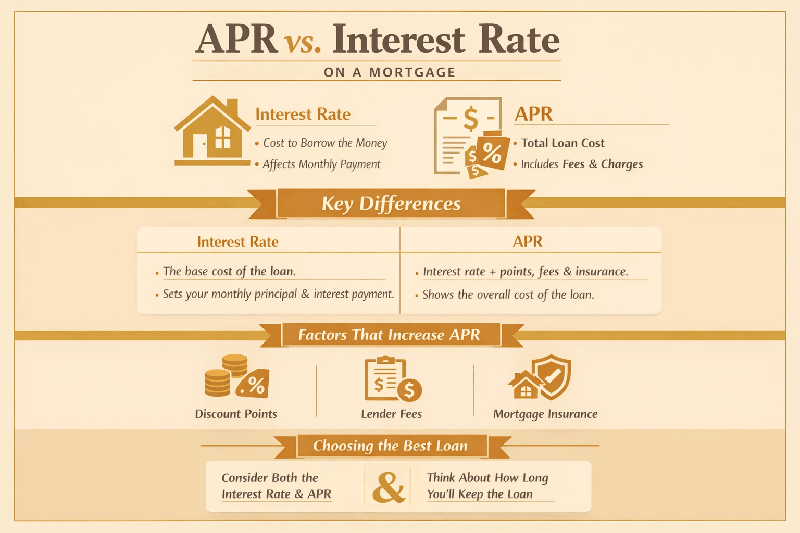 Compare official Loan Estimates issued on the same day because mortgage rates and pricing can change daily. Make sure both offers use the same loan amount, loan program, repayment term, down payment, occupancy type, and rate-lock period. Review each offer in this order:
- Compare the interest rates. The interest rate on page 1 affects the monthly principal-and-interest payment.
- Check discount points and lender credits. A lower rate may require more money upfront. A lender credit may reduce closing costs but result in a higher rate.
- Compare lender-controlled charges. On page 2, review origination, underwriting, processing, and other lender fees. Taxes, insurance, prepaid interest, and escrow deposits may vary for reasons unrelated to the lender’s pricing.
- Compare the APR. Page 3 shows the APR, which combines the interest rate with certain finance charges. Compare APRs only when the loans have the same type and term.
- Review the five-year cost. The Comparisons section on page 3 estimates how much you will pay in principal, interest, mortgage insurance, and loan costs during the first five years.
- Check cash to close. A loan with a lower APR may still require more money at closing. Confirm whether each offer includes the same down payment, credits, deposits, and prepaid expenses.
If one offer charges more for a lower rate, calculate the break-even period. Divide the additional upfront cost by the monthly payment savings. For example, paying $3,000 more to save $50 per month would take 60 months, or five years, to recover. The lower-rate offer may not be worthwhile if you expect to sell or refinance before then. When comparing APR and interest rate, do not select a mortgage based on a single number. Consider the monthly payment, upfront costs, APR, cash needed at closing, break-even period, and how long you expect to keep the loan.
Discount Points and the Break-Even Period
Discount points are voluntary fees paid up front to the lender in return for a reduced mortgage interest rate. One discount point equals 1% of the loan amount. For example, one point on a $300,000 mortgage costs $3,000. Paying points may reduce the monthly principal-and-interest payment, but the lower rate is not automatically the better deal. Calculate how long it will take for the monthly savings to recover the additional upfront cost. Use this formula: Break-even period = Additional upfront cost ÷ Monthly payment savings For example, assume you are comparing two $300,000 mortgages:
- Loan A has no discount points.
- Loan B costs $3,000 more but saves $50 per month.
- $3,000 divided by $50 equals 60 months.
The break-even period is five years. Paying the point may save money if you expect to keep the mortgage longer than five years. It may not be worthwhile if you plan to sell the home or refinance before reaching the break-even point. When comparing APR versus interest rate, remember that borrower-paid discount points are generally included in the APR. A loan with points may have a lower interest rate but require more cash at closing. Compare the interest rate, APR, monthly payment, total loan costs, and expected time in the home before choosing an offer.
FHA, VA, Conventional, and ARM Differences
APR can vary by mortgage program because each loan may have different insurance charges, funding fees, and rate structures. Compare APR only between loans with similar terms and features.
FHA Loans
FHA loans generally require an upfront mortgage insurance premium and an annual mortgage insurance premium. These required charges can increase the APR, even when the FHA interest rate is competitive. Borrowers should compare the monthly payment, upfront costs, APR, and how long mortgage insurance will remain on the loan.
VA Loans
VA loans do not require monthly mortgage insurance. However, most borrowers pay a one-time VA funding fee unless they qualify for an exemption. The funding fee can affect the APR, whether it is paid at closing or financed into the loan. A VA loan may still offer a lower overall cost than another program despite having a similar interest rate.
Conventional Loans
Conventional mortgages do not have a government funding fee or an upfront mortgage insurance premium. Private mortgage insurance may be required when the down payment is less than 20%, although it can usually be removed after the borrower meets applicable equity requirements. Credit score, down payment, property type, and occupancy can affect conventional loan pricing.
Adjustable-Rate Mortgages
An adjustable-rate mortgage, or ARM, usually offers a fixed interest rate for an initial period. After that period, the rate and payment may change based on the loan’s index, margin, adjustment limits, and lifetime cap. An ARM’s disclosed APR is calculated using required assumptions. It does not predict future market rates or show the highest possible payment. For this reason, borrowers should not compare a fixed-rate mortgage and an ARM using APR alone. When evaluating APR versus interest rate across these loan programs, review the mortgage insurance or funding fee, monthly payment, upfront costs, future rate-adjustment risk, and expected time in the home. The lowest advertised rate or APR is not necessarily the most suitable loan for every borrower.
When APR Can Be Misleading
APR is a useful comparison tool, but it does not capture all costs or risks associated with a mortgage. It can be misleading in the following situations:
- You sell or refinance early. APR spreads certain upfront finance charges across the assumed loan term. If you pay points but refinance after a few years, you may not keep the loan long enough to recover that cost.
- The loans have different terms. Comparing the APR on a 15-year mortgage with the APR on a 30-year mortgage does not provide an equal comparison. The payment amount and repayment period are substantially different.
- You compare a fixed-rate loan with an ARM. An ARM’s APR uses required assumptions about future adjustments. It does not predict future index values, the highest possible rate, or the maximum payment.
- The APR excludes certain closing costs. Appraisal, title, inspection, recording, tax, insurance, and escrow charges are generally not included when they meet applicable requirements. These expenses can still affect the cash-to-close.
- One offer includes points or lender credits. Discount points may lower the rate but increase upfront costs. Lender credits may reduce closing expenses while increasing the interest rate. APR alone may not reveal which option best fits your expected ownership period.
- Loan features are different. FHA mortgage insurance, a VA funding fee, conventional private mortgage insurance, or other program-specific costs can affect APR differently.
When reviewing APR versus interest rate, compare loans with the same program, term, loan amount, rate-lock period, and payment structure. Also, review the monthly payment, total loan costs, cash to close, break-even period, and how long you expect to keep the mortgage.
Real Mortgage Comparison Example
Consider a borrower comparing two 30-year fixed-rate mortgages with the same $250,000 loan amount:
- Loan A: 6.50% interest rate with lower upfront charges
- Loan B: 6.25% interest rate, but $4,000 more in discount points and lender fees
The estimated monthly principal-and-interest payment would be:
- Loan A: Approximately $1,580 per month
- Loan B: Approximately $1,539 per month
Loan B saves about $41 per month. However, the borrower must first recover the additional $4,000 paid at closing. $4,000 ÷ $41 = approximately 98 months The break-even period is about 8.2 years. If the borrower expects to keep the mortgage longer than eight years, Loan B may provide greater savings. If the borrower plans to sell or refinance soon, Loan A could be the more cost-effective option even though it has a higher interest rate. This APR versus interest rate example shows why borrowers should not choose a mortgage based only on the lowest rate. Compare the disclosed APR, monthly payment, upfront loan costs, cash to close, and break-even period before deciding. Taxes, homeowners’ insurance, and other excluded costs should be reviewed separately.
Final Thoughts on APR Versus Interest Rate
When comparing APR versus interest rate, neither number tells the whole story by itself. The interest rate determines your monthly principal-and-interest payment, while the APR reflects the interest rate plus certain borrowing costs.
Review Loan Estimates issued on the same day for loans with the same program, term, loan amount, and rate-lock period. Compare the interest rate, APR, discount points, lender fees, monthly payment, cash-to-close, and five-year cost.
The lowest rate may not provide the best value if it requires high upfront charges. Likewise, the lowest APR may not be the right choice if you plan to sell or refinance before reaching the break-even point. The best mortgage offer is the one that fits your budget, available funds, and expected time in the home.
Frequently Asked Questions About APR Versus Interest Rate:
What Is a Good APR for a Mortgage?
There is no single APR that is good for every borrower. Mortgage APRs change with market conditions, credit qualifications, loan type, term, property type, and lender fees. Compare official Loan Estimates from several lenders on the same day to determine whether an APR is competitive for your situation.
How Much Higher Should APR Be Than the Interest Rate?
There is no standard difference between a mortgage APR and interest rate. A wider gap often means the loan includes more discount points, lender fees, mortgage insurance, or other finance charges. Ask the lender to explain the differences and check the itemized costs before you accept the loan.
Can the APR and Mortgage Interest Rate Be the Same?
They may be the same or nearly the same when a mortgage has few or no qualifying finance charges. However, the APR is usually higher because it includes the interest rate plus certain costs required to obtain the loan.
Does Your Credit Score Affect Your Mortgage APR?
Yes. Your credit score can influence the interest rate, discount points, mortgage insurance, and other pricing offered by a lender. A stronger credit profile may help you qualify for a lower rate and APR, but lenders also consider the down payment, loan program, property type, occupancy, and debt-to-income ratio.
Does Locking the Interest Rate Also Lock the APR?
Not necessarily. A rate lock generally protects the interest rate and agreed-upon points as long as the application does not change and the loan closes before the lock expires. The APR may still change if qualifying fees, mortgage insurance, the loan amount, or other loan details change. Check the rate-lock information on page 1 of the Loan Estimate.
Why Did My APR Change Between the Loan Estimate and Closing Disclosure?
The APR may change if the interest rate, loan amount, discount points, lender fees, mortgage insurance, loan program, or payment schedule changes. Compare the revised figures and ask the lender for a written explanation before closing. A changed APR does not automatically mean the lender made an error.
Will an APR Change Delay My Mortgage Closing?
Not every APR change restarts the waiting period. A new three-business-day waiting period is generally required when the APR becomes inaccurate under federal disclosure rules. A new waiting period might also be necessary if there is a change in the loan product or if a prepayment penalty is included. Your lender should explain whether the revised disclosure affects the closing date.
Is Mortgage APR Tax-Deductible?
APR is not itself a fee or tax deduction. It is a percentage used to describe the loan’s broader borrowing cost. Mortgage interest and certain points may be deductible when they meet IRS requirements, but many costs included in the APR are not. Talk to a qualified tax professional about your mortgage expenses.
This article about “APR Versus Interest Rate Quoted By Mortgage Lenders” was updated on July 23rd, 2026.