Common VA Overlays: VA Guidelines vs. Lender Requirements
Common VA overlays are rules that lenders add on top of the basic VA guidelines. These rules can impact the borrower’s credit score, debt‑to‑income ratio, collections, bankruptcy, manual underwriting, reserves and even which property types a lender will finance. If you’ve been denied a VA loan, it’s important to understand common VA overlays.
A denial doesn’t always mean you failed to meet VA guidelines. Sometimes, you meet VA requirements but not the extra rules set by a specific lender. These specific higher rules by lenders are called overlays.
For example, the VA does not set a universal minimum credit score for VA loans, but a lender might still require you to meet their own minimum score. The same goes for debt-to-income ratios. VA uses a 41% DTI guideline, but it’s not a strict maximum for everyone. Some lenders still set their own maximum DTI. Knowing whether a mortgage issue stems from a VA rule or a lender overlay can help you determine your next steps.
What Are Common VA Overlays?
Lender-specific rules that are stricter than the Department of Veterans Affairs’ basic mortgage requirements. The VA sets the main rules for VA-guaranteed mortgages. Lenders are responsible for reviewing each loan and determining whether borrowers meet VA requirements and pose an acceptable credit risk. A lender might set extra requirements. A lender may add extra requirements based on their own credit policy. This set of extra requirements is called lender overlays.
Minimum Credit Score Requirements on VA Loans
One lender might require a 620 credit score, while another lender may consider VA borrowers with substantially lower scores when the overall loan file satisfies its underwriting requirements. In this case the minimum credit score is not a VA rule—it is a lender overlay.
Common VA overlays can affect borrowers with credit scores, high debt‑to‑income ratios, recent credit issues, collections, Chapter 13 bankruptcy, past foreclosures, limited reserves or loans that require manual underwriting.
TThis is why two Veterans who have finances might receive very different answers from different VA lenders. The Same Thing Many borrowers believe every requirement from their mortgage company comes directly from the VA, but that’s not always true. These include requirements covering eligibility, entitlement, income, credit, residual income, occupancy, property standards, appraisal requirements, and underwriting.
Common VA Overlays
Mortgage lenders must follow the minimum VA agency guidelines and rules, but they can also set stricter standards themselves. If a lender requires a 620 score on VA loans, that Veteran may be denied even though the Veteran meets the minimum agency guidelines. If the lender requires a 620 minimum, the borrower cannot get qualified and approved with this particular lender with VA overlays on credit scores. Another borrower may have a debt-to-income ratio above 41%. VA allows the underwriter to consider residual income and the entire credit profile rather than automatically rejecting every borrower above 41%. A lender may nevertheless establish its own maximum DTI.
Common VA Overlays: Collection Accounts
Collections are another example. VA does not necessarily require every collection account to be paid before closing. A particular lender may establish a stricter policy requiring payoff.
- The most important question after a VA mortgage denial is therefore not simply, “Why was I denied?”
- A better question to ask is, “Was I denied because of a VA rule or because of this lender’s own policy?”
This difference can help you decide whether to change something in your loan file or simply try a lender with different requirements. Mortgage lenders assume responsibilities and risks when originating VA loans. Although the Department of Veterans Affairs guarantees a portion of an eligible VA mortgage, lenders still must address underwriting, investor, quality control, compliance, repurchase, and operational considerations.
Not All Lenders Have the Same Loan Requirements on VA Loans
Each lender decides what types of loans they are comfortable offering. Some lenders prefer straightforward VA loans involving borrowers with stronger credit, lower DTI ratios, and automated underwriting approvals. Others may specialize in more complicated mortgage files involving manual underwriting, lower credit scores, active Chapter 13 bankruptcy, recent credit problems, higher DTI ratios, or unusual property types. Neither approach changes the basic VA program. It just means you shouldn’t assume all VA lenders have the same requirements.
Does VA Have a Minimum Credit Score?
The Department of Veterans Affairs does not set a minimum credit score for VA‑guaranteed mortgages. VA underwriting focuses on whether the borrower has shown a willingness and ability to repay financial obligations. The underwriter examines the borrower’s overall credit history rather than relying entirely on a single credit score. That does not mean credit scores are irrelevant. Credit scores still matter for automated underwriting, lender eligibility, pricing, and the overall underwriting decision.
A Veteran with a low credit score may also have recent late payments, collections, charge-offs, high revolving balances, or other credit issues that require additional review.
The important distinction is that a lender’s minimum credit score should not be automatically equated with the VA’s minimum score. If a lender says the borrower needs a 620 credit score for a VA loan remember this may be the lender’s rule, not a universal VA requirement. VA guidelines do not automatically prohibit the borrower with scores below 620.
How Can You Qualify and Get Approved for a VA Loan?
Approval depends on the borrower’s financial profile the lender’s requirements, underwriting results, income, debts, payment history, residual income, assets and other factors. If you have a lower credit score, expect the underwriter to look closely at why your score is low.
A lower score, driven primarily by high credit card utilization, may be viewed differently from a similar score resulting from a recent pattern of late payments.
This is another reason to look at credit scores as part of your whole VA loan application, not just by themselves. Debt-to-income ratio rules are another area where lender overlays often cause confusion. The debt-to-income ratio compares a borrower’s qualifying monthly debt obligations with qualifying gross monthly income. VA uses 41% DTI as a key guideline, but it’s not a hard limit for every borrower. VA also looks closely at your residual income and overall financial strength.
Can a VA Loan Be Approved With a DTI Above 41%?
Yes, A VA mortgage may potentially be approved with a debt‑to‑income ratio above 41 percent. A higher debt‑to‑income ratio usually means the underwriter will take a look at the borrower’s application.
The underwriter evaluates the entire mortgage file, including residual income, credit history, housing expenses, employment stability, assets, debts, and applicable compensating factors.
VA also provides special consideration when residual income substantially exceeds the minimum amount required for the household. This doesn’t mean everyone with a high DTI will qualify. It just means that having a DTI above 41% does not automatically disqualify you from a VA loan. A lender can still set its own maximum DTI, no matter your residual income. If their rule is stricter than the VA’s, it’s called a lender overlay.
Why VA Residual Income Is So Important
Residual income is one of the most important elements of VA mortgage underwriting and one of the features that makes VA underwriting different from many other mortgage programs. Residual income is the amount of qualifying income remaining after major monthly obligations and estimated housing expenses are accounted for.
VA residual-income requirements vary based on factors such as household size, geographic region, and loan amount.
Two borrowers can have the debt‑to‑income ratio but completely different financial situations. A borrower earning $4,000 per month with a 45 percent debt‑to‑income ratio will have an amount remaining after expenses than a borrower earning $12,000, per month with a similar debt‑to‑income ratio. Residual income provides the underwriter with another way to assess whether the household has sufficient funds remaining for ordinary living expenses after making the proposed mortgage payment and other obligations. High residual income can become especially important when a VA borrower has a higher DTI.
What is Residual Income on VA Loans?
Having high residual income can be especially important if you have a higher DTI. Policies can vary between lenders. Mortgage lenders commonly use automated underwriting systems to evaluate loan applications. Some borrowers receive findings that allow the lender to proceed through an automated underwriting process.
Manual Underwriting on VA Loans
There are cases where borrowers require manual underwriting on VA loans. Manual underwriting means a human underwriter evaluates the complete mortgage application under the applicable VA guidelines rather than relying primarily on an automated recommendation. A loan that needs manual underwriting is not automatically a bad loan.
The underwriter will review your housing history, payment patterns, job stability, compensating factors, residual income, credit explanations, assets, reserves, and other parts of your mortgage file.
Some lenders do not offer certain manually underwritten VA loans. Others may require higher scores, lower DTI ratios, additional reserves, or stronger payment histories. Those additional restrictions can become Common VA Overlays.
VA Loans With Collection and Charge-Off Accounts
These extra restrictions are examples of common VA overlays. You may hear different explanations from mortgage companies. It does not necessarily require every collection account to be paid before the borrower can qualify for a VA mortgage. The underwriter evaluates the nature of the collection, the amount owed, whether the debt has become a judgment, whether repayment arrangements exist, and whether the collection shows a larger pattern of credit problems.
Medical Collections on VA Loans
Medical collections receive different treatment from many other types of collection accounts. Under VA credit guidelines, identifiable medical collections that have not resulted in judgments or liens can generally receive more favorable treatment than other derogatory accounts. A lender may still evaluate the overall credit profile and determine whether other issues create unacceptable risk.
Borrowers should not assume that every outstanding medical collection must be paid before getting a VA loan. A single medical collection may be viewed differently from several new collections.
VA guidance also provides ways to account for nonmedical collection debt when calculating your debt-to-income ratio and residual income. The key thing to remember is that VA underwriting doesn’t require every collection to be paid before closing. A lender may nevertheless establish an internal requirement that certain collections be paid. That extra requirement may be a lender overlay.
Confused About VA Lender Overlays? Let Us Help You Navigate the Process!
Contact us today to learn how VA overlays differ from agency mortgages and find the best solution for you.VA Loans During Chapter 13 Bankruptcy
VA financing is available to qualifying borrowers who are still participating in an active Chapter 13 bankruptcy repayment plan. A borrower does not necessarily have to wait until the Chapter 13 bankruptcy has been discharged before obtaining a VA mortgage. VA Chapter 13 mortgage guidelines provide for favorable consideration after the borrower has made at least 12 months of satisfactory Chapter 13 payments and obtains the necessary approval from the bankruptcy trustee or bankruptcy court for the new mortgage obligation.
The mortgage still must satisfy all other applicable VA underwriting requirements. The borrower’s income, credit history, debt obligations, residual income, housing payment, employment, assets, and payment history remain important.
Some lenders may choose not to offer VA loans to borrowers in active Chapter 13 bankruptcy. Another lender may permit them but impose requirements beyond the underlying VA guidelines. These restrictions are another example of common VA overlays. Borrowers in Chapter 13 should work closely with their bankruptcy attorney before taking on new mortgage debt, as court or trustee requirements can vary from case to case.
VA Overlays After Bankruptcy or Foreclosure
A past bankruptcy or foreclosure does not automatically prevent someone from using VA financing forever. VA underwriting considers the circumstances surrounding serious derogatory credit and whether the borrower has re-established satisfactory credit.
The timing of the credit event, the reason it occurred, subsequent payment history, employment stability, and overall credit profile can all affect the underwriting decision.
Lenders can impose additional seasoning or credit requirements beyond the minimum treatment permitted under VA guidelines. This may result in cases where one lender declines a borrower after bankruptcy or foreclosure, while another lender is willing to evaluate the mortgage under different underwriting standards. You should never assume that a denial from one lender means you can never get VA financing. The actual reason for the denial must be identified.
Recent Late Payments and VA Lender Overlays
Recent late payments can be a significant issue during VA underwriting. VA generally evaluates the borrower’s overall payment pattern rather than basing every credit decision on one isolated incident. That does not mean late payments are ignored. Recent mortgage lates, rent lates, installment loan delinquencies, revolving-account delinquencies, or newly established collection accounts may indicate increased credit risk.
The timing and circumstances surrounding the late payment matter. An isolated late payment caused by a documented temporary event may be viewed differently from a continuing pattern of delinquent obligations.
Some lenders establish additional requirements regarding recent late payments. For example, a lender may require a certain period of satisfactory credit before approving a VA loan, even when VA guidelines allow the underwriter greater discretion. That is another area where lender overlays can affect your approval. Reserves are funds you have left after paying your required cash-to-close. VA underwriting does not require the same reserves for every borrower, but maintaining reserves can strengthen your mortgage application. Extra financial resources can help after closing.
The Importance of Reserves on Manual Underwriting
Reserves can be especially helpful if you have a higher DTI, need manual underwriting, are buying a multi-unit property, or have other situations that need extra financial strength. Some mortgage lenders establish reserve requirements beyond those required under the applicable VA guidelines. For example, a lender could require additional months of mortgage payments to be held in reserves for borrowers with lower scores or more complex credit histories. These extra requirements are lender overlays.
Common VA Property Overlays
Lender overlays can also involve the property rather than the borrower. VA financing can be used for several eligible property types when the home satisfies applicable VA requirements. But not every VA lender finances every type of property.
Some lenders restrict financing for manufactured homes, certain condominium projects, two- to four-unit properties, unique properties, rural properties, properties needing substantial repairs, or certain new-construction transactions.
If a lender declines one of these property types, it doesn’t always mean the VA program prohibits it. It may just mean that the lender doesn’t offer that program or property type. If you’re buying a less common property type, talk to your mortgage professional about it before making an offer if you can.
Automated Underwriting versus Manual Underwriting
Automated underwriting can provide an efficient method for evaluating many VA loan applications. However, you should not assume that an automated underwriting result is always the final answer for a VA mortgage. Some mortgage files can require manual underwriting or additional review.
A Veteran with a high income, sufficient residual income, stable employment, and documented compensating factors may still have circumstances that require human underwriting.
The challenge is that some lenders restrict manual underwriting. So, if you get an unfavorable automated result from one lender, you might think the VA program denied you, when it could just be that lender’s policy. Knowing if manual underwriting is available is especially important if you have a complicated credit history.
What Should You Do After a VA Loan Denial?
If you’re denied a VA mortgage, review the denial carefully before assuming you can’t buy a home. The first step is identifying the exact reason for the denial. If the lender says the credit score is too low, determine whether VA requires that score or the lender’s minimum.
If the debt-to-income ratio is too high, determine whether the lender has a maximum DTI overlay. If collections and charge-offs are the problem, ask whether VA specifically requires the accounts to be paid or whether the requirement comes from the lender.
If automated underwriting produced an unfavorable result, find out whether manual underwriting is permitted. Borrowers with active Chapter 13 bankruptcy should determine whether the lender offers VA financing during bankruptcy and what documentation is required. The goal is not to keep applying to different mortgage companies and hope for a different answer. Instead, focus on understanding the underwriting problem. Once the issue is understood, you and your mortgage professional can decide whether the loan needs to be changed, whether you need more documents, whether your credit needs work, or whether another lender’s guidelines are a better fit.
A VA Loan Denial From One Lender Does Not Always Mean Another Lender Will Deny the Loan
This is one of the most important lessons for Veterans to know when looking into common VA overlays.
- One lender may require a 620 credit score.
- Another may consider a lower score.
- One lender may impose a strict debt-to-income limit.
- Another may be willing to evaluate high residual income and compensating factors.
- One company may not permit manual underwriting.
- Another may specialize in manually underwritten VA loans.
- The borrower still must meet all applicable VA requirements and the requirements of the lender ultimately funding the mortgage.
- There is never a guarantee that another lender will approve the loan.
- However, it is important to distinguish between not qualifying for a VA loan and simply not meeting a lender’s requirements.
How Gustan Cho Associates Approaches VA Loans With Complicated Files
Gustan Cho Associates works with Veterans and eligible borrowers whose mortgage applications may involve lower credit scores, higher debt-to-income ratios, manual underwriting, active Chapter 13 bankruptcy, collections, previous credit problems, or prior mortgage denials. The first objective is to identify exactly why the borrower is having difficulty obtaining mortgage approval.
- Is the issue an actual VA requirement?
- Is it a lender overlay?
- Does the borrower need extra documentation?
- Does the loan need to be restructured?
- Would manual underwriting be required?
- Is residual income sufficient?
- Could paying down certain debt improve the mortgage qualification?
Those questions should be answered before repeatedly submitting the same loan to multiple lenders. Gustan Cho Associates works through wholesale lending relationships to identify mortgage programs that may fit a borrower’s overall financial profile. Not every borrower or mortgage scenario will qualify.
VA borrowers still must satisfy applicable Department of Veterans Affairs requirements, lender and investor guidelines, income and asset verification requirements, credit standards, residual-income requirements, occupancy guidelines, property requirements, and final underwriting conditions.
Why Comprehending Common VA Overlays Can Benefit Veterans
Understanding common VA overlays helps you see what might really be stopping your mortgage approval.
- A Veteran with a credit score below 620 should not automatically conclude that VA requires a 620 score.
- A borrower with a DTI above 41% should not automatically conclude that VA guidelines prohibit the mortgage.
- A borrower with outstanding collection accounts should not automatically assume every collection must be paid.
- A borrower who requires manual underwriting should not automatically assume that VA financing is unavailable.
- A Veteran participating in Chapter 13 bankruptcy should not automatically assume the bankruptcy must be discharged before buying a home.
Each situation still requires proper underwriting. But knowing the difference between VA guidelines and lender overlays helps you ask better questions and avoid giving up your VA home loan benefit too soon.
How to Avoid Common VA Overlays
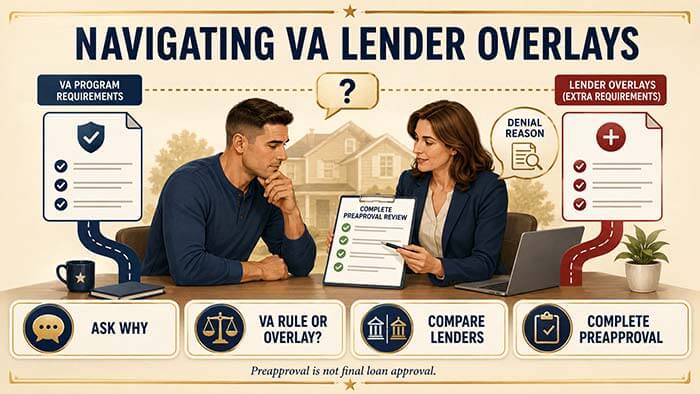
Choose a Lender with No Overlays
Not all lenders follow the same rules. Some stick strictly to VA guidelines, while others add extra hurdles. At Gustan Cho Associates, we pride ourselves on being a no-overlay brokers, meaning we follow VA guidelines to the letter.
Understand Your Options
If a lender says no to your application ask them why. Is it because you don’t meet VA guidelines or is it because of their special rules? Knowing the difference can help you find a lender that’s a better fit for what you need.
Work on Your Credit and Finances
Even though special rules can cause problems making your credit score better and lowering your debt to income ratio can make your loan application more appealing. Use this year as a chance to:
- Pay off debt that has interest.
- Stay away from credit applications before you apply.
- Save money for closing costs or extra funds.
Get Pre-Approved with a No-Overlay Lender
Getting pre-approved from a lender that doesn’t have rules helps you understand your budget better and avoids the trouble of being turned down at the last moment.
Real-Life Success Stories: Overcoming VA Overlays
Case Study 1: Getting Approved With a Low Credit Score
- Challenge: A veteran had a credit score of 580. Was turned down by several lenders because of their extra rules.
- Solution: The person worked with Gustan Cho Associates, a brokers that doesn’t have rules and got approval, from the automated system even with the low score.
- Result: They bought their dream home with 100% financing.
Case Study 2: High DTI Ratio
- Challenge: A retired service member with a DTI ratio of 55% was turned away by a lender imposing a 41% DTI cap.
- Solution: Gustan Cho Associates evaluated their compensating factors and approved the loan with no overlays.
- Result: They refinanced their existing mortgage, saving $400/month.
Why Choose Gustan Cho Associates for Your VA Loan?
At Gustan Cho Associates, we specialize in helping borrowers overcome challenges caused by common VA overlays. We’re proud to be a no-overlay lender, offering:
- Approvals are based on VA guidelines only.
- Flexible credit and DTI requirements.
- Expertise in manual underwriting.
- A smooth loan process from start to finish.
If you’re ready to buy or refinance a home call us at 800-900-8569 text us for replies or email us at gcho@gustancho.com. Let us help you reach your dream of owning a home without the stress of steps that aren’t needed.
Conclusion
VA loans are one of the choices for veterans and people currently serving in the military providing great advantages like no down payment no PMI and more flexible rules. However many lenders add steps called VA overlays that can make things harder. Working with a brokers like Gustan Cho Associates, which follows VA rules without adding steps means you can use all the benefits of a VA loan. Don’t let extra steps stop you. Reach out to us now to begin.
Frequently Asked Questions About Common VA Overlays:
In What Ways Do VA Overlays Impact the Requirements, for My Credit Score?
The VA does not set a credit score but many lenders add overlays that require a score of 620 or higher.
What is the Impact of Common VA Overlays on My DTI Ratio?
While the VA doesn’t cap DTI ratios, common VA overlays may require a maximum DTI of 41% to 50%, making it harder for borrowers with higher DTIs to qualify.
Can I qualify for a VA loan with collections on my credit report?
Yes, the VA allows loans without paying off collections. Still, common VA overlays might require you to pay off collections before approval.
Despite Common VA Overlays, Can I Get a VA Loan After Bankruptcy or Foreclosure?
Yes, VA guidelines are lenient with waiting periods. Still, common VA overlays may extend those periods, so choosing the right lender is crucial.
Do Common VA Overlays Affect Manual Underwriting?
Yes, some lenders with overlays avoid manual underwriting altogether, limiting options for borrowers who don’t qualify through automated systems.
What are Examples of Common VA Overlays?
Common VA overlays include higher credit score requirements, stricter DTI caps, mandatory collection payments, and extended waiting periods after financial hardships.
This Guide About “Common VA Overlays by Lenders versus Agency Guidelines” Was Updated on September 26, 2026.