
Home purchase with bad credit is possible, but the path depends on your credit score, recent payment history, down payment, loan program, and the type of credit issues on your report. A borrower with a 500 credit score may still qualify for an FHA loan with a larger down payment. A borrower with a 580 credit score or higher may qualify for FHA financing with only 3.5% down. Veterans may qualify for VA loans with flexible credit guidelines, and some rural home buyers may qualify for USDA loans.
Bad credit does not always mean automatic denial. Many borrowers can still qualify with unpaid collections, charge-offs, prior bankruptcy, foreclosure, or late payments if the loan file is structured correctly. The key is knowing which mortgage program fits your situation and whether the lender adds extra rules called lender overlays.
This guide explains how to qualify for a home purchase with bad credit, what credit scores are accepted, when collections may or may not need to be paid, how bankruptcy and foreclosure affect approval, which loan programs are best for low-credit borrowers, and provides some things you can do before applying to up your chances of getting approved.
What Counts As Bad Credit When Buying A Home?

Having bad credit doesn’t automatically rule out the possibility of a home purchase with bad credit. In the world of mortgage lending, bad credit typically indicates credit-related issues that can make a borrower’s loan application appear riskier to lenders. These issues may include a low credit score, recent late payments, accounts in collections, charge-offs, bankruptcy, foreclosure, high credit card debt, or a limited credit history.
The encouraging aspect is that mortgage lenders don’t rely solely on credit scores; they also consider the recency of the credit issues, whether the borrower has resumed making timely payments, the amount available for a down payment, and the borrower’s income stability.
Common bad credit issues include:
Low Credit Score
A low credit score is a big worry for a lot of people looking to buy a home. FHA loans allow credit scores as low as 500 with a 10% down payment. Borrowers with a credit score of 580 or higher may qualify for FHA financing with only 3.5% down.
Recent Late Payments
Recent late payments can be a bigger problem than older credit issues. Mortgage lenders want to see that the borrower has made on-time payments after past financial problems. A strong 12-month payment history can help show the lender that the borrower has recovered.
Collections
Unpaid collections do not always have to be paid off to qualify for a mortgage. The rules depend on the loan program, the collection amount, and the lender’s guidelines. FHA loans may allow borrowers to qualify with unpaid collections, but some lenders may add overlays and require them to be paid.
Charge-Offs
A charge-off means a creditor wrote off the debt as a loss. Charge-offs can hurt credit scores, but they do not always prevent mortgage approval. The lender will review the age of the charge-off, the balance, and the borrower’s recent credit history.
Prior Bankruptcy
A past bankruptcy does not automatically stop someone from buying a home. FHA loans generally allow borrowers to qualify two years after a Chapter 7 bankruptcy discharge. Borrowers in Chapter 13 bankruptcy may be able to qualify after making at least 12 on-time payments, with the trustee’s approval.
Foreclosure, Short Sale, Or Deed-In-Lieu
A prior foreclosure, short sale, or deed-in-lieu can create a waiting period before the borrower can qualify again. The waiting period depends on the loan program and the date the event was completed.
High Credit Card Balances
Having significant credit card debt can negatively affect your credit score and up your debt-to-income ratio. Paying down revolving credit cards can improve a mortgage file faster than paying off old collections.
Thin Credit History
Some borrowers lack sufficient traditional credit accounts to establish a robust credit profile. In such situations, lenders may consider alternative credit sources, like rent, utilities, insurance, or other regular monthly payments, to verify payment history.
A home purchase with bad credit is not always as daunting as many borrowers believe. What is most important is that the borrower aligns with the loan program guidelines and can demonstrate stable income, acceptable debt-to-income ratios, and a recent track record of responsible payments.
Struggling with Bad Credit? A Lender with No Overlays Can Help You Buy Your Home!
Contact us now to get pre-approved with a lender that works with no overlays and offers flexible terms for your home purchase.
What Are Mortgage Lender Overlays?
Mortgage lender overlays are extra rules added by a bank, credit union, or mortgage company on top of the basic loan program guidelines. These extra rules can make it harder for borrowers with bad credit to get approved, even when they technically meet FHA, VA, USDA, or conventional mortgage guidelines.
Agency guidelines are the baseline rules. FHA, VA, USDA, Fannie Mae, and Freddie Mac each have their own minimum mortgage requirements. However, lenders may impose stricter rules if they choose. These stricter rules are called lender overlays.
For example, FHA guidelines allow borrowers with credit scores as low as 500 to qualify with a 10% down payment. Borrowers with a credit score of 580 or higher may qualify with only 3.5% down. However, some lenders will not approve FHA loans unless the borrower has a 620 or 640 credit score. That is a lender overlay.
Another example is collections. FHA guidelines may allow borrowers to qualify with unpaid collections, depending on the file. However, some lenders may require collections to be paid before closing. That is also a lender overlay.
VA loans are another common example. The Department of Veterans Affairs does not set a strict minimum credit score for VA loans. However, many lenders add their own minimum credit score requirement, such as 580, 600, or 620. A veteran may meet VA guidelines but still be denied by a lender because of that lender’s overlay.
This is why choosing the right lender matters when buying a home with bad credit. A borrower can be denied by one lender and approved by another lender using the same FHA, VA, USDA, or conventional loan program. The difference is often not the borrower. The difference is the lender’s overlays.
Teaming up with a lender that imposes no overlays can be beneficial for those looking to make a home purchase with bad credit. Such lenders do not impose additional rules; instead, they adhere strictly to the agency’s guidelines and evaluate the complete loan file. This approach is especially helpful for borrowers facing issues like low credit scores, unpaid collections, charge-offs, or past bankruptcy and foreclosure.
Minimum Credit Scores To Buy A House With Bad Credit
When considering a home purchase with bad credit, it’s important to understand that a credit score is only one factor in the mortgage approval process. Borrowers with lower credit scores may still qualify if other elements of their loan application are solid. Lenders assess a variety of factors, including income, employment history, debt-to-income ratio, down payment, reserves, rent history, recent late payments, collections, charge-offs, bankruptcy, foreclosure, and overall payment behavior.
The lowest credit score allowed varies by loan program. FHA lets people with credit scores as low as 500 qualify for a loan as long as they put down at least 10%. FHA borrowers with a credit score of 580 or higher may qualify with as little as 3.5% down. The VA does not require a minimum credit score, but many lenders do. Conventional loans usually require stronger credit than FHA or VA loans.
FHA Credit Score Requirements
FHA loans are often the best option for home buyers with bad credit. FHA allows:
A 500 to 579 credit score with 10% down.
A 580 or higher credit score with 3.5% down.
However, meeting the minimum FHA credit score does not always mean automatic approval. The borrower still needs to meet FHA income, employment, debt-to-income, asset, and credit history requirements.
Recent late payments can pose a significant barrier for those looking to make a home purchase with bad credit. A borrower with a 620 score and recent late payments may struggle more to qualify compared to a borrower with a 580 score who has maintained a clean payment history for 12 months. Underwriters prefer to see evidence that the borrower has rectified prior credit issues and is now managing debt responsibly.
VA Loan Credit Guidelines
VA loans are one of the most flexible mortgage programs for eligible veterans, active-duty service members, and surviving spouses. The VA does not require a minimum credit score, but the lender still must review the borrower’s full credit profile. Many lenders add their own minimum credit score requirement, even though VA guidelines do not set one.
This is where lender overlays play a crucial role. A veteran might fulfill VA guidelines but still face denial from a lender that mandates a minimum score of 620. In contrast, another lender with fewer overlays may approve the same borrower seeking a home purchase with bad credit, especially if the application includes strong compensating factors like stable income, low debt levels, robust residual income, reserves, or a clean recent payment history.
USDA Credit Guidelines
USDA loans are an excellent option for individuals looking to purchase homes in rural and suburban areas, as they offer 100% financing. However, USDA loans are usually more credit-sensitive than FHA loans. Many USDA lenders prefer a 640 credit score because it can make automated approval easier.
Borrowers below 640 may still have options, but the file may need stronger compensating factors. These can include stable income, low debt-to-income ratios, verified rent history, cash reserves, or a strong explanation for past credit issues.
Conventional Loan Credit Score Requirements
Conventional loans are backed by Fannie Mae and Freddie Mac and are usually harder to qualify for with bad credit. Many conventional mortgage approvals require stronger credit, lower debt-to-income ratios, and better overall risk factors than FHA loans.
For many borrowers with bad credit, FHA may be more practical than conventional financing. Conventional loans may become more attractive later, once the borrower improves their credit, builds equity, or qualifies for better pricing.
Why Credit Score Alone Does Not Decide Mortgage Approval
A mortgage approval takes into account the entire loan application, rather than focusing solely on the credit score. Lenders are interested in determining if the borrower can handle the new mortgage payments and if they have demonstrated recent financial stability, which is especially important when considering a home purchase with bad credit.
Important factors include:
Recent Payment History
Recent late payments can hurt approval more than old bad credit. A borrower with older collections, charge-offs, or bankruptcy may still qualify if they have re-established credit and have made on-time payments for the past 12 months.
AUS Approval
AUS stands for Automated Underwriting System. FHA, VA, USDA, Fannie Mae, and Freddie Mac loans are often submitted through an automated system that reviews the borrower’s credit, income, assets, debt, and risk factors.
If the borrower receives an approve/eligible finding, the loan may be easier to move forward. If the borrower does not receive automated approval, manual underwriting may be needed.
Manual Underwriting
Manual underwriting means a human underwriter reviews the loan file rather than relying solely on automated approval. This can help borrowers with bad credit, limited credit, prior bankruptcy, or other complex credit issues.
Manual underwriting does not mean easy approval. The borrower may need stronger compensating factors, such as on-time rent history, reserves, lower debt-to-income ratios, stable employment, or a larger down payment.
Debt-To-Income Ratio
The debt-to-income ratio looks at how much you owe each month compared to how much money you bring in each month. Those looking to make a home purchase with bad credit, especially if they have substantial debt compared to their income, may face challenges in securing loan approval. However, reducing balances on credit cards, installment loans, or other debts can enhance the chances of obtaining approval.
Reserves
Reserves are funds left over after closing. They show the lender that the borrower has money available for emergencies. Reserves are especially helpful for borrowers with lower credit scores, manual underwriting, or recent credit issues.
Rent History
Strong rent history can help a bad-credit mortgage file. If the borrower has paid rent on time for the past 12 months, it can show the lender that the borrower is capable of handling a housing payment.
Compensating Factors
Compensating factors are strengths that help offset credit risk. Examples include a larger down payment, a stable job history, a low debt-to-income ratio, verified rent history, cash reserves, minimal payment shock, or high residual income on VA loans.
The stronger the compensating factors, the better the borrower’s chances of getting approved with bad credit.
Steps to Buy a Home with Bad Credit in 2026
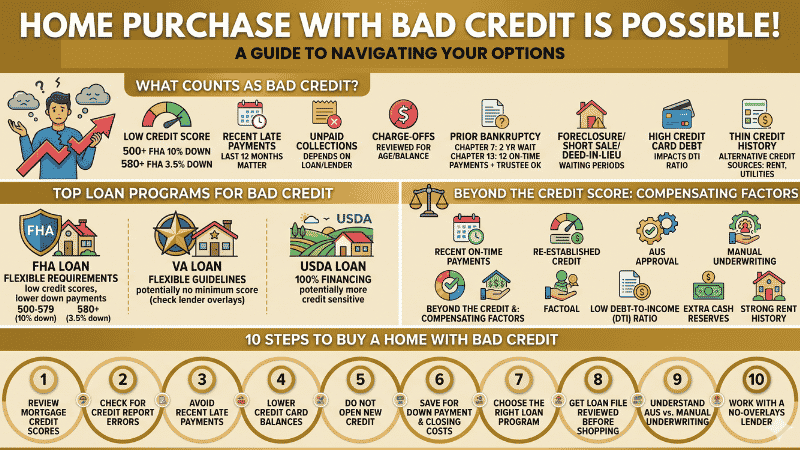
Buying a home with bad credit takes more planning than a standard mortgage approval. The goal is not just to raise your credit score. The goal is to build a mortgage file that an underwriter can approve. That means reviewing the right credit scores, cleaning up credit report issues, documenting income, lowering debt, choosing the right loan program, and working with a lender that understands bad-credit mortgage approvals.
Step 1: Review Your Mortgage Credit Scores
To start, check your credit. Keep in mind that mortgage lenders might look at different credit scores than what you see on those free consumer credit apps. Many of these apps display educational credit scores, while mortgage lenders use mortgage credit scores from the three major credit reporting agencies: Experian, Equifax, and TransUnion. This is particularly important for those seeking a home purchase with bad credit, as the scores used could significantly impact their borrowing options.
If you are applying by yourself, lenders usually use your middle credit score. For example, if your three scores are 540, 575, and 610, the lender will usually use 575 as your qualifying score.
If two borrowers are applying together, lenders usually use the middle score for each borrower and then qualify on the lower of the two middle scores. This is important because one borrower’s lower score can affect the entire mortgage approval.
Step 2: Check For Credit Report Errors Before Applying
Before you jump into getting a mortgage, check out your credit report for any mistakes, duplicate accounts, wrong balances, accounts that aren’t yours, and any incorrect late payment info. Credit report errors can lower your score and create problems during underwriting.
When considering a home purchase with bad credit, it’s important to handle credit disputes with caution. Having open disputes on your credit reports can delay mortgage approval. Certain loan programs may require that disputed accounts be resolved or removed before proceeding with the loan. It’s best to avoid disputing accounts randomly just before applying, unless you’ve consulted with a mortgage professional who is knowledgeable about how disputes impact underwriting.
Step 3: Avoid Recent Late Payments
Recent late payments can be one of the biggest problems when buying a home with bad credit. Older credit problems may be easier to explain if you have re-established good credit. But a late payment in the past few months can make the lender question whether you are ready for a new mortgage payment.
Before applying, try to show at least 12 months of on-time payments on rent, credit cards, auto loans, student loans, and other monthly debts. A clean recent payment history can help offset older credit problems such as collections, charge-offs, bankruptcy, or foreclosure.
Step 4: Lower Credit Card Balances
Carrying a lot of credit card debt can really hurt your credit score and bump up your debt-to-income ratio. For those considering a home purchase with bad credit, paying down revolving credit card balances is often one of the quickest ways to improve a mortgage application. It’s a good idea to keep your credit card balances under 30% of your total credit limit. It’s a good idea to keep your credit card balances under 30% of your total credit limit.
Keeping balances even lower can help boost credit scores more rapidly. For instance, a borrower with a $1,000 credit card limit should aim to keep the balance under $300, ideally lower, especially if they are trying to improve their score before applying for a mortgage.
Step 5: Do Not Open New Credit Before Closing
Avoid opening new credit cards, auto loans, furniture accounts, personal loans, or other new debts before and during the mortgage process. New credit can lower your score, increase your monthly debt, and change your approval.
Even if you are already pre-approved, new debt before closing can create problems. Lenders may check credit again before closing. If your score drops or your debt-to-income ratio increases, your approval could be delayed or denied.
Step 6: Save For Down Payment And Closing Costs
Individuals looking to make a home purchase with bad credit may need stronger compensating factors to secure approval. One of the most effective compensating factors is having sufficient savings to cover the down payment, closing costs, and reserves.
FHA allows 3.5% down payments for borrowers with a credit score of 580 or higher. Borrowers with credit scores from 500 to 579 generally need 10% down. Even when a larger down payment is not required, it can still strengthen the loan file.
You should also plan for closing costs, prepaid taxes, homeowners’ insurance, and possible reserves. Having extra funds left over after closing can help show the lender that you are financially prepared for homeownership.
Step 7: Choose The Right Loan Program
Not every mortgage program is a good fit for bad credit. The right loan program depends on your credit score, down payment, income, property location, military service, and credit history.
- FHA loans are often best for borrowers with lower credit scores, past collections, charge-offs, bankruptcy, or foreclosure.
- VA loans can be a strong option for eligible veterans and active-duty service members because they offer flexible credit guidelines and no down payment requirement.
- USDA loans may work for eligible rural and suburban home buyers, but they are usually more credit-sensitive than FHA.
- Conventional loans usually require stronger credit and may not be the best first option for borrowers with serious credit issues.
Some borrowers who do not meet FHA, VA, USDA, or conventional loan guidelines may need a non-QM mortgage.
Step 8: Get Your Loan File Reviewed Before Shopping For Homes
Before you begin your home search, it’s crucial to have your complete loan file assessed by a mortgage professional. A legitimate pre-approval should involve a thorough evaluation of your credit, income, bank statements, debt-to-income ratio, down payment, employment history, and any significant credit events. This step is especially important for anyone considering a home purchase with bad credit.
A quick prequalification won’t suffice if you have collections, charge-offs, late payments, bankruptcy, foreclosure, or high debt. You need to ensure that your financial profile can withstand underwriting scrutiny before committing to a purchase contract.
Step 9: Understand AUS And Manual Underwriting
Many mortgage files are submitted through an Automated Underwriting System, also known as an AUS. AUS reviews your credit, income, assets, debts, and risk factors. If the system shows an approve/eligible finding, the loan may be easier to move forward with.
If AUS does not approve the file, manual underwriting may be needed. Manual underwriting means a human underwriter reviews the file more closely. This can help some borrowers with bad credit, but it usually requires stronger compensating factors such as verified rent history, reserves, stable income, low payment shock, or a lower debt-to-income ratio.
Step 10: Work With A Lender That Understands Bad Credit
A home purchase with bad credit can be complicated, as a borrower may be denied by one lender while approved by another. This discrepancy often arises from lender overlays, in which some lenders impose additional requirements beyond FHA, VA, USDA, or conventional guidelines. These overlays can make it more challenging for borrowers with low credit scores, unpaid collections, recent bankruptcies, or other credit issues.
Partnering with a lender who specializes in bad-credit mortgage approvals can significantly help. The right lender will review the entire file, clarify the most suitable loan program, identify potential underwriting obstacles, and help you prepare before submitting the loan.
Example: Buying A Home After Bankruptcy With Bad Credit
Having a past bankruptcy doesn’t automatically prevent a home purchase with bad credit. What is most important is the type of bankruptcy filed, the discharge date, the borrower’s credit history following the bankruptcy, and whether the borrower meets the specific guidelines of the mortgage program.
For example, a borrower had a Chapter 7 bankruptcy discharged more than two years ago. Before the bankruptcy, the borrower had late payments, collections, and high credit card balances. After the bankruptcy was discharged, the borrower opened two secured credit cards, kept the balances low, and made every payment on time for 24 months.
The borrower also had stable employment, documented income, and no late payments after the bankruptcy. This was important because lenders want to see that the borrower has re-established credit and recovered from the financial hardship.
Since FHA loans typically allow individuals to qualify only 2 years after receiving a discharge from Chapter 7 bankruptcy, the borrower was able to proceed with FHA financing. The borrower had a credit score above 580 and saved enough money for the 3.5% down payment, closing costs, and reserves.
The lender submitted the file through the Automated Underwriting System (AUS). The file received an approve/eligible finding because the borrower had stable income, re-established credit, clean payment history after bankruptcy, and enough funds to close.
This example shows why bad credit and bankruptcy do not always mean mortgage denial. A borrower who has a Chapter 7 bankruptcy in the past may still qualify for a home purchase with bad credit if the waiting period has been met, credit has been re-established, payments have been made on time, and the loan file meets FHA guidelines.
For borrowers who do not receive AUS approval, manual underwriting may still be an option. In that case, the lender may look more closely at rent history, reserves, debt-to-income ratio, payment shock, and compensating factors before making a final decision.
Looking to Buy a Home with Bad Credit? Work with a Lender Who Has No Overlays!
Reach out today to discuss how we can help you secure financing for your home purchase.
Tips For Finding A Bad Credit Mortgage Lender With No Overlays
Finding the right lender is one of the most important steps with a home purchase with bad credit. Many borrowers are denied not because they fail FHA, VA, USDA, or conventional guidelines, but because lenders add extra rules called lender overlays.
A no-overlay lender follows the actual agency guidelines rather than imposing stricter requirements. This can make a major difference for borrowers with low credit scores, unpaid collections, charge-offs, bankruptcy, foreclosure, or recent credit challenges.
Before choosing a lender, ask direct questions. The answers can help you know whether the lender truly works with bad-credit mortgage files or only accepts cleaner borrowers.
Questions To Ask A Bad Credit Mortgage Lender
Ask the lender:
Do You Follow FHA Agency Guidelines Without Overlays?
Some lenders say they offer FHA loans but require higher credit scores than FHA requires. For example, FHA may allow credit scores as low as 500 with 10% down, but the lender may require a 620 or higher.
Can You Approve Borrowers With Unpaid Collections Or Charge-Offs?
Some loan programs may allow unpaid collections or charge-offs, depending on the file. However, some lenders require them to be paid before closing. That can create problems for borrowers who do not have extra cash.
Do You Offer Manual Underwriting For FHA Or VA Loans?
Manual underwriting can help borrowers who do not receive automated approval. This may be important for borrowers with limited credit, prior bankruptcy, late payments, or other credit challenges.
Can You Work With Borrowers In Chapter 13 Bankruptcy?
Some borrowers may qualify for a mortgage after making at least 12 on-time payments in Chapter 13 bankruptcy and receiving trustee approval. Not every lender is willing to work with these files.
Do You Require Higher Credit Scores Than FHA, VA, USDA, Or Conventional Guidelines?
This is one of the most important questions. A borrower may meet agency guidelines but still be denied if the lender has a higher internal credit score requirement.
How Do You Handle Recent Late Payments?
Recent late payments can be a serious issue. A good lender should explain whether the file may need more time, stronger compensating factors, or manual underwriting.
Do You Review The Full File Before Issuing A Pre-Approval?
Borrowers with bad credit should avoid quick pre-approvals that rely solely on basic information. A stronger pre-approval should include a review of credit, income, assets, debt-to-income ratio, payment history, bankruptcy, foreclosure, collections, and charge-offs.
Why These Questions Matter
A borrower with bad credit may be approved by one lender and denied by another using the same loan program. The difference is often the lender’s overlays, not the borrower’s qualifications.
For instance, one lender might decline a home purchase with bad credit if the borrower’s credit score is below 620. Another lender might follow FHA rules and approve the same borrower with a credit score of 580. This borrower would need to make a 3.5% down payment, have a clean payment history, and maintain a reasonable debt-to-income ratio.
This illustrates why borrowers shouldn’t lose hope after a single denial; a mortgage denial doesn’t necessarily mean they can’t qualify. It may simply indicate that the initial lender wasn’t the right choice.
Working With A No-Overlay Mortgage Lender
Gustan Cho Associates works with borrowers who have been denied by other lenders due to overlays, credit score issues, collections, charge-offs, bankruptcy, foreclosure, or manual underwriting requirements. The goal is to review the full mortgage file, match the borrower to the appropriate loan program, and determine whether the borrower qualifies under agency guidelines.
For borrowers trying to purchase a home with bad credit, the right lender can make the difference between another denial and a clear path to approval.
How To Improve Your Financial Profile Before Applying
You do not need perfect credit to buy a home, but you do need to show the lender that your finances are stable enough for a mortgage payment. Small changes before applying can make a big difference, especially for borrowers with bad credit, collections, charge-offs, late payments, bankruptcy, or high credit card balances.
The goal is to make your loan file cleaner, stronger, and easier for an underwriter to approve.
Bring All Accounts Current
Before applying for a mortgage, ensure that all your open accounts are current. This includes credit cards, auto loans, student loans, personal loans, rent, utilities, and any other monthly obligations. Recent late payments can be a significant red flag for lenders, especially when considering a home purchase with bad credit. While older bad credit may be more easily explained if you have established a history of good payments, new late payments can raise concerns about your readiness for a mortgage.
Do Not Dispute Accounts Right Before Applying
Credit disputes can create problems during mortgage underwriting. Some borrowers dispute old collections or late payments, hoping to raise their credit score quickly. However, open disputes may need to be removed or resolved before the loan can close.
Do not dispute accounts right before applying unless a mortgage professional has reviewed your credit and advised you to do so. A dispute may help in some cases, but it can also delay or damage the approval process.
Lower Credit Card Balances
Having a lot of credit card debt can hurt your credit score and increase your debt-to-income ratio. For those considering a home purchase with bad credit, paying down revolving credit is often one of the quickest ways to enhance a mortgage application. It’s advisable to keep credit card balances below 30% of the credit limit, as lower balances generally yield better results. If your credit limit is $1,000, try to keep your balance below $300; it helps out. Striving for an even lower balance may further boost your score.
Avoid New Auto Loans, Credit Cards, Or Personal Loans
Do not open new credit before or during the mortgage process unless your loan officer says it is safe to do so. New credit can lower your score, increase your monthly debt, and change your approval.
This includes auto loans, credit cards, furniture financing, personal loans, buy now, pay later accounts, and co-signed debts. Even a small new monthly payment can affect your debt-to-income ratio.
Document Your Rent History
A solid rental history can assist borrowers looking to make a home purchase with bad credit. If you have consistently paid your rent on time for the last 12 months, it’s important to keep records of those payments. Useful documents can include canceled checks, bank statements, money order receipts, or verification from a property management company.
Documenting rent paid in cash can be more challenging, so it’s advisable to use traceable payment methods whenever possible.
Keep Bank Statements Clean
Lenders review bank statements to confirm funds for the down payment, closing costs, and reserves. They also look for signs of financial instability.
Before applying, avoid overdrafts, bounced payments, negative balances, and unusual account activity. Clean bank statements show that you manage money responsibly.
Avoid Large Undocumented Deposits
Large deposits into your bank account need to be explained and documented. Lenders need to verify that your funds are from an acceptable source.
Avoid moving cash or depositing large amounts without a paper trail. If you receive gift funds, sell an asset, transfer money from another account, or receive a bonus, keep documentation.
Save Extra Funds For Reserves
Reserves refer to the funds that remain after the closing process. While they’re not always necessary, having these extra funds can significantly bolster a home purchase with bad credit. Demonstrating that you have savings left over after covering your down payment and closing costs indicates to lenders that you possess a financial cushion for unexpected expenses.
This can be really helpful for people with lower credit scores, those undergoing manual underwriting, or anyone who’s had recent credit issues.
Do Not Change Jobs Without Talking To Your Loan Officer
Stable employment helps support mortgage approval. Changing jobs before or during the mortgage process can create delays or new underwriting issues, especially if your income structure changes.
For example, moving from salary to commission, W-2 to self-employed, or full-time to part-time can affect approval. Always speak with your loan officer before making employment changes.
Get Fully Reviewed Before House Shopping
If you’re considering a home purchase with bad credit, it’s important not to depend solely on a quick prequalification. Instead, request a comprehensive review of your credit, income, assets, and debts before you start looking for homes.
A stronger review can uncover problems early, such as recent late payments, high DTI, disputed accounts, overdrafts, undocumented deposits, or missing documents. Fixing these issues before you sign a purchase contract can save time, stress, and money.
Improving your financial profile does not always mean waiting years. Sometimes the best move is simply cleaning up the file, lowering balances, avoiding new debt, documenting rent, and working with a lender who understands bad-credit mortgage approvals.
What to Expect in the Mortgage Process
Here’s what happens when you apply for a home loan with bad credit:
- Prequalification: Your lender will assess your financial situation and let you know what loan programs you qualify for.
- Credit Review: They’ll examine your credit history, focusing on the past 12–24 months.
- Approval Process: You will be required to present documents such as your tax returns, your bank statements, and evidence of your income.
- Closing: Once approved, you’ll sign the paperwork and get the keys to your new home.
Final Thoughts On Home Purchase with Bad Credit
A home purchase with bad credit can seem really tough, but having a low credit score doesn’t automatically mean you’ll get turned down for a mortgage. Many borrowers qualify for FHA, VA, USDA, conventional, or non-QM mortgage options, depending on their credit history, income, down payment, debt-to-income ratio, and recent payment history.
The most important step is to have the full loan file reviewed before shopping for homes. Collections, charge-offs, bankruptcy, foreclosure, late payments, high credit card balances, and lender overlays can all affect approval. However, some borrowers have more options than they realize when the file is structured correctly.
If you have bad credit and want to know whether you can qualify, Gustan Cho Associates can review your credit, income, down payment, and loan options. A borrower may have more options than they think, especially when working with a lender that understands FHA, VA, USDA, manual underwriting, and no-overlay mortgage guidelines.
To learn what mortgage options may be available, contact Gustan Cho Associates for a full file review.
FAQs About Home Purchase With Bad Credit
Can I Buy A House With Bad Credit?
- Yes, you can buy a house with bad credit if you meet the right mortgage guidelines. FHA, VA, USDA, conventional, and non-QM loans all have different credit requirements. FHA loans are often the best starting point for borrowers with low credit scores because FHA allows scores as low as 500 with 10% down or 580 with 3.5% down.
What Is The Lowest Credit Score To Buy A House?
- You can get an FHA loan with a credit score as low as 500 if you put down 10%. Borrowers with a credit score of 580 or higher may qualify for FHA financing with only 3.5% down. VA loans do not have a VA-set minimum credit score, but many lenders set their own minimum credit score requirements.
Can I Get A Mortgage With Collections Or Charge-Offs?
- Yes, you can get a mortgage with collections or charge-offs. These accounts do not always have to be paid before closing, especially on FHA loans. The lender will review the type of debt, balance, account age, recent payment history, and whether the lender has overlays. A no-overlay lender may have more flexibility than a bank or lender with stricter internal rules.
Can I Buy A House After Bankruptcy With Bad Credit?
- Yes, a past bankruptcy does not automatically stop you from buying a home. FHA generally allows borrowers to qualify two years after a Chapter 7 bankruptcy discharge. Borrowers in Chapter 13 bankruptcy may qualify after making at least 12 on-time payments and receiving trustee approval. The lender will also want to see re-established credit and no recent late payments.
What Mortgage Loan Is Best For Bad Credit?
- FHA loans are often the best mortgage option for borrowers with bad credit because they have flexible credit score and down payment requirements. VA loans can be excellent for eligible veterans because VA guidelines do not set a strict minimum credit score. USDA loans may be available to eligible rural buyers, but they are usually more credit-sensitive. Conventional loans usually require stronger credit.
How Can I Improve My Chances Of A Home Purchase With Bad Credit?
- The fastest ways to improve your mortgage approval chances are to bring all accounts current, avoid recent late payments, lower credit card balances, avoid new debt, document rent history, keep bank statements clean, and save extra funds for down payment, closing costs, and reserves. A credit score is important, but underwriters also consider the full loan file, including income, debt-to-income ratio, payment history, and compensating factors.
This article about “Home Purchase With Bad Credit With Lender With No Overlays” was updated on May 14th, 2026.
Bad Credit? No Problem! Get Approved for a Home Purchase with a Lender with No Overlays!
Contact us today to explore your options with a lender that has no overlays and helps you buy your dream home.