A Freddie Mac cash-out refinance can help you pull equity from your home, but the rules are not the same as a simple rate-and-term refinance. If too much money comes back at closing, the loan may be treated as a cash-out. That can change the loan-to-value limit, pricing, approval requirements, and documents the underwriter needs.
Many homeowners refinance to pay off a HELOC, consolidate debt, make home repairs, or replace their current mortgage with a better loan. The key is knowing when Freddie Mac considers the loan a cash-out and when it may still qualify as a no-cash-out refinance. That difference can affect your rate, closing costs, and how smoothly the loan moves through underwriting.
What Is a Freddie Mac Cash-Out Refinance?
A Freddie Mac cash-out refinance replaces your current mortgage with a new conventional loan and lets you take cash from your home equity at closing. The new loan initially settles the current mortgage. After closing costs, payoff amounts, and any allowed debts are accounted for, the remaining funds may be returned to the homeowner.
Borrowers often use a Freddie Mac cash-out refinance to pay off high-interest debt, make home repairs, build reserves, or combine a first mortgage and certain second liens into one new loan. The loan is called “cash-out” because the borrower is using the refinance to access equity, not just to lower the rate or change the loan term.
This is different from a Freddie Mac no cash-out refinance. With a no-cash-out refinance, the main purpose is usually to lower the payment, extend the term, or replace the current mortgage without taking out additional equity. A small amount of cash back may be allowed, but if the refinance exceeds Freddie Mac’s limits, the loan may be treated as a cash-out refinance.
Freddie Mac Cash-Out Refinance vs No Cash-Out Refinance
The biggest difference between a Freddie Mac cash-out refinance and a Freddie Mac no cash-out refinance is whether the borrower is accessing home equity. With a cash-out refinance, the new loan balance is larger than the amount needed to pay off the current mortgage and cover eligible closing costs. The borrower receives equity from the home as cash at closing. Many homeowners use these funds for home improvements, debt consolidation, emergency reserves, education expenses, or other financial goals. With a no cash-out refinance, the goal is usually to improve the existing mortgage rather than access equity. Borrowers may refinance to lower their interest rate, reduce their monthly payment, switch from an adjustable-rate mortgage to a fixed-rate mortgage, or change the loan term. Freddie Mac allows only a limited amount of cash back at closing under the no cash-out refinance rules. Because cash-out refinances involve greater risk to the lender, they often have stricter loan-to-value limits. They may carry higher interest rates than comparable no cash-out refinances. Underwriters also review the borrower’s credit, income, assets, and overall financial profile carefully before approving the loan. Understanding which refinance category your loan falls into is important because it can affect your eligibility, pricing, required documentation, and the maximum amount you can borrow against your home’s value.
When a Freddie Mac Refinance Becomes Cash-Out
Not every refinance is considered a Freddie Mac cash-out refinance. A refinance becomes a cash-out when the transaction exceeds Freddie Mac’s limits for a no cash-out refinance, and the borrower is accessing home equity.
For example, a refinance may become a cash-out if the new loan amount is large enough to provide the borrower with substantial funds at closing. It may also be treated as cash-out when paying off a second mortgage or HELOC that was originally used for purposes other than buying the home, such as debt consolidation, home improvements, business expenses, or personal spending.
Many homeowners are surprised to learn that the purpose of a second mortgage can affect how the refinance is classified. If the second lien was used to help purchase the property, it may qualify under Freddie Mac’s no cash-out refinance guidelines. If the funds were taken out later for cash purposes, the new refinance may be considered a cash-out. This difference matters because Freddie Mac cash-out refinances often have different loan-to-value limits, pricing adjustments, and underwriting requirements than no cash-out refinances. Before applying, borrowers should review how the existing mortgage, HELOC, or second lien was used so the lender can properly structure the loan.
Find Out How Much Cash You May Qualify For
Cash-out limits depend on your property type, occupancy, credit profile, loan-to-value ratio, and Freddie Mac guidelines. Get a clear estimate before you apply.
Freddie Mac Cash-Out Refinance LTV Limits
Freddie Mac cash-out refinance LTV limits depend on the property type, occupancy, and loan structure. For many borrowers refinancing a one-unit primary residence, the maximum loan-to-value is commonly capped at 80%. That means the new loan usually cannot exceed 80% of the home’s current appraised value. Freddie Mac lists cash-out refinance maximum LTV limits under its Guide requirements, including 80% for a one-unit primary residence and 75% for two- to four-unit primary residences. For example, if your home appraises at $400,000 and the maximum LTV is 80%, the maximum new loan amount may be $320,000 before deducting the current mortgage payoff, closing costs, and other required items. If you owe $240,000, the available cash is not automatically $80,000. The final amount depends on the payoff, fees, prepaid items, lien payoffs, and underwriting approval. Second homes and investment properties usually have lower or stricter limits than a one-unit primary residence. Freddie Mac also considers the total loan-to-value ratio when subordinate financing is present, such as a HELOC or a second mortgage. That is why the appraised value, current payoff, property type, credit profile, and whether any liens remain open all matter before a lender can estimate how much cash may be available. Borrowers should not assume they can always borrow up to the maximum LTV. A higher debt-to-income ratio, a lower credit score, a property type, a condo review issue, a large loan amount, or a lender overlay can reduce the eligible loan amount. The LTV limit is only one part of the approval. The full file still has to meet Freddie Mac cash-out refinance guidelines and the lender’s underwriting requirements.
Can You Pay Off a Second Mortgage or HELOC?
A second mortgage or HELOC may be paid off with a conventional refinance, but how it is treated depends on how the second lien was originally used. If the second mortgage or HELOC was used to buy the home, it may be eligible to be paid off under limited cash-out or no cash-out refinance rules.
If the second mortgage or HELOC was taken out after the home purchase and used for cash-out purposes, such as debt consolidation, home improvements, business expenses, or personal use, the new refinance may be treated as a full cash-out refinance.
This difference is important because a full Freddie Mac cash-out refinance can have different loan-to-value limits, pricing, and underwriting requirements. Borrowers should be ready to document when the second mortgage or HELOC was opened and how the funds were used.
Freddie Mac Cash-Out Refinance Seasoning Rules
Before you can qualify for a Freddie Mac cash-out refinance, you generally need to meet certain seasoning requirements. Seasoning refers to how long you have owned the property and how long the current mortgage has been in place before refinancing. In most cases, Freddie Mac requires the property to have been owned for at least 12 months before a cash-out refinance can be completed. This rule helps prevent borrowers from purchasing a home and immediately extracting equity through a new loan. Seasoning can become especially important when the property was recently purchased, inherited, transferred between family members, or financed with a bridge loan or hard-money loan. Underwriters may review the chain of title, purchase documents, and current value carefully to verify eligibility. The seasoning requirement is separate from the home’s appreciation. Even if the property has increased significantly in value, borrowers must still meet Freddie Mac’s ownership requirements before accessing equity through a cash-out refinance. If you recently purchased your home and need funds sooner, it is important to discuss your situation with a lender early in the process. Freddie Mac cash-out refinance guidelines can vary depending on the transaction details, property history, and the original structure of the current mortgage.
Credit, Income, and Appraisal Requirements
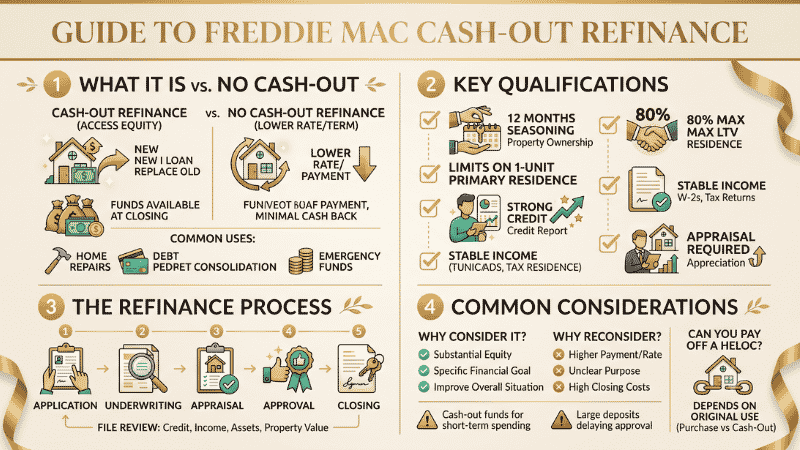 Freddie Mac cash-out refinance approval is not based solely on home equity. The lender still needs to review your credit, income, debt, assets, and property value before the loan can move forward. Credit matters because cash-out refinances are considered higher risk than simple rate-and-term refinances. A stronger credit score may help with approval and pricing. Borrowers with lower scores may still have options, but the loan may require stronger compensating factors, such as lower debt, solid reserves, stable income, or greater home equity.
Income must also be documented. W-2 borrowers are usually asked for recent pay stubs, W-2s, and employment verification. Self-employed borrowers may need tax returns, business records, profit and loss statements, or other documents showing stable income.
The underwriter wants to confirm that the borrower can afford the new payment after the cash-out refinance closes. The debt-to-income ratio is another key part of the review. Even if the home has enough equity, the borrower still needs to qualify for the new mortgage payment, property taxes, insurance, other housing costs, and monthly debts. Paying off debts through refinancing may improve the debt ratio, but the lender must document which debts are being paid and whether they can be excluded from the final calculation. An appraisal is usually required on a Freddie Mac cash-out refinance because the home’s current value determines the maximum loan amount. The appraised value affects the loan-to-value ratio, available cash back, and final approval. If the appraisal comes in lower than expected, the borrower may receive less cash, need to lower the loan amount, or restructure the refinance.
Common Problems That Delay Approval
A Freddie Mac cash-out refinance can slow down if the file is missing documents or the loan purpose is unclear. One common issue is a HELOC or second mortgage taken out after the home was purchased. The lender may need proof of how those funds were used before deciding whether the refinance is a cash-out or no cash-out. Another delay happens when the appraisal comes in lower than expected. Since the appraised value controls the loan-to-value ratio, a lower value can reduce the cash available, change the loan amount, or require the borrower to bring money to closing. Income issues can also delay approval. This is common among self-employed borrowers, those with commission income, overtime, bonus income, rental income, or recent job changes. The underwriter may request additional documents to confirm that the income is stable and can be used to qualify. Credit issues may cause delays, too. Recent late payments, new accounts, higher credit card balances, disputes, collections, or changes during the refinance process can affect approval. Borrowers should avoid opening new debt or making large credit moves before closing. Large deposits and unclear asset transfers can also create problems. If funds are needed for closing, reserves, or payoff, the lender may require bank statements and a clear paper trail. The cleaner the file is upfront, the faster the Freddie Mac cash-out refinance can move through underwriting.
Is a Freddie Mac Cash-Out Refinance Worth It?
A Freddie Mac cash-out refinance may be worth considering if you need access to home equity and can accomplish a financial goal that improves your overall situation. Many homeowners use cash-out funds for home improvements, paying off higher-interest debt, consolidating multiple payments, or creating a financial safety net. Borrowing against your home isn’t always the best idea. When you do a cash-out refinance, you’re actually increasing your loan balance, which might mean you’ll be making mortgage payments for longer. Even if the new interest rate looks good, it’s crucial to weigh the long-term costs of the new loan against the cash you’re getting right now. A Freddie Mac cash-out refinance may make sense if:
- You have substantial equity in your home
- The new payment comfortably fits your budget
- The funds will be used for a specific financial purpose
- The refinance improves your overall financial position
It may be worth reconsidering if:
- The refinance significantly increases your monthly payment
- Most of the available equity will be used for short-term spending
- Closing costs outweigh the potential benefit
- The new loan stretches your finances too thin
What we are seeing from homeowners today is that many are being more selective about tapping home equity than they were a few years ago. Higher mortgage rates have caused some borrowers to keep their existing first mortgage and use other options instead. Others are still finding value in a Freddie Mac cash-out refinance when it helps eliminate high-interest debt, fund major home improvements, or solve a specific financial need. The right choice depends on your home equity, current mortgage rate, financial goals, and how long you plan to keep the property. Before moving forward, review the numbers carefully to ensure the refinance provides a real benefit rather than simply increasing the amount you owe on your home.
FAQs About Freddie Mac Cash-Out Refinance
Does Freddie Mac have to Own My Current Loan to do a Cash-Out Refinance?
No. Your current mortgage does not always have to be owned by Freddie Mac to apply for a Freddie Mac cash-out refinance. The new loan must meet Freddie Mac’s guidelines, but the existing loan can often be paid off and replaced with a new Freddie Mac-eligible conventional loan.
Are Freddie Mac Cash-Out Refinance Rates Higher?
Freddie Mac cash-out refinance rates are often higher than no cash-out refinance rates because the borrower is taking equity out of the home. Pricing can also change based on credit score, loan-to-value ratio, property type, occupancy, and overall loan risk.
Can I Use a Freddie Mac Cash-Out Refinance to Pay Off Credit Cards?
Yes, cash-out funds may be used to pay off credit cards or other debts. However, borrowers should be careful. Moving unsecured debt into a mortgage can lower monthly payments, but it also turns that debt into debt secured by the home.
How Long Does a Freddie Mac Cash-Out Refinance Take?
A Freddie Mac cash-out refinance often takes several weeks from application to closing. The timeline depends on the appraisal, title work, income review, credit review, payoff statements, and how quickly the borrower provides the requested documents.
Can I Get a Freddie Mac Cash-Out Refinance After Bankruptcy?
It may be possible to qualify after bankruptcy, but waiting periods and credit requirements apply. The lender will review the bankruptcy discharge date, rebuilt credit, mortgage payment history, income, debt-to-income ratio, and overall risk before approving the loan.
Is Cash from a Freddie Mac Cash-Out Refinance Taxable?
Cash received from a refinance is generally not treated as taxable income because it is borrowed money, not earned income. However, tax rules can vary based on how the funds are used, so borrowers should speak with a tax professional before making decisions.
Can I Remove Someone from the Mortgage with a Freddie Mac Cash-Out Refinance?
A refinance may be used to remove someone from the mortgage if the remaining borrower can qualify for the new loan. This often comes up after divorce, separation, inheritance, or changes in ownership. Title, income, credit, and legal documents may need to be reviewed.
This article about “Freddie Mac Cash-Out Refinance Guidelines” was updated on June 23rd, 2026.