If you cannot afford mortgage payments, do not ignore the problem and hope it goes away. Failure to make a payment on time can lead to late fees, credit issues, and foreclosure if not addressed promptly. The good news is that homeowners usually have choices before they end up in foreclosure. The first step is to contact your mortgage servicer as early as possible. Depending on your situation, you can request forbearance, a repayment plan, a loan modification, a refinance, a short sale, or another foreclosure alternative. The sooner you act, the more choices you may have to protect your home, your credit, and any equity you have built.
What Happens If You Miss Mortgage Payments?
Missing a mortgage payment doesn’t lead to immediate foreclosure, but it can initiate a process that worsens over time, especially if you cannot afford mortgage payments. Most lenders provide a grace period, but once the payment is overdue, late fees may be added to your account.
If you keep missing payments, your mortgage servicer will start sending you notices and might reach out to talk about your options. Also, late payments can show up on your credit report, which could hurt your credit scores and make it harder to get loans in the future.
After several months of missed payments, the lender may begin foreclosure proceedings if no workout solution has been approved. However, foreclosure is typically a last resort. Most mortgage servicers would rather help borrowers through a repayment plan, forbearance agreement, loan modification, or another loss mitigation option than take ownership of the property. Homeowners who cannot afford mortgage payments should take action as soon as possible. The earlier you reach out to your mortgage servicer, the more options you will likely have. By ignoring the issue, you risk limiting your choices and making it more challenging to prevent foreclosure.
Why Homeowners Fall Behind On Mortgage Payments
Homeowners can fall behind for many reasons. Most of the time, it starts with a sudden change in income, expenses, or family situation. Common reasons include:
- Job loss: A paycheck stops, but the mortgage is still due.
- Reduced income: Fewer hours, lower commissions, or a pay cut can make the payment harder to afford.
- Medical bills: Hospital bills, prescriptions, or time away from work can drain savings fast.
- Divorce: One income may need to cover separate households, legal costs, and existing debts.
- Rising expenses: Higher insurance, property taxes, utilities, food, and credit card payments can squeeze the monthly budget.
- Business slowdown: Self-employed homeowners may fall behind when sales drop, clients pay late, or cash flow becomes unstable.
If you cannot afford mortgage payments because of any of these issues, contact your mortgage servicer early. Waiting too long can limit your options.
Contact Your Mortgage Servicer Immediately
If you cannot afford mortgage payments, avoiding calls or letters from your mortgage servicer is a major mistake. Many homeowners delay reaching out because they are embarrassed, overwhelmed, or worried they will be pressured into making payments they cannot afford. In reality, most servicers would rather help you find a solution than move forward with foreclosure.
The sooner you contact your servicer, the more options may be available. Waiting until you are several months behind can limit the programs you qualify for and make it harder to stop the foreclosure process once it begins.
Early communication gives the lender time to review your situation and determine what type of assistance may be available. Depending on your circumstances, your mortgage servicer may offer:
- A temporary forbearance plan
- A repayment plan to catch up on missed payments
- A payment deferral that moves missed payments to the end of the loan
- A loan modification that lowers the monthly payment
- Short sale or deed in lieu options if keeping the home is no longer possible
When you contact your servicer because you cannot afford mortgage payments, be ready to explain your situation. They might request income documentation, bank statements, proof of hardship, or other financial details. Providing all necessary documentation promptly can help avoid delays in the process. Many homeowners are shocked to learn that lenders usually don’t want to proceed with foreclosure. Foreclosures are expensive, time-consuming, and often result in losses for the lender. In most cases, the servicer will explore available loss mitigation options before foreclosure becomes necessary. Taking action early gives you the best chance of protecting your home, preserving your credit, and avoiding unnecessary stress.
Mortgage Forbearance Programs
Mortgage forbearance is a temporary agreement that allows homeowners experiencing financial hardship to pause or reduce their mortgage payments for a limited period. It is designed to provide short-term relief when a homeowner faces a situation such as job loss, reduced income, medical issues, a natural disaster, or another unexpected financial setback.
A common misunderstanding is that forbearance implies that missed mortgage payments are forgiven. This is not true. When individuals cannot afford mortgage payments, the missed amounts are usually deferred and must eventually be repaid through a repayment plan, payment deferral, loan modification, or another solution approved by the mortgage servicer.
Depending on the loan type and investor guidelines, homeowners may have several ways to handle missed payments after the forbearance period ends:
- Repaying the missed amount over time through a repayment plan
- Putting off missed payments until the end of the loan.
- Modifying the loan terms to create a more affordable payment
- Combining multiple solutions based on the borrower’s situation
Forbearance is a useful option for homeowners experiencing temporary hardships, especially when requested early. Waiting until you are significantly behind on payments may reduce available options and increase the risk of foreclosure. Before entering a forbearance agreement, ask your mortgage servicer how the missed payments will be handled once the forbearance period ends. Understanding the repayment requirements upfront can help you avoid surprises and better plan for your financial recovery.
Behind on Payments? Build a Plan Before Foreclosure Starts
The earlier you act, the more options you may have. Get a step-by-step plan for talking with your servicer, gathering documents, and understanding possible loss-mitigation paths.Loan Modification Options
A loan modification may help if you cannot afford mortgage payments and the hardship is more than temporary. A loan modification adjusts your existing mortgage terms to make payments easier to manage, rather than just providing a brief pause. A mortgage servicer may review a homeowner’s loan for modification after missed payments, forbearance, reduced income, divorce, medical hardship, or another financial setback. The goal is to create a payment the homeowner can afford and to reduce the risk of foreclosure.
A loan modification can involve lowering the interest rate, extending the loan term, adding missed payments to the balance, or adjusting the monthly payment. In some cases, the servicer may offer a trial payment plan first. If the homeowner makes the trial payments on time, the modification may become permanent.
A loan modification is not the same as a refinance. With a refinance, you apply for a new mortgage and must qualify based on income, credit, equity, and lender guidelines. With a loan modification, you work with your current mortgage servicer to change the existing loan. This may be an option even when refinancing is not possible. Homeowners should understand that a loan modification is not automatic. The servicer may ask for pay stubs, bank statements, tax returns, a hardship letter, a monthly budget, or other documents. Missing paperwork can delay the review or cause the request to be denied. Before accepting a loan modification, ask how the new payment is calculated, whether the loan term will be extended, how missed payments will be handled, and whether the modification will affect your credit. The right loan modification can help a homeowner stay in the home, but the new payment must be realistic for the long term.
Repayment Plans and Payment Deferrals
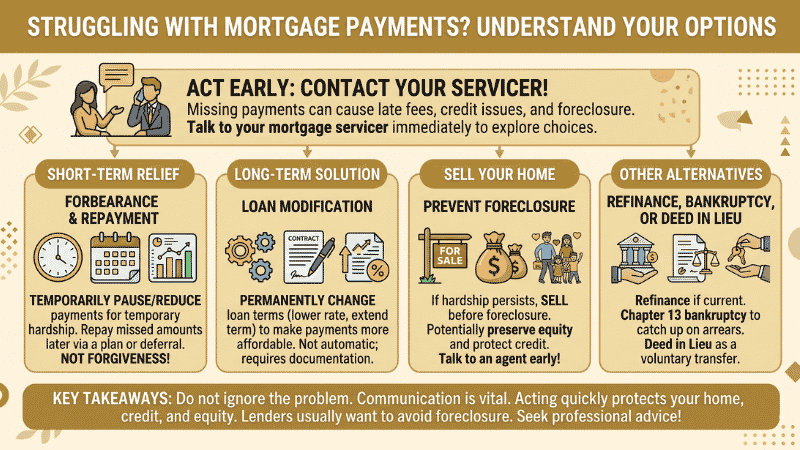 If you have fallen behind on your mortgage and cannot afford mortgage payments but can now cover your regular monthly dues, your mortgage servicer might provide a repayment plan or a payment deferral. These options can help you catch up on missed payments without needing to refinance the loan or immediately seek a loan modification. A repayment plan allows you to repay the past-due amount over time. Instead of paying everything at once, the servicer spreads the missed payments across several months. For example, if you missed three mortgage payments, the servicer may add a portion of the overdue balance to your regular monthly payment until the loan becomes current again. A payment deferral works differently. Rather than increasing your monthly payment, the missed payments are moved to the end of the loan, where they become due when you sell the home, refinance, or pay off the mortgage. This option can be attractive for homeowners who have recovered financially but cannot afford larger monthly payments. Both options are generally designed for homeowners who have experienced a temporary hardship and are now back on a stable financial footing. The mortgage servicer will typically review your income, expenses, and hardship history before determining which solution may be available. If you cannot afford mortgage payments, you may be able to avoid foreclosure by using repayment plans or payment deferrals while keeping your current mortgage. Not every loan program offers the same options, so it’s important to ask your servicer how they will handle missed payments and whether you need to provide additional documents. The sooner you ask for help, the more likely you are to find a solution before your situation gets worse.
Can You Refinance To Lower Your Mortgage Payment?
Refinancing can reduce your monthly mortgage payment, but it isn’t the best option for every homeowner. Whether refinancing makes sense depends on your interest rate, loan balance, home equity, credit profile, and overall financial situation. A refinance may lower your payment by:
- Securing a lower interest rate
- Extending the loan term
- Switching from an adjustable-rate mortgage to a fixed-rate loan
- Removing mortgage insurance in some situations
- Replacing a higher-cost loan with a more affordable program
However, homeowners who are already behind on mortgage payments may have difficulty qualifying for a refinance. Most lenders prefer borrowers who have made recent on-time mortgage payments and can demonstrate stable income. If you have faced a temporary hardship and are now back on track, refinancing may still be an option, even if you initially cannot afford mortgage payments. Some homeowners who have completed a forbearance plan, repayment plan, or loan modification may qualify for refinancing once they meet the lender’s waiting period and payment history criteria. For homeowners with FHA loans, an FHA Streamline Refinance may be an option if it provides a clear financial benefit and other program requirements are met. Other borrowers may qualify for conventional, VA, USDA, or non-QM refinance programs depending on their circumstances. Before refinancing, compare the new monthly payment, interest rate, closing costs, and the length of time you plan to keep the home. A lower payment can provide much-needed relief, but it is important to make sure the long-term savings outweigh the costs of obtaining the new loan. If refinancing is not available, alternatives such as a loan modification, a repayment plan, or a payment deferral may be better solutions for homeowners who cannot afford their mortgage payments.
Selling Your Home Before Foreclosure
If you cannot afford mortgage payments and do not believe your financial situation will improve soon, selling your home before foreclosure may be the best option. Taking action early can help you protect your credit, avoid foreclosure, and potentially preserve any equity you have built. Many homeowners are surprised to learn how much equity they have. Home values have increased significantly in many markets over the past several years, which means your home may be worth more than you owe on the mortgage. If that is the case, selling the property could allow you to pay off the loan, cover selling expenses, and keep the remaining proceeds. Talk to a real estate agent to find out your home’s current market value before making a decision. Comparing the home’s value to your mortgage balance can help you understand whether selling is a realistic solution. Selling before foreclosure may offer several benefits:
- Protect your credit from a completed foreclosure
- Preserve home equity
- Avoid foreclosure-related legal costs
- Maintain greater control over the timing of your move
- Reduce financial stress and uncertainty
If the home’s value is less than what you owe on the mortgage, a short sale may be an option. In a short sale, the lender accepts less than the full mortgage balance when the home is sold. While lender approval is required, a short sale is often less damaging than a foreclosure. The most important factor is timing. The earlier you explore your options, the more flexibility you may have. Waiting until foreclosure proceedings are well underway can make selling more difficult and reduce the number of solutions available.
Short Sale or Deed in Lieu: Two Foreclosure Alternatives
If you cannot afford mortgage payments and keeping the home is no longer realistic, your servicer may discuss a short sale or deed in lieu of foreclosure. Both options can help prevent foreclosure, but they work differently.
A short sale means the home is sold for less than the amount owed on the mortgage. The lender must approve the sale since they are accepting less than the full balance. This option works when the value of the home is less than the mortgage payoff, and a buyer is ready to buy the property.
A deed in lieu of foreclosure means you voluntarily transfer ownership of the home back to the lender. Instead of going through the full foreclosure process, the lender accepts the property. This may be considered when selling the home is not realistic or when the property has been on the market without a successful sale. The main difference is control. With a short sale, the homeowner lists the property, works with a buyer, and waits for lender approval. With a deed in lieu, the homeowner gives the property back to the lender directly. Both options require approval from the mortgage servicer. Before making a decision on either option, inquire whether the lender will forgive any remaining balance or retain the right to pursue a deficiency balance, especially if you cannot afford mortgage payments. A deficiency occurs when the sale or property value falls short of covering the amount owed. The rules governing this can vary by state law, loan type, and lender policies. A short sale or deed in lieu can still affect your credit and future mortgage eligibility, but they may be less damaging than a completed foreclosure. Homeowners should thoroughly review all documents and consult a real estate attorney, tax professional, or housing counselor before signing.
How Bankruptcy May Help In Certain Situations
Bankruptcy is not the right solution for every homeowner, but it may provide relief when mortgage problems are part of a larger financial struggle. If you cannot afford mortgage payments because of overwhelming debt, filing for bankruptcy might give you the time you need to reorganize your finances and explore ways to keep your home. A key benefit of filing for bankruptcy is the automatic stay, which halts collection efforts and foreclosure proceedings while your case is reviewed. This provides homeowners with extra time to negotiate with their mortgage servicer about options such as loan modifications or repayment plans. The two most common types of consumer bankruptcy are:
Chapter 7 Bankruptcy
- May eliminate certain unsecured debts, such as credit cards and medical bills
- Can improve monthly cash flow by removing debt obligations
- Does not automatically make missed mortgage payments go away
- May be appropriate for homeowners with limited income and significant unsecured debt
Chapter 13 Bankruptcy
- Sets up a repayment plan approved by the court that lasts about three to five years.
- May allow homeowners to catch up on past-due mortgage payments over time
- Can help borrowers who have a regular income but need time to get current
- Often used by homeowners trying to prevent foreclosure
Bankruptcy should generally be viewed as a legal and financial tool rather than a last resort. For some homeowners, it may provide a path to stabilize their finances and keep their home. For others, selling the property, pursuing a loan modification, or another foreclosure alternative may be the better option. Because bankruptcy laws are complex and every situation is different, homeowners should consult a qualified bankruptcy attorney before making any decisions.
Will Foreclosure Hurt Your Credit?
Foreclosure can hurt your credit score. It shows lenders that you cannot afford mortgage payments, which led to the lender taking back the home. This can make it harder to get another mortgage, rent a home, finance a car, or get approved for new credit. The damage usually starts before the foreclosure is completed. Missed mortgage payments can be reported to the credit bureaus once they become late. If the loan continues to fall behind, each additional late payment can further lower the credit score. Foreclosure can affect your credit in several ways:
- Late payments: Mortgage lates may appear before the foreclosure is finalized.
- Foreclosure record: A completed foreclosure can remain on your credit report for years.
- Lower credit scores: The drop depends on your credit history before the missed payments.
- Future mortgage delays: Most loan programs require a waiting period after foreclosure.
- Higher risk profile: Lenders may ask for higher income, reserves, or credit history after a foreclosure.
The good news is that foreclosure is not always the end of homeownership. Many borrowers can qualify for another mortgage after the required waiting period if they rebuild credit, keep accounts current, save money, and document stable income. If foreclosure has not happened yet, it is usually better to contact your mortgage servicer early. A repayment plan, loan modification, short sale, deed in lieu, or other foreclosure alternative may reduce the long-term damage compared to doing nothing.
Can You Buy Another Home After Foreclosure?
Yes, you can buy another home after a foreclosure, but you usually have to wait before you qualify for a new mortgage. The waiting period depends on the loan program, the date the foreclosure was completed, and whether the borrower has rebuilt credit since then.
FHA loans may allow a borrower to qualify after the required waiting period if credit has been re-established and the borrower meets income, debt-to-income, and down payment guidelines. VA loans, conventional loans, USDA loans, and non-QM loans each have their own rules. Some programs are stricter than others.
Lenders will review more than the foreclosure itself. They will look at recent payment history, credit scores, open collections, charge-offs, income stability, rental history, and current debt. A borrower with clean credit after foreclosure is usually in a stronger position than a borrower with new late payments or unpaid collections. The foreclosure date matters. Lenders typically count the waiting period from the date the foreclosure was completed, not the date the homeowner first missed payments. Borrowers should keep records showing when the foreclosure was finalized, as credit reports do not always reflect the correct date. After foreclosure, the strongest files usually show on-time payments, lower credit card balances, stable employment, a documented housing history, and savings for a down payment or reserves. Borrowers should also avoid new late payments, payday loans, overdrafts, and large, undocumented deposits before applying for another mortgage.
What We Are Seeing From Homeowners Today
Homeowners reaching out today often still have equity, but their monthly budgets are tighter than they were two or three years ago. The mortgage payment may not have changed, but escrow can. Higher homeowners’ insurance premiums and property tax bills can increase the total payment even when the loan itself stays the same. Insurance is a major issue in states where carriers have raised premiums, limited coverage, or pulled back from certain markets. A homeowner who qualified comfortably when the loan closed may now be dealing with a larger escrow shortage, a higher renewal premium, or both. Property taxes are creating a similar problem. When county assessments rise, the tax portion of the mortgage payment can increase. Homeowners who bought before recent price increases may feel the jump when the new assessment flows into escrow. Inflation is hitting the rest of the household budget at the same time. Groceries, utilities, car insurance, repairs, and credit card minimum payments leave less room for a temporary job loss, reduced hours, medical bills, or business slowdown. The difference from 2008 is equity. Many homeowners today owe less than their homes are worth. That can create options before foreclosure, including selling the home, using sale proceeds to pay off debt, or refinancing if the borrower still qualifies. We are also seeing more homeowners ask about loan modifications before foreclosure starts. They are not always months behind. Some are current, but know the next payment will be a problem. Those borrowers should contact the servicer before missing payments and ask what hardship options are available.
Key Takeaways: If You Cannot Afford Mortgage Payments
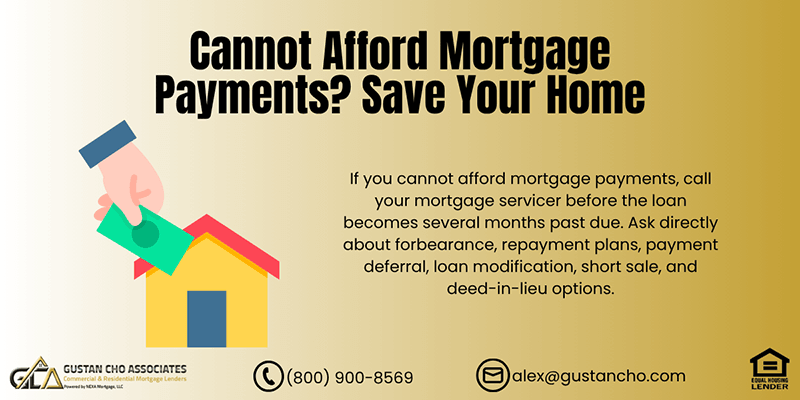
If you cannot afford mortgage payments, call your mortgage servicer before the loan becomes several months past due. Ask directly about forbearance, repayment plans, payment deferral, loan modification, short sale, and deed-in-lieu options.
Do not skip mortgage payments without knowing how your servicer will treat the account. Late payments can trigger fees, credit reporting, escrow shortages, attorney costs, and foreclosure notices.
If the home has equity, get a current market value before deciding what to do next. Selling before foreclosure may allow you to pay off the mortgage, cover closing costs, and keep part of the proceeds. If the hardship is tied to larger debt problems, speak with a bankruptcy attorney before foreclosure deadlines get close. Chapter 13 may allow some homeowners to catch up on past-due mortgage payments through a court-approved repayment plan.
FAQs About Homeowners Who Cannot Afford Mortgage Payments
How Many Mortgage Payments Can You Miss Before Foreclosure Starts?
Foreclosure does not usually start after one missed payment. Most lenders send notices first and try to contact the homeowner. The timeline depends on the loan, state law, and mortgage servicer. Once the loan is several months past due, foreclosure risk increases.
Can I Ask My Lender to Lower My Mortgage Payment?
Yes, you can ask your mortgage servicer about options to lower or manage the payment. They may review you for a loan modification, repayment plan, forbearance, or payment deferral. The servicer will usually ask for income documents, bank statements, and details about the hardship.
Should I Pay Other Bills Before My Mortgage?
The mortgage should usually be treated as a top priority because your home is tied to the loan. Credit cards, personal loans, and medical bills are serious, but missed mortgage payments can lead to foreclosure. Homeowners with heavy debt should speak with a housing counselor or bankruptcy attorney before choosing which bills to stop paying.
Can I Get Help if I am Current But Know I Will Miss a Payment Soon?
Yes. Contacting the servicer before missing a payment may give you more options. Some hardship programs are easier to review when the homeowner calls early instead of waiting until the loan is months behind.
Can My Mortgage Company Refuse to Help Me?
A mortgage servicer can deny a request if the homeowner does not qualify, fails to provide required documents, or cannot demonstrate sufficient income to support the proposed plan. A denial does not always mean foreclosure is the only option. You can ask why the request was denied and whether another option is available.
What Documents Should I Gather Before Calling My Mortgage Servicer?
Gather recent pay stubs, bank statements, mortgage statements, tax returns, proof of hardship, and a list of monthly expenses. If income dropped, include documents showing the change, such as a termination letter, a reduced-hours notice, a medical bill, divorce paperwork, or business income records.
Can a Housing Counselor Help Me Avoid Foreclosure?
A HUD-approved housing counselor may help review your budget, explain foreclosure prevention options, and prepare you for conversations with your mortgage servicer. This can be useful if you are confused by servicer forms, deadlines, or repayment choices.
This article about “Cannot Afford Mortgage Payments? Save Your Home” was updated on June 23rd, 2026.