Alabama homeowners with an existing FHA loan may find that an FHA streamline refinance in Alabama can help reduce their monthly mortgage payments. This program simplifies the refinancing process, as many borrowers are not required to undergo a new appraisal, full income verification, or a comprehensive credit review.
An FHA streamline refinance in Alabama is beneficial if your current FHA mortgage rate is higher than current market rates or if you’re looking to switch from an adjustable-rate FHA loan to a fixed-rate loan.
The primary condition for this refinance option is that it must provide a tangible financial benefit, such as a reduced payment, lower interest rate, or more stable loan terms.
This option could be particularly advantageous for homeowners in Birmingham, Huntsville, Montgomery, Mobile, Tuscaloosa, and other areas across Alabama who prefer a simpler refinancing experience. However, refinancing isn’t suitable for everyone. It’s important to check closing costs, payment savings, mortgage insurance, and how long you intend to stay in your home before determining if an FHA streamline refinance in Alabama is the right choice for you.
What Is an FHA Streamline Refinance in Alabama?
An FHA Streamline Refinance in Alabama is a refinance option for homeowners who already have an FHA loan. It allows eligible borrowers to replace their current FHA mortgage with a new FHA mortgage, usually with less paperwork than a full refinance.
The main purpose of an FHA Streamline Refinance is to help homeowners lower their monthly payment, reduce their interest rate, or move from an adjustable-rate FHA loan into a fixed-rate FHA loan. In many cases, Alabama homeowners may not need a new appraisal, full income verification, or full employment verification.
This program is called “streamline” because the process is designed to be faster and simpler than a traditional refinance. However, the new loan must still meet FHA rules. The refinance must provide a clear benefit to the homeowner, such as monthly savings or more stable loan terms.
No-Cost FHA Streamline Refinance in Alabama
A no-cost FHA Streamline Refinance does not always mean the refinance is free. It usually means the borrower has little to no out-of-pocket cost at closing. There are still normal refinance costs, such as title fees, recording fees, prepaid taxes, homeowners’ insurance, escrow setup, and FHA mortgage insurance.
In many cases, these costs may be handled through a lender credit, a slightly higher interest rate, or by financing certain allowable costs into the new loan. This can help Alabama homeowners refinance without bringing a large amount of money to closing.
The main thing to understand is the trade-off. A lower interest rate may give you bigger monthly savings, but it could require more cash to close. A no-cost option may reduce your upfront expense, but the interest rate may be slightly higher. The best choice depends on your monthly savings, closing costs, break-even point, and how long you plan to stay in the home.
Who Qualifies for an FHA Streamline Refinance in Alabama?
Alabama homeowners may qualify for an FHA Streamline Refinance if they already have an existing FHA loan on the property. This program is only available for borrowers refinancing from one FHA loan into another FHA loan. It is not used to refinance a conventional, VA, USDA, jumbo, or non-QM mortgage into an FHA loan.
The current FHA loan must also meet FHA seasoning requirements. In most cases, the homeowner must wait at least 210 days from the closing date of the current FHA loan and must have made the required number of monthly payments before applying for an FHA Streamline Refinance.
Mortgage payment history is another important factor. FHA generally wants to see that the borrower has made recent on-time housing payments. The FHA Streamline program is meant to be simpler than a full refinance, so your current mortgage payment history really matters.
The refinance must also pass the FHA net tangible benefit test. The new loan should really help the homeowner, such as by giving them a lower monthly payment, a better interest rate, or more reliable loan terms. For example, switching from an adjustable-rate FHA loan to a fixed-rate FHA loan can make a big difference.
Occupancy also matters. FHA Streamline Refinances are commonly used for primary residences. Some FHA-insured properties that are no longer owner-occupied may still be eligible for FHA review, but the loan officer should check the specific situation before moving forward.
Is an Appraisal Necessary for an FHA Streamline Refinance?
Many FHA Streamline Refinances do not require a new home appraisal. This is one of the main reasons Alabama homeowners choose this program instead of a full refinance. If the borrower qualifies for a non-credit qualifying FHA Streamline Refinance, the lender may not need to verify the home’s current market value.
This can help homeowners whose property value is uncertain, flat, or lower than expected. For example, if home values in the area have not increased much or there are few comparable sales nearby, the no-appraisal option can make the refinance process easier.
The main focus of an FHA Streamline Refinance is not the current value of the property. The focus is on whether the homeowner already has an FHA loan, meets the payment history and seasoning rules, and receives a real benefit from the new loan. Your loan officer should review your current FHA loan, payment history, and the savings from refinancing before deciding whether the no-appraisal option is available.
Do You Need Income Verification or Employment Verification?
Many FHA Streamline Refinances do not require full income verification or employment verification. This is called a non-credit-qualifying FHA Streamline Refinance. This means the lender may not need to calculate your debt-to-income ratio, verify your job history, or review your income as they would in a full refinance.
This can make the process much easier for Alabama homeowners who already have an FHA loan and simply want to lower their payment or improve their loan terms. The lender still reviews important items, such as your current FHA loan, mortgage payment history, seasoning requirement, and net tangible benefit.
A credit-qualifying FHA Streamline Refinance may be required in some situations. This can happen if a borrower is removed from the loan, the mortgage payment increases, or the file has risk factors that require a deeper review. In those cases, the lender may need to verify the borrower’s income, employment, credit, debts, and ability to repay the new loan.
The best option depends on your loan file. Your loan officer should review your current FHA mortgage, payment history, refinance goal, and borrower structure before deciding whether a non-credit-qualifying or credit-qualifying FHA Streamline Refinance is needed.
Net Tangible Benefit With FHA Streamline Refinance in Alabama
An FHA Streamline Refinance must provide the borrower with a net tangible benefit. This means the new FHA loan must give the homeowner a real financial advantage. The benefit may be a lower monthly mortgage payment, a lower interest rate, or a more stable loan by refinancing from an adjustable-rate FHA loan into a fixed-rate FHA loan.
FHA does not allow homeowners to refinance just to create a new loan. There must be a clear reason why the refinance helps the borrower. For many Alabama homeowners, the most common benefit is reducing the monthly payment. For others, the benefit may be getting out of an adjustable-rate mortgage and into a fixed payment.
Before starting the refinance, the loan officer should compare the current FHA loan to the new FHA loan. This covers the interest rate, how much you’re borrowing, your monthly payments, mortgage insurance, closing costs, and how long you plan to keep the house. The goal is to make sure the refinance truly saves money or improves the borrower’s loan terms.
Is it Possible to Get an FHA Streamline Refinance With Bad Credit?
You may still be able to get an FHA Streamline Refinance in Alabama with bad credit, especially if the loan is a non-credit-qualifying FHA Streamline Refinance. In many cases, the lender does not review credit the same way they would on a full refinance. The main goal is to determine whether the new FHA loan provides a real benefit, such as a lower payment or better loan terms.
However, bad credit does not mean mortgage payment history can be ignored. Your current FHA mortgage payment history is one of the most important parts of the review. FHA and the lender want to see that you have been making your housing payments on time, especially in the months leading up to your application.
Late payments on credit cards, auto loans, collections, or other debts may not always stop an FHA Streamline Refinance. However, recent late payments on your current mortgage can create problems. Before moving forward, your loan officer should review your mortgage payment history, current FHA loan status, seasoning date, and whether the refinance meets the FHA net tangible benefit rule.
FHA Streamline Refinance Closing Costs in Alabama
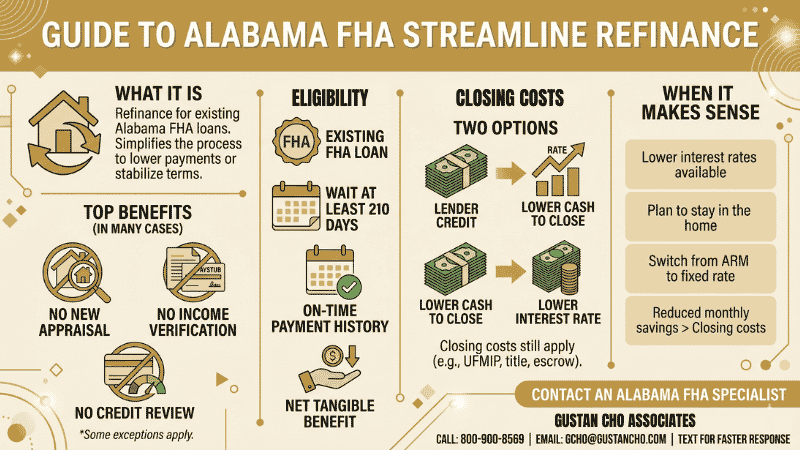
An FHA Streamline Refinance in Alabama can reduce paperwork, but it does not remove all closing costs. Homeowners may still have title fees, recording fees, escrow setup, prepaid property taxes, prepaid homeowners insurance, and other standard refinance charges. These costs should be reviewed before deciding if the refinance makes financial sense.
FHA loans also include an upfront mortgage insurance premium, also called UFMIP. In many FHA Streamline Refinances, the UFMIP can be financed into the new loan. Some borrowers may also qualify for a partial UFMIP refund credit if their current FHA loan is still within the eligible refund period.
A no-cost FHA Streamline Refinance usually means no out-of-pocket cost at closing, not that the refinance is free. The lender, title company, county recording office, insurance company, and escrow account may still have costs. Those costs may be handled through lender credits, a slightly higher interest rate, or certain allowable financed charges.
Lender credits can help reduce or eliminate the cash needed at closing. However, borrowers should compare the interest rate, monthly savings, total closing costs, and break-even point. The best refinance option is not always the one with the lowest cash-to-close. It is the option that gives the Alabama homeowner the strongest long-term benefit based on their goals.
FHA Mortgage Insurance on an Alabama Streamline Refinance
FHA mortgage insurance usually continues when you refinance with an FHA Streamline Refinance in Alabama. Since the new loan is still an FHA loan, borrowers typically continue to pay FHA mortgage insurance as part of their monthly mortgage payment.
There are two kinds of FHA mortgage insurance you should know about. First up is the upfront mortgage insurance premium (UFMIP). Instead of paying it out of pocket at closing, this is usually rolled into your new loan amount. Then there’s the annual mortgage insurance premium, or annual MIP, which you’ll pay each month along with your mortgage payment.
Some Alabama homeowners may qualify for a partial UFMIP refund credit if they refinance within the eligible FHA refund period. This credit can help reduce the new upfront mortgage insurance cost, but the amount depends on how long ago the current FHA loan closed.
Mortgage insurance is one reason homeowners should review the full payment before refinancing. A lower interest rate does not always tell the whole story. Your loan officer should compare your current principal, interest, mortgage insurance, taxes, and insurance with your new estimated payment to confirm that the FHA Streamline Refinance gives you a real benefit.
Lock today’s low FHA rates with confidence
Get a smart lock strategy and float-down protection when available
When Does an FHA Streamline Refinance Make Sense?
An FHA Streamline Refinance in Alabama may make sense if you plan to stay in your home long enough to benefit from the monthly savings. If the new loan lowers your payment and the savings from the lower payment outweigh the closing costs over time, refinancing may be a smart option.
This program can also help homeowners who currently have an FHA mortgage rate higher than the current rate. A lower interest rate may reduce the monthly principal and interest payment, thereby improving monthly cash flow and making the home more affordable.
An FHA Streamline Refinance may also be useful if you have an adjustable-rate FHA loan and want to refinance into a fixed-rate FHA loan. Even if the monthly savings are not large, switching to a fixed payment can give you more stability and protect you from future payment increases.
The refinance should always be reviewed carefully before moving forward. Your loan officer should compare your current payment, new payment, closing costs, mortgage insurance, and how long you expect to keep the home. The goal is to ensure the FHA Streamline Refinance provides you with a clear financial benefit.
When an FHA Streamline Refinance May Not Make Sense
An FHA Streamline Refinance in Alabama may not make sense if the monthly savings are too small. Even though the process may be easier than a full refinance, there can still be closing costs, prepaid taxes, insurance, escrow setup, and FHA mortgage insurance. If the savings are minor, it may take too long to recover the refinance costs.
This refinance may also not be the best option if you plan to sell the home soon. For example, if you expect to move within a year or two, the monthly savings may not be enough to justify starting a new loan and paying refinance-related costs.
A no-cost or low-out-of-pocket option should also be reviewed carefully. In some cases, the lender credit may come with a slightly higher interest rate. That may lower the cash needed at closing, but it could cost more over time if you keep the home for many years.
The best decision depends on your payment savings, closing costs, loan term, mortgage insurance, and how long you plan to stay in the property. Before refinancing, Alabama homeowners should compare the short-term savings with the long-term cost of the new FHA loan.
How Alabama Homeowners Can Apply
Alabama homeowners can start the FHA Streamline Refinance process by having a loan officer review their current FHA mortgage statement, interest rate, monthly payment, loan closing date, and recent mortgage payment history. This helps confirm whether the loan meets FHA seasoning rules and whether the refinance may provide a real financial benefit.
The next step is to compare refinance options. The loan officer should review the estimated new payment, interest rate, mortgage insurance, closing costs, lender credits, and cash needed to close. This is where the homeowner can decide whether a lower-rate, no-cost, or low-out-of-pocket option makes the most sense.
Once the borrower chooses the best option, the lender can prepare the application, disclosures, rate lock, title order, and closing documents. Because many FHA Streamline Refinances do not require a new appraisal or full income verification, the process may be faster and simpler than a traditional refinance.
Before closing, Alabama homeowners should review the final numbers carefully. The goal is to make sure the new FHA loan lowers the payment, improves the loan terms, or creates another clear benefit without adding unnecessary long-term cost.
How Long Will Homeowner Stay In Their Home?
How long you expect to stay in your home is also a factor to consider. If you’ll be moving in a few years, the month-to-month savings may never add up to the costs that are involved in refinancing. Homeowners need to realize that there are closing costs involved with a refinance.
Closing costs consist of tax stamps, appraisal, origination fees, and attorney’s fees if there will be an attorney involved in the refinancing and title charges.
Depending on the interest rate on your new refinance mortgage loan, it might take anywhere of several months to more than a year to recoup your refinance closing costs. Your mortgage broker will help you by advising you on whether or not it will be worthwhile for you to refinance.
Talk to an Alabama FHA Streamline Refinance Specialist
An FHA Streamline Refinance in Alabama can be a good option for homeowners who already have an FHA loan and want an easier way to reduce their monthly payment or improve their loan terms. The biggest benefits may include no appraisal in many cases, reduced documentation requirements, less income verification, and a faster process than a full refinance.
However, refinancing is not always the right move for every homeowner. The new loan should provide a real benefit after reviewing the interest rate, monthly payment, FHA mortgage insurance, closing costs, lender credits, and how long you plan to stay in the home.
At Gustan Cho Associates, our team reviews your current FHA loan, mortgage payment history, seasoning date, estimated savings, and closing cost options before recommending a refinance. The goal is not just to close another loan. The goal is to make sure the refinance makes sense for your financial situation.
To see if you qualify for an FHA Streamline Refinance in Alabama, call Gustan Cho Associates at 800-900-8569, text us for a faster response, or email gcho@gustancho.com. Our team is available evenings, weekends, and holidays to help Alabama homeowners review their FHA refinance options.
Frequently Asked Questions About FHA Streamline Refinance in Alabama:
Can I Take Cash Out With An FHA Streamline Refinance?
- No. An FHA Streamline Refinance is not designed for cash-out refinancing. HUD states that borrowers cannot receive more than $500 cash back from an FHA Streamline Refinance. If you need to access home equity, you may want to consider a different refinance option.
Can I Refinance My FHA Loan If I Am Behind On Payments?
- Usually, no. The FHA loan being refinanced must be current. Mortgage payment history is one of the most important parts of the FHA Streamline review. If you recently missed a mortgage payment, your loan officer should review the timeline before starting the refinance.
What Is The Timeframe For Refinancing Following The Acquisition Of An FHA Loan?
- Many FHA Streamline Refinances require seasoning before the borrower can refinance. Usually, you need to wait at least 210 days after closing on your current FHA loan before you can do anything else with it. Plus, you have to make sure your payment history checks out.
Can I Use An FHA Streamline Refinance To Remove Someone From The Mortgage?
- Sometimes, but removing a borrower may require a credit-qualifying FHA Streamline Refinance. That means the lender may need to review income, employment, credit, debts, and the remaining borrower’s ability to repay the loan. This should be reviewed before the loan is submitted.
Does An FHA Streamline Refinance Reset My Loan Term?
- It can. Many borrowers refinance into a new FHA loan term, which may restart the repayment schedule. A lower payment can help with monthly cash flow, but borrowers should also review the long-term interest cost before choosing a new term.
Can I Refinance An FHA Loan On A Second Home Or Investment Property?
- FHA Streamline Refinances are most commonly used for primary residences. Some FHA-insured properties that are no longer owner-occupied may still be eligible under FHA rules, but eligibility depends on the loan file and occupancy history. HUD confirms that the loan being refinanced must already be FHA-insured.
What Documents Are Usually Needed For An FHA Streamline Refinance?
- The documentation is usually lighter than a full refinance. Many borrowers start with a mortgage statement, photo ID, homeowners’ insurance information, and basic loan application details. The lender may request more documents if the file requires a credit-qualifying review.
Is An FHA Streamline Refinance Better Than A Regular FHA Refinance?
- It depends on your goal. An FHA Streamline Refinance may be better if you already have an FHA loan and want a faster, lower-documentation refinance. A regular FHA refinance may be better if you need cash out, want to change borrowers in a more complex file, or do not meet streamline requirements.
This article about “FHA Streamline Refinance in Alabama with Low Rates” was updated on June 3rd, 2026.
Talk to an Alabama FHA streamline specialist
Local expertise, no overlays, and on-time closings statewide