Can you get a conventional loan with charge-offs?
The Fannie Mae-Freddie Mac charge-off guidelines do not automatically require every non-mortgage charge-off to be paid before closing. Treatment depends on the agency, underwriting method, property occupancy, number of units, and type of debt. A mortgage-related charge-off may trigger a waiting period, while certain non-mortgage charge-offs may remain unpaid. The lender must review the credit report, follow the DU or LPA findings, and apply any lender-specific requirements before approving the loan.
What Is a Charge-Off on a Credit Report?
A charge-off is the creditor’s decision to record an account as unrecoverable and charge it to expense. This does not signify that the debt is forgiven. The lender, a collections firm, or a debt buyer may continue to pursue the collection of the debt. When considering the impact of a charge-off on mortgage qualification, what matters is how the charge-off is handled in the loan and underwriting guidelines.
Charge-Offs vs. Collections: What Is the Difference?
A credit account becomes a charge-off when the creditor has determined it is a seriously delinquent account that is a loss to the creditor. A collection occurs when an unpaid account is sold to or assigned to a third party who is a debt collector for that purpose. Even though some mortgage guidelines may treat collections and charge-offs together in certain instances, they must still be viewed as distinct credit events. Before determining whether a pay-off is necessary, the mortgage lender must understand how each account is reported.
Do You Have to Pay a Charge-Off Before Applying for a Conventional Loan?
This may not always be the case. For Fannie Mae-Freddie Mac charge-off guidelines, it depends on the agency, underwriting approach, property type, occupancy, and type of charge-off.
For instance, Fannie Mae DU will not require non-mortgage charge-offs to be settled on primary, single-family residences, regardless of the amount. Different pay-off standards apply to certain second homes, multi-unit primary residences, investment properties, and non-DU underwritten loans.
The lender may establish pay-off standards that are more stringent than the agency’s minimum standards.
Fannie Mae Charge-Off Guidelines
Fannie Mae loans can be underwritten by both the Desktop Underwriter (DU) software and by manual underwriting. The treatment of charge-offs differs depending on how the loans are underwritten. Fannie Mae requires lenders to distinguish the DU requirements from the requirements for manually underwritten loans. A mortgage charge-off is considered a major adverse credit event and typically results in a waiting period before a borrower becomes eligible for a Fannie Mae loan. All other types of charge-offs are treated differently.
Fannie Mae DU Guidelines for Non-Mortgage Charge-Offs
Each of Fannie Mae’s DU guidelines is based on the number of units and whether the property is a primary residence.
One Unit Primary Residence
For a one-unit primary residence, collections and non-Mortgage charge-offs do not have to be paid regardless of the amount.
Two to Four-Unit Primary Residence and Second Home
For collections and non-mortgage charge-offs totaling more than $5,000, a full payment must be made at/before closing.
Investment Property
For an investment property, payment is required for individual collections or non-mortgage charge-offs of $250 or more, and for a combination of these account balances totaling more than $1,000. These guidelines apply to Fannie Mae DU loans. Other requirements apply to manually underwritten loans.
Fannie Mae Manual Underwriting Charge-Off Guidelines
Manual underwriting requirements are more extensive at Fannie Mae than at DU. For a manually underwritten Fannie Mae loan, non-medical collection accounts and non-mortgage charge-offs do not have to be paid at or before closing if either:
- The balance of an individual account is less than $250, or
- The combined balance of all applicable accounts is $1,000 or less.
If neither exception applies, the applicable accounts must be paid at or before closing.
Freddie Mac Charge-Off Guidelines
Freddie Mac does not use the same charge-off payoff thresholds that Fannie Mae applies to loans underwritten through Desktop Underwriter. A Fannie Mae rule should not automatically be applied to a Freddie Mac loan.
Freddie Mac LPA Accept Mortgages
For a mortgage that receives an Accept recommendation from the Loan Product Advisor, LPA has evaluated the borrower’s credit reputation and determined that it is acceptable. An Accept recommendation does not allow the lender to ignore a charge-off. The lender must verify that the credit information submitted to LPA is complete and accurate. The lender must also comply with the documentation requirements and messages listed on the LPA Feedback Certificate. Freddie Mac does not publish the same occupancy-based dollar payoff schedule that Fannie Mae uses for DU loans. Therefore, there is no universal Freddie Mac rule requiring every non-mortgage charge-off to be paid before closing. The lender must review the individual account, the complete credit report, the LPA findings, and any related obligation. Different requirements may apply if the charge-off is connected to a judgment, lien, repayment agreement, or disputed balance.
Manually Underwritten Freddie Mac Loans
A manually underwritten Freddie Mac loan requires a separate review of the borrower’s credit reputation. The underwriter may consider:
- How recently the charge-off occurred
- The amount and type of debt
- Whether the problem was isolated or part of a larger pattern
- The circumstances that caused the delinquency
- The borrower’s payment history since the charge-off
- Whether the borrower has re-established acceptable credit
- Other risk factors in the mortgage file
The Fannie Mae DU thresholds of $5,000, $250, and $1,000 should not be used as Freddie Mac manual-underwriting rules. Freddie Mac manual underwriting is governed by its own credit-reputation requirements.
Freddie Mac Lender Overlays
Meeting the Freddie Mac requirements does not guarantee that every lender will approve the loan with an unpaid charge-off. A lender may impose an overlay that requires certain charge-offs to be paid before closing. Another lender may follow the Freddie Mac and LPA requirements without adding that condition. This is why the Fannie Mae-Freddie Mac charge-off guidelines must be reviewed according to the agency, underwriting method, LPA findings, and the lender’s own credit policies.
Conventional Loan With Charge-Offs? See If You Qualify
Fannie Mae and Freddie Mac charge-off guidelines do not always require every charge-off to be paid. We’ll review your credit report, AUS findings, DTI, and property type before underwriting.Fannie Mae Waiting Period After a Mortgage Charge-Off
A mortgage charge-off will not be viewed the same as a charge-off of a credit card, personal loan, or other non-mortgage account.
Fannie Mae generally requires four years from the documented completion date of a mortgage-account charge-off to the disbursement date of the new loan. The period may be reduced to two years when the borrower documents qualifying extenuating circumstances.
The four-year waiting period may be reduced to two years if the applicant documents extenuating circumstances. It is the lender’s responsibility to determine if the circumstances meet Fannie Mae’s guidelines. Mortgages include first and second mortgages, HELOCs, home equity loans, construction loans, and loans made to finance the purchase of manufactured homes.
Does a Charge-Off Affect Your Debt-to-Income Ratio?
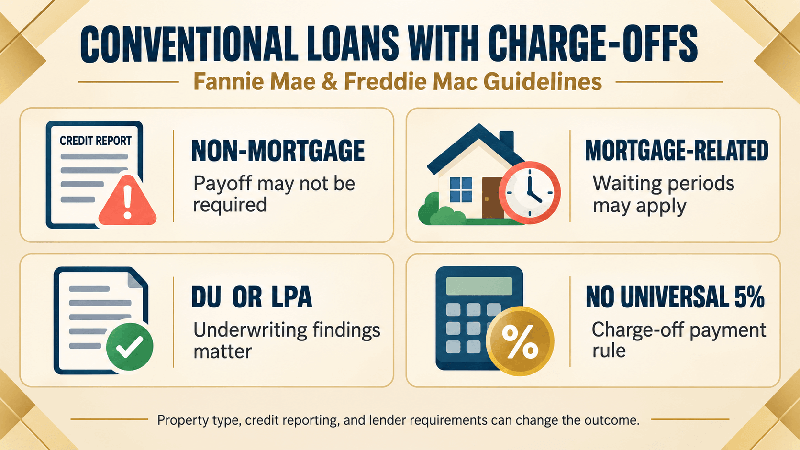
A non-mortgage charge-off does not automatically add a monthly payment to the borrower’s debt-to-income ratio. Fannie Mae and Freddie Mac do not apply a universal 5% hypothetical monthly payment merely because an account is reported as charged off. The lender must determine whether the account may remain unpaid, must be paid at closing, or is connected to another obligation that requires separate treatment. A charge-off may still affect qualification when:
- The borrower has entered into a repayment or settlement agreement
- The creditor has obtained a judgment or lien
- The account is reported as past due instead of charged off
- The underwriting findings require additional documentation
- The lender requires payment through an overlay
Even when no monthly payment is included in the DTI ratio, a required payoff can reduce the money available for the down payment, closing costs, and reserves.
Is 5% of a Charge-Off Balance Used as a Monthly Payment?
No. The Fannie Mae-Freddie Mac charge-off guidelines do not require lenders to treat a non-mortgage charge-off balance as a monthly debt solely because the account remains unpaid.
This rule is sometimes confused with FHA’s treatment of certain non-medical collection accounts. The FHA calculation applies to eligible collection balances, not to every account reported as a charge-off. It should not automatically be applied to a conventional loan.
For a conventional loan, the lender must follow the applicable Fannie Mae or Freddie Mac requirements, the automated underwriting findings, and any lender overlays. The account may be left unpaid, require payment at closing, or need separate treatment if another legal or monthly obligation exists.
Can You Qualify With Multiple Charge-Offs?
Multiple charge-offs do not disqualify borrowers from a conventional mortgage. There are other factors that are measured when Fannie Mae loans go through the DU system. These factors include the number and nature of credit accounts, the seriousness of gaps in payment history, and how long ago the credit issues occurred. Even with multiple charge-offs, the credit profile and overall loan file may be sufficient to result in approval.
How Automated Underwriting Systems Treat Charge-Offs
Most conventional loans are underwritten through one of two systems: Desktop Underwriter (DU) for Fannie Mae, or Loan Product Advisor (LPA) for Freddie Mac.
Each of these systems communicates with credit reporting systems and other sources of risk data, returning a risk assessment and an underwriting recommendation to the lender.
For Freddie Mac loans, as long as the recommendation is “Accept,” it is satisfactory for LPA to have evaluated the borrower’s credit reputation. The lender must comply with the Freddie Mac Guide and Feedback Certificate. An automated approval does not mean the charge-off may be ignored for that loan. The lender must verify and assess the credit report and loan file data.
How Lender Overlays Can Affect Charge-Off Approval
The Fannie Mae-Freddie Mac charge-off guidelines set agency requirements, and meeting those requirements does not mean approval by all lenders. For example, Fannie Mae requires lenders using DU to exercise prudent underwriting judgment, verify the accuracy of submitted information, review the credit report, and investigate any contradictory or derogatory information. Since lenders are liable for their underwriting decisions, some set their own credit standards above the minimum guidelines established by the agencies. Potential borrowers who meet Fannie Mae or Freddie Mac standards but are turned down by one lender may receive a different outcome from a lender that strictly follows the agency guidelines.
Common Charge-Off Problems That Delay Conventional Loan Approval
In conventional loan files reviewed by our mortgage team, charge-off delays often begin with the way an account is reported or handled. The balance alone does not tell the underwriter how the account should be treated.
The Account Is Reported Under the Wrong Status
We have seen accounts that the borrower describes as charge-offs, even though the credit report still lists them as past due. That difference matters. Fannie Mae generally requires a past-due account to be brought current, while some non-mortgage charge-offs may remain unpaid. We have also seen mortgage-related charge-offs mistaken for credit card or personal-loan charge-offs. A mortgage charge-off can trigger a waiting period that does not apply to a non-mortgage account.
The Property Type Changes the Payoff Requirement
A borrower may begin the process believing the property is a one-unit home. The appraisal, purchase contract, or underwriting review may later confirm that it has two units. That change can affect whether non-mortgage charge-offs must be paid. Fannie Mae applies different DU requirements to one-unit primary residences, two- to four-unit primary residences, second homes, and investment properties.
The Borrower Pays an Account Too Soon
Some borrowers pay or settle charge-offs before a loan officer reviews the credit report. We have seen this reduce the money available for the down payment, closing costs, or required reserves. Paying an account does not automatically improve mortgage eligibility. The borrower should first determine whether the account must be paid in accordance with the applicable agency guidelines and lender requirements.
The Same Debt Appears More Than Once
A charge-off may be sold or transferred to a debt collector. The original creditor and the collection company may then appear as separate tradelines. When the credit report does not clearly show that both entries represent the same debt, the lender may request account statements, settlement documents, or written verification. This review can delay underwriting if the documents are not readily available.
An Accurate Tradeline Is Disputed
We have seen borrowers dispute accurate charge-offs shortly before applying for a mortgage because they believe the dispute will improve their credit score. A disputed tradeline can create additional DU documentation requirements. If the borrower is responsible for the account and the information is accurate, the dispute may need to be addressed before the loan can proceed. Borrowers should still dispute information that is genuinely inaccurate or does not belong to them.
A Judgment or Lien Also Exists
A charged-off tradeline and a judgment or lien connected with the same debt are not always treated the same way. The charge-off may be allowed to remain unpaid, while an open judgment or outstanding lien may have to be satisfied before closing. The lender must review each item separately rather than relying solely on the charge-off status.
The Lender Requires More Than the Agency
We have also seen lenders require charge-offs to be paid even when agency guidelines or automated underwriting findings do not impose such a condition. This is a lender overlay. Payoff amounts can also change during loan processing due to accrued interest, collection fees, or updated settlement terms. If payment is required, the lender should obtain a current written payoff early enough to prevent a last-minute shortage or closing delay.
Denied for Conventional Because of Charge-Offs?
Some lenders add overlays or apply FHA collection rules to conventional loans by mistake. We’ll review your file and look for a cleaner Fannie Mae or Freddie Mac path.Hypothetical Conventional Loan Approval Examples
The examples below do not guarantee a loan approval. Loan approval is determined by the review of the completed loan package and the underwriting findings.
Example 1: DU Approval for Non-Mortgage Charge-Offs
The borrower, buying a primary residence, was able to purchase for cash after several old credit card charge-offs, but has since established a credit history with recent credit accounts. Fannie Mae DU does not require payment of the charge-off balance for non-mortgage charge-offs on a primary residence loan. If DU returns an acceptable recommendation for this borrower, charge-offs can be left unpaid, and the loan would still be eligible for acceptance.
Example 2: Charge-Off Information Is Reported Incorrectly
Another borrower has had account information reported as charged off, which the borrower believes is inaccurate. The lender cannot ignore the account. Fannie Mae directs lenders to validate the credit information reviewed by DU and states that DU may require an investigation into disputed accounts. Therefore, it may be necessary to correct the credit report or provide more documents to continue with the loan.
Documents You May Need for Charge-Offs During Underwriting
Not all charge-offs require additional paperwork. The required documentation depends on how the account is reported and its impact on loan eligibility. A lender may request one or more of the following:
- An updated credit report if account information requires clarification.
- Proof of payment if a payoff is required.
- Documentation to substantiate the charge-off or the credit-related disputed information
- Documentation substantiating extenuating circumstances when the borrower is requesting an exception to the waiting period
According to Fannie Mae, lenders are obligated to ensure the validity of the credit information. Borrowers should not pay an old charge-off without first discussing it with the loan officer to determine whether a payoff is required and to assess eligibility.
Steps to Take Before Applying for a Mortgage with Charge-Offs
People with charge-offs should do the following before applying for a conventional loan:
- Credit reports show errors, old charge-offs, duplicate accounts, etc. Check all three reports.
- Do not dispute accurate accounts with the credit reporting agencies. Contact your loan officer first.
- On charge-offs that appear on your report, do not settle the charge-offs just to remove the charge-off from your credit report. It may not be necessary to pay off the charged-off account.
- Keep records of all settlements and accounts that you paid off and accounts that were corrected.
- Be prepared to discuss recent credit issues with the underwriter.
Lenders are required to use the most recent and accurate credit information from Fannie Mae when underwriting a mortgage. Disputed accounts may require further investigation depending on the DU findings.
Final Thoughts on Fannie Mae-Freddie Mac Charge-Off Guidelines
Charge-offs do not mean that a borrower cannot obtain a conventional loan. The Fannie Mae-Freddie Mac charge-off guidelines will vary by agency, underwriting method, type and amount of debt, property type, and overall creditworthiness.
The key is to find out how a specific account must be treated before paying it, and assuming it will cause a denial. Fannie Mae, for example, will have different requirements depending on whether the loan is underwritten with DU or is a manual underwrite loan.
Borrowers with charge-offs should have their credit reports reviewed by a loan officer, along with the credit underwriting findings, to prepare them for the next steps.
FAQs About Conventional Loans and Charge-Offs
What is the Duration of a Charge-Off on a Credit Report?
Adverse information normally stays on a credit report for a period of around seven years. Merely having a charge-off on a credit report does not determine a borrower’s eligibility for a mortgage loan.
Will a Charge-Off be Removed from a Credit Report if the Balance is Paid?
Usually not. Paying or settling a charged-off account generally does not remove accurate negative information from a credit report. The account may instead be updated to show that it was paid or settled.
Will a Charge-Off Impact the Interest Rate of a Conventional Mortgage?
There is no separate Fannie Mae pricing adjustment for a charge-off account. However, a negative credit history can affect the borrower’s credit score. Pricing for conventional loans can vary based on credit score, loan purpose, occupancy, number of units, and other loan factors.
Does a Co-Borrower’s Charge-Off Impact the Mortgage Application?
It can. Per Fannie Mae guidelines, the credit report of any borrower on the loan application with an individual credit record must be requested. A co-borrower’s charge-offs will likely be reviewed during a loan application evaluation. Having an additional borrower does not mean that person’s credit history is disregarded.
Can a Business Charge-Off Affect a Self-Employed Borrower?
Possibly. A charge-off on a business owned by a self-employed borrower, especially if the borrower is personally liable, will be considered during the loan evaluation. Fannie Mae has specific guidelines for business debts that are in a borrower’s name. In some situations, an obligation paid by the business will not be considered the borrower’s personal obligation and will not be included in the borrower’s DTI if the appropriate supporting documentation is provided.
Can You Qualify if a Charge-Off is Paid but Your Credit Score is Still Low?
Paying a charge off does not guarantee a certain credit score or mortgage approval. Fannie Mae uses a borrower’s credit score for certain eligibility and pricing purposes. However, DU has other risk factors in the loan that will be evaluated. A borrower must meet all credit, income, asset, property, and other underwriting requirements.
Can a Debt Collector Still Pursue an Old Charged-Off Debt?
A charge-off for a debt does not mean the debt can no longer be collected. Whether a collector can legally sue to collect an old debt is decided by the state’s statute of limitations for that particular debt. The credit-reporting time limit and the statute of limitations for collecting a debt are distinct issues.
This article about “Fannie Mae-Freddie Mac Charge-Off Guidelines On Conventional Loans” was updated on September 9th, 2026.