Getting approved for a mortgage with marginal credit scores is possible, but the margin for error is smaller. A small score drop, a new account, or a missed payment during the mortgage process can affect your loan options, pricing, or approval status.
The good news is that many borrowers with lower or near-minimum credit scores still qualify every day. The key is choosing the right loan program, understanding where your score stands, and protecting your credit from application to closing.
In this guide, you’ll learn:
- What lenders usually mean by marginal credit scores
- Which mortgage programs may work with lower credit
- How close-to-minimum scores affect approval and pricing
- What can cause problems during underwriting
- How to improve your chances before and during the loan process
Whether you are exploring FHA, VA, USDA, conventional, or non-QM financing, this guide will help you understand what is realistic and what steps can make approval easier.
What Are Marginal Credit Scores?
There is no official mortgage rulebook definition of “marginal credit scores.” In real-world lending, the term usually refers to credit scores that are close to, or not far above, a program’s minimum requirement.
In other words, a borrower may still qualify, but there is less room for error if scores drop, balances rise, or new credit issues appear during the process.
Common real-world examples of marginal credit scores may include:
- an FHA borrower whose score is only modestly above the score needed for the preferred down payment option
- a conventional borrower whose score is just above the minimum commonly needed for approval
- a borrower whose score barely clears a lender’s program threshold
- a borrower whose score could change significantly from a small increase in credit card balances or a new late payment
These are not universal score bands or official government definitions. They are practical examples of how lenders and borrowers often describe borderline credit situations.
The key idea is simple: if you’re applying for a mortgage with marginal credit scores, your file may need extra care from application through closing.
Get approved even with marginal credit
FHA/VA/Non-QM paths with common-sense underwriting and no overlays
Minimum Credit Score Requirements By Loan Type
Understanding credit score guidelines is an important first step if you are trying to qualify for a mortgage with marginal credit scores. The most important thing to know is that credit score minimums are only part of the picture. Approval also depends on the full loan file, including income, assets, debt-to-income ratio, payment history, down payment, loan type, and automated underwriting findings.
FHA Loans
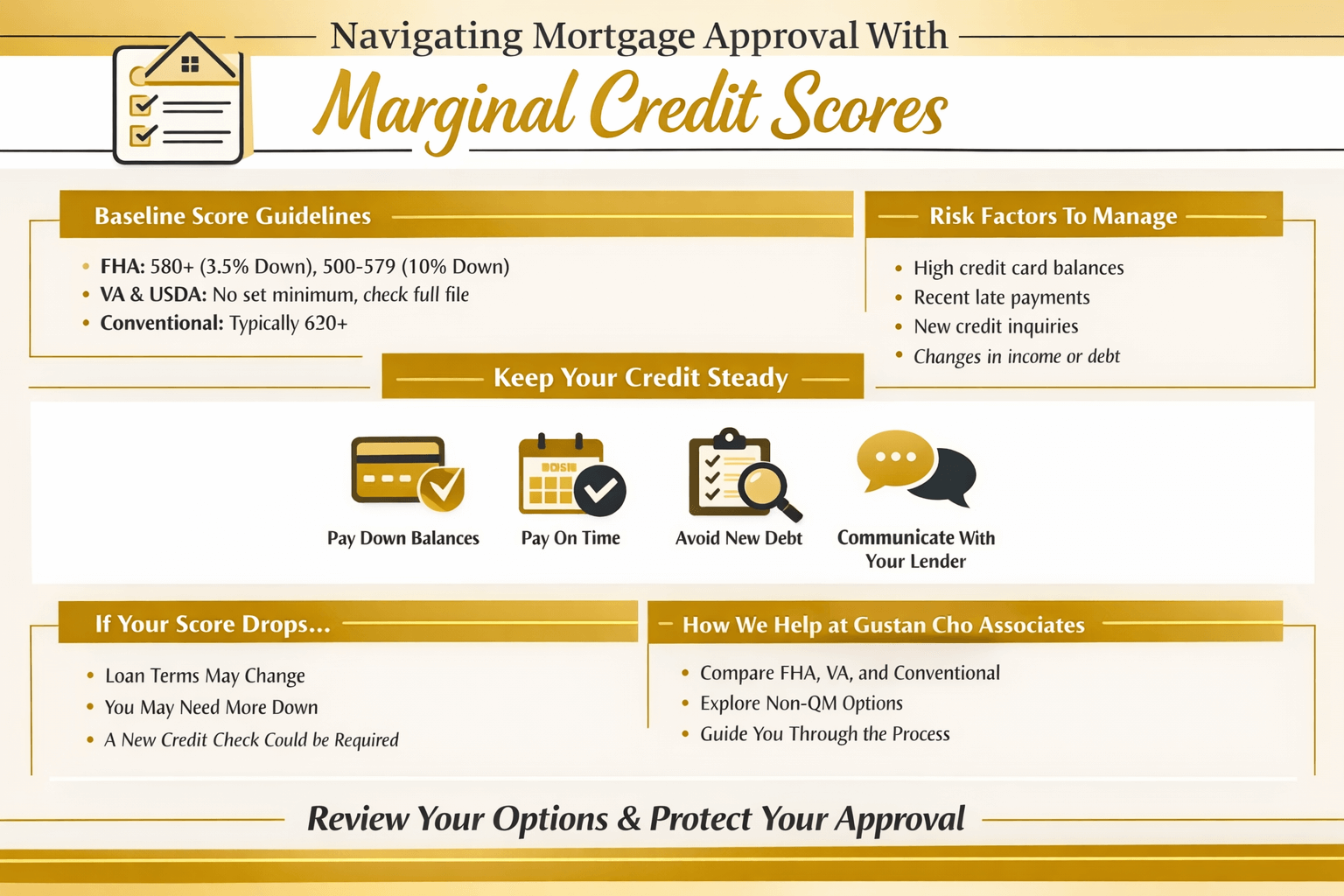
FHA loans are a flexible option for people with lower credit scores. If your credit score is 580 or higher, you can qualify for FHA financing with a 3.5% down payment. If your score is between 500 and 579, you can still qualify, but you will need a 10% down payment.
That said, those are baseline FHA guidelines, not a guarantee of approval. Lenders still review the full file, including income, assets, recent payment history, and underwriting findings. In real-world lending, some lenders add stricter internal requirements, while others stay closer to standard agency guidelines.
For borrowers seeking a mortgage with marginal credit scores, FHA is often the first program worth reviewing because it tends to be more forgiving than many other loan types when the overall file is strong.
Conventional Loans
Conventional loans backed by Fannie Mae or Freddie Mac typically require a credit score of 620 or higher for many programs. For most borrowers, that is the practical floor, not the point where approval becomes easy.
When credit scores are closer to the minimum, approval and pricing can be more sensitive to other parts of the file, such as:
- debt-to-income ratio
- loan-to-value ratio
- cash reserves
- property type
- occupancy type
In other words, a borrower with a 620 score may still qualify, but stronger files usually perform better and may receive more favorable pricing.
VA Loans
VA loans are one of the strongest options for eligible veterans, active-duty service members, and some surviving spouses. The VA itself does not publish one universal minimum credit score for all borrowers, but that does not mean credit is ignored.
Lenders still evaluate the overall credit profile, recent housing history, payment patterns, residual income, and the strength of the full application. Some lenders apply stricter internal standards than others, so the path to approval can vary depending on where you apply.
For borrowers with marginal credit, VA financing can still be a strong option when the rest of the file is stable.
USDA Loans
USDA loans can be a good fit for eligible borrowers in qualifying rural and suburban areas, especially because they offer low-down-payment or no-down-payment options for those who meet income and property requirements.
Credit expectations can vary, but USDA often works best for borrowers who show:
- stable income
- clean recent payment history
- manageable debt
- enough credit depth to support the application
For borrowers with marginal credit scores, USDA may still be possible, but recent late payments or a thin credit profile can make approval more difficult.
Jumbo and Non-QM Loans
Traditional jumbo loans usually require stronger credit profiles than government-backed loans or standard conforming loans. In many cases, borrowers will need higher scores, larger down payments, stronger reserves, and lower overall risk factors.
Non-QM and alternative loan programs may offer more flexibility in certain situations, especially for self-employed borrowers, real estate investors, or applicants with non-traditional income. However, approval still depends on the full file, not just the credit score.
If you are trying to qualify for a mortgage with marginal credit scores, the right program depends on more than just hitting a minimum number. The best path is usually the one that aligns with your full financial picture, not just your score.
Why A Mortgage With Marginal Credit Scores Needs Extra Care
Getting approved for a mortgage with marginal credit scores is possible, but files near the minimum usually need closer attention from application through closing.
The main reason is simple: when your score is close to a program’s cutoff, even a small change can have a bigger impact on your loan options than it would for a borrower with stronger credit. A higher credit card balance, a new inquiry, or a missed payment may not seem major on its own, but it can affect approval, pricing, or down payment requirements when there is very little score cushion.
That does not mean your loan is likely to fall apart. It means planning matters more.
Here are a few reasons borderline credit files need extra care:
- Credit scores can change as account balances update
- Lenders may need to review updated credit information in some situations
- A score that starts just above the minimum may leave less flexibility if something changes during the process
- Lower scores can affect not only approval, but also rate, costs, and loan structure
The goal is not just to qualify at the beginning. It is to stay in a strong enough position all the way to closing.
If you’re dealing with credit scores that are just above the minimum, the best thing you can do is pretty straightforward. Try not to make any big changes to your credit, keep your balances under control, always pay your bills on time, and don’t hesitate to reach out to your loan officer if your financial situation shifts.
How Credit Reports Work During The Mortgage Process
When you apply for a mortgage, the lender typically pulls a Tri-Merge credit report. This report pulls together info from all three big credit bureaus: Experian, Equifax, and TransUnion.
In most cases, lenders use your middle score from those three bureaus when reviewing your application.
That original credit report is often valid for a limited period during the loan process. If your loan closes within that window and nothing major changes, the lender will usually continue using the same report and scores during underwriting, which is the lender’s final review of your income, assets, credit, and overall loan file before closing.
However, there are situations where the lender may need to re-pull your credit, which means checking your credit again. If that happens, the lender may have to use the updated scores instead of the original ones.
This can matter more for borrowers applying for a mortgage with marginal credit scores, because even a small score drop could affect loan options, pricing, or minimum requirements.
A new credit check may be needed if:
- The original credit report expires before closing
- You make a major change to the application
- You add a co-borrower, meaning another person who applies for the loan with you
- The lender needs updated information before issuing final approval
The key takeaway is simple: your credit does not only matter on the day you apply. It can still matter throughout the mortgage process, especially if updated credit information is needed before closing.
Keep DTI inside approval range
Targeted paydowns and term choices to meet ratio limits
Situations That Can Trigger A New Credit Pull
Lenders do not always need to recheck your credit, but certain changes during the mortgage process may trigger an updated credit review. If you are applying for a mortgage with marginal credit scores, this matters because even a small score change can affect your loan options.
A simple way to think about it is this:
Changes That Often Matter
These are the situations most likely to lead to a new credit check or updated file review:
- Your original credit report expires before closing
- You add or remove a borrower from the application
- You apply for new credit, such as a credit card, auto loan, or financing plan
- You take on new debt that changes your debt-to-income ratio
- You make a major change to the loan program or loan structure
Changes That May Require Review
These situations do not always trigger a new credit pull, but they may cause the lender to take a closer look at your file:
- There is an error or missing information in the original application
- The lender needs updated documents to clear final approval
- Your bank statements or other documents suggest new debt or recent credit activity
- The lender needs to confirm that your financial profile is still consistent before closing
Changes To Avoid Without Telling Your Loan Officer
These are the moves most likely to create problems if your score is already close to a program minimum:
- opening a new credit card
- financing furniture, appliances, or a car before closing
- allowing credit card balances to rise sharply
- missing any payment during the loan process
- co-signing for someone else’s loan
- transferring large balances or making unusual credit changes without asking first
The safest approach is simple: before making any credit-related decision during the mortgage process, check with your loan officer first. That small step can help you avoid surprises and protect your approval through closing.
Do’s And Don’ts When You Have Marginal Credit Scores
If you are applying for a mortgage with marginal credit scores, the goal is simple: keep your credit profile as stable as possible from application to closing. Small changes that might not matter for a stronger borrower can have a bigger impact when your score is close to a program minimum.
Don’ts During The Mortgage Process
Avoid these moves unless your loan officer specifically tells you otherwise:
- Do not open new credit cards or loans
- Do not finance furniture, appliances, or a vehicle before closing
- Do not let your credit card balances rise
- Do not miss any payment, even by a few days
- Do not co-sign for someone else’s debt
- Do not make major credit changes without asking first
One area that deserves extra care is credit disputes. Do not add or remove disputes during the mortgage process without checking with your loan officer first, because it can affect how your credit is evaluated and, in some cases, your score.
Smart Moves That Can Help Protect Your Approval
These steps can help keep your file more stable during the loan process:
- Keep revolving balances as low as possible
- Make every payment on time
- Set up automatic payments if needed
- Respond quickly to document requests from your lender
- Tell your loan officer right away if anything changes with your income, debt, or credit
The Main Goal
The goal is not just to get approved at the start. It is to stay in a strong enough position all the way to closing. When your score is near the minimum, steady credit habits can make a meaningful difference.
What Happens If Your Credit Score Drops During The Process?
If you are applying for a mortgage with marginal credit scores, a score change during the loan process does not always mean the deal is over. What matters most is how much the score changes, whether it stays above the program minimum, and whether the lender has to check your credit again before closing.
If Your Score Stays Above The Minimum
If your score drops a little but still remains above the minimum needed for your loan program, your mortgage may still move forward.
However, a lower score can still affect:
- Your interest rate
- Lender fees or pricing
- The amount of flexibility in underwriting
- Which loan option gives you the best overall value
In many cases, the loan can still proceed, but the lender may take a closer look at the file or re-run pricing based on the lower score.
If Your Score Falls Below The Minimum
If your score drops below the program’s minimum, your options may change.
Depending on the loan type, you may need to:
- Switch to a different loan program
- Bring in a larger down payment
- Improve your score before closing
- Delay the transaction until the file is stronger
For example, a borrower who starts just above a key threshold may find that a small score drop changes down payment requirements or limits available loan choices.
If The Lender Must Re-Check Your Credit
Sometimes the biggest issue is not the score drop itself, but the need for updated credit information before closing. If the lender must recheck your credit, they may have to use the newer score instead of the original one.
This can matter if:
- The original credit report expires
- The application changes
- A borrower is added or removed
- The lender needs updated information for final approval
For borrowers with marginal credit scores, it is so important to avoid unnecessary credit changes during the mortgage process.
The Bottom Line
A score drop does not always lead to a denial, but it can affect your pricing, loan structure, or available options. The best strategy is to protect your credit from the day you apply until the day you close.
Price smart with points vs. lender credits
Balance upfront cost and monthly savings for your budget
How Gustan Cho Associates Helps Borrowers With Marginal Credit
Borrowers applying for a mortgage with marginal credit scores often need more than a basic rate quote. They usually need help identifying which loan programs are realistic, what credit issues may affect approval, and how to avoid changes that could create problems before closing.
At Gustan Cho Associates, our role is to help borrowers review available options based on the full file, not just the credit score alone.
That may include:
- Comparing FHA, VA, conventional, USDA, and non-QM options
- Reviewing whether a borrower’s current score range fits the loan program they want
- Identifying when compensating factors, such as reserves, down payment, or lower debt, may strengthen the file
- Helping borrowers understand how to protect their credit during the mortgage process
- Reviewing alternative paths when a standard loan may not be the best fit
For borrowers with borderline credit, the goal is not just to find a program that works today. It is to choose a loan structure that remains workable through underwriting and closing.
A lender experienced with lower-credit files can explain the trade-offs between programs, identify avoidable risks, and help borrowers make more informed decisions before they move forward.
Take The Next Step Toward Homeownership With Marginal Credit
Getting approved with borderline credit is possible, but the best results usually come from choosing the right loan program early and avoiding credit mistakes during the process.
If your score is close to a program minimum, it can help to review your options before you start shopping for a home or making major financial changes. A careful review can show which loan programs may be a good fit, what issues may need attention, and what steps can help keep your approval on track.
If you would like help comparing FHA, VA, USDA, conventional, or non-QM options, you can reach out to Gustan Cho Associates for guidance on the next step.
Frequently Asked Questions About Mortgage with Marginal Credit Scores:
Can I Get a Mortgage with a Credit Score of 580?
You can totally still get a mortgage with marginal credit scores, like around 580. FHA is often the first program borrowers review at that level because 580 is commonly associated with the lower 3.5% down payment threshold. However, final approval still depends on the full file, not just the score.
Can I Buy a House with a Credit Score Below 620?
Yes, it may still be possible, especially through FHA or certain non-QM options. Conventional loans often start around 620 for many borrowers, so scores below that usually require looking at other loan types, stronger compensating factors, or a different approval strategy.
What is the Minimum Credit Score for an FHA Loan?
FHA usually lets borrowers with a credit score of 580 and up qualify for a mortgage with just a 3.5% down payment. If your score is between 500 and 579, you can still get a loan, but you’ll need to put down 10%. These are the basic FHA rules, but remember that lenders will also look at your income, assets, payment history, and other factors during the review process.
Will Applying for a Mortgage Hurt My Credit Score?
A mortgage application usually creates a hard inquiry, which can cause a small score drop. However, mortgage-rate shopping within a short period is generally treated more favorably by scoring models than applying for multiple unrelated credit accounts, so the bigger risk is often opening new debt during the process, not comparing mortgage offers.
How Can I Improve My Credit Score Before Applying for a Mortgage?
The most practical steps are usually to pay down credit card balances, make every payment on time, avoid opening new accounts, and keep your overall credit activity steady. For borrowers trying to qualify for a mortgage with marginal credit scores, even a small bump in your score can open up more loan options and help you get better rates.
Is an FHA Easier to Qualify for Than a Conventional Loan?
For many borrowers with lower credit scores, FHA is often easier to qualify for than conventional financing because its credit score and down payment requirements are more flexible. Conventional loans may still work well for stronger files, but borrowers near minimum credit thresholds often compare FHA first because conventional approval and pricing can become more sensitive as scores fall closer to the floor.
This article about “Mortgage With Marginal Credit Scores: How To Qualify” was updated on March 5th, 2026.
Talk to a lender who does tough loans daily
Expert guidance for marginal credit—fast answers, no runaround