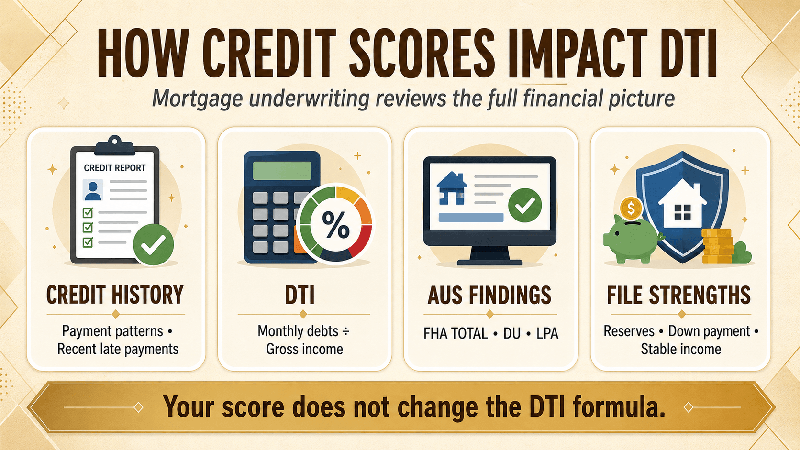
Understanding how credit scores impact DTI starts with one important fact: your credit score does not change the mathematical calculation of your debt-to-income ratio. DTI is calculated by dividing qualifying monthly debt payments by gross monthly income. However, mortgage underwriters and automated underwriting systems review your credit history alongside your DTI, income, assets, reserves, loan-to-value ratio, and payment history. A stronger overall file may support approval with a higher DTI. In comparison, a weaker file may require lower debt or documented compensating factors.
Credit Score and DTI Measure Different Risks
A credit score and a debt-to-income ratio answer two different underwriting questions. A credit score helps predict a borrower’s likelihood of repaying debt based on information in the credit report. DTI measures whether the borrower’s current gross monthly income can support existing obligations and the proposed housing payment.
A borrower can have a high credit score but also have a high DTI. That borrower may have an excellent payment history, but very little monthly income remaining after paying debts. Another borrower may have a low DTI but weaker credit because of recent late payments, collections, or other credit problems. The second borrower may have more room in the monthly budget but a higher history-based repayment risk.
This distinction is central to understanding how credit scores impact DTI during mortgage underwriting. The score does not change the DTI percentage. Instead, the lender or the automated underwriting system evaluates both measures, along with income stability, assets, reserves, loan-to-value ratio, payment history, and the requested loan program. A strong credit score cannot always overcome a DTI that is too high for the applicable guidelines or AUS findings. Likewise, a low DTI does not erase serious credit problems. Mortgage approval depends on how the complete file fits together, including whether other strengths can serve as acceptable compensating factors.
How Mortgage Lenders Calculate DTI
Mortgage lenders calculate DTI by dividing qualifying monthly debt payments by qualifying gross monthly income. Gross income refers to earnings prior to the deduction of taxes and other payroll expenses. The lender must first determine which income is stable, documented, and eligible under the selected loan program. Front-end DTI measures only the proposed housing payment. Depending on the property and loan, the housing payment may include principal, interest, property taxes, homeowners’ insurance, mortgage insurance, homeowners’ association dues, and other required housing expenses. Front-end DTI = Monthly housing payment ÷ Gross monthly income Back-end DTI includes the full housing payment plus qualifying monthly obligations such as:
- Credit card minimum payments
- Auto and personal loans
- Student loan payments
- Other mortgage or housing obligations
- Child support and alimony when required
- Other recurring debts that must be counted
Back-end DTI = Housing payment plus other monthly debts ÷ Gross monthly income For example, assume a borrower earns $6,000 in qualifying gross income each month. The proposed housing payment is $1,800, and other qualifying monthly debts total $900. The front-end DTI is 30% because $1,800 divided by $6,000 equals 30%. The back-end DTI is 45% because the combined $2,700 in monthly obligations divided by $6,000 equals 45%. A credit score is not included in either calculation. Understanding how credit scores impact DTI requires looking beyond the formula. After calculating the ratio, the lender and the automated underwriting system evaluate whether the DTI is acceptable when combined with the borrower’s credit history, assets, reserves, loan-to-value ratio, and other risk factors.
Why Two Borrowers With the Same DTI May Get Different Results
Two borrowers can have the same debt-to-income ratio and receive different mortgage underwriting results because DTI is only one part of the risk assessment. Automated underwriting systems and mortgage underwriters also review credit history, payment patterns, income stability, assets, reserves, loan-to-value, property type, occupancy, and the selected loan program. Consider two borrowers, each with a 48% back-end DTI.
Borrower one has a long history of on-time payment of obligations, stable employment, documented cash reserves, a manageable increase over the current housing payment, and no recently opened debt. These strengths help support the loan and could result in an acceptable AUS recommendation, depending on the program and the complete file.
Borrower two has the same 48% DTI but also has recent late payments, limited savings, several newly opened accounts, unstable income, and a large increase from the current housing payment. The combined risks may produce a refer, caution, or ineligible result. The borrower might need to lower the monthly debt, document additional eligible income, provide compensating factors, or consider another loan program. This comparison demonstrates how credit scores impact DTI without changing the actual ratio. The credit score and underlying credit history help describe past repayment risk, while DTI measures current payment capacity. AUS findings consider how those risks interact with the rest of the application. A higher score does not guarantee approval at a high DTI, and a lower score does not automatically mean denial. The final result depends on the full mortgage profile, applicable underwriting guidelines, accurate application data, and any lender overlays.
How FHA TOTAL Reviews Credit and DTI
FHA’s Technology Open To Approved Lenders Mortgage Scorecard, known as FHA TOTAL, evaluates the borrower’s overall creditworthiness using credit and loan-application information. TOTAL is accessed through an automated underwriting system, but TOTAL is not an AUS by itself. The system reviews the combined risk in the mortgage application. Relevant information may include the borrower’s credit history, monthly debts, qualifying income, DTI, available assets, reserves, loan amount, loan-to-value, and other application data. This broader review helps explain how credit scores impact DTI without changing the DTI calculation. FHA TOTAL provides two processing classifications:
- Accept: The loan may proceed without a standard manual underwriting review unless FHA guidelines require a manual downgrade.
- Refer: The file must be manually reviewed by an FHA Direct Endorsement underwriter.
An Accept classification does not mean the loan is automatically approved. The lender must still verify the borrower’s income, assets, debts, credit information, employment, and property eligibility. The lender must also confirm that the loan satisfies all applicable FHA requirements. A Refer classification does not automatically mean the borrower is denied. It means a qualified underwriter must review the mortgage in accordance with FHA’s manual underwriting guidelines. DTI limits, credit history, housing payment history, reserves, and acceptable compensating factors become especially important during that review. Borrowers should not assume that a particular credit score creates an automatic FHA AUS DTI limit. FHA TOTAL evaluates the complete risk profile, and HUD states that a mortgagee may not accept or deny an FHA-insured mortgage solely based on the TOTAL assessment. The final decision must follow the FHA Single Family Housing Policy Handbook and applicable lender requirements.
FHA AUS Approval Versus Manual Underwriting
 Most FHA mortgage applications are submitted through an automated underwriting system connected to FHA TOTAL. The system evaluates credit and application information and provides findings indicating how the file should be processed.
An acceptable AUS result allows the lender to process the application without standard manual underwriting unless FHA requires a manual downgrade. However, AUS approval is not final loan approval. The lender must still verify the income, employment, assets, debts, credit history, property information, and other data used to obtain the findings. Incorrect or changed information may require the file to be resubmitted.
Manual underwriting is required when FHA TOTAL returns a Refer classification or when FHA guidelines require the lender to downgrade an otherwise acceptable AUS result. A qualified FHA Direct Endorsement underwriter then reviews the borrower’s complete financial history instead of relying on the automated risk assessment. During manual underwriting, the underwriter pays close attention to:
- Recent housing and debt-payment history
- The reason for past credit problems
- Income and employment stability
- Front-end and back-end DTI
- Cash reserves after closing
- Payment shock
- New or undisclosed debt
- Acceptable compensating factors
This process demonstrates how credit scores impact DTI differently under AUS and manual underwriting. An AUS evaluates the combined risk in the electronic loan file. Manual underwriting applies FHA’s published ratio requirements and compensating-factor rules more directly. Manual underwriting is not automatically easier than AUS approval. It requires additional documentation and a clear explanation of how the borrower can manage the proposed mortgage payment. Some lenders also impose overlays or do not offer manual underwriting for FHA loans, even when HUD guidelines permit it. Borrowers who receive a Refer result may therefore have different options depending on the lender reviewing the application.
FHA Manual Underwriting and Compensating Factors
FHA manual underwriting uses published front-end and back-end DTI limits. The maximum ratios depend on the borrower’s minimum decision credit score and whether the file contains compensating factors that meet HUD’s documentation requirements. The general FHA manual underwriting limits are:
- 31% front-end and 43% back-end: Standard ratios with no compensating factors required.
- 37% front-end and 47% back-end: Available to borrowers with a minimum decision credit score of at least 580 and one acceptable compensating factor.
- 40% front-end and 40% back-end: Available to borrowers with a minimum decision credit score of at least 580 and no discretionary debt.
- 40% front-end and 50% back-end: Available to borrowers with a minimum decision credit score of at least 580 and at least two acceptable compensating factors.
Borrowers with a minimum decision credit score from 500 to 579, or borrowers with nontraditional or insufficient credit, generally cannot use compensating factors to exceed the standard 31%/43% ratios. FHA provides limited ratio flexibility for qualifying energy-efficient homes. HUD recognizes the following compensating factors:
- Verified and documented cash reserves: Generally, at least three total monthly mortgage payments for a one- or two-unit property or six payments for a three- or four-unit property.
- Minimal increase in housing payment: The proposed mortgage payment must meet HUD’s payment-increase limits and be supported by an acceptable 12-month housing payment history.
- No discretionary debt: The borrower must have established credit, carry no qualifying discretionary debt, and document a history of paying revolving accounts in full.
- Significant additional income not used to qualify: The borrower has documented income that cannot yet be included as effective income but meets HUD’s history and continuance requirements.
- Residual income: The borrower has enough qualifying income remaining after monthly obligations and household expenses under HUD’s residual-income standards.
This framework illustrates how credit scores impact DTI during FHA manual underwriting. A score of at least 580 may allow the underwriter to consider approved compensating factors for higher ratio limits. The score does not affect the DTI calculation, nor does it guarantee approval. Compensating factors must be documented and recorded in the underwriting file. Stable employment, a good explanation for past credit problems, or a large down payment may strengthen the application, but they do not automatically qualify as HUD-approved compensating factors. The underwriter must still determine that the borrower has demonstrated the ability and willingness to manage the proposed mortgage payment.
High DTI or Low Credit Score? You May Still Have Options
FHA, VA, conventional, USDA, jumbo, and Non-QM loans may treat credit scores and DTI differently. Get a side-by-side review before assuming you cannot qualify.How Conventional Underwriting Reviews Credit and DTI
Conventional lenders commonly use Fannie Mae’s Desktop Underwriter (DU) or Freddie Mac’s Loan Product Advisor (LPA) to evaluate a mortgage application. These automated underwriting systems review the borrower’s full financial profile—not just one credit score or DTI percentage.
The review may include payment history, recent late payments, credit-card use, monthly debts, income, cash reserves, down payment, property type, and loan-to-value ratio. According to Fannie Mae, a high DTI may have a greater negative effect when the loan also has other high-risk factors.
This helps explain how credit scores impact DTI during conventional underwriting. A credit score does not change the DTI calculation, but credit strength can affect how the complete loan file is viewed. Two borrowers with the same DTI may receive different findings because one has a stronger credit history, more reserves, or a larger down payment. Fannie Mae also notes that DU performs its own review of the information in the borrower’s credit report. However, lenders still use credit scores to determine loan eligibility, interest rates, and potential mortgage insurance requirements. A lower score may make a high-DTI application more difficult or expensive, even if it does not create a separate DTI limit. Approval ultimately depends on the AUS findings, the conventional loan program, mortgage insurance rules, and any additional lender requirements. Borrowers with higher DTI ratios may improve their files by reducing their monthly debt, increasing their down payment, building reserves, or correcting credit report problems before applying.
Fannie Mae DU DTI Limits and Risk Factors
Fannie Mae’s Desktop Underwriter, commonly called DU, permits a maximum debt-to-income ratio of 50% for eligible loan casefiles. However, a 50% DTI is a maximum limit—not an automatic approval level. A borrower can receive an unfavorable finding with a DTI below 50% if the rest of the loan carries too much risk. Fannie Mae’s DTI guidelines confirm that DU-underwritten loans cannot exceed the 50% maximum.
DU evaluates the complete loan application. Its review includes the borrower’s payment history, late payments, revolving credit use, installment debt, available reserves, down payment, loan-to-value ratio, housing expense, property type, occupancy, and loan purpose.
A lower DTI usually presents less risk. As the DTI increases, the application may need stronger factors elsewhere. Fannie Mae states that a high DTI has the greatest negative effect when it appears with other high-risk factors. For example, a high DTI combined with limited reserves, recent late payments, high credit-card use, or a small down payment may weaken the DU findings. Understanding how credit scores impact DTI requires looking beyond the numbers alone. A credit score does not change the DTI calculation, and Fannie Mae does not publish a rule guaranteeing approval for a certain score-and-DTI combination. DU reviews the credit report and overall loan profile to assess how much risk the factors collectively pose. A borrower with a 48% DTI could receive an Approve/Eligible finding, while another borrower with a 42% DTI might not. The difference could involve payment history, credit depth, reserves, down payment, loan type, or other application details. Lender overlays, mortgage insurance requirements, and changes in debt or income before closing may also affect the final approval.
How PMI and Lender Overlays May Affect Approval
PMI (private mortgage insurance) is required on a conventional loan if the loan-to-value ratio is over 80%. The PMI premium protects the lender if the borrower defaults, but it also adds to the borrower’s monthly housing payment. Because monthly PMI is included in the qualifying housing expense, it can increase the borrower’s debt-to-income ratio. A borrower whose DTI is already close to the allowable limit could have difficulty qualifying once the final PMI premium is added. The cost can vary based on the credit profile, down payment, loan type, and mortgage insurance provider. The mortgage must also meet applicable mortgage insurance requirements. A borrower may receive an Approve/Eligible finding from Desktop Underwriter, but the lender must still obtain the required amount of eligible mortgage insurance coverage. Fannie Mae publishes specific mortgage insurance coverage requirements based partly on the loan-to-value ratio and transaction type. Lender overlays can create another approval hurdle. An overlay is a rule that is stricter than the minimum requirement established by Fannie Mae, Freddie Mac, or the automated underwriting system. For example, a lender may require a higher credit score, a lower DTI, more cash reserves, or a longer period of on-time payments. This is another example of how credit scores affect DTI without changing the DTI formula itself. A lower credit score can lead to a higher PMI premium, increasing housing payments and the debt-to-income (DTI) ratio. The lender may also impose a lower maximum DTI because of its own risk standards. Borrowers who qualify under agency guidelines but are denied because of an overlay may still have options with another lender. Mortgage insurance pricing, lender overlays, and underwriting policies can differ, so an unfavorable result from one lender does not always mean the borrower is ineligible for a conventional mortgage.
Mortgage Examples With the Same DTI but Different Profiles
The debt-to-income ratio is only one part of a mortgage decision. The following hypothetical borrowers each have a 46% DTI, but their credit histories, assets, and loan details create different levels of risk.
Borrower One: Strong Credit and Cash Reserves
Borrower One has a 740 credit score, no recent late payments, low credit-card balances, a 10% down payment, and six months of mortgage reserves after closing. The borrower has also worked in the same field for several years. Although the 46% DTI is relatively high, the strong payment history, reserves, and down payment may help the file receive favorable automated underwriting findings.
Borrower Two: Recent Late Payments and Limited Funds
Borrower Two also has a 46% DTI but a 640 credit score, a recent 30-day late payment, high credit card use, a 3% down payment, and little money remaining after closing. This borrower may receive a less favorable AUS result because the high DTI appears with several other risk factors. A lender or mortgage insurance provider may also apply stricter requirements. Reducing debt, improving recent payment history, or saving additional reserves could strengthen the application.
Borrower Three: Average Credit but a Larger Down Payment
Borrower Three has the same 46% DTI, a 680 credit score, no recent late payments, a 20% down payment, and several months of reserves. The larger down payment lowers the loan-to-value ratio and removes the need for PMI. Even though this borrower’s credit score is lower than Borrower One’s, the additional equity and the absence of PMI may improve the overall loan profile. Removing PMI also lowers the qualifying housing payment compared with a similar loan requiring mortgage insurance. These examples show how credit scores impact DTI as part of the complete underwriting decision. The score does not change the DTI formula, but credit history, reserves, down payment, PMI, and other risk factors can affect whether a particular DTI is acceptable. An AUS approval is never based on a single number. The lender must verify the information used for underwriting, follow the AUS findings, and confirm that the loan meets all program, investor, and mortgage insurance requirements.
Ways to Improve Approval With a High DTI
A high debt-to-income ratio does not always prevent mortgage approval. If the DTI is within the loan program’s limit, the borrower may improve the application by lowering monthly obligations or strengthening other parts of the loan profile.
Reduce Monthly Debt Payments
Paying off a car loan, personal loan, or credit-card balance may lower DTI if the monthly payment can be excluded under the applicable guidelines. Paying down a balance without reducing or removing the required payment may not change the DTI. Before using money to pay off debt, ask the loan officer to calculate how the payment would affect qualification. The borrower should also avoid using funds needed for the down payment, closing costs, or reserves. Fannie Mae provides specific rules for debts paid off at or before closing.
Confirm All Eligible Income
Make sure the application includes all stable, documentable income permitted by the loan program. This may include base pay, overtime, bonuses, commissions, retirement income, Social Security, alimony, rental income, or a second job. Income cannot be added simply to lower the ratio. The lender must verify that it meets the program’s requirements for history, stability, and continuance.
Consider a Lower Loan Amount
A larger down payment or lower purchase price can reduce the mortgage payment and DTI. A larger down payment may also lower or eliminate PMI, depending on the loan-to-value ratio. The borrower should still keep sufficient funds for closing costs, emergency expenses, and any reserves required by the AUS or the lender.
Build Cash Reserves
Cash reserves do not directly lower DTI, but they may strengthen the overall application. Reserves show that the borrower may have funds available to make mortgage payments after an unexpected expense or loss of income. Fannie Mae’s DU considers higher liquid reserves more favorable than limited or no reserves. However, reserves do not guarantee approval or allow a borrower to exceed the program’s maximum DTI.
Protect the Credit Profile
Understanding how credit scores impact DTI is important when preparing a high-DTI mortgage application. A credit score does not change the DTI formula, but recent late payments, new debt, high revolving balances, or several new credit inquiries may add risk to an already tight loan file. Continue making every payment on time and avoid opening new accounts before closing. A new car loan, personal loan, or credit-card balance could raise the DTI and require the lender to underwrite the mortgage again.
Review Other Programs and Lenders
FHA, VA, USDA, Fannie Mae, and Freddie Mac do not evaluate every application in the same way. Lenders may also impose overlays that are stricter than the agency’s minimum requirements. A borrower who does not qualify with one lender may have options through another lender or loan program. The best approach is to correct the application, compare eligible programs, and rerun the AUS using accurate income, debt, asset, and property information.
Final Thoughts About How Credit Scores Impact DTI
Understanding how credit scores impact DTI starts with knowing that these numbers measure different risks. A credit score reflects how a borrower has managed credit, while DTI measures how much qualifying monthly income is needed to cover housing expenses and other debts.
A higher credit score does not change the DTI formula or guarantee approval with a high ratio. A lower score does not automatically create a fixed DTI limit. The AUS reviews credit history, payment patterns, income, debts, reserves, down payment, loan-to-value ratio, and other details together.
FHA and conventional underwriting systems may reach different results on the same borrower. Manual underwriting rules, compensating factors, PMI requirements, and lender overlays may also affect the final decision. If one lender denies a mortgage because of credit or DTI, the borrower may still have options. An experienced loan officer can review the complete profile, identify the actual approval problem, compare eligible loan programs, and determine whether lowering debt, building reserves, changing the loan amount, or using a lender without additional overlays could help.
Frequently Asked Questions About Credit Scores and DTI
Can You Get a Mortgage With Collection Accounts?
Yes. Collection accounts do not automatically prevent mortgage approval. The lender will review the type, balance, age, and loan program. FHA may require the lender to use a payment equal to 5% of the total outstanding balance of certain nonmedical collections when the combined balance is at least $2,000. The borrower may instead pay the accounts or document an approved payment arrangement. Conventional treatment depends on the AUS findings, property type, and applicable agency rules.
How Are Student Loans Counted When the Reported Payment Is Zero?
The answer depends on the mortgage program. Fannie Mae may permit a documented $0 income-driven payment. If a loan is deferred or in forbearance, Fannie Mae generally requires either 1% of the balance or a fully amortizing payment. Freddie Mac requires a payment amount greater than 0, while FHA generally uses 0.5% of the outstanding balance when the credit report shows a $0 payment.
Does a 401(k) Loan Count Against Mortgage DTI?
A loan secured by the borrower’s own 401(k) or another qualifying financial asset may not need to be included in DTI under Fannie Mae guidelines. The lender must document that the financial asset secures the loan. If the borrower also wants to use that account as reserves, the lender must reduce its available value by the loan proceeds and related fees.
Can Adding a Co-Borrower Lower DTI?
Adding a co-borrower can lower the combined DTI if the additional qualifying income exceeds the debts being added. However, the lender must also consider the co-borrower’s credit history, monthly obligations, and eligibility. A co-borrower with high debt or weak credit could make the application less favorable. Non-occupant co-borrowers may also be subject to additional loan-program rules.
Is Current Rent Included in DTI When Buying a Primary Home?
For a primary home purchase, the proposed mortgage payment generally replaces the borrower’s current rent as the qualifying housing expense. The lender does not normally add both payments simply because the borrower is renting at the time of application. However, rental payment history may still be reviewed. Different treatment may apply to non-occupant borrowers and people purchasing second homes or investment properties.
Can a Debt Be Excluded if Someone Else Makes the Payments?
Possibly. Fannie Mae may allow certain debts to be excluded when another person has made the payments from their own funds for the most recent 12 months with no late payments. The lender will normally require canceled checks or bank statements. Mortgage debts have additional requirements, including that the person making the payments must also be obligated on the mortgage.
Do Utilities, Groceries, and Insurance Count in Mortgage DTI?
Everyday living expenses such as groceries, utilities, gasoline, internet service, and health or auto insurance are generally not included as separate debts in the mortgage DTI calculation. However, property taxes, homeowners’ insurance, flood insurance, HOA dues, and mortgage insurance are included when they are part of the proposed housing expense.
Does a Car Lease Count if It Ends Soon?
Yes. Fannie Mae generally counts a vehicle lease payment regardless of how many months remain because the borrower may lease or purchase another vehicle when the current lease ends. A standard auto loan is treated differently. An installment loan with ten or fewer payments remaining may sometimes be excluded, but the lender can still count it if the payment significantly affects the borrower’s ability to meet other obligations.
This article about “How Credit Scores Impact DTI When Applying for a Mortgage” was updated on August 31st, 2026.