
An FHA loan in Montana may be a suitable choice for people who have only limited savings or who have less-than-excellent credit. In order to obtain such a loan, a down payment of 3.5% is required if the credit score is 580 or above, whereas those with a score between 500 and 579 can qualify by putting down 10%. Approval also varies according to income, debts, credit history, the property’s eligibility, and the lender’s underwriting requirements.
FHA Loan Requirements in Montana
Federal Housing Administration-insured loans are provided by lenders who have been approved by the FHA and are open to both first-time and experienced homebuyers, with no requirement for first-time buyers.
The property had to be used as the main residence by the borrower; acceptable types of property included single-family homes and those with four units or fewer, on the condition that the borrower occupied the property and it complied with FHA requirements.
Approval is based on the complete loan file. The lender reviews qualifying income, employment history, monthly debts, credit, and funds available for the transaction. FHA sets the program guidelines, but individual lenders may have additional requirements of their own.
FHA Loan Limits in Montana
The FHA loan limits in Montana vary by county. Montana one-unit limits range from $541,287 to $754,400, depending on the county. Counties with higher property values will have correspondingly higher limits. The limit also increases for two-, three-, and four-unit properties. Buyers should check the specific county limit before making an offer because the maximum FHA loan amount may differ from one part of Montana to another. HUD publishes the current limits via its official FHA Mortgage Limits lookup tool.
FHA Credit Score and Down Payment Requirements
FHA’s minimum guidelines connect the required down payment to the borrower’s credit score. A borrower with a minimum decision credit score of 580 or higher may be eligible for an FHA loan in Montana with 3.5% down. A score between 500 and 579 generally requires at least 10% down because FHA limits the loan-to-value ratio to 90%.
Borrowers with credit scores under 500 cannot qualify for FHA-insured financing. Meeting the minimum score and down payment requirements does not guarantee approval. The lender must also review income, employment, debts, payment history, available funds, and the property being financed.
Some lenders require higher credit scores than the FHA’s minimum standard. These additional requirements are lender overlays. Eligible gift funds or approved down payment assistance may be used when properly documented, but the source of the money must meet FHA requirements.
Debt-to-Income Guidelines for Montana FHA Loans
FHA does not impose one debt-to-income limit on every borrower. An FHA loan in Montana that receives approval through FHA’s automated underwriting system may be eligible with higher ratios when the complete application is acceptable. Manually underwritten loans follow a more specific DTI matrix. For manual underwriting, FHA generally permits:
- 500–579 credit score or no credit score: Maximum 31% housing DTI and 43% total DTI.
- 580 or higher: Up to 31%/43% without compensating factors.
- 580 or higher: Up to 37%/47% with verified cash reserves, a minimal increase in the housing payment, or sufficient residual income.
- 580 or higher: Up to 40%/40% when the borrower has no discretionary debt.
- 580 or higher: Up to 40%/50% with at least two approved compensating factors.
Approved factors for the 40%/50% tier include verified cash reserves, a minimal housing-payment increase, significant additional income not used as qualifying income, and sufficient residual income. Cash reserves must generally equal at least three monthly mortgage payments for a one- or two-unit property, or six payments for a three- or four-unit property. A minimal housing payment increase means the new payment does not exceed the current payment by more than the lesser of $100 or 5%, provided there is an acceptable 12-month payment history. No ratio or compensating factor guarantees approval. The underwriter must document that the complete loan file meets FHA requirements, and individual lenders may apply additional restrictions.
Manual Underwriting for Montana FHA Borrowers
Manual underwriting may provide another path when an FHA loan application does not receive an automated approval. Instead of relying primarily on FHA’s TOTAL Mortgage Scorecard, an underwriter reviews the borrower’s income, assets, debts, credit history, housing-payment history, and ability to manage the proposed mortgage payment.
An FHA loan in Montana may require manual underwriting when the automated system returns a Refer recommendation or when FHA rules require the lender to downgrade the file. It may also help borrowers with limited traditional credit, provided they can document acceptable payment histories using rent, utilities, insurance, or other eligible accounts.
Manually underwritten loans follow specific debt-to-income limits and may require compensating factors, such as verified cash reserves, a minimal increase in the housing payment, or sufficient residual income. Recent late payments and other credit problems must be reviewed and satisfactorily explained. Manual underwriting is not exempt from FHA guidelines and does not guarantee approval. The borrower must still meet FHA requirements, and the lender must determine that the complete loan file represents an acceptable credit risk.
Collections, Charge-Offs, and Recent Credit Problems
FHA does not require every collection or charge-off to be paid before closing. Charge-off accounts generally do not need to be included in the monthly debt total, although the lender can still review the circumstances that caused the delinquency. When the total amount of non-medical collections is $2,000 or more, the lender must address the debt. This may be achieved by setting out an acceptable payment plan, paying the collection at or before the closing date, or employing 5% of the outstanding balance as the monthly payment if no payment arrangement is made available. Medical collections are not included in the $2,000 figure.
FHA Loans After Bankruptcy or Foreclosure
A past bankruptcy or foreclosure does not automatically prevent someone from getting an FHA loan. The waiting period depends on the type of credit event and when it was completed. For a Chapter 7 bankruptcy, FHA generally requires two years from the discharge date. Chapter 13 borrowers may be eligible while still in bankruptcy after making at least 12 months of satisfactory plan payments and obtaining the required court approval. After a foreclosure or when a deed is given in place of foreclosure, the FHA usually imposes a three-year waiting period, but exceptions may be considered if the applicant provides evidence of exceptional circumstances and demonstrates that they have re-established good credit.
Montana Down Payment Assistance for FHA Buyers
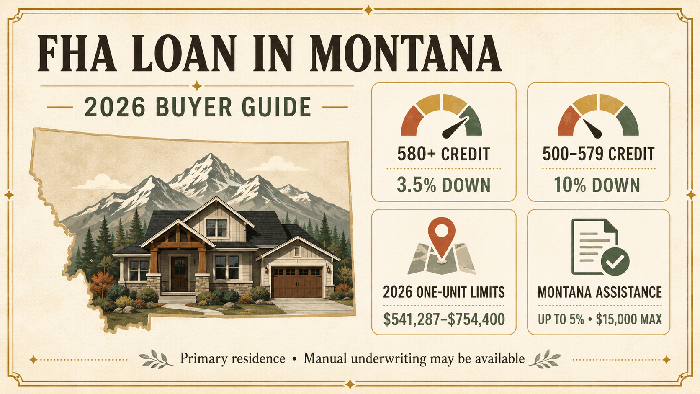
If you have an FHA loan in Montana, you may be able to get help with your down payment and closing costs from the Montana Board of Housing. Applicants must first be eligible for a Regular Bond Program loan and apply through a participating lender. The Bond Advantage Down Payment Assistance Program provides up to 5% of the sales price, capped at $15,000. It is a 15-year amortizing second mortgage with monthly payments. The first and second mortgages have the same fixed interest rate. The MBOH Plus 0% Deferred Program also provides up to 5% of the sales price, capped at $15,000. However, it is a 0% deferred second mortgage with no monthly payments. The balance becomes due when the borrower sells or transfers the property, refinances, or pays off the first mortgage. Both programs generally require a minimum credit score of 620, homebuyer education, and a borrower investment of at least $1,000, which may be made with an eligible gift. MBOH Plus also has household income limits and a maximum debt-to-income ratio of 45%. These programs provide repayable secondary financing rather than grants. Requirements, interest rates, and funding availability can change, so buyers should verify current terms with a participating lender.
FHA Property and Appraisal Requirements in Montana
Any house that is bought with FHA financing must be assessed by an FHA-approved appraiser. This assessment determines the property’s value and notes any conditions that might affect FHA eligibility. Generally, the FHA requires that the home be safe, sound, and secure. Problems involving structural damage, exposed wiring, water intrusion, defective systems, or other health and safety concerns may need to be corrected before the loan can close. Not every cosmetic issue requires repair. An FHA appraisal is also different from a home inspection. Buyers may still want an independent inspection to get a more detailed look at the property’s condition.
Moving to Montana With a New Job
Starting a new job in Montana does not always mean a buyer has to wait for several paychecks before using that income for an FHA loan. FHA allows expected income from a new job to be considered if the borrower will begin receiving it within 60 days of closing. The lender will require documentation showing the position, start date, and expected earnings, and the borrower must have sufficient verified funds or alternative income to cover expenses until new job income begins.
Bad Credit? FHA May Still Be an Option in Montana
FHA loans can be more flexible for buyers with lower credit scores, past credit issues, collections, or limited savings. Get a quick review before assuming you cannot qualify.
FHA Mortgage Insurance Requirements and Associated Closing Costs
The FHA mandates an upfront mortgage insurance premium of 1.75% of the principal loan amount. Borrowers usually don’t have to pay the full upfront premium in cash at closing because this cost can be added to the FHA loan amount.
For a typical 30-year FHA purchase with less than 5% down, the annual mortgage insurance premium is 0.55% and is collected as part of the monthly mortgage payment. When the original loan-to-value ratio exceeds 90%, the annual MIP generally remains in effect for the term of the mortgage. At 90% LTV or below, it is generally required for 11 years.
Closing costs are not the same as your down payment. With an FHA loan, sellers or other parties can help by contributing up to 6% of the sales price to cover closing costs, prepaid expenses, and discount points.
FHA Versus USDA, VA, and Conventional Loans in Montana
An FHA loan in Montana is not the only option for financing a primary residence. USDA loans can provide 100% financing for eligible borrowers purchasing homes in qualifying rural areas, although income and property location requirements apply. Eligible Veterans and service members may prefer VA financing because VA does not require a down payment in many cases and does not require monthly mortgage insurance. Conventional financing can also work for buyers with stronger credit, and some programs allow as little as 3% down. The best loan program depends on the borrower’s eligibility, credit profile, available funds, property location, and long-term cost of the mortgage.
FHA Guidelines Versus Lender Overlays
FHA sets the minimum rules lenders must follow, but individual mortgage companies can choose to be more restrictive. Those additional lender requirements are commonly known as lender overlays. HUD has acknowledged that overlays can go beyond FHA’s own lending standards. For example, the FHA permits credit scores as low as 500 under certain conditions, but a lender may require a higher score. One lender may also have stricter rules for debt-to-income ratios, recent late payments, or manual underwriting. Because overlays vary by lender, being denied by one mortgage company does not always mean the borrower is ineligible for an FHA loan.
Hypothetical Montana FHA Approval Example
Consider a buyer purchasing a Montana home for $325,000 with a 560 credit score. Under FHA’s minimum guidelines, a score between 500 and 579 generally requires a 10% down payment. The buyer would need to provide $32,500, resulting in a base FHA loan amount of $292,500.
The 1.75% upfront mortgage insurance premium would equal approximately $5,119. If financed, it would increase the total mortgage balance to approximately $297,619. Closing costs, prepaid expenses, and escrow deposits would be separate from the required down payment.
Assume the buyer also has $3,000 in unpaid nonmedical collections and no documented payment arrangement. The lender may include 5% of the collection balance, or $150 per month, when calculating the buyer’s debt-to-income ratio. After including that payment, the buyer has a 29% housing DTI and a 41% total DTI. The file also shows stable W-2 income, 12 months of on-time rent payments, documented funds to close, and no recent late payments. If the property meets FHA appraisal requirements, the borrower could be approved through manual underwriting. This hypothetical FHA loan in Montana example is for educational purposes only. It does not represent a guaranteed approval, rate, payment, or loan amount. The final decision depends on the complete application, supporting documents, lender requirements, appraisal, and underwriting review.
Documents and Steps for Preapproval
Getting preapproved for an FHA loan in Montana begins with completing a mortgage application and authorizing the lender to review your credit. The lender evaluates income, employment, monthly debts, assets, credit history, and the estimated funds needed for the purchase. Most applicants should be prepared to provide:
- A government-issued photo ID
- Pay stubs covering the most recent 30 days
- W-2 forms for the previous two years
- Bank statements covering the most recent two months
- Employment information for the previous two years
- Documentation for retirement, Social Security, disability, or other qualifying income
- Bankruptcy, foreclosure, child support, divorce, collection, or payment-plan documents when applicable
Self-employed borrowers may also need personal and business tax returns, profit-and-loss statements, balance sheets, and business bank statements. Buyers using gift funds or down payment assistance must document the source and transfer of those funds. After reviewing the application and documents, the lender calculates the borrower’s qualifying income, debt-to-income ratio, estimated payment, down payment, and cash needed to close. The application may then be evaluated through FHA’s automated underwriting system or submitted for manual underwriting when required. A preapproval letter may be issued when the initial review supports the requested loan amount. However, preapproval is not final loan approval or a commitment to lend. The property must still be appraised, the supporting documents must be verified, and the complete file must receive final underwriting approval.
Final Thoughts on FHA Loans in Montana
An FHA loan in Montana may provide a path to homeownership for buyers with limited savings, lower credit scores, past credit problems, or higher debt-to-income ratios. FHA financing is not limited to first-time homebuyers, but the property must generally be used as the borrower’s primary residence and meet FHA requirements.
Meeting FHA’s minimum guidelines does not guarantee approval. The lender must review the borrower’s complete financial profile, including income, employment, debts, assets, payment history, and funds to close. The property must also meet appraisal standards and remain within the FHA loan limit for the Montana county where it is located.
Borrowers who have been denied due to a low credit score, collections, manual underwriting, or lender overlays may benefit from a second opinion. Gustan Cho Associates will review your loan file, outline your options, and highlight any issues to address before proceeding.
Frequently Asked Questions About FHA Loan in Montana:
Is There a Minimum Income Requirement for an FHA Loan in Montana?
FHA does not establish a specific minimum income requirement. However, the borrower must have sufficient stable, verifiable income to cover the proposed mortgage payment and other monthly obligations. The lender will calculate the borrower’s debt-to-income ratio and evaluate whether the income is reasonably likely to continue.
Can a Family Member Co-Borrow Without Living in the Home?
FHA allows non-occupying co-borrowers in certain situations. The lender must still review the income, debts, credit, and relationship of everyone applying for the mortgage. Additional loan-to-value rules can apply depending on the transaction.
Can You have Two FHA Loans at the Same Time?
Usually, FHA will not insure two homes as a borrower’s primary residence at the same time. Exceptions may be available in specific situations, such as certain relocations or changes in family size.
Are FHA Loans Assumable?
Yes. FHA-insured mortgages are assumable. A buyer taking over the loan may still need to meet the lender’s requirements before the existing borrower can be released from responsibility for the mortgage.
Can FHA Financing be Used for a Manufactured Home?
Yes. FHA has financing options for eligible manufactured and factory-built homes. The property and loan must meet the requirements for the FHA program being used.
Can You Use an FHA 203(k) Loan to Buy a Fixer-Upper in Montana?
Yes. FHA’s 203(k) program allows eligible buyers to finance the purchase and approved repairs with a single mortgage. FHA offers Standard and Limited 203(k) options depending on the type and extent of the renovations.
This article about “Bad Credit? Get an FHA Loan in Montana Today” was updated on August 17th, 2026.