
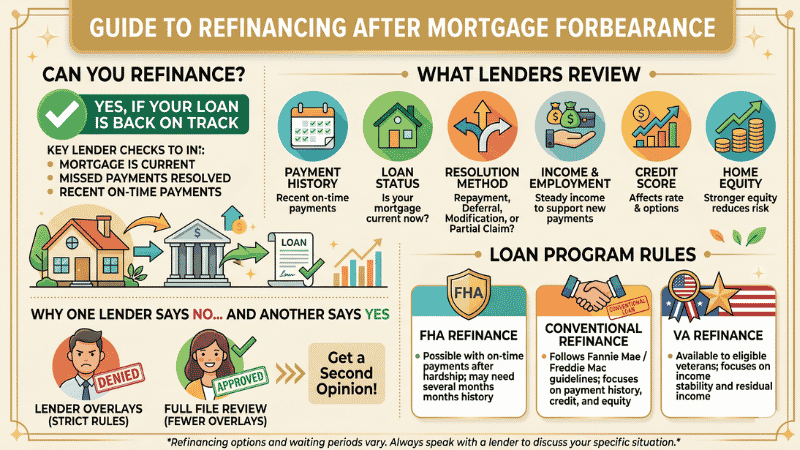
You may be able to refinance after a mortgage forbearance, but being current on your monthly payments is only part of the review. Find out how the skipped payments were handled and request a payoff for every balance tied to the home. A deferral or separate lien can change the amount you need to refinance and, in some cases, the refinance available. Then compare the new payment, loan balance, and closing costs to your current mortgage.
Start With the Full Payoff Amount
Your mortgage statement shows a balance, but that amount may not be sufficient to close a refinance. The payoff can include interest through the payoff date and other amounts due. If your forbearance ended with a payment deferral or a separate lien, that balance also needs to be identified.
Ask your servicer for a payoff statement and written confirmation of how the paused payments were dealt with. If there’s a separate lien, get the payoff details for that as well. Pass both of those on to your loan officer before you go on to rely on any estimate of the amount of equity you can use.
For instance, a homeowner might see a $230k first mortgage balance and assume that’s all the new loan will need to cover. If there’s also an $18k partial claim to be paid, the amount required at closing will be higher before you even get to the refinance costs. That difference significantly affects the loan amount or cash available at closing.
How a Deferral or Partial Claim Changes the Refinance
A payment deferral generally leaves the skipped amount to be paid later, often when the mortgage is refinanced or paid off. An FHA partial claim is a separate, secured balance. Neither should be treated as forgiven simply because regular monthly payments have resumed. The way a new loan handles that balance depends on its program and transaction rules. Paying off a separate lien may affect whether a conventional refinance is treated as a limited cash-out or cash-out transaction, even when the homeowner receives no cash. A lien that remains in place may need to meet the new lender’s requirements for staying behind the new first mortgage. Have the loan officer review the lien documents and proposed payoffs before choosing a refinance program. A small difference in how the transaction is classified can change its equity, pricing, and approval requirements.
Choose a Refinance That Fits the Payoff
A refinance without cash out may make sense when the goal is a better rate, a different term, or a more manageable payment. The loan still has to cover the amounts due at closing.
Homeowners with an existing FHA loan may ask about an FHA Streamline Refinance. Veterans with a VA loan can inquire about a VA Interest Rate Reduction Refinance Loan (IRRRL).
These programs can involve less documentation than a fully underwritten refinance, but they have their own payment history and loan benefit requirements. A VA IRRRL cannot be used to pay off a separate second lien with its proceeds, so any such lien needs to be addressed when reviewing that option. A cash-out refinance is a different decision. It may pay off the old loan and provide funds to the homeowner, subject to the program’s limits. First, calculate what remains after the mortgage, any deferred balance or lien, and closing costs are paid. The home’s apparent equity is not the same as the cash available at closing.
Check the Rules for the Loan You Want
There is no single refinance rule that applies to every homeowner after forbearance. The new loan program, the refinance, and the documented payment history all matter. For FHA, the distinction is especially important. FHA’s no-cash-out refinance rules include a requirement for at least three consecutive payments within the month due after completing forbearance. FHA cash-out refinances require that the plan be completed and that at least 12 consecutive payments be made within the month due afterward. FHA Streamline Refinances have separate credit-qualifying and non-credit-qualifying paths that need individual review. Ask your loan officer which rule applies to the proposed refinance. The separate waiting-period article can cover when the payment count begins; this page is for deciding how to structure and evaluate the refinance.
Compare the New Loan With the Mortgage You Have
A lower monthly payment can help, but it’s important to understand why it’s lower. The payment might go down because of a lower interest rate, a longer repayment period, or both. If you extend the loan term, you could end up paying more interest overall, even if your monthly payment is smaller.
Look at the new loan balance just as closely as you look at the interest rate. If your refinance pays off a deferred amount and includes closing costs, your new mortgage balance might be higher than what you currently owe.
Additionally, evaluate factors such as mortgage insurance, discount points, the cash required at closing, and the time it will take for your monthly savings to offset refinancing costs. Also ask how escrow will be handled. A new loan may require money for a new tax and insurance escrow account. Any remaining escrow balance on the paid-off mortgage may be refunded or handled separately; do not assume it will be available to fund the closing.
Get the Records Together Before Applying
Provide a recent mortgage statement, the forbearance exit documents, and the agreement that explains any repayment plan, deferral, partial claim, or modification. Request a payment history if the statement or credit report does not clearly show what happened during and after the plan. For the refinance calculation, obtain payoffs for the first mortgage and any separate lien. Your loan officer can then estimate the new loan amount and determine whether the proposed transaction fits the program you want. Income, credit, property value, and ordinary refinance requirements will still be reviewed.
FAQs about Refinancing After a Mortgage Forbearance
Can I Use a Different Lender from My Current Mortgage Servicer?
Yes, you can compare refinance offers from other mortgage providers. Each of those will require you to provide reliable information about your existing loan, your payment history, and all balances on the property.
Will I Need an Appraisal?
It varies depending on the refinance program and the property. Some streamline refinances won’t normally require an appraisal. Other refinances may require an appraisal or may be eligible for an appraisal waiver. Always ask. You can’t assume that the value that’s listed on a property website will be the value that’s used.
Do I Need Cash at Closing if I have Equity?
Possibly. Equity won’t necessarily mean that every payoff and every closing cost can be rolled into the new loan. It depends on the property value, the loan limits, the program rules, and how the refinance is classified.
Can Refinancing Remove Mortgage Insurance?
It may well be, depending on your mortgage and the new loan you’re able to get. You need to look at the full new payment and the full new closing costs, rather than assuming that removing one insurance policy will make refinancing worthwhile.
What if My Current Interest Rate is Already Low?
A refinance could end up costing you more over the long term, particularly if it’s replacing a low-rate loan with a bigger balance or if it’s effectively restarting a long-term loan. Always get a side-by-side comparison before you make a decision.
What if My Payment History and Credit Report Disagree?
Ask your servicer for a full payment history and an explanation of how the payments made during the forbearance period were recorded. Pass that on to your loan officer as soon as possible so it can be looked at before closing.
Final Thoughts on Refinancing After a Mortgage Forbearance
Before shopping for a rate, establish what the new loan must pay off. Then choose a refinance program that can handle those balances and compare its complete cost with your current mortgage. Gustan Cho Associates can review the forbearance documents, payoffs, and proposed loan terms to help you decide whether refinancing makes sense now.
This article about “Refinance After a Mortgage Forbearance: Check Your Payoff and Options” was updated on November 17th, 2026.