

If you are considering refinancing an FHA loan, it helps to know that FHA does not offer a single refinance program. There are several FHA refinance options, each designed for a different goal. Some homeowners want to lower their interest rate or monthly payment. Others want to tap into home equity. Some want to change their loan term, while others want to refinance and pay for repairs at the same time.
That is why understanding FHA refinance options matters. The best FHA refinance is not always the one with the lowest rate on paper. It is the one that aligns with your reasons for refinancing, your current loan, your home equity, and your long-term plans.
When you understand the difference between FHA Streamline Refinance, FHA Cash-Out Refinance, FHA Rate-and-Term Refinance, and FHA 203(k) Refinance, it becomes much easier to choose the right path. This guide explains how FHA refinance options work, who they are best for, what costs to expect, and how to compare them the smart way.
FHA Refinance Options at a Glance
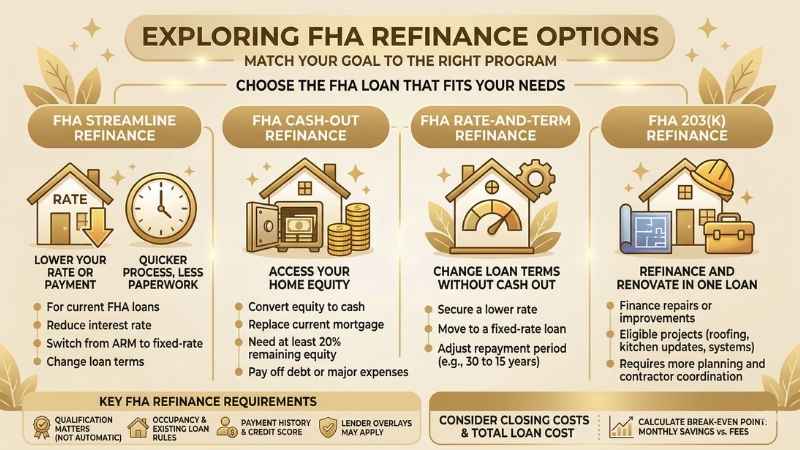
FHA refinance loans help current homeowners replace their existing mortgage with a new one. The right option depends on what you want the new loan to do. If your goal is to lower your rate or monthly payment with less paperwork, an FHA Streamline Refinance may be the best fit. If your goal is to tap your home equity, an FHA Cash-Out Refinance may make more sense. If you want to change your loan structure without taking cash out, an FHA Rate-and-Term Refinance may be the right choice. If you want to refinance and finance repairs in a single new loan, an FHA 203(k) Refinance may be worth exploring. Many borrowers search for an FHA refinance comparison because they want a simple answer. The short answer is this: each FHA refinance option solves a different problem. Once you identify your main goal, the best option becomes much clearer.
Why Homeowners Use FHA Refinance Loans
Homeowners use FHA refinance options for many reasons. Some want payment relief. Some want more stability by moving from an adjustable-rate mortgage to a fixed-rate loan. Others need to use home equity for major expenses, debt consolidation, or home improvements. In some cases, borrowers want to fix up a property and roll the repair costs into a new mortgage.
One of the main reasons FHA refinance loans stay popular is flexibility. FHA financing can be more accessible for borrowers who may not meet stricter conventional guidelines. That does not mean approval is automatic.
Lenders still review credit, payment history, income, occupancy, and other factors. Lender overlays may also apply. But FHA refinance options remain an important option for homeowners seeking alternatives. Another reason borrowers consider FHA refinance loans is that the programs are not all the same. A homeowner who already has an FHA loan and wants a lower payment may not need the same type of refinance as someone who wants cash out or someone planning major home renovations.
FHA Streamline Refinance: Best for Lowering Your Rate or Payment
FHA Streamline Refinance is often the first option people think about when they already have an FHA loan and want a simpler refinance. This program is here to help homeowners qualify for lower interest rates, shrink their monthly payments, or switch from an adjustable-rate mortgage to a more reliable fixed-rate loan.
Who an FHA Streamline Refinance Is For
An FHA Streamline Refinance is generally for homeowners who already have an FHA-insured mortgage and want a more affordable or more predictable loan. It is best for borrowers who do not need cash out and want a more efficient refinance process than a standard full-doc refinance. For many borrowers, the biggest appeal is that the process can be simpler than other refinance options. That can make it attractive for homeowners who want a practical way to improve their mortgage terms without starting over from scratch.
Main Benefits of an FHA Streamline Refinance
One major benefit of the FHA Streamline Refinance is reduced paperwork compared with many other refinance programs. Depending on the lender and loan setup, the process may involve fewer documentation requirements than a standard refinance. This can speed up the loan process and make it feel less stressful. One more plus is that homeowners can reduce their monthly payments or change from an adjustable-rate loan to a fixed-rate loan. That can bring both savings and peace of mind. For borrowers who plan to stay in the home, better loan terms can create meaningful long-term value.
Limits to Know Before You Apply
FHA Streamline Refinance is not for borrowers who want cash back at closing beyond limited incidental amounts. It is also not a cure-all. Borrowers still need to meet lender requirements, and lenders may apply their own standards on credit score, payment history, and other factors. Homeowners should also remember that a lower rate does not always mean a better deal if closing costs are too high or if the new loan resets the repayment timeline in a way that costs more over time. The refinance should provide a real benefit, not just a new loan.
FHA Simple Refinance: An Appraisal-Based FHA-to-FHA Option
An FHA Simple Refinance allows homeowners with an existing FHA-insured mortgage to refinance without taking cash out. The new loan proceeds are used to pay off the existing FHA loan and cover eligible costs connected with the refinance. Borrowers cannot use this program to withdraw equity as cash. HUD classifies this transaction as a “Simple—with appraisal” FHA-to-FHA refinance. Unlike an FHA Streamline Refinance, a Simple Refinance requires a new FHA appraisal. The appraised value helps determine the maximum loan amount and whether the property provides enough value to support the refinance. The borrower must also complete standard FHA credit and capacity underwriting. The lender generally reviews income, employment, assets, credit history, monthly debts, mortgage-payment history, and the borrower’s ability to afford the new payment. Eligible closing costs and other transaction expenses may be included in the lender’s calculation of the new mortgage amount, provided the loan remains within FHA loan limits, loan-to-value requirements, and other program rules. This is an important difference from an FHA Streamline Refinance, which generally does not allow the addition of closing costs to the base loan amount. An FHA Simple Refinance may be worth considering when:
- The current mortgage is already FHA-insured.
- The borrower wants a no-cash-out refinance.
- A new appraisal may support the proposed loan amount.
- The borrower can document income and meet standard FHA qualification requirements.
- The borrower wants to finance eligible transaction costs instead of choosing a Streamline Refinance structure.
The word “simple” does not mean the loan has no documentation or underwriting. It refers to a specific FHA refinance category. Because an appraisal and full qualification are generally required, the process may involve more documentation than a Streamline Refinance. However, it may provide an appropriate appraisal-based FHA-to-FHA option for borrowers who cannot—or do not want to—use the Streamline program. Borrowers should compare the interest rate, mortgage insurance, closing costs, monthly payment, cash required at closing, and total long-term cost before choosing among the available FHA refinance options.
Ready to Refinance? Start Your FHA Refinance Review
Complete a quick application or upload your current mortgage statement. We’ll confirm your best option and guide you step-by-step to closingFHA Cash-Out Refinance: Access Home Equity With Full Qualification
An FHA cash-out refinance allows an eligible homeowner to replace an existing mortgage with a new FHA-insured loan and receive part of the available equity in cash. The funds may be used for purposes such as home improvements, debt consolidation, education expenses, or other financial needs. However, taking cash out increases the mortgage balance and may raise the borrower’s monthly payment and total interest cost. Unlike an FHA Streamline Refinance, a cash-out refinance requires a new FHA appraisal and full mortgage underwriting. The lender must review the borrower’s credit, income, employment, assets, monthly debts, housing-payment history, and ability to repay the new loan.
FHA Cash-Out Refinance LTV and CLTV Limits
FHA cash-out refinancing is generally limited to a maximum 80% loan-to-value ratio and 80% combined loan-to-value ratio based on the property’s adjusted value. HUD reduced both limits from 85% to 80% for applicable FHA case numbers assigned on or after September 1, 2019. The loan-to-value ratio compares the new first mortgage with the property’s adjusted value. The combined loan-to-value ratio includes the new FHA mortgage and any subordinate financing that will remain attached to the property. For example, suppose a home has an FHA adjusted value of $400,000. An 80% LTV would equal $320,000. The new FHA mortgage and any remaining subordinate liens generally could not exceed $320,000, subject to the applicable FHA county loan limit and all other underwriting requirements. The borrower’s available cash would not automatically equal the difference between $320,000 and the current mortgage balance. The lender must also account for existing liens, closing costs, prepaid expenses, mortgage insurance, and other amounts connected with the transaction.
FHA Cash-Out Refinance Qualification Requirements
Borrowers generally must meet the following requirements:
- New FHA appraisal: An FHA-approved appraisal is required to establish the property’s value and determine the maximum available loan amount.
- Full credit qualification: The lender reviews the borrower’s credit history and overall repayment risk.
- Verified income and employment: The borrower must document stable, verifiable income to qualify for FHA.
- Debt-to-income review: The lender evaluates the proposed housing payment and other monthly debts.
- Asset verification: Funds needed for closing and applicable reserves must come from acceptable, documented sources.
- Mortgage-payment history: The lender must review the payment history on the mortgage being refinanced and determine whether it meets current FHA requirements.
- Ownership review: The borrower’s ownership history and method of acquiring the property must be documented, as they can affect how FHA calculates the adjusted value and the maximum mortgage amount.
- Principal-residence requirement: FHA cash-out refinancing is intended for an eligible owner-occupied principal residence. The lender must confirm that the borrower satisfies the applicable occupancy requirements.
The property must also meet FHA eligibility and minimum property requirements. Approval is not based on equity alone. A homeowner may have enough equity to remain within the 80% limit but still need to meet the FHA credit, income, debt, appraisal, ownership, and occupancy standards. Among the available FHA refinance options, cash-out refinancing may help homeowners access equity, but it should be compared with a home equity loan, a home equity line of credit, a conventional cash-out refinance, or a no-cash-out refinance. Borrowers should review the new payment, mortgage insurance, closing costs, interest rate, cash received, and long-term borrowing cost before proceeding.
FHA Rate-and-Term Refinance: Best for Changing Loan Terms Without Taking Cash Out
FHA Rate-and-Term Refinance is for homeowners who want to adjust the structure of their mortgage without using the loan to pull out equity. This option focuses on improving the loan terms rather than giving cash back to the borrower.
What an FHA Rate-and-Term Refinance Changes
A rate-and-term refinance can help a borrower secure a lower rate, change from an adjustable-rate mortgage to a fixed-rate loan, or change the loan term from one repayment period to another. For some homeowners, this means switching from a 30-year mortgage to a 15-year loan to pay off the home faster. For others, it may mean stretching out the term to reduce the monthly payment. This option can be a good fit for borrowers who want to improve the shape of the loan rather than use home equity.
When a Rate-and-Term Refinance Is Better Than Cash-Out
If your goal is to improve monthly affordability, reduce interest costs, or create a more stable payment structure, rate-and-term refinance is often a better fit than cash-out refinance. It keeps the focus on the mortgage itself instead of turning home equity into spendable cash. This is really helpful for people who want to avoid having a bigger loan than they really need. If no cash is needed, there may be little reason to choose the cash-out route.
Common Reasons Homeowners Choose This Option
Many homeowners choose an FHA rate-and-term refinance to lower their monthly payments, lock in a fixed interest rate, or shorten their loan term. Others use it because the existing loan no longer matches their needs. The right mortgage structure can matter just as much as the interest rate, especially for homeowners planning for the next five to ten years.
FHA 203(k) Refinance: Refinance and Renovate With One Loan
An FHA 203(k) refinance allows an eligible homeowner to replace an existing mortgage and finance qualified repairs or renovations through one FHA-insured loan. The property generally must have been completed for at least one year. In a refinance transaction, part of the new loan proceeds pays off the existing mortgage, while the renovation funds are placed in a rehabilitation escrow account. An FHA 203(k) refinance is a rehabilitation loan—not an unrestricted cash-out refinance. The borrower does not receive the renovation budget as a lump-sum cash payment to use for any purpose. Instead, the lender controls the rehabilitation escrow and releases funds as approved work is completed.
Limited 203(k) Versus Standard 203(k)
The FHA provides two variations of the 203(k) program. The appropriate option depends on the cost, complexity, and type of work being completed.
Limited 203(k) Refinance
A Limited 203(k) is intended for minor remodeling, home improvements, and nonstructural repairs. Current FHA rules permit up to $75,000 in total rehabilitation costs under the Limited program. An FHA-approved 203(k) consultant is optional, although the lender may require one when necessary. Common Limited 203(k) projects may include:
- Painting and flooring
- Kitchen or bathroom updates
- Roofing, gutters, or siding
- Heating and cooling system repairs
- Plumbing or electrical improvements
- New appliances permitted under FHA rules
- Accessibility improvements
- Repairing decks, patios, walkways, or driveways
The Limited program cannot be used for major structural rehabilitation or projects that require extensive architectural plans. Repairs generally must be completed within nine months. Effective June 23, 2026, FHA permits up to four draw requests per contractor under the Limited 203(k), including the initial, intermediate, and final draws.
Standard 203(k) Refinance
A Standard 203(k) is designed for major rehabilitation, structural repairs, and more complex renovation projects. It may be used for work such as structural alterations, additions, foundation repairs, reconstruction, major system replacement, or extensive property rehabilitation. The planned rehabilitation cost must generally be at least $5,000, and the completed property must remain within the applicable FHA mortgage limits. A Standard 203(k) requires an FHA-approved 203(k) consultant. The consultant examines the property and creates a Work Write-Up that includes a cost estimate, detailing each repair, specifications, and the estimated costs for labor and materials. FHA permits a Standard 203(k) rehabilitation period of up to 12 months and generally allows up to five draw requests—four intermediate draws and one final draw.
Contractor Bids and Renovation Documentation
Before closing, the lender must review the proposed scope of work and supporting documentation. Depending on the program and project, the file may include:
- Contractor bids and cost estimates
- Borrower-contractor agreements
- A consultant’s Work Write-Up
- Architectural plans or engineering documents
- Building permits
- Contractor licenses and insurance when required
- A rehabilitation timeline
- Draw and inspection schedules
- Change-order requests for approved changes
The contractor generally must obtain the required permits before starting work. For a Standard 203(k), the consultant typically inspects completed work and certifies that it meets the approved Work Write-Up before the lender releases the next draw.
How the Rehabilitation Escrow and Draw Process Works
Renovation funds remain in an escrow account after the refinance closes. The contractor completes an approved stage of the project and submits a draw request. The lender then reviews the request, required receipts, title updates, and inspection results before releasing funds. For Standard 203(k) projects, draw inspections are generally used to confirm that the work was completed according to the approved plans. Limited 203(k) inspection requirements may depend on the total repair cost and the lender’s risk review. Under current HUD guidance, completed Limited 203(k) work exceeding $15,000 must be inspected by the lender or an acceptable third party. The lender may issue the payment jointly to the borrower and contractor or directly to the contractor when properly authorized. The escrow closes only after the lender receives the required completion documents and confirms that the renovation is complete.
Contingency Reserves and Unexpected Repairs
A contingency reserve may be required or established to cover eligible costs that were not known when the original renovation budget was prepared. This can be important when work exposes hidden damage, code issues, or other unexpected conditions.
Contingency funds are not unrestricted cash for the borrower. Their use must be approved by the lender and may require an updated work order, a cost breakdown, or a formal change order. Any remaining funds are handled in accordance with FHA requirements after the project is completed.
Among the available FHA refinance options, a 203(k) may be useful when a homeowner needs to refinance and complete eligible repairs through one mortgage. However, borrowers should consider the additional documentation, contractor coordination, inspections, draw requests, consultant fees, and completion deadlines before deciding whether a Limited or Standard 203(k) is appropriate for the project.
Which FHA Refinance Option Fits Your Goal?
The easiest way to compare FHA refinance options is to start with your main goal. If you already have an FHA loan and mainly want a lower payment or more stable terms, an FHA Streamline Refinance may be the best fit. If your goal is to use your home equity for cash, an FHA Cash-Out Refinance may make more sense. If you want to improve the loan structure without taking cash out, an FHA Rate-and-Term Refinance is often the better option. If you want to refinance and pay for repairs in one loan, the FHA 203(k) Refinance stands out. This is why many side-by-side comparisons fall short. They list features but do not connect them to real homeowner goals. The better approach is to match the loan to the reason for refinancing.
Choose Streamline if You Want a Simpler FHA-to-FHA Refinance
This option is usually best for current FHA borrowers who want to reduce the burden of their mortgage without taking cash out.
Choose Cash-Out if You Need Equity for a Major Expense
This option is suitable for homeowners who have sufficient equity and a clear reason to use it.
Choose Rate-and-Term if You Want Better Loan Structure
This is often the right move for homeowners focused on the mortgage terms rather than cash access.
Choose 203(k) if You Need to Finance Repairs
This option works best when the property requires approved improvements and the borrower wants a single loan rather than separate financing.
FHA Refinance Requirements Homeowners Should Know
Before comparing loan features, homeowners should understand that FHA refinance approval still depends on qualification. FHA loans are flexible, but they are not automatic.
Occupancy and Existing Loan Requirements
Some FHA refinance options are limited to borrowers with an existing FHA loan. In contrast, others may have different rules based on the current mortgage type and use of the property. Occupancy matters, and the loan being refinanced matters too. These details can affect which refinance paths are even available.
Credit Score and Payment History Considerations
FHA financing is often more forgiving than conventional financing, but payment history still matters. Lenders want to see responsible mortgage behavior and overall financial stability. Credit score requirements may vary by lender, and lender overlays can still raise the bar above basic FHA standards.
Home Equity and Loan-to-Value Limits
Equity matters most for cash-out refinance, but it can also affect other refinance decisions. Borrowers should know how much equity they have, because loan-to-value rules help determine what refinance options are realistic.
Why Lender Overlays Can Still Matter
Even when FHA program guidelines allow a certain type of transaction, individual lenders may have stricter rules. That is one reason borrowers sometimes hear different answers from different lenders. Understanding lender overlays can help avoid confusion and save time during the refinance process.
FHA Refinance Closing Costs and Other Tradeoffs
Many homeowners focus first on the interest rate, but closing costs and total loan cost are just as important. A refinance should be evaluated as a full financial decision, not just a rate quote.
Upfront and Ongoing Mortgage Insurance Costs
Because FHA loans include mortgage insurance, borrowers should pay close attention to both upfront and ongoing costs. In some cases, these costs are worth it because FHA offers access or flexibility that another loan may not. In other cases, borrowers may later decide that a conventional refinance makes more sense once equity and credit improve.
When Refinancing Saves Money and When It Does Not
Refinancing can save money when the monthly payment drops enough, the loan becomes more stable, or the new structure better matches the homeowner’s goals. But not every refinance creates meaningful savings. If fees are too high, the rate improvement is too small, or the borrower is extending the loan too long, the deal may not be as strong as it first appears.
How to Think About Break-Even Point
A smart way to look at FHA refinance options is to ask how long it will take for the monthly savings to recover the closing costs. This is often called the break-even point. If you plan to keep the home long enough to benefit beyond that point, the refinance may be worthwhile. If not, it may be better to wait.
See If You Qualify for an FHA Streamline Refinance
If you already have an FHA loan, a Streamline may reduce documentation and speed up the process. We’ll confirm eligibility and estimate savingsQuestions to Ask Before Choosing an FHA Refinance
Before applying, homeowners should step back and ask a few practical questions.
Do You Want Lower Payments or Cash at Closing?
This is the first big filter. If you want cash, you are looking at a very different refinance path than someone who only wants a lower monthly payment.
Are You Trying to Change Your Loan Type or Loan Term?
Some borrowers prefer a fixed rate over an adjustable rate. Others want to shorten the payoff period or extend the term to improve affordability. These goals matter because they shape which refinance option makes the most sense.
Does Your Home Need Repairs Before It Fits Your Long-Term Plans?
If the property needs meaningful upgrades, an FHA 203(k) Refinance may deserve a closer look.
Are the Refinance Costs Worth the Monthly Savings?
A refinance should create a real benefit. The payment, fees, mortgage insurance, and long-term costs all need to be weighed together.
How to Compare FHA Refinance Options the Smart Way
The smartest way to compare FHA refinance options is to avoid chasing only the lowest advertised rate. Instead, focus on the loan that best solves your actual problem.
Start With Your Main Refinance Goal
Do not start with the loan product. Start with your reason. Are you trying to save money each month, lock in stability, pull equity, or improve the home? That answer should guide the rest of the process.
Review Your Current Loan, Equity, and Payment History
Your current mortgage type, remaining balance, home equity, and payment history can all shape your refinance choices. A strong comparison starts with accurate numbers.
Compare the New Payment, Total Cost, and Long-Term Benefit
FHA refinance options that look attractive today may not always be the best long-term move. Compare the monthly payment, closing costs, mortgage insurance, total cost over time, and the length of time you plan to stay in the home.
Work With a Lender Who Explains the Trade offs Clearly
A good lender shouldn’t just rattle off rates. They should break down the pros and cons of things like FHA Streamline Refinance, FHA Cash-Out Refinance, FHA Rate-and-Term Refinance, and FHA 203(k) Refinance in simple terms, so you can pick the option that works best for you.
Final Thoughts on FHA Refinance Options
FHA refinance options give homeowners several ways to improve their mortgage situation, but the right choice depends on the goal. Streamline Refinance is often the simplest path for current FHA borrowers who want a lower payment or better terms. A Cash-Out Refinance is designed for homeowners who want to tap their equity. Rate-and-Term Refinance helps reshape the loan without turning equity into cash. FHA 203(k) Refinance is built for those who want to refinance and renovate at the same time. The strongest refinance decision is not based on a single headline rate or sales pitch. It is based on how well the new loan matches your financial goals, your home, and your long-term plans. When you compare FHA refinance options with that mindset, you are much more likely to choose the loan that makes sense now and later.
Frequently Asked Questions About FHA Refinance Options
How Soon Can You Refinance an FHA Loan After Closing?
The waiting period depends on the FHA refinance program. For an FHA Streamline Refinance, the borrower must meet these criteria: make at least 6 payments, have at least 6 full months since the first payment due date, and wait at least 210 days since the original mortgage closed. Other refinance programs may have different ownership, payment history, and seasoning requirements. A lender may also apply additional rules.
Can You Refinance an FHA Loan More Than Once?
Yes. FHA does not establish a lifetime numerical limit on how many times a homeowner may refinance. However, each new refinance must meet the applicable FHA eligibility, seasoning, payment history, loan-to-value, and underwriting requirements. Repeated refinancing may not make financial sense when closing costs, mortgage insurance, or an extended repayment term outweigh the expected savings. For an FHA Streamline Refinance, the new loan must also provide a net tangible benefit to the borrower.
Can You Refinance an FHA Loan if You have Little or no Home Equity?
Possibly. An eligible FHA Streamline Refinance may be completed without a new appraisal, which means approval may not depend on the home’s current appraised value in the same way as an appraisal-based refinance. The existing mortgage must already be FHA-insured and current, and the new loan must provide the required net tangible benefit. Cash-out, Simple, rate-and-term, and 203(k) refinances may use an appraisal and have different loan-to-value requirements.
Do You Receive an FHA Mortgage Insurance Refund When Refinancing?
A borrower refinancing one FHA-insured mortgage into another FHA-insured mortgage may qualify for a partial refund credit from the original upfront mortgage insurance premium. The credit is generally applied toward the upfront mortgage insurance premium charged on the new FHA loan rather than paid to the borrower as cash. For FHA loans endorsed on or after December 8, 2004, HUD states that no refund is due after the third year of insurance. The actual credit depends on when the existing FHA loan was originated and paid off.
Is a No-Closing-Cost FHA Refinance Really Free?
No. A “no-closing-cost” refinance typically means the borrower does not pay upfront costs. The lender may cover eligible closing costs by providing a lender credit in exchange for a higher interest rate. The borrower may therefore pay more interest or have a higher monthly payment over time. HUD also states that closing costs cannot be added to the new base loan amount on an FHA Streamline Refinance. Borrowers should compare the rate, lender credits, monthly payment, cash-to-close, and long-term interest costs before accepting a no-out-of-pocket-cost offer.
Can a Borrower be Removed During an FHA Streamline Refinance?
A borrower may be removed from a non-credit-qualifying FHA Streamline Refinance only in limited circumstances. HUD permits removal in cases involving divorce, legal separation, or death when the required documentation is provided. The remaining borrower must also be able to show that they made the mortgage payments for at least six months before the new FHA case number is assigned. Otherwise, all borrowers on the existing mortgage generally must remain borrowers on a non-credit-qualifying Streamline Refinance. A different refinance structure and full qualification may be required when the requested change does not meet an FHA exception.
What Happens to the Existing Escrow Balance After an FHA Refinance?
The old mortgage servicer generally must return any money remaining in the borrower’s escrow account after the existing loan is paid in full. Federal servicing rules generally require the refund within 20 days, excluding Saturdays, Sundays, and legal public holidays. The updated FHA mortgage might require the establishment of a distinct escrow account for property taxes, homeowners’ insurance, and mortgage insurance. This means borrowers may need funds to establish the new escrow account before receiving the refund from the previous servicer.
This article about “FHA Refinance Options Compared: Streamline, Cash-Out, 203(k)” was updated on July 20th, 2026.
