Buying a home does not mean you have to accept the first mortgage payment or loan offer you receive. Saving money on a mortgage starts before you sign a purchase contract by comparing the rate, lender fees, cash needed at closing, monthly payment, and how long you expect to keep the loan.
The lowest rate is not always the lowest-cost mortgage. A loan with discount points may cost more upfront but lower your payment over time, while a lender credit can reduce closing costs but may come with a higher rate. The right choice depends on your budget, down payment, credit profile, and plans for the home.
Before choosing a mortgage, compare written Loan Estimates from multiple lenders and consider the full cost of each option. Small differences in pricing, fees, loan term, and repayment strategy can add up to meaningful savings over the life of your home loan.
Saving Money on a Mortgage Starts With Total Cost
The lowest interest rate does not always mean you are getting the least expensive mortgage. Before choosing a loan, look at how much cash you need at closing, your monthly principal and interest payment, property taxes, homeowners’ insurance, mortgage insurance, lender fees, and the total interest you may pay over time. Two lenders can offer similar rates but have very different closing costs, discount points, lender credits, or monthly payments. One option may save money upfront but cost more over the life of the loan. Another may require more cash at closing, but lower your payment and total interest. Ask each lender for a written Loan Estimate and compare the full numbers side by side. The best mortgage is usually the one that fits your budget now, your expected time in the home, and your long-term financial goals—not simply the loan with the lowest advertised rate.
Compare Loan Estimates, Not Verbal Quotes
Do not choose a mortgage based on a verbal rate quote. Ask each lender for a written Loan Estimate using the same loan amount, down payment, property type, and estimated closing date. The CFPB recommends comparing Loan Estimates because they show loan terms and estimated costs in a consistent format.
Compare the interest rate, APR, discount points, lender credits, cash-to-close, and projected monthly payment. Check whether taxes, homeowners’ insurance, and mortgage insurance are included in the estimated payment. A lower rate may require more cash upfront, while a lender credit can lower closing costs but increase the rate.
Be sure to check the loan terms for any prepayment penalties, balloon payments, or potential increases in rates and payments later on. Comparing written estimates side by side is a valuable strategy for saving money on a mortgage, as it allows you to clearly see the true cost of each offer before selecting a lender.
Choose Between Points and Lender Credits Based on Your Timeline
Discount points and lender credits are two ways to adjust how you pay for your mortgage. Points usually mean paying more at closing for a lower interest rate. Lender credits reduce the cash you need at closing but usually come with a higher rate. Saving money on a mortgage depends on how long you expect to keep the loan. For example, if points cost $3,000 and lower your payment by $100 per month, it would take about 30 months to recover that upfront cost. This is called your break-even point. Points may make more sense when you expect to keep the home and mortgage beyond that break-even period. But if you may sell, move, or refinance sooner, you may not recover what you paid upfront. A lender credit can be a better fit for borrowers who need to keep more cash available for closing, moving expenses, repairs, or emergency savings—even though it may mean a higher rate.
Pick a Loan Term You Can Comfortably Maintain
A 15-year fixed mortgage lets you pay off your house faster and lowers your total interest payments. However, the required monthly payment is usually much higher because you are repaying the balance in half the time.
A 30-year fixed mortgage typically offers a lower monthly payment, allowing for greater flexibility in your budget for savings, home repairs, retirement, or other costs. You may pay more interest over time, but you also have the option to make extra principal payments when your budget allows.
The better choice is the loan term you can manage comfortably without stretching your finances too thin. A shorter term is not automatically better if the higher payment leaves you with little emergency savings or makes your budget difficult to maintain.
Be Careful With Adjustable-Rate Mortgages
An adjustable-rate mortgage, or ARM, may fit a borrower who expects to sell, move, or refinance before the fixed-rate period ends. It can also work for someone who has enough room in their budget to handle a higher payment later. But an ARM should never be chosen only because its starting payment is lower. After the fixed period ends, the rate and payment may change. Saving money on a mortgage with an ARM depends on understanding what could happen after the introductory rate expires. Before choosing one, review the fixed period, when the first adjustment can happen, how often the rate can adjust, the rate caps, the index, the lender’s margin, and the highest possible payment under the loan terms. The index can change with market conditions, while the margin is set by the lender in the loan agreement. A fixed-rate mortgage is the safer choice when you plan to keep the home for many years or struggle if the payment increases. Ask the lender to show you the estimated payment at the first adjustment and the highest payment allowed under the ARM before you decide.
Use Seller Credits Strategically
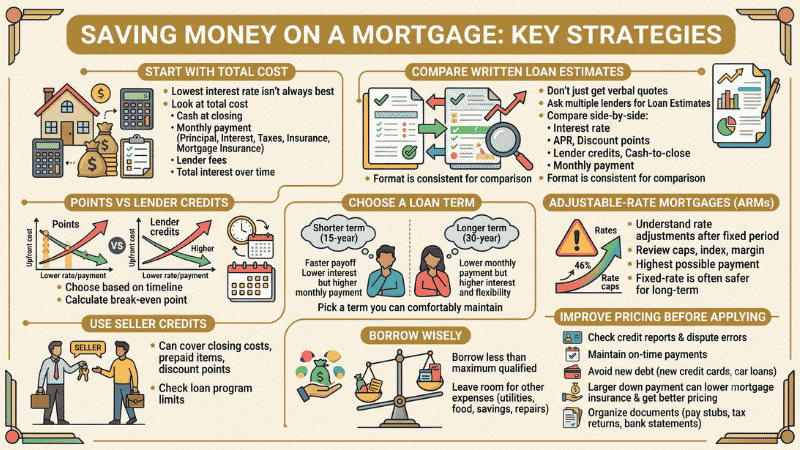
Seller credits can reduce the cash you need at closing. Funds from the loan program and purchase contract can cover eligible closing costs, prepaid items such as homeowners’ insurance or property taxes, and discount points to reduce your interest rate. Seller-paid costs should appear on your Closing Disclosure.
Seller credits are not down payment money and cannot be used as cash back for the buyer. The credit must be applied to eligible costs before closing. If part of the credit is left over, it is usually unused rather than refunded to you.
Before writing an offer, ask your loan officer how much seller credit your loan program allows and how it could be used. In some cases, using available credits for discount points or other eligible costs can lower your upfront expenses or improve the loan terms. For FHA loans, interested-party contributions may generally be used toward eligible closing costs and prepaid expenses, subject to program limits.
Borrow Less Than the Maximum You Qualify For
A lender may approve you for more than you feel comfortable spending each month. That approval is based on qualifying income and reported debts, but it may not fully reflect your child care costs, groceries, utilities, medical expenses, travel, retirement savings, or plans for repairs and emergencies. Saving money on a mortgage can also mean choosing a lower payment than the maximum available to you. Buying within a comfortable budget can give you more room to save, handle unexpected costs, and avoid feeling stretched after closing.
Improve Your Loan Pricing Before You Apply
Check your credit reports for errors, outdated balances, or accounts that aren’t yours. Dispute inaccurate information early because corrections can take time. Keep all accounts current and, when possible, avoid carrying high balances on revolving credit cards.
Avoid opening new credit accounts, financing a car, or taking on other debt shortly before applying for a mortgage. New debt can affect your monthly qualifying payment, credit profile, and the amount you can borrow.
Your down payment can also affect loan pricing. A larger down payment lowers your loan-to-value ratio, which means you are borrowing a lesser percentage of the property’s worth. Depending on the loan program and your overall profile, a lower loan-to-value ratio can lead to lower mortgage insurance costs or better pricing options, which can help you save money on a mortgage. Finally, organize your documents before you apply. Provide recent pay stubs, W-2s or tax returns, bank statements, and explanations for any large deposits to help the lender review your file accurately. A stronger, well-documented application gives you a clearer picture of the loan options available to you.
Make Extra Principal Payments Carefully
Making extra principal payments can help with saving money on a mortgage by reducing the balance faster, shortening the repayment period, and lowering the total interest paid. Before sending extra money, confirm that your mortgage servicer will apply it directly to your principal balance rather than treating it as an early payment on your future balance. Extra payments should not come at the expense of emergency savings, high-interest debt, retirement contributions, or other important financial needs. Learn more about how principal payments work on a mortgage and biweekly mortgage payments versus monthly payments before choosing a payoff strategy.
Refinance Only When the Numbers Work
A lower interest rate does not always mean refinancing will save you money. Before moving forward, compare the new monthly payment, closing costs, loan term, total interest, and the time it will take to recoup the refinance costs. For example, a refinance may lower your payment but reset your term to a new 30-year term, which could increase the total interest paid over time. Calculate your break-even period by dividing your estimated closing costs by your monthly savings. If you plan to sell, move, or refinance again before reaching that point, refinancing may not make financial sense.
Final Thoughts About Saving Money on a Mortgage
Saving money on a mortgage is not about chasing the lowest advertised rate. It is about looking at the full cost of the loan, including upfront cash, monthly payments, lender fees, mortgage insurance, and the interest you may pay over time. The best option depends on your budget, how long you expect to keep the home, and how much flexibility you need after closing. Before you commit, compare written Loan Estimates and ask questions about any cost or loan term you do not understand. A mortgage professional can check your credit, income, down payment, and timeline. They will help you choose a loan that fits your financial goals and doesn’t go over your budget.
Frequently Asked Questions About Saving Money on a Mortgage
Can You Negotiate Mortgage Closing Costs?
Yes. Ask your lender to lower or remove certain lender-controlled fees before you sign the closing documents. Third-party charges, such as appraisal, title, and recording fees, may be harder to negotiate. Comparing multiple Loan Estimates gives you a stronger basis for asking a lender to improve its offer.
What Is the Difference Between a Mortgage Interest Rate and APR?
The interest rate is the cost of borrowing the loan balance. APR, or annual percentage rate, includes the interest rate plus certain points, fees, and other charges. APR can help you compare similar loan offers, but you should still review the cash needed at closing and the projected payment before choosing a mortgage.
When Should You Lock a Mortgage Rate?
There is no single best time for every borrower to lock a rate. A rate lock can protect you if rates rise before closing, as long as you close within the lock period and your application does not materially change. However, a lock may prevent you from benefiting if rates fall later unless your lender offers a float-down option.
Can Your Mortgage Payment Increase With a Fixed-Rate Loan?
Your principal and interest payment generally stays the same with a fixed-rate mortgage. However, your total monthly payment can still change when property taxes, homeowners’ insurance premiums, mortgage insurance, or other escrowed costs increase or decrease.
When Can You Remove Private Mortgage Insurance?
For many conventional mortgages, you can request PMI cancellation once your loan balance drops to 80% of the home’s original value. PMI may generally end automatically when the scheduled balance reaches 78%, as long as you are current on your payments. FHA mortgage insurance follows different rules.
What is the Total Interest Percentage on a Mortgage?
Total Interest Percentage, or TIP, shows the total scheduled interest you would pay over the full loan term compared with the amount borrowed. You can find TIP on page three of the Loan Estimate and page five of the Closing Disclosure. It can be useful when comparing the long-term cost of similar mortgage options.
Can Mortgage Costs Increase After You Receive a Loan Estimate?
Some costs can change before closing, but others are subject to limits under federal disclosure rules. Changes may happen when your rate is not locked, your loan details change, the appraisal comes in differently than expected, or certain third-party charges change. Review every revised Loan Estimate and compare it with your Closing Disclosure before signing.
This article about “Saving Money on a Mortgage: Costly Mistakes to Avoid” was updated on July 2nd, 2026.