Undisclosed Debt Guidelines During Mortgage Process
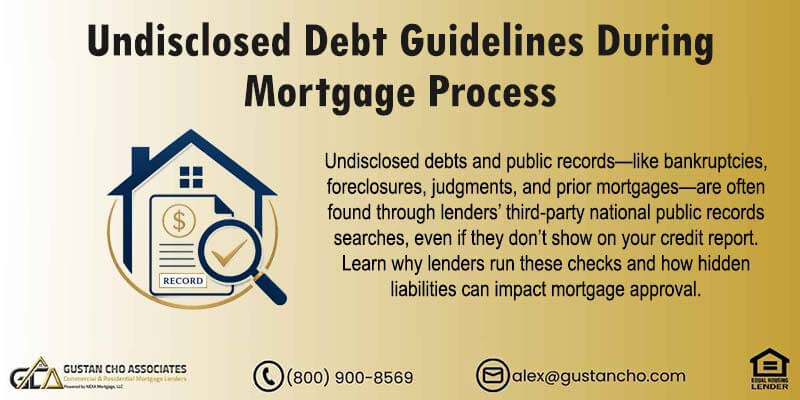
Most undisclosed debts will be discovered by lenders during a third-party national public records search. For example, if you have mortgages, bankruptcy, foreclosure, judgments, short sales, and other public records not reporting on your credit report, it will be discovered by the lender. This holds true even though it does not report on your credit report.
Many consumers hire credit repair companies in hopes to delete bad credit tradelines and other debt. There are debts like outstanding collections, late payments, and charged-off accounts that lenders cannot find out.
Public records will get discovered. All lenders will do a third-party national public records search as part of the mortgage process. Credit bureaus are not always accurate in reporting consumer credit tradelines. Most credit tradelines are on consumer credit reports for a period of seven years and then fall off if it is bad credit. This is the exact reason for lenders doing a national public records search on all mortgage loan applicants.
Undisclosed Debts Guidelines During the Mortgage Process
Purchasing a home is thrilling from start to finish of the mortgage process. Unfortunately, the mortgage process does not end once the buyer receives the loan and the seller receives the keys. A lot of clients think that once they get their pre-approval, conditional approval, or even a clear to close, they are then entitled to open new credit accounts, take out a loan to buy furniture, take out a lease on a vehicle, co-sign for a loan m, or even run a new credit card. This is not just a costly mistake, but one that may cost the buyer the home of his/her dreams.
Undisclosed Debts Rules While Applying for a Mortgage
Debt-undisclosed guidelines in the mortgage process are among the most common sections of mortgage underwriting. Lenders are required to determine whether the loan buyer continues to meet the lending guidelines.
These guidelines include debt, income, credit, and assets. If new debts are discovered in the periods preceding the closing, a lender is justified in increasing the buyer’s debt ratio.
An update to the loan application may be required, a new automated underwriting run may be needed, and the loan package may need to be resubmitted for underwriting review.
Undisclosed Debt Causes Mortgage Approval Delays
At Gustan Cho Associates, we understand that every day we have clients who were denied a mortgage for undisclosed debts, or were granted a loan for undisclosed debts, or were granted a loan for undisclosed debts, or had changes to their credit history, such as authorize new credit, switch cars, or purchase new credit cards, or were denied a loan based on a change in their debt-to-income ratio.
Something that may provide relief to these borrowers is that, in some situations, undisclosed debt may not result in a definite loan denial.
Those who face undisclosed debt challenges typically have more opportunities to resolve the problem if it is identified early, coupled with knowledge of the loan guidelines the borrower would still qualify for if the loan were granted. Some of these loan guidelines may include the FHA, VA, USDA, conventional, and non-QM lending standards.
Undisclosed Debt in the Mortgage Process
Undisclosed debt is the debt owed by a borrower that is not disclosed on the loan application when it is submitted for consideration. This includes, but is not limited to, all debts that may be reported to the credit bureau, debts that have not yet been reported to the credit bureau, loans that are co-signed, installment debts, secured and unsecured debt, automobile debts, unsecured personal loans, student loans, debts that a borrower incurs in the course of his or her business, and debts of the borrower that are incurred subsequent to the date of the borrower’s credit.
Undisclosed Debt Leads To Issues With Mortgage Approval
The borrower’s credit liability must be shown on the mortgage application, including all liabilities the borrower has discussed or that have been determined during underwriting. Liabilities or debts that the borrower has disclosed on the credit application or in other documents, or that the underwriter has requested in support of the application. In a nutshell, borrowers should never make the mistake of presuming that a certain debt ought to be ignored by all means. More often than not, if a debt obligation exists, it has to be factored into the equation.
Why Researchers Verify Debt Prior To Loan Fund Disbursement
Mortgage lenders verify debt prior to loan disbursement primarily to determine whether the borrower remains eligible for the loan. A borrower can no longer be eligible for the loan prior to fund disbursement if new debts increase the borrower’s monthly payments. Case in point, a borrower may be approved for a loan at a 48% back-end debt-to-income ratio.
If that borrower decides to finance a new car prior to fund disbursement, the new car payment may result in that borrower’s debt-to-income ratio crossing the permissible limit.
The one transaction may result in the loan fund disbursement being stalled, a new underwriting assessment being initiated, or the disbursement being completely disallowed. Fannie Mae has also raised red flags about undisclosed debts, as they can result in a debt-to-income ratio that makes the borrower ineligible for the mortgage. Fannie Mae has recognized that automobiles with unreported debts pose a credit risk. (Fannie Mae)
How Undisclosed Debt Affects Debt-To-Income Ratio
Debt-to-income ratio, also referred to in the financial services industry as DTI, is the ratio used to answer the question “Is the borrower going to be able to make payments to the lender?” Undisclosed debt can lead to an increase in DTI because the new payment is included in DTI if the borrower is responsible for making the payment, and debt can also include:
- Minimum payments on credit cards.
- Payments on car loans.
- Payments for leasing vehicles.
- Personal loans.
- Payments on loans.
- Debt that has been co-signed.
- Deferred payments.
- Payment plans for furniture.
- Payment plans for modern appliances.
- Financing for solar systems.
- This also includes debt that the loan applicant has guaranteed on behalf of a business.
- Personal rental payments or mortgage payment obligations that are due.
- Even if borrowers have all the good signs, like top-tier credit, high income, and even verification of liquid assets, the mortgage approval is still in jeopardy if they have undisclosed debt, which can push the DTI too high.
Do Consumers Have To Disclosed Debts Not Reporting On Credit Reports
Lately, we have received numerous phone calls regarding undisclosed debt and the mortgage process. Many clients are unsure of what undisclosed debt means. In short, undisclosed debt means a financial obligation that is not reporting on your credit report. In this blog, we will detail the do’s and don’ts undisclosed during the mortgage process.
Qualifying For Home Loans
When it comes to qualifying for a mortgage, there are three main areas to consider.
- Appraised value/ equity position
- Assets for a down payment
- Debt to income ratio
In this blog, we will focus on debt to income ratio and undisclosed debt guidelines
Credit Scoring Model And Process
Credit scoring models and credit reporting by the credit bureau are a mystery to most Americans. Each credit bureau weighs in differently when computing credit scores. While they are all very similar, each algorithm is different.
There are obvious factors that go into your credit scores such as payment history, utilization, and length of open trade lines. All of these factors create a record of stability demonstrating how you pay your debts.
Credit scoring is not the only factor that goes into a mortgage approval. It is important to factor in undisclosed debts into your qualifications. Late payments can kill your mortgage approval. Just because a debt does not report to the credit bureaus, that does not mean the payment history that is irrelevant.
What Debt Must be Disclosed in a Mortgage Application
It is also the applicant’s responsibility to ensure that there are no errors or omissions, including any debt omissions. Some borrowers report debt that is not reported on their credit report because they are “not required to disclose the debt.”
The mortgage application is a legal statement. A mortgage applicant must sign and attest to the form’s accuracy and completeness.
However, without exception, if the debt is current, the borrower is a cosigner, the debt was opened even a few days before the loan application, or the debt is in a payment status, the lender must be informed. A borrower can avoid all liability by disclosing everything to the loan officer before the underwriter does.
Undisclosed Debt Can Derail Your Mortgage—Check Your Risk Now
Undisclosed debts (new credit, unreported payments, or hidden liabilities) can trigger re-underwriting, delays, or denial—especially right before Clear to Close. Get a quick review and a clean approval plan.What Happens if Debt Is Not Disclosed to The Lender
There is a reason mortgage loans hinge on disclosures. A lender must approve the borrower, the significant asset being acquired, and the entire debt capital structure. If undisclosed debt or a credit report becomes available to the lender, the underwriter must be accordingly notified. A lender can be sidelined if the borrower incurs debt or receives credit. Often, even a low balance can mean the lender must do a DTI on it and assess the debt.
Opening A New Credit Card Can Make The Following Issues More Likely:
- A credit inquiry can prompt an explanation.
- A new account can drop a person’s credit score.
- A new payment may need to be calculated.
- A new statement may be required.
- A re-underwriting of the file can be necessary.
Even having a credit card balance can be problematic if the borrower is close to surpassing the maximum allowable debt-to-income ratio.
Auto Loans And Leases Before Closing
Among the many hidden debt issues borrowers face when taking out a mortgage, automobile loans, and leases are the most common. Many borrowers, getting a little overzealous after signing a purchase agreement, decide to purchase a new vehicle before they even move into the new home. This is one of the quickest ways to endanger mortgage approval.
A new auto loan can increase a borrower’s liabilities by several hundred to even over a thousand dollars. For borrowers with narrow debt-to-income ratios (DTI), an auto loan can render a mortgage loan ineligible.
This is why Gustan Cho Associates recommends that borrowers abstain from buying, leasing, or co-signing vehicles until after their mortgage loans are closed and have been funded.
Personal Loans, Buy Now Pay Later Accounts, And Co-Signed Debt
Personal loans, Buy Now Pay Later (BNPL) accounts, furniture financing, and appliance financing can also create undisclosed debt challenges.
Many of these accounts may not be immediately reflected in a borrower’s credit report, but they can still be found by credit monitoring agencies, reviewed in their bank statements, or obtained from collected updated credit reports.
Another significant problem is co-signed debt. Borrowers will often exclaim, “That is not my loan. I only co-signed.” However, in a mortgage underwriting context, co-signed debt will count against the borrower unless the loan program has a provision that allows it to be excluded, and the necessary documentation is submitted.
How Lenders Locate Undisclosed Debt Before the Clear to Close
Borrowers must always disclose that any outstanding debt will be discovered before the closing. Lenders tend to be persistent in uncovering undisclosed debt and use a variety of methods to determine its existence during the mortgage process.
Credit Refresh Before Closing
Most lenders request a credit refresh before the closing documents are executed. A credit refresh is seldom a completely new credit report, and is primarily concerned with the outcomes of other inquiries and with the existence of new debt.
When a credit refresh shows a new inquiry, the mortgagor will be given a new credit line. Lenders typically redesign debt in a new and unusual manner.
When a loan is only given new documentation to consider a record, that loan will be re-geared and re-labeled in a new manner within the traditional mortgage lending framework.
Undisclosed Debt and the Mortgage Process
Many lenders have been using Undisclosed Debt Monitoring (UDM) to detect applicants with undisclosed debts during mortgage processing. Fannie Mae has suggested UDM to determine whether borrowers incur new debt or make new credit inquiries during the process.
The Fannie Mae model has suggested that lenders warn borrowers during the application and closing processes not to take on new debt.
Because of measures such as UDM, borrowers should not assume that the different steps lenders and investors have taken to minimize the risk of a mortgage repurchase are effective. Mortgage quality control offices take undisclosed debts very seriously, since they can create repurchase risk.
Automatic Payments and Bank Statement Review
Bank statements are a tool that lenders use to see different forms of debt. Automatic transfers, in particular, can show debt that is not known (or listed) on the credit statement.
An example of this would be an underwriter seeing a monthly debt payment that is automatically deducted from a finance company loan; that payment could be on a credit card or a personal loan.
If this is the case, the underwriter can and will ask what that payment is for. Taking this a step further, the Fannie Mae model has advised lenders to check for automatic payments to a personal loan or credit card, as these payments can indicate that new debt is being repaid. Borrowers should be open and forthright. It is always a positive to have the underwriter know about an undisclosed debt.
Consequences for Discoverable Debt Prior to Closing
Discoverable debt impacts closing and the determination of continued eligibility. The consequences may vary depending on factors such as the type of debt, monthly payment, loan program, credit score, debt-to-income ratio, automated underwriting results, and lender preferences.
Re-Underwriting the Loan Is Possible
Discoverable debt may warrant underwriting the loan file anew. Underwriting of the loan file may require:
- Letter of explanation
- Recent account statement
- Proof of monthly payment
- Revised credit report
- Recent bank statement
- Revised loan application
- Revised automated underwriting
- Debt exclusion documentation
This circumstance delays the loan’s closing. In certain cases, the delay may be minimal. In other cases, due to the re-underwriting and documentation requirements, closing may be postponed.
Possible Increased Debt-To-Income Ratio
The most likely result of discoverable debt prior to closing is an increase in the debt-to-income ratio. The borrower may continue to qualify for the loan, depending on the new monthly payment. In contrast, if the new payment is significantly larger, the borrower may no longer qualify under the mortgage guidelines. For example, the additional monthly $50 payment due to newly discovered debt is likely inconsequential. However, the additional monthly car loan payment of $750 may significantly exceed the borrower’s DTI limit, leading to loan disapproval.
Borrowers Risk Losing Mortgage Approval
If there is undisclosed debt that renders the borrower ineligible, the loan can be denied. This is especially common when the borrower has:
- Unfavorable DTI ratios
- Poor credit scores
- Little to no reserves
- Recent payments have been made late.
- A file that has been manually underwritten
- A dubious automated underwriting approval
- A recently opened auto loan or lease
- A recently opened high-limit credit card
- A recently opened debt that has been co-signed
For this reason, borrowers should talk to their loan officer, receive clear instructions, and follow them before opening any new credit accounts prior to closing.
Undisclosed Debt Rules for FHA, VA, USDA, and Conventional Loans
Undisclosed debt rules apply to each prominent mortgage loan type. They vary from one to another, but the fundamental rule is the same for all: the lender must be aware of the entirety of the borrower’s debt before they can approve and close the loan.
How Mortgage Underwriters Analyze Borrowers Credit And DTI
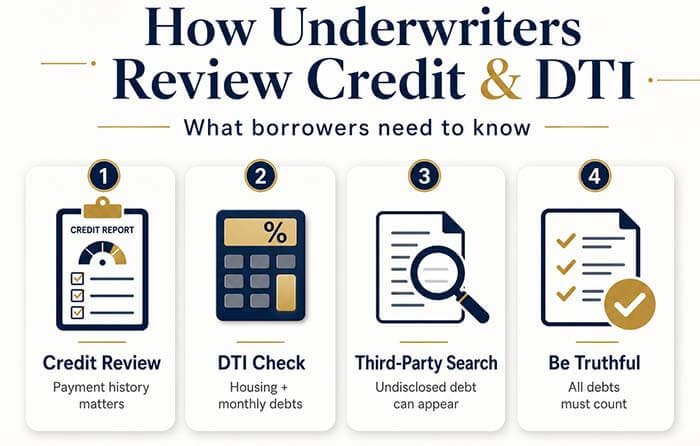
Lenders must still verify payment history on all undisclosed debts. The debt to income ratio is one of the largest obstacles to obtaining a mortgage.
The debt to income ratio is calculated based on housing payments and debts that report to your credit report. During the mortgage process, there is numerous third-party verification that is completed, and undisclosed debt will pop up.
It is important to be truthful with your lender and tell them about all the debts you currently pay. When a debt does not report on your credit report it still needs to be factored into your debt to income ratio.
Undisclosed Debt Guidelines On Debts Not Reporting On Credit Report
There are a few reasons the debt may not report. Typically, the debt is so new that it has not been cycled into your credit report yet. You may also have a creditor who does not report to the credit bureaus. Some small installment loans or even auto loans may not report to a free credit report. There are plenty of reasons a lender is concerned about undisclosed debt. It may significantly impact your ability to afford the housing payment resulting in foreclosure.
Types Of Undisclosed Debts
There are two types of undisclosed debt:
- non-mortgage undisclosed debts
- mortgage undisclosed debts
Non-Mortgage Undisclosed Debts
Non-mortgage undisclosed debts:
- This simply means a debt that is not a mortgage that does not report to your credit report but is a financial obligation you are responsible for
- This must be included when completing AUS (automated underwriting system), it is the lender’s responsibility to verify the actual mortgage payment, and resubmit the AUS to include the undisclosed debt in the FHA TOTAL SCORECARD
- The lender must evaluate if the undisclosed debt is being used as part of your down payment
- For example, if you took out an installment loan with a small private company that does not report to a credit bureau and those funds are being used for the down payment, that adds a layer of risk to the total scorecard
You may not be able to close on this mortgage. This is why it is important to be 100% open and honest with your loan officer.
Undisclosed Debt Guidelines: Mortgage Debts
Undisclosed Mortgage Debts:
- When existing debt that is secured by a mortgage is not listed on the credit report the lender must obtain verification of mortgage directly from the servicer
- More importantly, they must include this undisclosed Mortgage Debt in the AUS findings, it must be counted in the FHA total scorecard
- Depending on the results from the verification of mortgage, the lender may need to downgrade to a manually underwritten loan
Below Are A Few Reasons This Can Occur After Receiving The Verification Of Mortgage:
- A current delinquency
- Any delinquencies within the past 12 months of the FHA case number is assigned
- More than two 30-day late payments within the past 24 months of the FHA case number is assigned
Note: At times, verification of mortgage may identify that the mortgage has been modified, at that point the lender must confirm the modification and timeframe since the modification started. During certain modifications, the mortgage debt may no longer report to the credit bureaus.
Undisclosed Debt Guidelines: How Do Lenders Discover Debts Not Reporting On Credit Reports
How do lenders find out about undisclosed debt? Gustan Cho Associates has been industry-leading experts in the mortgage process. We have been doing this for a long time. There is numerous third-party verification that goes into closing a mortgage.
Underwriters are on the lookout for consistent payments based on your bank statements. If they noticed a trend in monies being paid that do not report on the credit bureau, questions will arise.
During these verifications, an undisclosed debt will show up. We are on the same team as our clients and an open and honest relationship must be established. If you are trying to hide undisclosed debt, chances are your mortgage will not close.
Credit Pulls By Mortgage Underwriters
During the pre-approval process, a lender will verify your credit report.
- This credit report is valid for 120 days
- Meaning your loan must close and fund within that time frame
- As you get closer to the closing table, within 10 days of closing the lender must order a credit refresh
- This is a soft pull to confirm if new debts have been obtained
- It is incredibly important not to have your credit pulled during the mortgage process
- There are instances where you do not have a choice such as a car accident and need to purchase a vehicle
- We encourage you to inform your loan officer before any credit pull
During this credit refresh, you will sign and date a form stating if a new debt was acquired. If you did take out new debt and are not
Get the “Undisclosed Debt” Mortgage Checklist
Learn what lenders look for—credit refreshes, bank statement reviews, payment patterns, and new accounts—plus what to avoid during underwriting and before closing.Company Licensed In Multiple States With No Lender Overlays
As stated above we are experts in the mortgage process. We are available 7 days a week for any questions regarding mortgages and preparing to qualify for a mortgage. Even with direct advice from a loan officer about not taking out new debt, many borrowers do not listen. If you do take out new debt, you may not close on your home. New debt may push your ratios over the qualifying limit.
Many clients go out and finance furniture before moving in, this is not a good idea. You need a house to put the furniture in so make sure you close on the house before making any large purchases.
We have seen it all from clients purchasing Furniture, new vehicles, and even an RV! It is more important than ever that Americans stay within their budget when it comes to housing payments. Please reach out for any clarification regarding undisclosed debt or any other mortgage question.
FHA Undisclosed Debt Rules
FHA loans are appealing to many borrowers due to their relaxed credit requirements, low down payment requirements, and the ability to exceed the debt-to-income ratio for many. Even so, borrowers of FHA loans must disclose all debts in their entirety. FHA lenders assess monthly obligations through the credit report, mortgage application, and all supporting documentation.
If a debt is on the credit report but absent from the loan application, the borrower must explain the absence, and the lender may be obliged to amend the application.
If you are near the debt-to-income ratio limit, you need to be careful if you are borrowing from the FHA. A new payment may change the AUS findings, and something that was previously approved may now become problematic.
VA Loan Undisclosed Debt Guidelines
For eligible veterans, active-duty members, and surviving spouses, VA loans are among the best mortgage options. VA loans focus on balancing residual income, debt-to-income ratio, credit score, and repayment ability.
VA loans can have problems with undisclosed debt, as new debt can reduce residual income. Even with an acceptable debt-to-income ratio, the borrower must still have adequate residual income after all monthly obligations.
VA loan borrowers should refrain from new credit cards, new auto loans, and co-signed debt obligations throughout the mortgage process. A new payment can lower residual income and raise concerns with the underwriter.
Conventional Loan Undisclosed Debt Guidelines
Conventional loans do not allow borrower obligations to be understated. Per the Freddie Mac convention, obligations can’t be understated on the mortgage application and must include obligations detailed on the credit report and any other borrower obligations shown or disclosed as part of the mortgage process. When there are undisclosed debts and borrower ratios change with respect to debts and credits, the lender must rerun DU or LPA post-reset and, as such, reset the entire process from the beginning. Conventional loans are quite sensitive to changes in DTI, credit scores, and loan-level pricing changes.
Non-QM Mortgage Solutions with Undisclosed Debt Issues
FHA, VA, USDA, and conventional mortgages do not suit all borrowers, especially those with undisclosed debts. In these cases, borrowers may need non-QM mortgages.
Non-QM Loans Benefit Borrowers With:
- Uncontrollable credit events.
- Highly burdensome debt-to-income ratios.
- Bank statement income.
- Debt service coverage ratio loans.
- Temporary bankruptcies.
- Insolvency.
- Decreased credit ratings.
- Involving peculiar sensitivities in income.
At Gustan Cho Associates, virtually everyone who has undisclosed debt and has been turned down for a loan with a competing institution still has a chance through a different loan program or a lender with no overlays.
Undisclosed Debt Scenarios During a Mortgage Application
Unlike many benign breaches of the rules, which do not result in any obstructive debt impression, there are many cases of undisclosed debt breaches during loan applications where the intent to breach the rules is specifically absent.
Pre-Closing Intent To Purchase Furniture
When buyers purchase furniture for the new home before funding, they risk placing a financial burden on themselves. They think, in good faith, that furniture debt won’t matter, and more often than not, it doesn’t, because they won’t have the payment once the debt is reported. They seem to get away without it, but more often than not, the truth comes to light.
Family Member/Dear One Co-signing
Also, in family and/or friend transactions where the borrower will not be recompensed, lenders more often than not consider it borderline impairing.
Vehicle Leasing
Before closing, leasing a vehicle can be a significant concern, as lease payments typically weigh on a borrower’s monthly debt. Unlike installment loans, leases have a variable number of remaining payments and therefore cannot always be excluded.
Personal Loans
Borrowers can run into mortgage approval issues during the loan process if they open a personal loan to cover relocation costs, furniture, or debt consolidation.
Credit Card Debt
Borrowers do not always open new lines of credit. Sometimes, they increase their current debts. Higher credit card balances can increase monthly payments, decrease credit scores, and jeopardize mortgage approval.
How Undisclosed Debt Can Affect Clear To Close
Clear to close means the underwriter has issued final approval for the loan to proceed to closing. However, clear to close does not mean the borrower can open new credit before funding. The lender may still check credit, verify employment, review updated documents, or require a closing certification confirming no new debts were opened. Fannie Mae has recommended that lenders require borrowers to sign a certification at closing that they have not taken on new debt.
Clear To Close Is Not Permission To Open New Debt
Borrowers should treat the period between clear to close and funding as a danger zone. Do not finance furniture. Do not buy a car. Do not open a new credit card. Do not co-sign. Do not make large, unexplained deposits. Do not change jobs without speaking to the loan officer.
Funding Can Still Be Stopped
In some states, signing closing documents does not mean the loan has funded. If a lender discovers new debt before funding, the loan can still be delayed or stopped. This is why Gustan Cho Associates tells borrowers to keep their financial profile stable until the loan is fully closed and funded.
How To Avoid Undisclosed Debt Problems Before Closing
Avoiding undisclosed debt problems is simple if borrowers follow the right steps.
Do Not Open New Credit During the Mortgage Process
The safest rule is to avoid all new credit from application through closing. This includes credit cards, auto loans, leases, personal loans, furniture financing, appliance financing, and buy now pay later accounts.
Do Not Co-Sign For Anyone
Do not co-sign for anyone during the mortgage process. Even if the other person promises to make the payment, the debt can still affect your mortgage approval.
Tell Your Loan Officer Before Making Financial Moves
Before opening a credit account, moving money, changing jobs, depositing large funds, paying off debts, or making a major purchase, speak with your loan officer. A five-minute conversation can prevent a last-minute mortgage denial.
Keep Bank Activity Clean And Documented
Lenders review bank statements carefully. Avoid unexplained deposits, large transfers, cash deposits, and new automatic payments unless they can be fully documented.
Do Not Assume Small Debts Do Not Matter
Small debts can matter when the borrower has tight DTI ratios. Always disclose debts to the loan officer so the file can be reviewed correctly.
What Borrowers Should Do If They Have Already Opened New Debt
If you have already opened new debt during the mortgage process, do not panic or hide it. Contact your loan officer immediately.
Be Honest Immediately
The worst thing a borrower can do is wait for the lender to discover the debt. Tell your loan officer what happened when the account was opened, the current balance, and the monthly payment.
Provide Documentation Fast
The lender may need a new account statement, payment letter, credit supplement, updated bank statements, or a letter of explanation. Fast documentation can help reduce delays.
Ask Whether The Debt Can Be Paid Off
In some cases, paying off the debt may help. In other cases, paying it off may not solve the problem if the account still affects the credit profile or if the funds used to pay it off create asset documentation issues. Do not pay off debt without guidance from your loan officer. Paying off debt the wrong way can create new problems if the source of funds is not properly documented.
See Whether Another Loan Program Works
If the new debt makes the borrower ineligible for one loan program, another loan program may still work. For example, a borrower denied for a conventional loan may qualify for FHA, VA, or non-QM financing depending on the full file.
Gustan Cho Associates Helps Borrowers With Undisclosed Debt Issues
Gustan Cho Associates specializes in helping borrowers who could not qualify with other lenders. Many mortgage denials happen not because the borrower does not qualify under agency guidelines, but because the lender has overlays, strict internal rules, or limited loan options.
No Lender Overlays On Government And Conventional Loans
Gustan Cho Associates is known for helping borrowers with FHA, VA, USDA, conventional, and non-QM mortgage options. Many borrowers come to us after another lender denied them due to debt-to-income ratio issues, credit score overlays, late credit activity, or undisclosed debt discovered late in the process.
Same-Day Mortgage Review For Borrowers With New Debt
If your lender found undisclosed debt before closing, you may still have options. Gustan Cho Associates can review the file, calculate the updated DTI, review the credit report, check loan program options, and determine whether the loan can still be saved.
Mortgage Solutions After Another Lender Denied Your Loan
A mortgage denial does not always mean the borrower cannot buy the home. It may mean the borrower needs the right lender, the right loan program, and the right underwriting strategy. Borrowers with new debt, high DTI, credit issues, recent bankruptcy, recent foreclosure, collections, charge-offs, or non-traditional income may still qualify with the correct mortgage program.
Final Thoughts On Undisclosed Debt Guidelines During the Mortgage Process
Undisclosed debt guidelines during the mortgage process are important because lenders must verify that borrowers still qualify for the loan before closing. New credit, new loans, co-signed debt, auto leases, credit card balances, and hidden liabilities can delay or stop a mortgage approval.
The best advice is simple: do not open new credit, do not co-sign, do not finance large purchases, and do not make major financial changes until after the mortgage loan closes and funds are received.
If undisclosed debt has already been discovered, be honest with your loan officer immediately. The sooner the issue is reviewed, the better the chance of saving the loan. Gustan Cho Associates helps borrowers nationwide with mortgage approvals, lender overlays, high debt-to-income ratios, credit challenges, and last-minute mortgage problems. If another lender denied your loan because of undisclosed debt, new credit, or debt-to-income ratio issues, Gustan Cho Associates may be able to help you find a solution.
FAQs About Undisclosed Debt Guidelines During the Mortgage Process
What Is Undisclosed Debt During The Mortgage Process?
Undisclosed debt during the mortgage process is any debt, liability, loan, credit account, co-signed obligation, or monthly payment that was not properly disclosed to the lender. This can include new credit cards, auto loans, leases, personal loans, furniture financing, student loans, and debts that do not yet appear on the credit report.
Can Undisclosed Debt Cause A Mortgage Denial?
Yes, undisclosed debt can cause a mortgage denial if the new payment increases the borrower’s debt-to-income ratio beyond the allowable limit or changes the automated underwriting approval. Some borrowers can still qualify if the debt is documented and the updated file still meets mortgage guidelines.
Do Lenders Check For New Debt Before Closing?
Yes, many lenders check for new debt before closing through credit refreshes, undisclosed debt monitoring, updated credit reports, bank statement reviews, and borrower certifications. Borrowers should assume that new credit activity can be discovered before loan funds are disbursed.
Can I Open A Credit Card After Mortgage Approval?
It is not recommended to open a credit card after mortgage approval and before closing. A new credit card can trigger a credit inquiry, a new account, a new payment, a lower credit score, and an underwriting delay. Wait until after the mortgage loan closes and the funds are received.
Can I Buy Furniture Before Closing On A House?
Borrowers should not finance furniture before closing. Furniture financing can create new debt and affect mortgage approval. It is safer to wait until after the loan closes and the funds are in before buying furniture on credit.
What Happens If I Buy A Car Before Closing?
Buying or leasing a car before closing can create serious mortgage problems. The new auto payment may increase your debt-to-income ratio and cause the lender to re-underwrite the loan. In some cases, it can lead to mortgage approval being denied.
Does Co-Signed Debt Count Against Me For A Mortgage?
Co-signed debt can count against you for a mortgage because you are legally responsible for the payment. Some loan programs may allow the debt to be excluded if another party has made the payments and the required documentation is provided, but borrowers should never assume co-signed debt will be ignored.
What Should I Do If I Forgot To Disclose A Debt?
If you forgot to disclose a debt, contact your loan officer immediately. Provide the account details, monthly payment, balance, and any requested documentation. It is better to disclose the debt early than to have the underwriter discover it later.
Can Paying Off Undisclosed Debt Fix The Problem?
Paying off undisclosed debt may help in some cases, but borrowers should not pay off debt without first speaking with their loan officer. The lender may need to document the source of funds used to pay off the debt, and some debts may still require underwriting review.
Can Gustan Cho Associates Help After Undisclosed Debt Was Found?
Yes. Gustan Cho Associates helps borrowers who were denied, delayed, or placed back into underwriting because of undisclosed debt, new credit, high debt-to-income ratios, or lender overlays. A new debt does not always mean the loan is dead. The file needs to be reviewed in accordance with the appropriate mortgage guidelines.