
Mortgage programs differ in their down payment, credit, income, property, occupancy, and mortgage insurance requirements. The right loan depends on your complete financial profile—not simply which program offers the lowest advertised interest rate. FHA loans may help borrowers with lower credit scores or limited savings. VA loans can offer eligible service members and veterans zero-down financing without monthly mortgage insurance. USDA loans may provide zero-down financing for qualified borrowers purchasing primary homes in eligible areas. Conventional loans can offer flexible terms and removable private mortgage insurance, while jumbo loans finance properties above conforming loan limits. Non-QM programs may help self-employed borrowers, real estate investors, and others who cannot document income through traditional methods. You may qualify for more than one mortgage program. Compare the interest rate, APR, monthly payment, mortgage insurance, closing costs, cash required at closing, and long-term borrowing cost before deciding. A licensed loan officer can review your income, credit, assets, debts, property type, and future plans to help identify the most suitable options.
What Are the Main Types of Mortgage Loans?
Lending choices weigh heavy on most house hunters. Though picky, they sort through multiple paths before landing on one that fits. Conventional routes stand beside government-backed picks like those backed by the Federal Housing Administration. Veterans might lean toward ones tied to service benefits instead. Rural spots open doors with special support for buyers outside cities.
Bigger amounts needing larger financing bring their own category into play. Rules shift widely when it comes to approval numbers, upfront cash demands, earnings checks, building styles, and extra fees tacked on over time.
Most people with solid credit pick a standard mortgage. Those needing easier approval sometimes go with an FHA option instead. For military families and vets, there’s another path through VA support. Rural home shopping? One route skips the upfront cost entirely via USDA rules. Big mortgages kick in once you go past the usual borrowing cap. For folks running their own business or buying rental properties, these non-traditional loans might open doors. Sometimes regular rules just don’t match how people earn or spend. A different kind of financing steps up when typical banks say no. Numbers that fall outside standard boxes need a separate path. When income doesn’t look like a paycheck every two weeks, alternatives become necessary. Lenders have options even if your finances aren’t textbook.
FHA Loans
FHA loans come with support from the Federal Housing Administration, usually helping people who face tougher financial conditions get into homes. When someone has a credit rating of 580 or above, they might pay just 3.5 percent upfront to make it happen. Those scoring between 500 and 579 could be looking at a bigger initial cost – often around 10 percent – though each lending rulebook can shift that number slightly. Getting into a home with an FHA loan might work for those buying their first place, doing it again later, or rebuilding credit after setbacks. What comes along with that chance is extra cost tied to insurance protecting the lender. A chunk of that protection gets paid right when the deal closes, another part shows up on each month’s bill. Since these loans back homes meeting certain rules, inspectors check how safe, sound, and suitable a house really is. Their review digs into things like working systems, structural health, and basic comfort before approval moves forward.
VA Loans
Eligible veterans, active-duty personnel, select National Guard and Reserve individuals, plus specific surviving spouses can qualify for VA loans. Buying a house without putting money down might happen if you meet the criteria – also skipping monthly private mortgage insurance comes with it. Not every borrower needs perfect credit when using a VA loan – flexible standards often apply. Yet the entire application matters, not just one part. What counts includes payment records, how much money comes in each month, leftover funds after expenses, whether work has been steady, and details about the home. A fee sometimes shows up during closing, though those receiving certain disability payments through the VA might skip it entirely.
USDA Loans
Backed by the U.S. Department of Agriculture, USDA loans help people purchase homes in certain countryside or outer-town spots. Not every area qualifies – where the house sits matters just as much as the buyer’s status. Some folks get in without paying anything upfront, provided the land fits within official boundaries. Rules about placement can make or break eligibility, even if finances look good. Not everyone qualifies for USDA loans – limits depend on where you live, how many people are in your home, plus what others earn nearby. A steady paycheck helps make these loans work when saving for a down payment feels tough. Credit history matters just as much as debts compared to earnings each month. The house itself must meet certain standards too, not only numbers on paper.
Conventional Loans
Not tied to federal backing, these loans usually go to people who earn regularly. People with solid credit scores tend to qualify more easily. A stable paycheck helps too when applying. For some qualified applicants, putting down just 3% might be possible. Closing fees still need coverage from the buyer’s pocket. Most folks with strong credit find conventional loans work well. These loans offer freedom in choosing properties. Once you build up your home’s value, that extra fee tied to borrowing vanishes. Not so with certain federal loan types – they keep it longer. Tougher checks on earnings show up here though. Credit history gets close attention too. Rules around how much debt fits your paycheck tend to tighten. Property rules might block some homes others would accept.
Jumbo Loans
Most homebuyers turn to jumbo loans once they cross the county’s set limit for regular mortgages. In areas where homes cost more, typical financing falls short – so bigger loans fill the gap. Lenders often demand better credit when offering bigger loans. A solid financial history might be needed, along with extra savings set aside before closing. Payment stability matters just as much as the amount put down at purchase. Though PMI sometimes gets waived on these large amounts, every bank sets its own conditions. Interest levels differ, depending who handles the paperwork and how strict they are.
Non-QM Mortgage Options
Some folks fall outside the usual lending rules – non-QM mortgages open doors for them. Self-employment? Irregular paychecks? Retired on a patchwork of income streams? These paths still lead to homeownership. Gig work doesn’t follow old 9-to-5 patterns, yet lenders can still see value. Investors stacking rental properties often earn differently than most. Even if paperwork looks unusual, financing exists beyond traditional boxes. Some Non-QM choices are bank statement loans, 1099 income loans, asset depletion loans, DSCR loans, alongside jumbo Non-QM loans. Instead of standard rules, these paths look at income through alternative lenses – sometimes focusing on assets or rental numbers. Down payments tend to be steeper, reserve demands firmer, interest costs elevated when set beside FHA, VA, USDA, or traditional loan types.
How To Compare Mortgage Programs
Most people check just the interest numbers when picking a home loan. Yet what matters often hides behind that first glance. Look past the rate – peek at how much cash you need upfront. Monthly bills add up differently depending on the plan picked. Some loans demand extra fees each month through insurance. Your credit history might block certain paths entirely. Closing day brings its own set of charges too. Even if one deal seems cheaper today, it could cost more years later. Time changes which choice feels smart. Thinking about what you want money-wise makes a difference. Take someone buying their first home – they might like programs that ask for little upfront cash. Veterans could find loans through the VA that require nothing down. When work comes from freelancing or contracts, standard proof of earnings sometimes falls short – there are alternatives built for that. Looking at different loans together gives clarity on which one lines up with how much you earn, spend, and plan to live long term.
Fixed-Rate Versus Adjustable-Rate Mortgages
Choosing between a fixed-rate mortgage and an adjustable-rate mortgage determines how long your interest rate stays the same and if your principal and interest payments may increase later. FHA, VA, conventional, jumbo, and some Non-QM loans may be available with either structure. This mortgage guide can help borrowers understand the differences, but available terms vary by program and lender.
How a Fixed-Rate Mortgage Works
A fixed-rate mortgage keeps the same interest rate throughout the loan term. As a result, the monthly principal-and-interest payment does not change. However, the total housing payment may still increase or decrease when property taxes, homeowners’ insurance, flood insurance, mortgage insurance, or escrow requirements change. “Fixed rate” applies to the loan’s interest rate—not necessarily the entire monthly payment. A fixed-rate mortgage may be appropriate for borrowers who:
- Expect to keep the home for many years
- Prefer predictable principal-and-interest payments
- Have limited room in their budget for future payment increases
- Believe interest rates may rise
- Do not want to depend on selling or refinancing before a rate adjustment
The tradeoff is that a fixed-rate mortgage may initially have a higher rate than a comparable ARM. If market rates later decline, the borrower generally must refinance and qualify for a new loan to obtain a lower rate.
How an Adjustable-Rate Mortgage Works
An adjustable-rate mortgage, or ARM, usually begins with a rate that remains fixed for an introductory period. After that period ends, the rate can adjust at scheduled intervals. For example, a 5/1 ARM generally has a fixed rate for the first five years and can adjust once each year afterward. A 7/6 ARM generally remains fixed for seven years and can adjust every six months after that. Borrowers should confirm the exact adjustment schedule in the loan documents because ARM structures vary. Once the introductory period ends, the new rate is typically calculated using:
- Index: A benchmark rate that moves with market conditions
- Margin: A percentage added to the index and established in the loan agreement
- Rate caps: Limits on how much the rate can change at the first adjustment, at later adjustments, and over the life of the loan
The index plus the margin produces the fully indexed rate, subject to the loan’s caps. If the index rises, the borrower’s rate and principal-and-interest payment may increase. If the index falls, the rate may decrease, depending on the loan terms and applicable rate floor. The Consumer Financial Protection Bureau explains that ARM adjustments are based on the index, margin, and contractual rate caps—not on a borrower’s financial circumstances at the time of adjustment.
When an ARM May Be Considered
An ARM may be considered when the initial rate and payment are lower than those of a comparable fixed-rate loan, and the borrower understands the risk of future adjustments. It may appeal to borrowers who reasonably expect to sell the property, pay off the mortgage, or move before the initial fixed period ends. However, those plans are not guaranteed. Home values may decline, interest rates may rise, or the borrower’s income and credit profile may change. A borrower should be able to manage a higher payment without assuming that refinancing will be available.
How to Compare Fixed-Rate and Adjustable-Rate Offers
Do not compare the initial interest rates alone. Review the following terms on each Loan Estimate and ARM disclosure:
- Initial rate and monthly payment
- Length of the introductory period
- Adjustment frequency
- Index and margin
- Fully indexed rate
- Initial, periodic, and lifetime rate caps
- Highest possible rate and payment
- APR, discount points, lender credits, and closing costs
- Expected time in the home
- Break-even period
- Ability to afford future payment increases
The APR on an ARM does not show the loan’s maximum possible interest rate, so it should not be used by itself to compare an ARM with a fixed-rate mortgage. The better choice depends on the borrower’s budget, risk tolerance, expected ownership period, and the complete cost and terms of each loan.
Which Mortgage May Fit Your Situation?
 The right mortgage depends on your eligibility, credit history, qualifying income, available funds, property type, and long-term plans. This mortgage guide can help you identify programs worth comparing, but no single loan is best for every borrower.
Eligible Veteran or Service Member With Limited Funds
A VA loan may be a strong option for an eligible veteran, active-duty service member, or qualifying surviving spouse. Eligible borrowers have the opportunity to purchase a home without making a down payment, depending on entitlement, appraisal, credit, income, and underwriting criteria. VA loans do not require monthly mortgage insurance. However, most borrowers pay a VA funding fee unless they qualify for an exemption. Individual lenders may also impose credit-score or debt-to-income overlays beyond VA’s minimum guidelines.
Buyer With Moderate Credit and Limited Savings
An FHA loan may fit a borrower with a lower credit score, a small down payment, or previous credit problems. Eligible borrowers with qualifying credit scores of 580 or higher may purchase a home with 3.5% down under FHA guidelines. Lenders may require higher scores. FHA loans require you to pay mortgage insurance upfront and every year. Borrowers should compare the FHA payment and lifetime insurance costs with available conventional options before deciding.
Buyer With Strong Credit and at Least 3% to 5% Down
A conventional loan may be suitable for a borrower with stronger credit, stable qualifying income, and sufficient funds for the down payment and closing costs. Certain conventional programs permit as little as 3% down for eligible borrowers, although 5% or more may be required depending on the borrower, property, and occupancy type. Private mortgage insurance is generally required with less than 20% down, but it may be canceled after applicable equity, payment history, and loan requirements are satisfied. Conventional financing may produce lower long-term mortgage-insurance costs than FHA financing for some borrowers.
Rural or Suburban Buyer Within USDA Income Limits
A USDA Guaranteed Loan may offer 100% financing for an eligible borrower purchasing a primary residence in a USDA-approved area. Some qualifying locations are small towns or communities outside metropolitan centers rather than remote rural areas. The property address and total household income must meet USDA requirements. USDA loans also include upfront and annual guarantee fees, so zero down does not mean zero cash needed at closing.
Buyer Purchasing Above the Conforming Loan Limit
A jumbo loan may be necessary when the mortgage amount exceeds the conforming loan limit for the property’s location and number of units. Jumbo requirements vary because lenders establish their own underwriting standards. Borrowers commonly need stronger credit, a larger down payment, and substantial cash reserves. Comparing several lenders is important because one lender’s jumbo guidelines may differ significantly from another’s.
Self-Employed Borrower With Significant Tax Write-Offs
A bank statement, 1099-only, profit-and-loss, asset depletion, or other Non-QM loan may help a self-employed borrower whose taxable income does not accurately reflect available cash flow. These programs still require underwriting and documentation. They may also carry higher interest rates, larger down-payment requirements, and stronger reserve requirements than conventional financing. A self-employed borrower should compare both traditional and alternative-documentation options before assuming that Non-QM is necessary.
Investor Qualifying Through Rental Cash Flow
A DSCR loan may fit a real estate investor who wants to qualify primarily through the property’s expected rental income rather than personal employment income. The lender generally compares qualifying rent with the property’s required debt payments and expenses under its specific calculation. DSCR requirements differ by lender and may include minimum down payments, reserve requirements, property restrictions, and prepayment penalties where permitted. These loans are generally intended for business-purpose investment properties—not owner-occupied homes.
Compare Every Program Available to You
A borrower may qualify for two or more mortgage programs. Before choosing one, compare:
- Interest rate and APR
- Monthly principal-and-interest payment
- Mortgage insurance or guarantee fees
- Discount points and lender credits
- Down payment and total cash to close
- Fixed-rate or adjustable-rate terms
- Prepayment penalties, if applicable
- Five-year borrowing cost
- Expected time in the home
- Long-term cost of the loan
The program with the smallest down payment may not offer the lowest monthly payment or the lowest long-term cost. Ask the lender to prepare comparable Loan Estimates using the same loan amount, property, rate-lock period, and loan structure before making a final decision.
Find the Right Mortgage Program Before You Apply
Each loan program has different rules. We’ll review your credit, income, debts, down payment, and homebuying goals to match you with the best approval path..How to Compare Loan Estimates Correctly
A Loan Estimate provides a standardized summary of a mortgage’s proposed terms, projected payments, closing costs, and other important features. However, comparing only the interest rate or the monthly payment can lead to the wrong decision. This mortgage guide recommends reviewing Loan Estimates side by side using identical loan assumptions.
Compare the Same Loan Scenario
Ask each lender to prepare the Loan Estimate using the same:
- Property and purchase price
- Down payment and loan amount
- Mortgage program
- Fixed-rate or adjustable-rate structure
- Loan term
- Occupancy type
- Credit and income information
- Rate-lock status and lock period
- Estimated closing date
Try to obtain the offers on the same day because mortgage rates and pricing can change daily. A locked rate should not be compared directly with an unlocked rate without considering the difference.
Review the Loan Terms on Page 1
Start with the Loan Terms section. Confirm that the loan amount, interest rate, and monthly principal-and-interest payment match the offer you requested. Also, determine whether:
- The interest rate can increase after closing
- The loan balance can increase
- A prepayment penalty applies
- The loan includes a balloon payment
For an adjustable-rate mortgage, review the separate ARM disclosures for the index, margin, adjustment schedule, rate caps, and highest possible payment.
Compare the Projected Monthly Payment
The Projected Payments section shows the estimated principal, interest, mortgage insurance, and escrow payment. Compare the complete payment, not only principal and interest. Review:
- Principal and interest
- Private mortgage insurance or FHA annual mortgage insurance
- Estimated property taxes
- Homeowners insurance
- Flood insurance, when applicable
- HOA dues or other housing expenses are not included in escrow
Property taxes and insurance are generally not controlled by the lender. Different estimates for these expenses may reflect different assumptions rather than a true difference in loan pricing. Ask the lenders to use the same figures when possible.
Examine Loan Costs on Page 2
Page 2 separates the lender’s charges from other closing expenses. Pay close attention to Section A, Origination Charges, because these fees are generally controlled by the lender. Origination charges may include:
- Loan origination or underwriting fees
- Processing fees
- Discount points
- Application-related charges
Then review the services you cannot shop for and those you can. Appraisal, credit-report, title, settlement, and recording costs may vary, but they should not distract from substantial differences in lender-controlled fees.
Understand Discount Points and Lender Credits
Discount points are upfront charges paid in exchange for a lower interest rate. A lender credit generally reduces upfront closing costs in exchange for accepting a higher rate. Do not assume that an offer with the lowest rate is automatically the least expensive. Determine how much extra you must pay for that rate and calculate the break-even period: Additional upfront cost ÷ monthly payment savings = estimated break-even period Paying points may not make financial sense if you expect to sell or refinance before reaching the break-even point. A higher-rate loan with lender credits may be useful when preserving cash is more important than minimizing long-term interest.
Compare Cash to Close Carefully
The Estimated Cash to Close figure includes more than lender fees. It may reflect:
- Down payment
- Closing costs
- Prepaid interest
- Initial escrow deposits
- Earnest-money deposits
- Seller credits
- Lender credits
- Other adjustments
A lower cash-to-close figure does not necessarily mean the loan is less expensive. One offer may show a smaller down payment, larger lender credit, or different tax and insurance assumptions. Review how the figure was calculated before comparing it with another offer.
Use the Five-Year Cost on Page 3
The Comparisons section on Page 3 helps borrowers evaluate the medium-term cost of competing offers. Under “In 5 Years,” the first number is the total amount paid over five years, including principal. The second is the principal paid off during that period. Subtract the principal paid from the total paid: Total paid in five years − principal paid = five-year borrowing cost This calculation estimates the interest, mortgage insurance, and loan costs paid during the first five years. The Consumer Financial Protection Bureau recommends this method when comparing similar Loan Estimates.
Review the APR—But Do Not Use It Alone
The annual percentage rate (APR) is the interest rate combined with certain loan costs, expressed as an annual rate. It can help compare loans with the same type, term, and repayment structure. However, APR has limitations. It may not reflect:
- How long do you expect to keep the mortgage
- Every closing expense
- The maximum possible cost of an ARM
- Future changes in taxes, insurance, or mortgage insurance
- The financial effect of making extra principal payments
A loan with a lower APR could still require more cash at closing or have a higher monthly payment. Use APR with the five-year borrowing cost, cash to close, and break-even period.
Check the Rate-Lock Information
Confirm whether the interest rate is locked and when the lock expires. If it is not locked, the rate, points, lender credits, and payment may change before closing. If the rate is locked, verify that the lock period provides enough time to complete underwriting, the appraisal, and closing. Ask whether an extension fee could apply if the loan does not close before the expiration date.
Compare the Final Closing Disclosure
A Loan Estimate is not the final closing statement. Before closing, compare the Closing Disclosure with the most recent Loan Estimate. Confirm that the interest rate, loan amount, monthly payment, lender credits, cash to close, and closing costs are consistent with the agreed terms. Ask the lender to explain every material difference before signing. Some charges may change under permitted circumstances, but unexplained increases should be reviewed immediately. The best mortgage offer is not always the one with the lowest advertised rate. It is the offer that provides the right combination of monthly payment, upfront cost, rate stability, cash to close, and long-term expense for the borrower’s expected time in the home.
What Lenders Review Before Approval
Mortgage approval depends on more than a credit score. Lenders review whether the borrower qualifies for the selected program, can reasonably repay the loan, and is purchasing an acceptable property. This mortgage guide explains the main factors underwriters evaluate before issuing final approval.
Credit History
The lender reviews the borrower’s credit reports, credit scores, and payment history. The underwriter may consider:
- Recent late payments
- Collections and charge-offs
- Bankruptcy, foreclosure, or short-sale history
- Outstanding judgments or tax liens
- Credit-card balances and utilization
- Disputed accounts
- Length and depth of credit history
- New accounts and recent credit inquiries
A lower score does not always result in a denial. FHA, VA, conventional, and Non-QM programs evaluate credit differently. The cause, timing, and pattern of past credit problems may matter as much as the score itself. Lenders may also apply minimum-score requirements that are stricter than the program’s underlying guidelines.
Income and Employment
Lenders must determine whether the borrower has enough qualifying income to manage the proposed mortgage and other monthly obligations. Income must generally be documented, stable, and reasonably expected to continue. Depending on the borrower’s situation, the lender may review:
- Pay stubs and W-2 forms
- Federal income-tax returns
- Employment verification
- Business tax returns
- Profit-and-loss statements
- Bank statements
- Social Security or pension award letters
- Disability, child support, or alimony documentation
- Rental-income records
- Asset statements are used for income qualification
Not every dollar received counts as qualifying income. Overtime, bonuses, commissions, self-employment income, and variable work hours may require a documented history and an average calculation. Fannie Mae requires lenders to evaluate whether income is stable, predictable, and likely to continue. Fannie Mae’s income guidelines explain the general approach for conventional loans.
Monthly Debts and Debt-to-Income Ratio
The debt-to-income ratio, or DTI, compares qualifying monthly income with recurring debt obligations. The calculation may include:
- Proposed mortgage payment
- Property taxes and insurance
- Mortgage insurance
- HOA dues
- Car loans and leases
- Student-loan payments
- Credit-card minimum payments
- Personal and installment loans
- Child support and alimony
- Payments on other properties
There is no single maximum DTI that applies to every borrower or mortgage. The permitted ratio depends on the loan program, automated underwriting findings, credit profile, reserves, and lender requirements. VA underwriting also considers residual income—the money remaining after major monthly obligations and estimated living expenses. VA states that eligible borrowers must have satisfactory credit and sufficient income to meet their expected obligations. VA Home Loan requirements provide more information.
Assets, Down Payment, and Cash to Close
The lender verifies that the borrower has enough acceptable funds for the down payment, closing costs, prepaid expenses, and required reserves. Funds may come from permitted sources such as:
- Checking or savings accounts
- Investment or retirement accounts
- Proceeds from selling another property
- Eligible gift funds
- Approved down-payment-assistance programs
- A documented gift of equity
- Business funds are released when program requirements are met
The underwriter may request an explanation and supporting documents for large or unusual deposits. Borrowed funds, cash deposits, undisclosed loans, or money that cannot be properly sourced may not be eligible. Some programs also require reserves. Reserves are funds remaining after closing, commonly measured by the number of months of housing payments they could cover.
Property Value and Condition
Approval involves both the borrower and the property. The lender normally orders an appraisal to determine whether the home provides adequate collateral for the requested mortgage. The appraisal may address:
- Estimated market value
- Property type and legal use
- Comparable sales
- Overall condition
- Safety or structural concerns
- Required repairs
- Program-specific property standards
An appraisal is not the same as a home inspection. The appraisal protects the lender’s financial interest and addresses program requirements. An independent home inspection helps the buyer evaluate the home’s condition more thoroughly. Condominiums, manufactured homes, mixed-use properties, multiunit homes, and unique properties may require additional reviews. The property must also meet the rules of the selected loan program.
Occupancy and Program Eligibility
The lender confirms how the property will be used. Primary residences, second homes, and investment properties have different down-payment and underwriting requirements. Program-specific eligibility may also include:
- Military service and a valid Certificate of Eligibility for VA financing
- Household-income and property-location requirements for USDA loans
- FHA or conforming loan limits
- First-time homebuyer requirements for certain assistance programs
- Citizenship, residency, or eligible immigration status
- Restrictions on property type or the number of financed properties
Providing inaccurate occupancy information can be considered mortgage fraud. Borrowers should state their intended use of the property honestly.
Automated or Manual Underwriting Findings
Many FHA, VA, USDA, and conventional applications are first evaluated through an automated underwriting system, or AUS. The system analyzes the loan data and may issue findings such as approval, accept, refer, caution, or ineligible, depending on the program. An acceptable AUS finding is not final loan approval. The underwriter must still verify that the documents support the information entered into the system and that all conditions have been satisfied. A loan that does not receive an automated approval may sometimes be reviewed through manual underwriting. Manual underwriting generally requires a closer review of payment history, income, debts, reserves, and compensating factors. Availability depends on the loan program and lender.
Consistency and Undisclosed Obligations
Underwriters compare the application with credit reports, bank statements, tax returns, pay records, fraud reports, and other documents. Inconsistencies may lead to additional questions. Common issues include:
- Undisclosed properties or mortgages
- New debts opened during the loan process
- Changes in employment or income
- Large unexplained deposits
- Address differences
- Unreported child-support obligations
- Business losses shown on tax returns
- Recent overdrafts or insufficient funds
- Conflicting occupancy information
Responding quickly and providing complete documents can prevent unnecessary delays.
Ability to Repay the Mortgage
In the case of most consumer mortgages, the lender is required to conduct a fair and earnest assessment of the borrower’s ability to repay the loan. The review can include income, assets, employment, monthly debts, mortgage payments, and credit history. The Consumer Financial Protection Bureau explains the Ability-to-Repay rule. Non-QM does not mean that the borrower’s ability to repay is ignored. Alternative-documentation loans use different methods to evaluate income, assets, or cash flow.
Final Approval Is Often Conditional
An initial approval or preapproval may include conditions that must be cleared before closing. The lender may request updated bank statements, proof of insurance, employment verification, appraisal corrections, or explanations for specific credit and financial issues. Borrowers should avoid changing jobs, opening new credit, increasing credit-card balances, moving money without documentation, or making large purchases before closing. Lenders may reverify credit, employment, income, and assets before issuing final approval or funding the loan.
Agency Guidelines Versus Lender Overlays
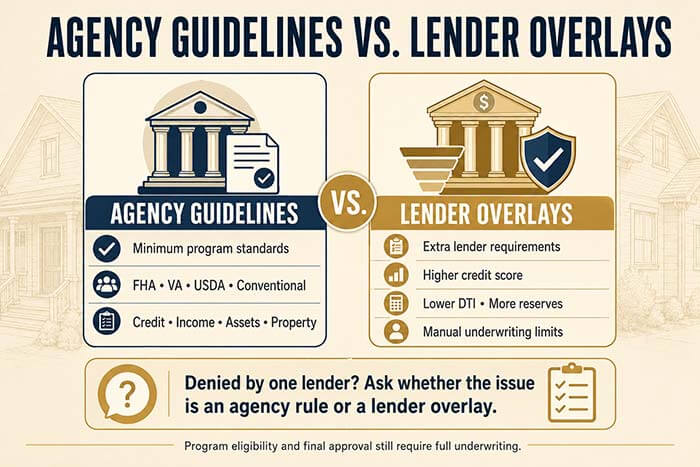
Agency guidelines establish the basic eligibility and underwriting requirements for mortgages backed, insured, guaranteed, or purchased by a government agency or government-sponsored enterprise. Lender overlays are additional requirements imposed by an individual bank, credit union, mortgage company, or wholesale lender. Understanding this distinction is important because a borrower who is denied by one lender may still qualify with another lender offering the same mortgage program.
What Are Agency Mortgage Guidelines?
Agency guidelines establish the minimum framework lenders must follow when originating eligible loans. The applicable authority depends on the mortgage program:
- HUD establishes requirements for FHA-insured loans.
- The Department of Veterans Affairs establishes requirements for VA-guaranteed loans.
- USDA establishes requirements for its rural housing programs.
- Fannie Mae and Freddie Mac publish guidelines for conforming conventional loans.
These guidelines address credit history, income, assets, debt-to-income ratios, property eligibility, occupancy, mortgage insurance, appraisals, and other underwriting factors. Automated underwriting systems may also provide loan-specific findings based on the information submitted. Meeting an agency’s minimum requirements does not guarantee approval. The lender must verify the application, follow the automated underwriting findings, evaluate the property, and confirm that all applicable requirements have been satisfied.
What Is a Lender Overlay?
A lender overlay is a rule that is more restrictive than the underlying agency guideline. Lenders may use overlays to manage risk, meet investor requirements, control loan performance, or limit the types of files they are willing to underwrite. Common lender overlays may include:
- A higher minimum credit score
- A lower maximum debt-to-income ratio
- Additional cash reserve requirements
- Restrictions on manual underwriting
- Stricter rules following bankruptcy or foreclosure
- Additional verification of rent
- Limits on gift funds or down-payment assistance
- Restrictions on manufactured homes, condominiums, or multiunit properties
- Additional requirements for collections, charge-offs, or disputed accounts
This mortgage guide distinguishes overlays from agency requirements because borrowers are frequently told that they do not qualify when the actual obstacle is a particular lender’s internal policy.
Examples of Agency Guidelines and Overlays
Under FHA guidelines, borrowers with qualifying credit scores of 580 or higher may be eligible for the minimum 3.5% down payment. Scores from 500 through 579 generally require at least 10% down. However, an FHA lender may require a minimum score of 620 or 640. The higher score requirement is a lender overlay—not a universal FHA rule. The VA generally does not establish a minimum credit score for its home-loan guaranty. Nevertheless, many VA lenders impose their own minimum scores. Some lenders also cap the allowable debt-to-income ratio even when the borrower satisfies VA residual-income requirements and receives acceptable automated underwriting findings. Fannie Mae and Freddie Mac permit certain loans with debt-to-income ratios above a lender’s internal limit when supported by automated underwriting. A lender may still restrict DTI to a lower percentage as an overlay.
Automated Approval Does Not Eliminate Overlays
An Approve/Eligible, Accept, or similar AUS finding indicates that the application may satisfy the automated system’s requirements based on the data submitted. It is not a promise of final approval. The lender must verify the data, clear all underwriting conditions, and apply its own eligibility rules. A borrower may therefore receive acceptable AUS findings but still be denied because of a lender overlay involving credit scores, recent late payments, reserves, property type, or another risk factor.
Manual Underwriting Availability Varies
FHA and VA guidelines permit manual underwriting in certain situations, but not every lender offers it. Some lenders accept only loans that receive automated approval. Others permit manual underwriting but apply stricter credit, reserve, housing-payment, or debt-ratio requirements. Borrowers who receive a Refer or Refer with Caution finding should ask whether the program permits manual underwriting and whether the lender actually offers it. A lender’s refusal to manually underwrite a loan does not necessarily mean that the agency prohibits the loan.
What to Do When a Lender Says You Do Not Qualify
Ask the loan officer to explain the exact reason for the decision and whether it comes from:
- Published agency guidelines
- Automated underwriting findings
- An investor requirement
- The lender’s internal overlay
- Incomplete or unverifiable documentation
- A property-eligibility problem
If the issue is an overlay, another lender may evaluate the application differently. However, changing lenders cannot overcome an actual agency restriction, insufficient qualifying income, an ineligible property, or information that cannot be documented. The absence of overlays also does not guarantee approval. Every loan must still satisfy the applicable program rules, underwriting findings, ability-to-repay requirements, and lender verification standards.
GCA Mortgage Comparison Example
The following simplified example shows how Gustan Cho Associates may compare two mortgage programs before recommending that a borrower review the complete Loan Estimates. Actual rates, mortgage insurance premiums, closing costs, and qualification requirements change by borrower, property, lender, and market conditions.
Borrower’s Original Plan
A first-time homebuyer wanted to purchase a $300,000 primary residence. The borrower had:
- A 680 credit score
- Stable W-2 income
- A manageable debt-to-income ratio
- Limited funds available for closing
- Plans to remain in the home for at least seven years
The borrower initially requested an FHA loan because FHA financing was believed to require less cash and provide the lowest payment. After reviewing the complete application, GCA determined that the borrower might also qualify for an eligible 3%-down conventional program.
FHA Option
With the FHA option, the borrower would make a 3.5% down payment of $10,500. The base loan amount would be $289,500. FHA financing would also require an upfront mortgage insurance premium, which could be added to the loan balance, along with an annual mortgage insurance premium paid through the monthly payment. Because the initial loan-to-value ratio would exceed 90%, annual FHA mortgage insurance would generally remain for the mortgage term unless the borrower later refinanced or paid off the loan. The FHA option offered a competitive interest rate and more flexible credit guidelines. However, the financed upfront premium increased the starting loan balance, and the continuing annual mortgage insurance increased the long-term cost.
Conventional Option
Under an eligible 3%-down conventional program, the borrower would make a $9,000 down payment and finance $291,000. The conventional interest rate was slightly higher, and private mortgage insurance was required. However, the conventional loan did not include FHA’s upfront mortgage insurance premium. Its private mortgage insurance may be canceled once the borrower meets applicable equity, payment history, seasoning, and servicing requirements. The conventional option required a smaller down payment and allowed for the elimination of mortgage insurance without refinancing. Its initial monthly payment was slightly higher, but its projected long-term cost was lower if the borrower remained in the home long enough to cancel PMI.
Why the Lowest Rate Did Not Automatically Win
The FHA loan showed the lower interest rate, but that did not make it the least expensive option. GCA compared:
- Down payment
- Base and total loan amounts
- Interest rate and APR
- Monthly principal and interest
- FHA mortgage insurance versus conventional PMI
- Discount points and lender fees
- Total cash required at closing
- Five-year borrowing cost
- Mortgage-insurance cancellation rules
- Expected time in the home
Because the borrower expected to keep the home for at least seven years, the ability to cancel conventional PMI became an important advantage. The borrower selected the conventional loan after determining that the slightly higher initial payment was manageable and could lead to lower long-term costs.
What This Comparison Demonstrates
A borrower should not select a mortgage based only on the advertised rate, minimum down payment, or initial monthly payment. The FHA loan could have been more appropriate if the borrower had a lower score, a higher debt-to-income ratio, or underwriting circumstances that made conventional financing unavailable. This mortgage guide example also shows why two borrowers purchasing equally priced homes may choose different programs. The appropriate choice depends on qualification, cash available, monthly affordability, mortgage-insurance costs, expected ownership period, and future plans.
Steps to Take Before Applying
Preparing before submitting a mortgage application can reduce underwriting delays, reveal potential problems, and help you compare suitable loan programs. Use this mortgage guide checklist before requesting a preapproval or making an offer on a home.
Review All Three Credit Reports
Review your credit reports from Equifax, Experian, and TransUnion for any incorrect balances, unknown accounts, duplicate collections, or erroneous late payments. Reviewing your reports early gives you time to dispute legitimate errors before a lender pulls your mortgage credit. Do not assume that a score from a free consumer-credit service will match the score used by a mortgage lender. Credit-scoring models and report dates may differ. Borrowers can obtain their official free credit reports through AnnualCreditReport.com.
Calculate a Comfortable Housing Budget
A preapproval amount represents what a lender may approve—not necessarily what you should spend. Estimate a complete monthly housing payment that includes:
- Principal and interest
- Property taxes
- Homeowners insurance
- Mortgage insurance or guarantee fees
- Flood insurance, when required
- HOA dues
- Expected maintenance and utility costs
Consider your regular living expenses, savings goals, childcare, transportation, medical costs, and other obligations that may not appear on a credit report. The CFPB recommends reviewing your finances and setting a realistic home-price budget before shopping for a mortgage.
Estimate the Funds Needed to Close
Determine how much money you can use without exhausting your emergency savings. Funds may be required for:
- Earnest-money deposit
- Down payment
- Appraisal and inspection
- Closing costs
- Prepaid interest
- Initial tax and insurance escrow deposits
- Required cash reserves
- Moving expenses and immediate repairs
Zero-down financing does not always mean zero cash at closing. VA and USDA borrowers may still have closing costs, prepaid expenses, or expenses that cannot be financed.
Gather Your Mortgage Documents
Organizing documents before applying can help the lender evaluate the application accurately. Depending on the loan and income type, borrowers may need:
- Recent pay stubs
- W-2 forms
- Personal and business tax returns
- Bank and investment statements
- Retirement-account statements
- Government-issued identification
- Employment history
- Social Security, pension, or disability award letters
- Divorce, alimony, or child support documents
- Bankruptcy or foreclosure records
- Current mortgage statements
- Homeowners insurance and property-tax information
- Business licenses and profit-and-loss statements
Self-employed borrowers and those using alternative-documentation programs may need additional records. Ask the lender which documents apply to your specific income and mortgage program.
Document Down-Payment and Closing Funds
Keep funds in traceable financial accounts and retain records showing where the money came from. Large deposits, recent transfers, cash deposits, gift funds, and proceeds from selling assets may require supporting documentation. If a relative will provide gift funds, ask about the program’s gift requirements before transferring the money. The lender might request a gift letter, documentation showing the donor’s capacity to provide the funds, and proof of the transfer.
Avoid Major Financial Changes
Before and during the mortgage process, avoid making changes that could affect qualification without first discussing them with the loan officer. These changes may include:
- Opening or closing credit accounts
- Financing a vehicle or furniture
- Increasing credit-card balances
- Co-signing for another person
- Changing jobs or compensation structure
- Making large unexplained bank deposits
- Moving substantial funds between accounts
- Paying off debts needed for the lender’s qualification strategy
Lenders may reverify credit, employment, income, debts, and assets before closing. A change made after preapproval could affect the approved loan amount or result in additional underwriting conditions.
Compare More Than One Mortgage Program
Ask the loan officer whether you may qualify for FHA, VA, USDA, conventional, jumbo, or Non-QM financing. Compare the down payment, mortgage insurance, monthly payment, cash to close, property requirements, and long-term cost. Do not assume the program with the lowest advertised rate or smallest down payment is automatically the least expensive. The most suitable option depends on the borrower’s complete profile and the expected time in the home.
Request a Thorough Preapproval
A useful preapproval should be based on a meaningful review of credit, income, assets, debts, and available documentation. Ask the lender:
- Which mortgage programs were evaluated?
- What loan amount and payment were used?
- Are there unresolved underwriting concerns?
- Does the lender impose overlays?
- Is the preapproval subject to an acceptable property and appraisal?
- What documents or conditions remain outstanding?
- Is the interest rate locked?
A preapproval is not final approval, and it does not automatically lock an interest rate. The property, appraisal, title, updated finances, and complete underwriting review must still satisfy the lender’s requirements. The CFPB advises borrowers to ask what assumptions the lender used and whether any issue could later affect approval, pricing, or loan costs.
Final Thoughts About This Mortgage Guide
Choosing a home loan requires more than finding the lowest advertised interest rate. FHA, VA, USDA, conventional, jumbo, and Non-QM loans differ in their eligibility rules, down-payment requirements, mortgage insurance, income documentation, property standards, and long-term costs.
Use this mortgage guide to identify the programs that may fit your financial situation. Then compare the Loan Estimates prepared with the same loan amount, term, rate-lock period, and property details.
Review the APR, monthly payment, discount points, lender credits, cash to close, five-year borrowing cost, and mortgage-insurance requirements before making a decision. You may qualify for more than one mortgage program. A denial from one lender may also result from a lender overlay rather than the underlying agency guidelines. Ask the loan officer to explain which programs were evaluated, what affected the underwriting decision, and whether another available program or lender could provide a better solution. Gustan Cho Associates helps borrowers compare traditional and alternative mortgage options based on their complete credit, income, asset, debt, and property profiles. To discuss your mortgage options, call 800-900-8569 or email gcho@gustancho.com.
Frequently Asked Questions:
What Is the Difference Between Mortgage Prequalification and Preapproval?
Both provide an estimate of how much a lender may be willing to lend, but the lender’s review process can differ. A basic prequalification may rely mainly on information provided by the borrower, while a preapproval may involve a credit check and review of income, assets, and debts. However, lenders do not always use these terms consistently. Ask what information was verified and whether an underwriter reviewed the file. Neither a prequalification nor a preapproval guarantees final approval. The Consumer Financial Protection Bureau explains that both remain subject to assumptions and additional requirements.
How Long Does a Mortgage Preapproval Last?
Mortgage preapproval letters commonly remain valid for 30 to 90 days, although the exact period depends on the lender. Credit reports, income documents, bank statements, and interest-rate assumptions can become outdated. If the letter expires before you find a home, the lender may request updated documents and obtain a new credit report. Changes in employment, income, debts, credit scores, mortgage rates, or property taxes could affect the amount you are preapproved to borrow. Check the expiration date shown on your letter and contact the lender before submitting an offer.
How Many Mortgage Lenders Should I Contact?
Consider contacting at least three mortgage lenders or brokers. Comparing multiple offers can reveal differences in interest rates, discount points, lender fees, mortgage insurance, loan programs, and underwriting overlays. Ask each lender to prepare an offer using the same loan amount, down payment, term, property type, and rate-lock period. This makes the comparison more meaningful. The CFPB recommends contacting at least three lenders, while Freddie Mac suggests discussing options with three to five.
Will Applying With Multiple Mortgage Lenders Hurt My Credit?
Mortgage preapproval generally involves a hard credit inquiry, which may have a small effect on your credit score. However, credit-scoring models usually group multiple mortgage inquiries made within a limited rate-shopping period into a single inquiry for scoring purposes. The exact period varies by scoring model, so complete your mortgage shopping within a short time. The CFPB states that multiple mortgage credit checks made within 45 days are generally recorded as a single inquiry. This treatment does not apply to applications for credit cards, personal loans, or unrelated financing.
Can I Switch Mortgage Lenders After Getting Preapproved?
Yes. A preapproval normally does not require you to close with the lender that issued the letter. You may change lenders before closing if another company offers better terms, provides a more suitable program, or can approve a situation that the first lender cannot. Switching late in the process can create delays. The new lender may need to repeat underwriting, issue new disclosures, review the appraisal, verify the property, and establish a new rate lock. Before switching, confirm that the new lender can meet the financing and closing deadlines in your purchase contract. The CFPB advises borrowers who switch lenders to verify that the new lender can close on time.
What Happens if the Appraisal Is Lower Than the Purchase Price?
The lender determines the loan-to-value ratio by taking the smaller of the purchase price and the appraised value. A low appraisal could reduce the available loan amount or require the borrower to bring more money to closing. Possible options include asking the seller to reduce the price, renegotiating other contract terms, requesting a reconsideration of value when supported by better comparable sales or factual corrections, or paying part of the appraisal gap in cash. A buyer may also be able to cancel under an appraisal or financing contingency, depending on the purchase contract. The CFPB recommends using the appraisal to negotiate with the seller.
Can Closing Costs Be Rolled Into a Mortgage?
Some closing costs may be covered through a lender credit, a higher loan amount, or permitted seller credits. Whether costs can be added directly to the loan depends on the mortgage program, appraisal, loan-to-value limit, and transaction type. FHA upfront mortgage insurance and certain VA or USDA upfront fees may generally be financed when program requirements are met. Refinances may also permit eligible closing costs to be added to the balance when sufficient equity is available. These costs are not free: increasing the balance or accepting a higher rate can raise the loan’s total cost. The CFPB explains how financed costs and lender credits work.
Can Someone Co-Sign a Mortgage Without Living in the Home?
Some mortgage programs permit a non-occupant co-borrower, guarantor, or co-signer. The person’s qualifying income may help the application, but the lender will also review that person’s credit and monthly debts. The co-signer is legally obligated for the mortgage, regardless of whether they reside in the house. Late payments or foreclosure could affect everyone named on the loan. Eligibility, down-payment requirements, ownership rights, and acceptable relationships vary by program. For example, Fannie Mae permits non-occupant borrowers on eligible transactions, but FHA, VA, USDA, and individual lenders apply different requirements.
This article about “Mortgage Guide to FHA, VA, USDA and Conventional Loans” was updated on July 24th, 2026.
