Buying a home after rental problems can feel overwhelming, especially if past-due rent, collections, landlord debt, or an eviction are still affecting your credit or rental history. Many renters who went through hardship during the pandemic or after job loss, rising costs, or other financial setbacks now wonder whether homeownership is still possible.
In many cases, it is. The biggest obstacles are usually unpaid landlord balances, housing-related collections, court judgments, damaged credit, and a limited recent history of on-time housing payments. These issues do not always block you from getting a mortgage, but they can affect which loan programs are available and what steps you need to take first.
This guide explains what lenders usually look at, which problems you may need to fix before applying, how to buy a home after rental hardship, and which loan options may fit your situation best.
Key Takeaways: How to Buy a Home After Rental Hardship
- You may still qualify for a mortgage after late rent, collections, or even an eviction if your finances are stronger now.
- The biggest factors are your recent payment history, current income, and how you handled any old rental debt.
- Paying off or settling landlord judgments and housing-related collections can make mortgage approval easier.
- FHA, VA, conventional, and non-QM loans each treat past hardship differently, so the right loan choice matters.
- A lender familiar with rental hardship can help you understand your options and build a realistic timeline.
What Is Rental Hardship?
[embedy]https://youtu.be/WEk2sN5gkh4[/embedyt]
Rental hardship means you had trouble paying rent due to a financial setback. That can include late rent, missed payments, landlord collections, eviction notices, court action, or the need for emergency rental assistance.
Many renters experienced this during the pandemic, but rental hardship can also happen after job loss, reduced income, illness, divorce, or rising living costs. Even if the hardship occurred years ago, its effects can still appear as collections, judgments, or damaged credit.
That matters because mortgage lenders usually do not focus on the word “eviction” alone. They focus on what is attached to it, such as unpaid landlord debt, court records, or recent payment problems. Understanding that difference is the first step toward preparing for homeownership after rental hardship.
Ready to Buy After Rental Hardship?
Don’t let past late rent stop your homeownership dreams
Does Rental Hardship Stop You From Buying a Home?
Here’s the simple truth:
- Rental hardship does not automatically block you from getting a mortgage.
- But it can slow you down or make approval harder if:
- You have unpaid judgments from an old landlord.
- Your past-due rent has been reported to a collection agency, which will appear on your credit report.
- You had a recent eviction, bankruptcy, or other serious credit issue.
Most of the time:
- An eviction does not show up directly as “eviction” on your credit report.
- If your landlord takes you to court and wins, or sends your unpaid rent to collections, that debt will show up on your record. It can significantly impact your credit score and make it more difficult to obtain a home loan.
So, when we talk about how to buy a home after rental hardship, we are really talking about:
- Cleaning up debts and court issues from the rental hardship.
- Rebuilding your credit and payment history.
- Showing a lender that you can handle a house payment today, even if you had trouble in the past.
Does Rental Hardship Stop You From Buying a Home?
Here’s the simple truth:
- Rental hardship does not automatically block you from getting a mortgage.
- But it can slow you down or make approval harder if:
- You have unpaid judgments from an old landlord.
- Your overdue rent has been sent to a collections agency, which will be reflected on your credit report.
- You had a recent eviction, bankruptcy, or other serious credit issue.
Most of the time:
- An eviction does not show up directly as “eviction” on your credit report.
- If your landlord takes you to court and wins, or sends your unpaid rent to collections, that debt will show up on your record. Your credit rating can decline considerably, which may complicate your ability to secure a mortgage.
So, when we talk about how to buy a home after rental hardship, we are really talking about:
- Cleaning up debts and court issues from the rental hardship.
- Rebuilding your credit and payment history.
- Showing a lender that you can handle a house payment today, even if you had trouble in the past.
Late Rent History? You Still Have Options
We work with borrowers recovering from eviction, late rent, and collections
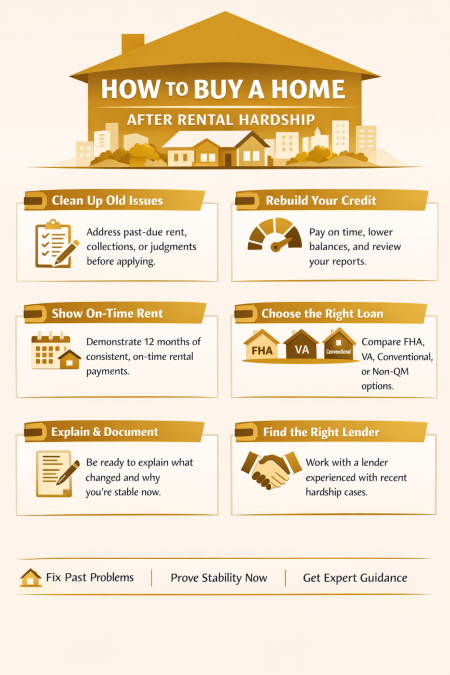
1. Talk to Old Landlords and Collection Agencies
If you still owe money from past rent, start by finding out who legally owns the debt now. In some cases, it is still the landlord. In others, it has been assigned or sold to a collection agency.
When you contact them:
- Ask for the current balance in writing.
- Ask whether they will accept a settlement or payment plan.
- Ask what reporting update they are willing to make once payment is completed, and get that agreement in writing before you send money.
- Keep copies of all letters, emails, receipts, and payment confirmations.
Some lenders may require landlord judgments or housing-related collections to be resolved before closing. Taking care of these early can make the mortgage process smoother and reduce surprises later.
2. Rebuild Your Credit After Rental Hardship
How to buy a home after rental hardship? You do not need perfect credit to buy a home after rental hardship. What matters most is showing that your financial habits are improving and that old problems are no longer ongoing.
Everyday Credit Rebuilding Steps
If your rental hardship led to late payments, collections, or a lower credit score, start with the basics:
- Pay every bill on time, even if you can only make the minimum payment.
- Keep credit card balances as low as possible.
- Try not to apply for a bunch of new credit accounts at once.
- If you want to improve your credit history, consider getting a secured credit card or a credit-builder loan.
- Review your credit reports and dispute any errors.
For many borrowers, the most important part of recovery is the last 12 to 24 months. Lenders want to see that your payment habits are stable now, even if you had problems in the past.
Major Credit Events and Waiting Periods
Some renters went through more than late rent or collections. If your hardship also led to a bankruptcy, foreclosure, or short sale, extra rules may apply depending on the loan program.
These events may require waiting periods before you are eligible for certain mortgages, especially conventional loans. The exact timeline depends on:
- the type of credit event
- the loan program
- whether there were documented extenuating circumstances
- how strong your credit and payment history have been since the event
If this applies to you, ask a lender to review your timeline before you start house shopping. That can help you focus on the loan programs you may qualify for now, rather than guessing.
3. Prove You Can Handle a House Payment
After rental hardship, one of the most important things you can show is that your housing payments are now stable and on time.
Show Strong Rental History Now
If you are renting today, focus on creating a clear record of consistent payments:
- Pay your rent on time every month.
- Use checks, online payments, or bank transfers when possible.
- Avoid cash payments unless you always receive a receipt.
- Keep copies of lease agreements, payment confirmations, and bank records.
One of the strongest things you can show is 12 months of on-time rent. That helps demonstrate that the hardship is behind you and that you are managing your housing costs responsibly today.
If your landlord does not report rent to the credit bureaus, your payment records may still help document your history. In some cases, bank statements, canceled checks, or a verification from your landlord can help support your file.
Build Savings for Down Payment and Reserves
It also shows that you have money set aside for the home purchase and unexpected expenses.
Try to build savings for:
- your down payment
- closing costs
- emergency reserves after closing
Even if you qualify for a low down payment loan, savings can strengthen your overall profile. A financial cushion shows that you may be better prepared to handle your future mortgage payment and other housing costs.
4. Choose the Right Loan Program After Rental Hardship
Not every mortgage program looks at past rental problems the same way. It really comes down to your credit score, whether you’ve sorted out any old landlord debts, how good your recent payment habits are, and if your income is pretty simple or a bit complicated.
Here is a simple way to compare the main options.
Best for Lower Credit: FHA Loans
FHA loans are often the most forgiving option for borrowers rebuilding after rental hardship. They are generally more flexible with lower credit scores and past financial setbacks than conventional loans.
FHA may be a strong fit if:
- Your credit score dropped after late rent or collections
- Your past hardship is older, and your recent payment history is stronger
- You have limited savings for a down payment
What rental hardship changes here is not usually the word “hardship” itself. The bigger issue is whether it left behind unpaid collections, judgments, or other credit problems that still need to be addressed.
Best for Eligible Veterans and Active-Duty Service Members: VA Loans
VA loans can be one of the best paths to homeownership for eligible borrowers because they often allow no down payment and flexible credit treatment compared with many other loan types.
VA may be a strong fit if:
- You are a qualifying veteran, active-duty military personnel, or an eligible surviving spouse.
- You want to buy with little or no down payment
- Your finances have stabilized after a past rental issue
With VA loans, the same general rule applies: lenders will look closely at your current ability to repay, your recent housing history, and whether any housing-related debt or judgments still affect your file.
Best for Stronger Credit: Conventional Loans
Conventional loans usually work best for borrowers with stronger credit, cleaner recent payment history, and fewer unresolved credit issues. They can be a good choice after rental hardship, but they are often less forgiving than FHA when credit damage is still recent.
Conventional may be a strong fit if:
- Your credit score has recovered well
- Old landlord debt or collections have already been resolved
- You have a steady income and a solid overall file
If your rental hardship led to bigger credit events, such as a foreclosure or bankruptcy, conventional rules may be stricter, and waiting periods may apply.
Best for Recent Credit Issues or Nontraditional Income: Non-QM Loans
Non-QM loans are intended for borrower that meet traditional lending guidelines. They can help when you are recovering from recent credit issues or when your income is harder to document through traditional methods.
Non-QM may be a strong fit if:
- You have recent credit problems that make FHA or conventional approval harder
- You need to qualify using bank statements or other alternative income documentation
- You are self-employed or have a more complex income
In many cases, non-QM works best as a bridge rather than a permanent long-term solution. How to buy a home after rental hardship with non-QM loans? It can help you buy sooner, then refinance later once your credit improves and you qualify for a more standard mortgage. Because rates and down payment requirements are often higher, it is usually better to view non-QM as a strategic option rather than a first choice unless it clearly fits your situation.
Simple Comparison at a Glance
- Best for lower credit: FHA
- Best for eligible veterans: VA
- Best for stronger credit: Conventional
- Best for recent credit issues or nontraditional income: Non-QM
From Rental Hardship To Rebuilt Hope and Keys in Hand
Let our team guide you from recovery to clear-to-close
5. Be Ready to Explain the Hardship Clearly
You do not need to write a long essay about your past. But if rental hardship affected your credit, court history, or housing record, it helps to be ready with a short and honest explanation.
Focus on three things:
- What happened
- What changed
- Why is your situation stable now
For example, your hardship may have been caused by job loss, illness, divorce, reduced hours, or a temporary financial setback during the pandemic. What matters most is showing that the problem was not ongoing forever and that your finances have improved since then.
If a lender asks for more details, supporting documents may help. These can include payment receipts, settlement letters, proof of new employment, or other records that show the hardship has been resolved. This is how to buy a home after rental hardship.
Keep your explanation simple, factual, and truthful. The goal is not to tell a dramatic story. The goal is to show that the setback happened, you addressed it, and you are in a stronger position today.
6. Work With a Lender Who Understands Rental Hardship
Not every lender looks at past rental problems the same way. Some are more comfortable with housing-related collections, manual underwriting, and borrowers who are still rebuilding after financial setbacks. Others may be quicker to decline a file without explaining what can be improved.
That is why it helps to look for a lender who has experience with:
- Housing-related collections and landlord judgments
- Recent credit recovery
- Manual underwriting when needed
- FHA, VA, conventional, and non-QM options
- Creating a realistic timeline if you are not ready yet
The right lender should be able to explain what is helping your file, what is hurting it, and what steps may improve your chances of approval. That kind of guidance can make the process feel much clearer, especially if you are trying to recover from late rent, an eviction-related debt, or damaged credit.
The goal is not to find someone who gives false hope. The goal is to find someone who can review your situation honestly and help you choose the most realistic path forward.
Borrowers who need a five-star national mortgage company licensed in 48
How to Buy a Home After Rental Hardship
states with no overlays and who are experts on how to buy a home after rental hardship, please contact us at 800-900-8569, text us for a faster response, or email us at alex@gustancho.com.
Frequently Asked Questions About How to Buy a Home After Rental Hardship:
Can I Still Buy a House After an Eviction? How to Buy a Home After Rental Hardship?
Yes, in many cases, you can still buy a house after an eviction. One of the biggest parts of learning how to buy a home after rental hardship is understanding that the eviction itself is not always the main issue. What matters more is whether it led to unpaid rent, a landlord judgment, or a collection account that now affects your credit and mortgage approval.
How Long Does Rental Hardship Affect Mortgage Approval?
There is no single waiting period that applies to everyone. When figuring out how to buy a home after rental hardship, lenders usually look at how recent the problem was, whether any housing-related debt is still unresolved, and whether you have built a stronger payment history since then. For many borrowers, the last 12 to 24 months matter most.
Do I Need to Pay Off Rental Collections Before Buying a Home?
Sometimes yes. Housing-related collections can matter more than other old debts because they are tied directly to your ability to manage housing payments. A major step in buying a home after rental hardship is determining whether those collections must be paid, settled, or documented before you can move forward with a mortgage.
Can On-Time Rent Help Me Qualify for Mortgage?
Yes. One of the strongest things you can show after past rental problems is a recent history of on-time rent payments. If you are working on buying a home after rental hardship, a strong rent history can help demonstrate that your finances are now stable and that the hardship is behind you.
Is an FHA or a Conventional Loan Better After a Rental Hardship?
For many borrowers, FHA is often the more flexible option after rental hardship because it can be more forgiving with lower credit scores and past credit issues. Conventional loans may work better if your credit has recovered more fully and your recent payment history is stronger. Choosing the right loan program is a key part of buying a home after rental hardship.
Can I Get a Mortgage with Bad Credit After a Rental Hardship?
Possibly, yes. The answer depends on your current credit score, income, savings, recent payment habits, and whether any landlord debt or court judgments are still open. How to buy a home after rental hardship often comes down to showing that your financial situation is more stable now than it was during the hardship period.
This article about “How to Buy a Home After Rental Hardship and Rebuild Hope” was updated on March 9th, 2026.
Don’t Let Your Rental Past Define Your Homebuying Future
See how much you can qualify for—even after hardship