Chicago property tax increases don’t just make headlines—they can raise your mortgage payment even if your interest rate never changes. That’s because most homeowners pay taxes through an escrow account. When the annual tax bill rises, your lender adjusts your monthly escrow deposit to cover it.
In this guide, you’ll learn (in plain English) how Chicago property taxes flow into escrow and increase PITI (principal, interest, taxes, and insurance). You’ll also get a simple two-scenario method to estimate your payment using today’s tax bill vs. a conservative cushion—so you can avoid “payment shock” before you buy, refinance, or renew your budget. If you’d like, we can run both scenarios using a Loan Estimate to confirm that your approval still applies under higher taxes.
Quick win: Always model two payments—current taxes and current taxes + 5–10%—so a surprise reassessment or levy change doesn’t derail your DTI.
Key Takeaways
- Chicago Tax Hikes flow straight into your mortgage escrow, which raises your total PITI payment.
- The pension gap is structural. Tax Hikes can slow the shortfall, but rarely fix it fast.
- Buyers and owners can still win: model higher-tax scenarios, appeal assessments, and choose loan options that absorb changing escrows.
- Use two Loan Estimates—one with current taxes and one with a cushion—to avoid payment shock tied to Chicago Tax Hikes.
Why This Guide Exists
This article breaks things down and shows how Chicago tax hikes impact your monthly housing costs. We translate pensions, assessments, and levies into plain-English steps so buyers, owners, and investors can plan budgets, choose neighborhoods, and qualify confidently—even when tax hikes make headlines.
What “Unfunded Pension Liability” Means
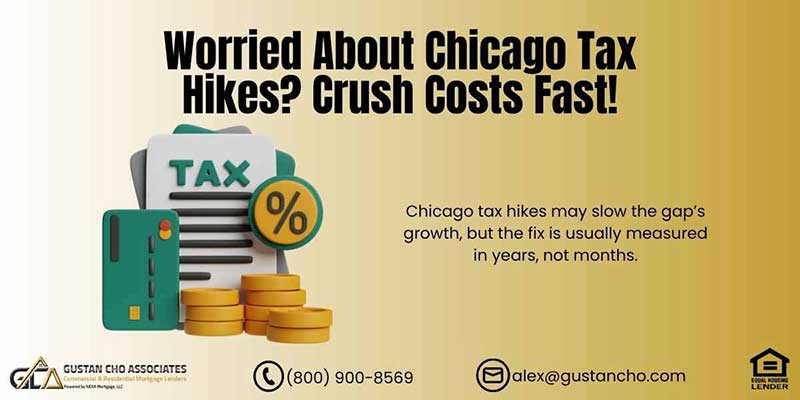
Public pensions promise future benefits. To keep the promise, the city needs enough invested assets. The unfunded liability is the gap between promised benefits and current assets. When the gap is large or contributions lag, decision-makers often consider Chicago tax hikes, higher employee contributions, or other revenue changes to close the distance. The key takeaway: Chicago tax hikes may slow the gap’s growth, but the fix is usually measured in years, not months.
How Chicago Tax Hikes Hit Your Monthly Payment (PITI)
Most mortgages include Principal and interest, Taxes, and Insurance—your PITI. Chicago tax hikes appear in the Taxes line through your escrow.
- Assessment: The county assigns a taxable value.
- Rates/Levies: Local tax rates apply to that value.
- Annual Bill: That total is your property tax.
- Escrow: Your lender divides the annual bill by 12 and adds it to your monthly payment.
- PITI: PI + Taxes + Insurance = your real monthly cost.
Illustration: If your annual bill is $9,600, escrow adds $800/m before insurance. If Chicago Tax Hikes or reassessment raise the bill to $10,800, escrow becomes $900/m—a $100 monthly swing that can change affordability and DTI.
Where Other City Costs Show Up
Some items—like transfer taxes—hit at closing. Others impact your cash flow but not your escrow. When tax hikes raise recurring costs, align your budget to the new reality, not last year’s bill.
Escrow Analysis Explained: Why Your Payment Jumps (Even If Your Rate Didn’t)
An escrow account is a “tax and insurance savings account” your lender manages for you. Instead of paying one big property tax bill (and annual insurance) on your own, you pay 1/12 of the expected yearly total each month. When taxes increase, your lender updates the escrow amount—and your total payment rises.
Here’s the part that surprises homeowners: your payment can rise for two reasons at once:
1) Your escrow deposit increases to match the new tax bill
If last year’s property taxes were $9,600, your monthly escrow for taxes is about $800.
If the new bill is $10,800, your monthly escrow for taxes will be approximately $900.
That’s the “normal” increase—just the higher bill spread over 12 months.
2) You may also have an escrow shortage that must be repaid
If your lender continues to collect escrow based on the old bill, but the tax bill is higher, your escrow account may come up short. When that happens, your servicer typically gives you options:
- Option A: Pay the shortage in a lump sum (smaller monthly increase going forward)
- Option B: Spread the shortage across the next 12 months (higher monthly payment for one year)
This is why some homeowners see a bigger jump than expected: they’re paying the new, higher escrow amount plus repaying last year’s shortage.
What is an “Escrow Cushion”?
Most loans are allowed to keep a small reserve (often up to about two months of escrow payments, depending on the loan and servicing rules). This cushion helps prevent missed tax or insurance payments if bills rise unexpectedly. But in a high-tax or rapidly changing area, it’s still smart to budget your own cushion so your payment stays comfortable.
How to Protect Yourself from Payment Shock
Before you buy or refinance, ask for two payment scenarios:
- Scenario 1 (Current Taxes): based on the most recent official tax bill
- Scenario 2 (Cushion): current taxes + 5–10% (or more if you want to be conservative)
If you still qualify under Scenario 2, you’re far less likely to be blindsided by a reassessment, levy change, or escrow shortage.
Appeal your property taxes and lower the bill
Step-by-step guidance to challenge assessed value and save annually
Timeline Lens: Why Hikes Didn’t “Fix It” Overnight
Compounding Matters
Funding shortfalls are made worse by compounding. When contributions to pension plans do not meet the required targets, the funding gaps do not stay the same—they grow over time. This creates a bigger problem for future budgets. As these shortfalls increase, the need to fix them becomes more urgent. This highlights the importance of making regular and sufficient contributions to meet long-term obligations.
Market Returns Vary
Investment performance is very important for pension funds, but can be unpredictable. When market returns are lower than expected, the financial gap can remain or even widen. Pension planners need to realize that market conditions can change significantly. They should adjust their expectations and strategies to prepare for the possibility of poor investment results.
Policy Lags Exist
Implementing tax hikes or policy changes does not yield immediate results. For instance, even after the introduction of Chicago’s tax hikes, there is a significant time lag before the increased revenue translates into stabilizing long-term funding shortfalls. This delay is critical to understand, as it requires planning and patience to navigate through the ongoing challenges of underfunded pensions, emphasizing the need for proactive measures rather than reactive ones.
You don’t need to be an actuary—just plan conservatively. Assume Chicago tax hikes can raise escrow, and price that into your approval.
Neighborhood & Border Effects: Chicago vs. Suburbs vs. NW Indiana
Taxes change across boundaries. Two similar homes can carry different tax bills because of district levies, assessments, and services. Some buyers compare Chicago to Northwest Indiana for total monthly cost. If Chicago tax hikes push your PITI higher than expected, compare three addresses side-by-side with real tax data so you see the actual monthly difference.
Quick Comparison Framework:
- School district and municipal levies
- Assessment practices and cycles
- Insurance and maintenance profiles
- Commute time/cost
- Days on market and price resilience under Chicago tax hikes
What Homeowners Can Do Today
1) Appeal Your Assessment
If your assessed value looks off, you may appeal. Chicago tax hikes increase pressure to verify accuracy.
Steps:
- Pull your assessment and recent comparable sales.
- Check for data errors (square footage, beds/baths, condition).
- File within the appeal window.
- Provide comps and documentation.
- Calendar the next cycle—assessments aren’t “set and forget.”
A modest assessed-value adjustment can offset the bite from tax hikes via a lower escrow.
2) Refinance, Restructure, or Relocate
Refi Math
These options can help you manage your finances better. Refinancing your mortgage to get a lower interest rate can lower your monthly payments. This can help you handle any increases in property taxes. Also, restructuring your debts or moving to a less expensive area can save you money.
Term Choice
Choosing between a 30-year loan and a shorter loan term can greatly affect your monthly expenses and overall financial health. Choosing a shorter loan term can mean higher monthly payments, but you’ll end up paying less in interest overall. On the flip side, a 30-year loan usually has lower monthly payments, which can be easier on your budget. Just consider your financial situation when making this decision.
Relocation
Moving to a new area can have various financial effects, so creating a clear budget is important. Your budget should cover your mortgage payment, interest, taxes, insurance (PITI), utilities, commuting costs, and any possible increases in local taxes. Knowing these expenses well can help you make a smart choice and avoid unexpected financial problems.
3) Pick the Right Loan for Variable Taxes
- Conventional: Flexible PMI removal; strong fit if credit is solid.
- FHA: Often helpful on DTI when tax hikes pressure escrow.
- VA (eligible borrowers): No monthly mortgage insurance; can lower total cost.
- Non-QM: Useful for self-employed and complex income when taxes vary.
Gustan Cho Associates models two tax scenarios—the current bill and a conservative cushion—so Chicago tax hikes don’t derail approvals at the eleventh hour.
Buying in a High-Tax Market Without Overpaying

Underwriting Prep for Volatile Escrows
Ask us to qualify you with a small cushion (e.g., +5–10%) on taxes. If Chicago tax hikes land, you’re still inside the guardrails.
Read Listings Carefully
A listing may display last year’s bill or a partial figure. Confirm official records and whether exemptions applied to the seller that you won’t receive immediately. This is essential when Chicago tax hikes or reassessments are in the news.
Request Two Loan Estimates
See both a current-tax and a higher-tax Loan Estimate. Side-by-side, you’ll know if Chicago tax hikes push you past comfort.
Simple Worksheet: Estimate Your Payment With a Cushion
- Find the most recent official annual tax bill.
- Remove exemptions you won’t receive at closing.
- Create a cushion for potential tax hikes (e.g., +5–10%).
- Divide by 12 → monthly escrow estimate
- Add PI and insurance quotes → PITI.
- Verify DTI still works under the cushion.
- Re-run if the property has recent renovations (post-improvement reassessment risk).
Investors & Renters: How Hikes Flow to Rents and Values
For landlords, property taxes are a major operating expense. Chicago tax hikes can compress NOI and pressure cap rates unless rents rise. For renters, renewals can reflect owner cost increases. For investors, underwrite with conservative taxes; for renters, plan renewals with a buffer when tax hikes are likely.
Work With Gustan Cho Associates
Chicago tax hikes don’t have to derail your plans. We’ll model conservative tax scenarios, compare FHA/VA/Conventional/Non-QM, and coordinate with your agent to make your approval and payment solid—even if tax hikes adjust your escrow.
Borrowers who need a five-star national mortgage company licensed in 5o states with no overlays and who are experts on tax hikes, please contact us at 800-900-8569, text us for a faster response, or email us at alex@gustancho.com.
Frequently Asked Questions About Chicago Tax Hikes:
Why did My Mortgage Payment Go Up When My Interest Rate Stayed the Same?
Your payment may increase when property taxes or homeowners’ insurance rates rise. If you pay through escrow, your lender recalculates your monthly escrow deposit to match the new yearly totals—and may also collect extra if your escrow account had a shortage.
How do Property Tax Increases Affect Escrow?
Property tax increases raise your annual tax bill, and escrow collects 1/12 of that bill each month. When the bill increases, your lender updates the escrow portion of your payment to ensure there’s enough money to cover the next tax installment(s).
What is an Escrow Shortage, and How do I Fix it?
An escrow shortage happens when your escrow account doesn’t have enough money to cover taxes or insurance when they come due. You can usually fix the problem by either paying off the missing amount all at once or spreading it out over 12 months, which will bump up your monthly payment for a bit.
How Can I Estimate My Mortgage Payment with Higher Chicago Property Taxes?
Use a two-scenario estimate:
- Start with the most recent official annual tax bill
- Divide by 12 for the monthly escrow
- Add a 5–10% cushion to taxes for a second scenario
- Add principal/interest and insurance to get two PITI payments
- If you’re comfortable with the higher scenario, you’re better protected from payment shock.
Are the Property Taxes Shown on Listings Accurate?
Not always. Listings may show last year’s taxes, partial figures, or taxes that include exemptions the seller has that you may not receive immediately. The safest approach is to verify the tax amount using official county or city records before finalizing your budget.
Can I Appeal My Property Taxes in Chicago and Lower My Payment?
Yes. If your assessed value is too high or property details are incorrect, an appeal may reduce your tax bill. A lower tax bill can reduce your escrow payment after your lender updates the escrow analysis (timing depends on when the change is reflected on official billing).
How Much Can Chicago Property Taxes Raise My Monthly Payment?
A simple rule: every $1,200 per year in higher property taxes is about $100 per month in escrow. Example: if taxes rise from $9,600 to $10,800 annually, that’s a $1,200 increase—about $100 more per month, before any escrow shortage repayment.
Should I Budget Extra for Property Taxes When Buying in Cook County?
Yes. A smart baseline is 5–10% above the current tax bill, especially if the area is known for reassessments or levy changes. This helps you avoid becoming “house poor” if your escrow adjusts upward after closing.
Do Chicago Transfer Taxes Increase My Monthly Mortgage Payment?
Usually no. Transfer taxes are typically one-time closing costs, not part of your monthly escrow. They can increase the cash you need at closing, but they usually don’t change your monthly payment the way property tax hikes do.
What’s the Best Mortgage Type When Property Taxes are High?
There isn’t one best option for everyone. The best approach is to choose the loan that keeps your DTI workable while you model higher escrow scenarios:
- Conventional: flexible if credit is strong and PMI can be removed later
- FHA: can help some borrowers qualify when payments are tight
- VA (eligible): no monthly mortgage insurance, often lowers total payment
- Non-QM: useful for self-employed or complex income when tax escrows vary
- The key is qualifying under current tax rates and maintaining a cushion so that tax changes don’t jeopardize the approval.
This article about “Worried About Chicago Tax Hikes? Crush Costs Fast!” was updated on January 9th, 2026.
Recast your mortgage after a lump-sum payment
Lower the monthly without changing your rate or term