A mortgage denial with good credit usually means another part of the loan file did not meet underwriting guidelines. A 740 or 760 credit score may look strong, but the lender still has to verify income, monthly debts, assets, employment history, and the property being financed. A borrower can have clean credit and still be denied because the debt-to-income ratio is too high, the income cannot be fully counted, or a new debt appears before closing. Self-employed borrowers may encounter this when tax write-offs reduce qualifying income. Buyers can also lose approval if the appraisal comes in low, the condo project is not eligible, or bank statements show funds that cannot be documented. Good credit helps, but it does not override mortgage guidelines. The lender must prove the borrower can afford the payment, document the money needed to close, and confirm the loan program allows the full file.
Yes, You Can Get Denied Even With Good Credit
Yes, you can have a mortgage denial with good credit. A credit score tells the lender how you have handled debt in the past, but it does not prove that you can afford the new mortgage payment.
Mortgage approval is based on the full loan file. The lender reviews your income, monthly debt, job history, cash-to-close, reserves, credit report details, and the property. A high score will not fix a debt-to-income ratio that is too high, income that cannot be documented, or an appraisal problem.
Mortgage underwriting is also different from getting approved for a credit card. A credit card company may approve you based mainly on your credit score, credit history, and available income. A mortgage lender has to verify documents, follow loan program rules, review the property, and prove the loan meets FHA, VA, USDA, Fannie Mae, Freddie Mac, or Non-QM guidelines.
Why One Lender May Deny You and Another May Approve You
A mortgage denial with good credit can happen when one lender declines your application while another approves it. This often depends on factors such as lender overlays, specific loan program guidelines, manual underwriting processes, or methods used to calculate income and debt.
Lender Overlays
Lender overlays are extra rules added by the lender. FHA, VA, USDA, Fannie Mae, and Freddie Mac set the main guidelines, but lenders can be stricter. One lender may deny a file because of high DTI, recent late payments, collections, or limited reserves. Another lender may approve the same file if it complies with agency guidelines without additional overlays.
Loan Program Choice Matters
A borrower denied for a conventional loan may still qualify for an FHA loan. A VA borrower may be approved with a higher DTI if residual income is strong. A borrower with unusual income may need a Non-QM loan instead of a standard agency loan.
Manual Underwriting Can Change the Result
Some lenders do not offer manual underwriting, even when FHA or VA allows it. Other lenders may review the file manually if the borrower has compensating factors such as steady income, verified reserves, low payment shock, or clean recent payment history.
Income Calculations Can Vary
Self-employed income, overtime, bonuses, commissions, part-time income, and seasonal income are not always counted the same way. One lender may calculate a lower qualifying income, while another may review the documents differently under the program guidelines. A mortgage denial with good credit doesn’t necessarily mean you can’t qualify for a loan. It might suggest that your application was submitted to an unsuitable lender, an inappropriate loan program, or a lender that has stricter criteria than others.
Good Credit but Denied for a Mortgage? Find Out Why
A strong credit score helps, but lenders also review income, DTI, employment, assets, property type, and documentation. Get a quick review to find what blocked approval.Top Reasons Borrowers With Good Credit Get Denied
A strong credit score can get the file started, but underwriting still has to clear the rest of the loan. A mortgage denial with good credit typically stems from one of six areas: debt, income, employment, student loans, credit report details, or the property.
Debt-to-Income Ratio Is Too High
The debt-to-income ratio compares monthly debt payments to gross monthly income. Lenders count the proposed mortgage payment, credit cards, auto loans, student loans, personal loans, child support, alimony, and co-signed debts unless the loan program allows an exception. A borrower with a 760 credit score may still be denied if the new mortgage payment pushes the DTI too high. A large car payment, several credit cards, or a co-signed loan can reduce buying power even when every account has been paid on time.
Income Cannot Be Fully Used
Mortgage lenders use qualifying income, not always the income a borrower believes they earn. The income must be documented, stable, and likely to continue. This can hurt self-employed borrowers when tax write-offs reduce net income on tax returns. It can also affect borrowers who rely on overtime, bonuses, commissions, part-time work, or seasonal income. If there is not enough history, the lender may not be able to use that income to qualify.
Employment Issues
Job history matters because lenders want to know the income is likely to continue after closing. Recent job changes are not always a problem, but they can create extra conditions if the borrower changed industries, moved from W-2 to 1099, started a new business, or has gaps in employment. When your income goes down, it can cause some problems. Even if a borrower has sufficient earnings today, any declines evident in tax returns, pay history, or year-to-date earnings may prompt the underwriter to consider a lower amount or request additional documentation. This situation can result in mortgage denial with good credit, despite the borrower’s current financial standing.
Student Loan Payments
Student loans can cause a mortgage denial with good credit when the payment used for qualifying pushes the DTI too high. This can happen even when the loan is deferred, in forbearance, or showing a low payment on the credit report. FHA, VA, USDA, Fannie Mae, and Freddie Mac do not always treat student loans the same way. Some programs may use the payment on the credit report. Others may require a calculated payment if the reported payment is $0 or does not fully amortize the loan. An income-driven repayment plan may help if the lender can document the actual required payment.
Credit Report Problems
A high credit score does not mean the credit report is free of underwriting issues. Underwriters review the details behind the score, especially recent payment history and unresolved accounts. Recent late payments can be a problem, especially if they happened in the last 12 months or during the mortgage process. Collections may need to be explained, paid, ignored, or counted depending on the loan program and type of debt. Open credit disputes can delay approval because the lender may need the dispute removed before using the credit report. Charge-offs can also raise questions about whether the balance affects DTI or shows a recent pattern of unpaid debt.
Property Problems
The borrower is not the only part of the approval. The property must also qualify for the loan program. An appraisal can cause a denial if the value comes in too low, the appraiser notes safety issues, or required repairs are not completed. Property condition can matter with FHA, VA, USDA, and conventional loans. Peeling paint, roof problems, broken utilities, missing handrails, or health and safety issues can stop the file until corrected. Condos can create a separate problem. A borrower may qualify, but the condo project may not. Litigation, low reserves, too many rentals, insurance issues, commercial space, or an unwarrantable condo status can cause a denial even when the buyer has strong credit and income.
Can You Get Denied After Being Pre-Approved?
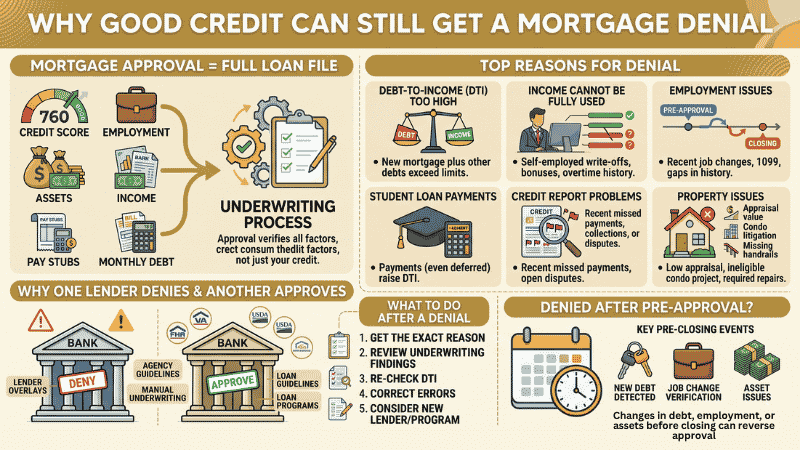 Yes, a borrower can be denied after pre-approval. A pre-approval is not the same as final approval. It is based on the information reviewed at the beginning of the loan process. Final approval comes later, after underwriting verifies the full file and clears all conditions.
One common reason is a credit refresh. Many lenders recheck credit before closing to see whether the borrower has opened new accounts, increased credit card balances, missed a payment, or taken on new debt.
A new car loan, furniture account, personal loan, or credit card balance can raise the debt-to-income ratio enough to change the approval. Employment is also checked again. The lender may complete a verbal verification of employment before closing. If the borrower changed jobs, quit, became self-employed, moved from salary to commission, or had reduced hours, the underwriter may need to recalculate income. In some cases, the new income cannot be used right away. Assets can cause problems late in the process, too. Large deposits, cash deposits, borrowed funds, missing bank statements, or money moved between accounts may need a paper trail. If the borrower cannot document the funds needed for down payment, closing costs, or reserves, the loan may not be cleared to close. The property still has to pass review. A low appraisal can change the loan-to-value ratio or force a price renegotiation. Repair issues can delay or stop approval if the loan program requires them to be fixed before closing. If a condo project faces legal issues, insurance problems, budget shortfalls, or does not meet agency guidelines, it can lead to complications that might contribute to mortgage denial with good credit.
When Can a Mortgage Denial Happen?
A mortgage denial with good credit can happen at several points in the loan process. The timing usually depends on when the lender finds the issue and whether it can be fixed before closing.
Before Pre-Approval
A mortgage denial with good credit usually means the lender found a major issue early. This may be a credit score below the program’s requirements, income that does not support the loan amount, excessive monthly debt, or a recent late housing payment. This stage is often easier to recover from because no purchase contract is usually at risk yet. The borrower can review the reason for the denial, correct errors, reduce debt, choose a different loan program, or get a second opinion before making an offer.
During Underwriting
Many denials happen during underwriting because that is when the file is reviewed in detail. The underwriter checks income documents, tax returns, bank statements, credit history, debt payments, and the property. A borrower may be denied during underwriting if the income is calculated at a lower amount than expected, bank deposits cannot be documented, the debt-to-income ratio is too high, or the credit report shows disputes, collections, charge-offs, or recent late payments. Property issues can also appear at this stage after the appraisal or condo review is completed.
After Conditional Approval
Conditional approval means the lender is willing to approve the loan if certain conditions are met. It is not the same as final approval. A mortgage denial with good credit can still happen if the borrower does not meet specific conditions. Common issues that may lead to this include missing bank statements, unexplained large deposits, pay stubs reflecting lower income, problems with employment verification, expired documents, title issues, or incomplete required repairs.
Right Before Closing
A denial right before closing is usually tied to a last-minute change or final verification. Lenders may recheck credit, confirm employment, review updated bank statements, and make sure the appraisal, title, insurance, and closing disclosure are still acceptable. New debt is one of the most common late-stage problems. A borrower who buys a car, finances furniture, opens a credit card, or runs up credit card balances before closing can lose approval if the new payment changes the DTI. Job changes, missing funds to close, a low appraisal, unresolved title issues, or property repairs can also stop the loan at the end.
Real Examples of Mortgage Denials Despite Good Credit
A mortgage denial with good credit often comes down to one part of the file, not the credit score itself. These examples show how a borrower can look strong on paper but still run into underwriting problems.
760 Credit Score, But the DTI Was Too High
A borrower had a 760 credit score, steady W-2 income, and clean payment history. The problem was the debt-to-income ratio. After the lender accounted for the new mortgage payment, two auto loans, credit card minimum payments, and student loans, the DTI came in at around 53%. The borrower was denied a conventional loan because the file did not meet the lender’s conventional DTI limits. After reviewing the same income and debts under FHA guidelines, the borrower received an FHA approval. The credit score was not the issue. The loan program was.
740 Credit Score, But New Debt Appeared Before Closing
Another borrower had a 740 credit score and had already been pre-approved. A week before closing, the lender completed a credit refresh and found a new auto loan. The new monthly payment changed the DTI, no longer matching the original approval. The lender had to send the file back through underwriting. After the new debt was added, the borrower no longer qualified for the approved loan amount. The approval was revoked because the borrower’s financial profile changed before closing.
780 Credit Score, But Self-Employment Income Was Lower on Paper
A self-employed borrower had a 780 credit score, strong bank deposits, and a profitable business. The issue was the tax returns. After business write-offs were reviewed, the qualifying income was much lower than the borrower’s gross deposits. The borrower was denied a traditional loan because the tax return income did not cover the mortgage payment. In this type of case, a bank statement loan or another Non-QM option may be worth reviewing if the borrower has strong deposits but lower taxable income.
Loan Programs That May Help After a Mortgage Denial
A mortgage denial with good credit does not always mean the borrower cannot qualify. Sometimes the file needs a different loan program because FHA, VA, USDA, conventional, and Non-QM loans do not treat income, debt, credit history, and property issues the same way.
FHA Loans
FHA loans may help borrowers who were denied due to higher debt-to-income ratios, limited down payments, or past credit issues. FHA approval still depends on income, assets, credit history, property condition, and automated underwriting findings.
VA Loans
VA loans may help eligible veterans, active-duty service members, and qualifying surviving spouses. VA underwriting closely examines residual income, the money left over after major monthly debts are paid. A borrower denied by another program may still qualify for VA if the residual income is strong and the file meets VA guidelines.
USDA Loans
USDA loans may help buyers purchase in eligible rural or suburban areas. These loans have income limits and property eligibility rules, so they are not available for every borrower or every home. A USDA denial can happen if the household income is too high, the property is not eligible, or the debt ratio does not meet approval requirements.
Conventional Loans
Conventional loans backed by Fannie Mae or Freddie Mac may work for borrowers with strong credit, stable income, and acceptable debt ratios. They can be a good fit when the borrower has enough down payment, clean recent credit, and a property that meets agency guidelines. A conventional denial may still happen if the DTI is too high, reserves are short, or the property does not qualify.
Non-QM Loans
Non-QM loans may help borrowers who do not fit standard agency rules. These programs may be used for self-employed borrowers, real estate investors, bank statement income, 1099 income, asset-based income, recent credit events, or unique property and income situations. Non-QM loans usually have different pricing, down payment, and documentation rules, so the full file needs to be reviewed before choosing this path.
What To Do If You Were Denied for a Mortgage
If you had a mortgage denial with bad credit, start with the exact reason. Ask the lender what caused the denial. Was it the debt-to-income ratio, income calculation, credit history, employment, assets, property, or a lender overlay?
- Ask for the reason for the denial in writing. A general answer is not enough. You need to know which part of the file failed.
- Request the underwriting findings. If the lender can provide the AUS findings, review them. They may show whether the issue came from FHA, VA, USDA, Fannie Mae, Freddie Mac, missing documents, or lender overlays.
- Review your DTI. Check every monthly debt used in the file, including student loans, auto loans, credit cards, co-signed debts, child support, and personal loans. An incorrect payment, a duplicate debt, or a debt that should have been excluded can change the result.
- Review the income calculation. This matters for self-employed borrowers, commission income, overtime, bonus income, part-time work, and recent job changes. A lower income calculation can push the file over the DTI limit.
- Fix errors before applying again. Correct credit reporting errors, open disputes, wrong late payments, missing bank statements, unexplained deposits, and outdated employment information.
- Get a second opinion. One lender may deny the file because of overlays. Another lender may be able to approve it under agency guidelines.
- Consider another loan program. A borrower denied conventional financing may qualify for FHA financing. An eligible veteran may qualify for VA. A self-employed borrower may need a bank statement loan or another Non-QM option.
Can You Still Get a Mortgage After Past Credit Problems?
Yes, you may still qualify for a mortgage after bankruptcy, foreclosure, short sale, or deed-in-lieu. The main issue is timing. Each loan program has its own waiting period, and the clock does not always start on the date the borrower expects. A bankruptcy waiting period may depend on the chapter filed, the discharge date, dismissal date, and the loan program. Chapter 7, Chapter 13, FHA, VA, USDA, conventional, and Non-QM loans can all treat the same borrower differently.
Some borrowers may qualify during or soon after Chapter 13 with the right documentation, while others may need to wait longer after Chapter 7.
Foreclosure rules can be more complicated when a mortgage was included in bankruptcy. Some programs look at the foreclosure completion date. Others may review the bankruptcy discharge date, title transfer date, or seasoning requirements tied to the loan type. A borrower with strong credit today can still be denied if the required waiting period has not been met. A short sale or deed-in-lieu can also affect approval, even if the borrower rebuilt credit afterward. The lender will review the completion date, credit report history, mortgage payment history before the event, and whether the borrower meets the required waiting period for the new loan program. Past credit problems do not always block approval forever. The file needs to be reviewed by event type, dates, loan program, credit history after the event, income, assets, and current debt-to-income ratio.
Final Thoughts on Mortgage Denial with Good Credit
A mortgage denial with good credit usually means the lender found a problem elsewhere. The issue may be a high debt-to-income ratio, income that cannot be fully documented, employment concerns, student loan payments, property issues, or lender overlays.
The first step after a denial is finding out exactly why it happened. Once the reason is identified, the solution may be as simple as correcting an error, reducing debt, providing additional documentation, choosing a different loan program, or working with a lender that uses different underwriting guidelines.
A mortgage denial with good credit does not necessarily mean you are not eligible for a mortgage. It simply indicates that the lender was unable to approve the loan based on the specific information, guidelines, and program associated with that application.
FAQs on Mortgage Denial With Good Credit
Does a Mortgage Denial Mean I Cannot Buy a House?
No. A mortgage denial with good credit means that one lender could not approve the file under the loan program, documents, and guidelines used for that application. Another lender may review income, debts, overlays, or loan options differently.
Can I be Denied a Mortgage Because I do Not have Enough Cash Reserves?
Yes. Some loan files require reserves, especially with higher debt ratios, multiple properties, investment properties, or manual underwriting. Reserves are funds left after closing, not money used for the down payment or closing costs.
Can a Lender Deny My Mortgage Application Because of Deposits on My Bank Statements?
Yes. Large or unusual deposits may need to be sourced. If the funds came from cash, borrowed money, business accounts, or an undocumented gift, the lender may not allow those funds to be used for closing.
Can I Get Denied if My Spouse has Bad Credit?
It depends on whether your spouse is on the loan. If your spouse is a co-borrower, their credit, debts, and income are reviewed. In some community property states, certain debts may still be considered even if only one spouse is on the mortgage.
Does Changing Jobs Before Closing Always Cause a Denial?
No, but it can delay the loan or change the approval. A move from one W-2 job to another in the same field is usually easier to document than switching to commission, 1099 income, self-employment, or a different industry.
Can a Mortgage be Denied After Clear-to-Close?
It is less common, but it can happen if something changes before funding is secured. A new debt, job loss, credit issue, title problem, insurance issue, or funding condition can still stop the loan from being released before funds are released.
Can I Apply with Another Lender After Being Denied?
Yes. You can apply with another lender after a denial. Before doing that, get the denial reason and review whether the issue was caused by DTI, income calculation, credit history, property issues, missing documents, or lender overlays.
How Long Should I Wait Before Reapplying After a Mortgage Denial?
There is no fixed waiting period unless the denial was tied to a guideline issue, such as bankruptcy seasoning, foreclosure seasoning, late payments, or employment history. If the denial was caused by an error, a missing document, or a lender overlay, another lender may be able to review the file right away.
This article about “Can You Get a Mortgage Denial with Good Credit?” was updated on June 17th, 2026.