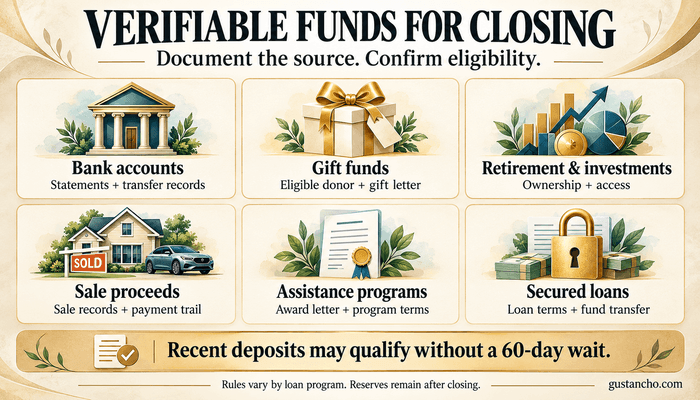
Quick Answer: Acceptable sources of verifiable funds for closing can include checking and savings accounts, eligible gifts, investment and retirement funds, documented sale proceeds, business assets, assistance programs, and certain loans secured by assets. The lender must verify that the funds are available and permitted for their intended use. A recent deposit does not automatically require a 60-day wait. The required account-history period and the eligibility of individual deposits are separate issues. This guide primarily focuses on Fannie Mae conventional mortgage guidelines and highlights selected differences with FHA guidelines. Freddie Mac, VA, USDA, other mortgage programs, and individual lenders may have different requirements. Rules attributed to Fannie Mae, including its large-deposit threshold, should not be treated as universal mortgage rules.
What are ‘Verifiable Funds for Closing’?
Verifiable funds are assets which the lender can document as belonging to the borrower or as coming from some other source permitted by the loan program. The lender will assess the ownership of the funds, the source of the funds, the availability of the funds and the eligibility of the funds for the down payment, closing costs, prepaid expenses or required reserves. Reserves are the eligible assets available after closing. They are not an additional closing charge or money paid to the closing agent. The lender will deduct the amount required to close prior to looking at the balance of eligible assets against the reserve requirements. So for example $30,000 in eligible assets less $24,000 required at closing would leave $6,000 potentially available for reserves.
Bank Accounts, Joint Accounts, and Transfers
Accounts (checking, savings, money market, certificates of deposit, etc.) are the usual source of funds. Documentation may include bank statements, a verification of deposits, or a qualifying electronic verification service. The records must demonstrate account ownership, balances, and the required transaction history.
Joint accounts can be acceptable provided the lender can verify the borrower’s ownership and access. You’ll need to provide statements which identify you as an account holder. If there’s any doubt about the level of withdrawal authority you have, the lender may well ask for further bank confirmation or access documentation.
For transfers between your own accounts, you need to keep records of both the withdrawal and the matching deposit. So a $15,000 withdrawal from savings would be matched by a $15,000 deposit to checking. Don’t make unnecessary transfers, as they will make the source of the funds harder to track. Check out Fannie Mae’s asset verification requirements and our bank statement guide.
Do Mortgage Funds Need to Be Seasoned for 60 Days?
Fannie Mae’s standard purchase-loan documentation generally covers the most recent two months of account activity. This review period does not mean every dollar must have been deposited at least 60 days before closing. A documented gift, asset sale, or other acceptable recent deposit may be usable without that wait. Desktop Underwriter (DU) is Fannie Mae’s automated underwriting system. It evaluates mortgage application information and provides an underwriting recommendation. Its asset-documentation findings, including electronic validation, may affect which records the lender requests. Large or unusual deposits may require additional sourcing. Simply leaving money in an account for 60 days does not make an otherwise unacceptable source eligible.
How Lenders Evaluate Large Deposits
When reviewing bank statements for Fannie Mae purchase loans, a deposit is considered large if it is more than half of the total monthly qualifying income. If only part of a deposit can be documented, lenders look at the undocumented portion to see if it exceeds that limit. Hypothetical Example: A borrower earns $8,000 a month and has $30,000 in their account, including a $7,000 deposit, they might show that $2,000 came from a tax refund. If they can’t document the other $5,000, that amount is over the $4,000 limit. The lender would subtract $5,000, so only $25,000 counts as usable assets. If $22,000 is needed to close and $3,000 is needed for reserves, the borrower still meets the asset requirements. Deposits like payroll, tax refunds, or transfers between verified accounts usually do not need more documentation unless there are still questions, such as whether the money was borrowed.
Gift Funds and Gifts of Equity
 A gift must be unconditional, with no expectation of repayment. Fannie Mae will allow eligible personal gifts for principal residence and second home transactions but not for investment properties. The lender will confirm the donor’s eligibility, the gift, and the transfer. For 2- to 4-unit properties and second residences, the borrower will generally need to contribute at least 5% of the excess funds if the LTV exceeds 80%. A gift from an eligible donor can count toward the 5% contribution requirement if the donor has lived with the borrower for the past 12 months. Both will occupy the property as their primary residence (as evidenced by shared residency documentation). HomeReady has different requirements. A gift of equity is a credit drawn from the eligible seller’s equity rather than a cash gift. Fannie Mae will permit a qualifying gift of equity to be used towards a down payment and/or closing costs on a primary residence or a second home, but not towards reserves. The lender will require the signed gift letter and the settlement statement which identifies the credit. FHA has separate donor and documentation rules. Under HUD’s rules, gifts of equity are only permitted in qualifying transactions between family members. See HUD Handbook 4000.1 for the FHA-specific requirements.
Down Payment and Employer Assistance
Assistance programs can help with your purchase costs, but you’ll need to review the program and its terms. Please provide the award or approval letter and the agreement. For Fannie Mae grants, make sure the documents show that repayment isn’t required and explain how the funds will be sent. If the assistance is a loan, include the repayment terms and any second-mortgage paperwork. If you’re getting help from your employer, Fannie Mae needs proof of the company’s program, the amount you’ll receive, and the terms. Some employer-provided unsecured loans can be used for your down payment or closing costs, but not for reserves. These loans have different rules than regular personal unsecured loans.
Earnest Money Deposits
Earnest money may be credited toward the down payment and closing costs. For Fannie Mae, the lender must verify an acceptable source when the deposit is part of the borrower’s minimum contribution. A receipt can be verified with a canceled check or written confirmation from the person who made the deposit; additional documentation may be required. Once the deposit clears the borrower’s account, it should be reflected as a purchase credit. It must not also remain counted in the available bank balance.
Retirement and Investment Accounts
Eligible vested retirement funds (401(k), IRA, SEP, and Keogh) can be used for closing or as reserves. The lender will confirm ownership, vesting, and eligibility to withdraw. Fannie Mae does not require that eligible retirement funds used solely as reserves be withdrawn. For stocks, bonds, and mutual funds used as down payment or closing cost funds, Fannie Mae’s documentation requirements are based on the asset value relative to the required amount. If the eligible value is 20% or more of the required amount, documentation of actual receipt from liquidation is not required under that rule. If the eligible value is less than 20% of the required amount, then actual receipt must be documented. Confirm the requirements before selling the investments.
Need Help Documenting Your Funds to Close?
The documents required can depend on where your funds came from and your mortgage program. Review your available assets and what may be needed to verify them.Proceeds From Selling Real Estate or Personal Property
When selling a home, Fannie Mae needs proof of the actual proceeds. If you plan to use these funds for your new purchase, your settlement statement must show enough net funds before or at the same time as your new closing. Just listing an expected sales price is not enough to prove you have the funds.
If you sell personal property, you need to show proof of ownership for titled items, proof that you transferred ownership, and proof you received payment. The person buying your asset cannot be part of your home purchase or mortgage. If the proceeds from the sale are more than half of your monthly qualifying income, Fannie Mae requires an independent, reputable valuation. In that case, only the lower amount between the valuation and the actual sale price counts as eligible proceeds.
For example, if you earn $8,000 a month and deposit $9,000 from selling a car, a bank statement by itself is not enough to show the sale details. You would need to provide the previous title, a signed bill of sale, payment records, and an independent valuation—say, $8,500. The lender would then count $8,500 as eligible proceeds. Make sure to keep these records before you sell an asset.
Business Funds and Loans Secured by Assets
Business assets may be eligible when account ownership and funds are verified. If income from that business is also used to qualify, the lender must evaluate whether the withdrawal would harm the business. Additional cash flow records may be needed; the bank balance alone does not determine how much working capital can be withdrawn. Fannie Mae also permits eligible loans secured by assets, such as a 401(k), savings, investments, real estate, or vehicles. Payments generally count as debt, with an exception for loans secured by the borrower’s financial assets. The debt-to-income (DTI) ratio compares qualifying monthly debt obligations, including housing expenses, with qualifying monthly income. If the same financial asset is counted for reserves, reduce its value by the loan proceeds and related fees.
Cash on Hand and Cryptocurrency
Cash Saved Outside a Bank
Standard Fannie Mae loans don’t allow for cash on hand for the down payment or the closing costs. HomeReady does have an exception regarding the documentation and timing of the deposit. FHA will accept documented cash on hand, provided the lender can establish how it was obtained and that the amount is reasonable in the context of the borrower’s income, expenses, spending patterns, and banking history. The cash must be deposited with a financial institution or held by the escrow/title company.
Converted Cryptocurrency Proceeds
For Fannie Mae, the cryptocurrency must be converted to USD, held at a U.S.- or state-regulated financial institution, and verified before closing. For a large deposit of converted crypto, the lender will require sufficient documentation to trace the proceeds back to the borrower’s crypto account. Crypto itself cannot be used as earnest money.
Funds That May Be Ineligible for Closing
The applicable program determines eligibility. Funds that may be excluded include:
- Deposits without sufficient documentation of an acceptable source when sourcing is required.
- Ordinary personal unsecured-loan proceeds prohibited by the loan program.
- Credit-card cash advances used for the down payment.
- Gifts from donors who do not meet the program’s eligibility requirements.
- Account funds the borrower cannot establish ownership of or access to.
- Ordinary seller credits applied toward the down payment, minimum borrower contribution, or reserves when prohibited.
Fannie Mae prohibits the use of ordinary personal unsecured loans, including signature loans, credit card lines of credit, and overdraft protection, as closing funds or reserves. Qualifying employer assistance follows the separate rules described above.
Documents to Gather Before Closing
Ask your loan officer what the statement periods are and what the supporting documentation is. Collect the items required for your proposed funding sources:
- Full bank or investment statements and joint account access records (if required).
- Transfer records showing the withdrawal and the subsequent matching deposit.
- A signed gift letter and the requisite evidence of donor funds and transfer.
- Home sale settlement records or personal property ownership, sale, payment, and valuation records.
- Retirement statements showing the amount of vested funds and the terms of withdrawal, plus the required withdrawal/loan documentation.
- Assistance award letters, agreements, repayment terms, and fund delivery records.
- Earnest money receipts and any required source of funds documentation.
Confirm the list of documents before you transfer money, withdraw funds, or borrow. Submit your records via the secure method your mortgage team provides. Gustan Cho Associates’ bank statement guide goes into more detail on the common documentation issues.
Final Thoughts on Acceptable Sources of Verifiable Funds for Closing
To use funds for closing, you need to show where they came from, that you own them, and that they meet your loan program’s rules. If you recently deposited money and can prove its source, it may count. Just having money in your account for a long time doesn’t always make it acceptable. Also, you must keep enough reserves after paying your closing costs. Figure out where your closing funds will come from as soon as possible, and check with your loan officer about what documents you’ll need. Save records of any transfers or sales, get gift or assistance paperwork ready in advance, and talk to your lender before making any account changes or taking out new loans. Keeping good records makes it easier for your lender to review your finances and leads to fewer questions later.
FAQs About Acceptable Sources of Verifiable Funds for Closing
Can I Submit a Balance Screenshot Instead of a Bank Statement?
A balance-only screenshot may omit account ownership, the statement period, or transaction history. Provide the bank-issued records your lender requests. Approved electronic verification may change the documentation needed.
Does a Mortgage Preapproval Letter Prove I Have the Down Payment?
No. A preapproval letter does not replace the account records or other documentation needed to verify closing funds. The lender must still establish that sufficient eligible assets are available.
Can a Donor Send Gift Funds Directly to the Closing Agent?
Yes, under Fannie Mae guidelines when its requirements are met. The lender must document the gift and the permitted transfer to the closing agent; the funds do not always have to pass through the borrower’s account.
Can I Pay Off Debt With Money Already Counted as Reserves?
Discuss the payment with your loan officer first. Spending those assets changes the balance available after closing, so the lender must reassess whether sufficient eligible reserves remain.
Can I Use Money From GoFundMe or Another Crowdfunding Account?
Do not assume the account balance qualifies. The lender must evaluate the contributors, whether the funds satisfy applicable gift or grant rules, and the available documentation. Ask for a review before relying on those funds.
Can Seller Credits Replace My Down Payment?
Ordinary seller credits cannot replace the down payment or required reserves under Fannie Mae rules. An eligible gift or an equity gift from a seller who qualifies as a donor is evaluated separately.
This article about “Acceptable Sources of Verifiable Funds for Closing: Mortgage Asset Guidelines” was updated on October 28th, 2026.